
Home » Posts tagged 'Florida 2014' (Page 2)
Tag Archives: Florida 2014

Florida’s legislative leaders won’t appeal decision to strike down U.S. House map
Senate President Don Gaetz and House Speaker Will Weatherford ask judge to delay redrawing map until after November’s election
♦By Rich Shumate, Chickenfriedpolitics.com editor
 TALLAHASSEE, Florida (CFP) — Republican leaders in the Florida Legislature won’t appeal a judge’s ruling that the U.S. House map drawn in 2011 was unconstitutionally gerrymandered.
But Senate President Don Gaetz and House Speaker Will Weatherford are urging Leon County Circuit Judge Terry Lewis not to order the map redrawn until the end of the current election cycle, noting that ballots have already gone out to military and overseas voters for the August 26 primary.
“Any attempt to change the districts at this late stage of the 2014 elections process would cause chaos and confusion and would threaten the rights of our deployed military voters,” Gaetz and Weatherford said in a July 15 joint statement.
“It has been the practice in other states and in Florida to remedy maps at a future election so as not to disrupt and disenfranchise voters.”
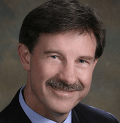
Florida Circuit Judge Terry Lewis
In his July 10 order striking down the map, Lewis did not indicate when or how it might be redrawn. But attorneys for the plaintiffs who brought the suit, including the League of Women Voters, have said they wank the judge to change the map immediately.
The suit arose over two constitutional amendments Florida voters approved in 2010 designed to limit political gerrymandering. Under the new rules, districts cannot be drawn to benefit any political party and must be geographically compact.
However, the amendments left redistricting in the hands of legislators, rather than turning it over to an independent outside panel.
Lewis found two congressional maps — the 5th District and the 10th District — were drawn to benefit Republicans. While he rejected specific challenges to several other districts, bringing those two districts into compliance would likely trigger revisions across the state’s 27 districts.
Although Democrats are highly competitive in statewide races, Republicans hold a 17-10 majority in Florida’s congressional delegation under the map drawn by the GOP-controlled legislature.
Lewis was also highly critical of the behind-the-scenes role Republican political consultants played in drawing the map, which was supposed to be apolitical.
“They made a mockery of the legislature’s proclaimed transparent and open process of redistricting by doing all of this in the shadow of that process, utilizing the access it gave them to the decision makers, but going to great lengths to conceal from the public their plan and their participation in it,” Lewis said.
The 5th District, held by Democratic U.S. Rep Corrine Brown, is a majority black district that meanders from Jacksonville over to Gainesville and then down to Orlando. At one point, it is the width of a highway.
The 10th District, held by Republican U.S. Rep. Daniel Webster, is anchored in central Florida west of Orlando. But it has an appendage that wraps around Orlando to take in GOP voters to the east in Seminole County.
Legislative leaders have said they drew the districts to comply with the Voting Rights Act: Brown’s to create a majority black district and Webster’s to create a neighboring district in which Latino voters would have influence.
But Lewis ruled that a majority black district could have been drawn that was more compact and that putting those Republican voters in Webster’s district was unlikely to increase Latino influence.
Brown has joined with Republican leaders in defending the map,
“Minority communities do not live in compact, cookie-cutter like neighborhoods, and excessive adherence to district ‘compactness,’ while ignoring the maintenance of minority access districts, fragments minority communities across the state,” she said in a statement.
To comply with the Voting Rights Act, Republican legislators across the South have created legislative and congressional districts with black majorities, which, in order to capture as many black voters as possible, are often oddly shaped.
Because the black vote is overwhelmingly Democratic, adjacent districts have become more Republican. At the congressional level, this has meant that white Democrats have virtually disappeared, and the GOP dominates House delegations.
Florida’s 2010 constitutional amendments added a new wrinkle by forbidding both use of party considerations in redistricting and requiring geographic compactness, neither of which are required in other Southern states.
Alex Sink won’t run again for Florida U.S. House seat
Sink’s decision to bow out of the 13th District race leaves Democrats scrambling for a last-minute candidate
♦By Rich Shumate, Chickenfriedpolitics.com editor
ST. PETERSBURG, Florida (CFP) — Less than three weeks before Florida’s filing deadline, Democrat Alex Sink has announced that she won’t seek a rematch with Republican U.S. Rep. David Jolly in the state’s 13th U.S. House District, leaving her party scrambling to find a new candidate.

Alex Sink
Jolly narrowly defeated Sink in a March special election for the St. Petersburg-based seat, despite an all-out effort on her behalf by national Democratic officials.
“After reflection with my family, I have made a personal decision not to run,” Sink said in a statement. “I remain totally convinced that a Democrat can and will win this congressional seat in the fall, and I look forward to helping the Democratic nominee.”
Although Republicans hold an edge in party registration in the 13th District, it is one of just three GOP-held congressional districts in the South that President Barack Obama carried in 2012, making it a top Democratic target. The seat became vacant when Republican U.S. Rep. C.W. “Bill” Young, who held it for more than 42 years, died last October.

U.S. Rep. David Jolly
Jolly, 41, a former Washington lobbyist and Young aide, is seeking a full term in November. The filing deadline for Democrats who want to run against Jolly is May 2.
Sink, 65, Florida’s former chief financial officer, was the Democratic nominee for governor in 2010, narrowly losing to Gov. Rick Scott. Although she didn’t live in the district, she was recruited to run by national party officials. Once she got into the race, other Democrats in Pinellas County stepped aside.
Outside Democratic and Republican groups poured more than $9 million into the special election, which was seen as a bellweather of their political prospects heading into November’s mid-term election.
The main fault line in the campaign was Obamacare, which Sink embraced and Jolly opposed.
Poll: Republican incumbent Rick Scott trails Charlie Crist in Florida governor’s race
Crist, the Sunshine State’s former governor, also calls for ending U.S. embargo against Cuba
MIAMI (CFP) — Republican-turned-independent-turned-Democrat Charlie Crist holds a small lead over Republican Governor Rick Scott in the Florida governor’s race, according to two recent polls.

Democratic challenger Charlie Crist
And in a turnabout likely to draw the ire of the state’s influential Cuban-American community, Crist now says he thinks the U.S. embargo against Cuba, in place since 1962, ought to be lifted.
“The embargo has done nothing in more than 50 years to change the regime in Cuba,” Crist said in a statement, adding that “if we want to bring democracy to Cuba, we need to encourage American values and investment there.”
Just four years ago, when Crist was making a unsuccessful bid for the U.S. Senate, he supported the embargo. Scott immediately pounced on Crist’s change of heart, which he first announced in a response to a question from television satirist Bill Maher.

Florida Governor Rick Scott
“Our nation is great because we were built on a foundation of freedom and democracy,” Scott said. ” That is not true in Cuba, and we should not pretend it is. The importance of maintaining the embargo is that it stands for the Cuban people’s right to be free.”
In his interview with Maher, Crist agreed with Maher that more Florida politicians need to stand up to the Cuban-American community, a remark Scott called “insulting.”
A February 5 poll by the University of Florida found Crist leading Scott 47 percent to 40 percent in a head-to-head matchup. A poll from Quinniapiac University released January 30 gave Crist a slightly larger lead, 46 percent to 38 percent.
Scott, 61, a multimillionaire health care entrepreneuer, narrowly won the governorship four years ago. Crist, 57, served as governor as a Republican from 2007 to 2011. He gave up the office to run for the U.S. Senate as an independent, losing to Republican U.S. Senator Marco Rubio. Crist later became a Democrat.
Crist faces a primary challenge from Nan Rich, a former Democratic state senator, who, alluding to Crist’s often changing political affiliations, styles herself as the “one true Democrat” in the race.
There has also been speculation that Democratic U.S. Senator Bill Nelson might run against Crist for governor. However, Nelson has distanced himself from that speculation, saying he has no plans to leave the Senate.
The University of Florida poll found that Nelson also leads Scott in a hypothetical matchup, while both the UF poll and Quinniapiac polls found that Scott leads Rich when they are compared head-to-head.
 Chicken Fried Politics