
Home » Posts tagged 'Georgia 6th District' (Page 3)
Tag Archives: Georgia 6th District

Secretary of State Brian Kemp gets landslide win in GOP runoff for Georgia governor, will now face Stacey Abrams
Democrats pick nominees for two targeted GOP-held seats in Atlanta suburbs
♦By Rich Shumate, ChickenFriedPolitics.com editor

 ATLANTA (CFP) — With the backing of both President Donald Trump and Vice President Mike Pence, Secretary of State Brian Kemp has won the Republican nomination for Georgia governor, winning a runoff by nearly 40 points after a stunning collapse by Lieutenant Governor Casey Cagle.
Kemp’s win sets up one of the nation’s marquee governor’s races this fall against Democrat Stacey Abrams, the first African American woman ever nominated for governor by a major political party in a U.S. state, who won her nomination in May without a runoff.
Georgia Democrats have also settled on nominees for two Republican-held U.S. House seats in metro Atlanta being targeted this fall, picking Lucy McBath in the 6th District and Carolyn Bourdeaux in the 7th District.
McBath will now face U.S. Rep. Karen Handel, while Bourdeaux will take on U.S. Rep. Rob Woodall.

Secretary of State Brian Kemp
In the GOP governor’s race, Kemp took 69 percent of the vote in the July 24 runoff to 31 percent for Cagle, who had finished 13 points ahead of Kemp in the first round of voting in May but saw his support collapse in the final weeks of the race.
“We have earned a clear and convincing victory,” Kemp told supporters at a election night rally in Athens. “We had the momentum in this race, and those endorsements by the president and vice president — they poured gasoline on the fire.”
Although both men had vied for the Trump vote, the president endorsed Kemp a week before the runoff, and Pence traveled to Georgia to campaign with him. Cagle, serving his third term as lieutenant governor, was endorsed by incumbent Republican Governor Nathan Deal, who is term limited.
During the campaign, Kemp drew criticism for a humorous ad in which he points a shotgun at a young man who wants to date one of his daughters and gets him to acknowledge “a healthy appreciation for the Second Amendment, sir.” Kemp was unapologetic, saying in a statement that “liberal media and radical, left-wing activists — who have probably never even held a firearm — are freaking out and creating fake controversy.”
The National Rifle Association had earlier endorsed Cagle after the lieutenant governor proposed stripping a lucrative tax exemption from Atlanta-based Delta Airlines to retaliate against the company for ending a discount program for NRA members in the wake of the massacre of high school students in Parkland, Florida.
The turning point in the race may have been release of secretly recorded audio in June in which Cagle admitted that he had supported “bad public policy” in the legislature to undercut one of his primary rivals and complained that the Republican primary had devolved into a contest of “who had the biggest gun, who had the biggest truck and who could be the craziest.”
In a concession speech to supporters in Atlanta, Cagle promised his “full, undivided support” for Kemp in the general election.
“It didn’t turn out the way we wanted it, but at the end of the day, I can promise you my life is so rich,” he said.

Democratic nominee Stacey Abrams
Democrats, who have not won a governor’s race in Georgia since 1998, are hoping to turn those fortunes around with Abrams, 44, a Yale-educated Atlanta lawyer who served six years as minority leader of the Georgia House.
During the Democratic primary, Abrams had argued that the way to reclaim the governor’s mansion was to energize and expand the electorate, rather than trying to appeal to Republican-leaning voters by offering more moderate stands. That strategy will be put to the test against Kemp, 54, a conservative businessman from Athens who has been secretary of state since 2011.
Kemp went after Abrams in his victory speech, calling her an “out-of-touch radical liberal who cares more for her billionaire backers than for you all.”
“This election is going to be for the soul of our state,” Kemp said. “It is going to be about our values, and it is going to be literally a fight for the future of the great state of Georgia.”
While Republicans have dominated Georgia politics for nearly two decades, demographic changes — particularly an influx of new minority voters — have begun to shift the political calculus. In 2004, George W. Bush carried Georgia by 16 points; Trump only won by 5 points in 2016, and he lost two large suburban Atlanta counties — Cobb and Gwinnett — that had not gone Democratic in a generation.
Both of the U.S. House races where Democrats may have a shot this fall are anchored in those same suburbs. In the 6th District, which takes in Cobb, North Fulton and North DeKalb counties, Trump won by just 1.5 points; in the 7th District, which includes Gwinnett and Forsyth counties, he won by just 6 points.

Lucy McBath

Karen Handel
Handel won the 6th District seat in a special election in 2017 that became nationalized amid rising resistance to Trump. More than $50 million was spent on that race, making it the most expensive House election in history.
The Democrat who Handel defeated in that race, Jon Ossoff, decided against a rematch, leaving her to face McBath, a retired flight attendant and gun control activist from Cobb County, who took 54 percent in the runoff to defeat Kevin Abel, a Sandy Springs businessman, who took 46 percent.
McBath’s son, Jordan Davis, was shot and killed in 2012 by a man at a gas station in Jacksonville, Florida, over a dispute over loud hip-hop music. His case became part of the nationwide campaign against deadly violence aimed at young African-American men. The shooter, Michael David Dunn, was later convicted of first-degree murder and sentenced to life without parole.

Rob Woodall

Carolyn Bourdeaux
In the 7th District, Woodall will face Bourdeaux, from Suwanee, a professor at Georgia State University and former budget analyst for the Georgia Senate. In the runoff, she took 52 percent of the vote to defeat Duluth businessman David Kim with 48 percent.
In the runoff, Republicans also settled on their nominees for the posts of lieutenant governor and secretary of state given up by Cagle and Kemp.
In the lieutenant governor’s race, former State Rep. Geoff Duncan from Cumming, a former professional baseball player, edged out State Senator David Shafer from Duluth. However, the two candidates were separated by less than 1,700 votes, which could trigger a runoff.
Duncan will now face the Democratic nominee, Kennesaw businesswoman Sarah Riggs Amico.
In the secretary of state’s race, State Rep. Brad Raffensperger from Johns Creek defeated Alpharetta Mayor David Belle Isle. He will now face former U.S. Rep. John Barrow from Athens, who was the last white Democrat left in Georgia’s congressional delegation until he was defeated in 2014.
U.S. House Primary Wrap: Democrats pick female Marine fighter pilot for targeted seat in Kentucky
Voters in Georgia, Arkansas and Texas also pick party nominees for House seats that could help decide balance of power
♦By Rich Shumate, ChickenFriedPolitics.com editor
 LEXINGTON, Kentucky (CFP) — In a year in which women candidates have been making noise nationally, Amy McGrath has made her own statement in Kentucky’s Bluegrass country by winning the Democratic nomination for a U.S. House seat over a candidate recruited by party leaders in Washington.
Meanwhile, in other May 22 primaries in Georgia, Arkansas and Texas, Democrats narrowed the fields in races for seven GOP-held seats that are being targeted in November, while Texas Republicans picked nominees in four open seats that are expected to stay in Republican hands.
 In central Kentucky’s 6th District, which includes Lexington and Frankfort, McGrath took 48 percent of the vote to 40 percent for Lexington Mayor Jim Gray, who had been recruited for the race by the Democratic Congressional Campaign Committee. Kentucky does not have primary runoffs, so McGrath won the nomination with a plurality and will now face GOP U.S. Rep. Andy Barr in November.

Democratic U.S. House nominee Amy McGrath
Declaring victory with her supporters in Richmond, McGrath — a retired Marine Corps fighter pilot whose call sign was “Krusty” — said “what happened tonight is amazing.”
“Six months ago, political pundits and establishment insiders didn’t think we could pull this off,” she said. “What those insiders maybe still don’t know is how this happened. Well, I know how it happened. It’s because you all care about the future of our country.”
McGrath began her campaign in August 2017 with a video in which she told how, as a young girl growing up in Kentucky, she decided she wanted to be a fighter pilot but discovered that women were not allowed to serve in combat. She then wrote letters to members of Congress in which she asked why she was barred from serving, including a letter to Kentucky U.S. Senator Mitch McConnell, which she said was never answered.
After the ban was lifted, McGrath enrolled in the U.S. Naval Academy and served in Iraq and Afghanistan as a Marine Corps aviator before retiring at the rank of lieutenant colonel.
McGrath’s video went viral, triggering a wave of contributions to her long-shot campaign. She now raised almost $2 million in her quest to unseat Barr, who is seeking his fourth term.
Another positive sign for McGrath: More than 100,000 Democrats turned out to vote in the primary, compared to just 49,000 Republicans in a district President Donald Trump carried by 15 points in 2016. However, GOP turnout also lagged behind Democratic turnout in 2016, when Barr took 61 percent.
Meanwhile, in Kentucky’s 3rd District in metro Louisville, Republicans nominated Vickie Glisson, a Louisville attorney who headed the state health department, to face U.S. Rep. John Yarmuth, who has drawn the particular ire of Republicans nationally with his strong criticism of Trump, including introducing articles of impeachment.
In Georgia, the House races receiving the most attention are in the 6th and 7th districts, where Republican incumbents are seen as possibly vulnerable in districts that President Donald Trump won by narrow margins in 2016.
In the 6th District, in Atlanta’s northern suburbs, where Republican U.S. Rep. Karen Handel won her seat in 2017 after a hard-fought and hugely expensive special election, Democrats have narrowed their field to Lucy McBath, a gun control activist from Cobb County, and Kevin Abel, a Sandy Springs businessman, who will compete in a July 24 runoff.
McBath’s son, Jordan Davis, was shot and killed in 2012 by a man at a gas station in Jacksonville, Florida, over a dispute over loud hip-hop music. His case became part of the nationwide campaign against deadly violence aimed at young African-American men. The shooter, Michael David Dunn, was later convicted of first-degree murder and sentenced to life without parole.
Handel’s chances of keeping the seat — in a district Trump only carried by just 1.5 points — improved when the man she defeated in the special election, Democrat Jon Ossoff, decided against a rematch.
In the 7th District, in northwest metro Atlanta, Democrats Carolyn Bordeaux and David Kim advanced to the runoff for the right to face Republican U.S. Rep. Rob Woodall in November.
Bordeaux, from Suwanee, is a professor at Georgia State University and former budget analyst for the Georgia Senate. Kim, from Duluth, is the son of Korean immigrants who owns a company that provides tutoring for students. If elected, he would become Georgia’s first Asian-American congressman, running in a district with a growing Asian population.
While Woodall took 60 percent of the vote in the 7th District in 2016, Trump only won by 6 points, putting the seat within the realm of possibility for Democrats.
 In Arkansas, the House race drawing the most attention is the 2nd District in metro Little Rock, where Democrats believe they might have a shot at ousting GOP U.S. Rep. French Hill if a national Democratic wave develops.
The Democratic nominee will be State Rep. Clarke Tucker of Little Rock, who won the primary without a runoff.
While Hill won re-election by 11 points in 2016, the 2nd District is the least Republican district in the state, anchored by Pulaski County, which Hillary Clinton carried in 2016. Trump won the district by less than 10 points.
 In Texas, Democrats have picked nominees in four targeted U.S. House seats now in Republican hands that Democrats have hopes of flipping in the fall.
In the 7th District, in metro Houston, attorney Lizzie Pannill Fletcher defeated liberal activist Laura Moser for the right to take on Republican U.S. John Culberson, in a district Hillary Clinton carried in 2016. Fletcher had been backed by the DCCC against Moser, who was seen by Democratic leaders as too liberal for the district.
In the 21st District, which stretches from Austin to San Antonio and takes in part of the Texas Hill Country, Republican Chip Roy will face Democrat Joseph Kosper for the seat now held by retiring U.S. Rep. Lamar Smith, a district which Trump carried by 10 points.
Roy served as chief of staff for U.S. Senator Ted Cruz. Kosper is a former U.S. Army officer and technology entrepreneur.
In the 23rd District — the largest Texas district geographically, sprawling from the suburbs of San Antonio to near El Paso — Democrats picked Gina Ortiz Jones to take on incumbent Republican U.S. Rep. Will Hurd in November. Clinton also carried this majority-Latino swing district, which has changed hands four times in the last 12 years.
Jones is a former military intelligence officer who worked as a U.S. trade representative in the Obama administration. If elected, she would be the first open lesbian, Iraq War veteran and Filipino American to represent Texas in Washington.
In the 32nd District, in metro Dallas, former NFL player Colin Allred defeated businesswoman Lillian Salerno and will now face Republican U.S. Rep. Pete Sessions, who is trying to keep a traditionally Republican seat in a district that Clinton also carried. Allred, a civil rights attorney, played five seasons in the NFL for the Tennessee Titans before his career ended after a neck injury.
Also in Texas, the fields have been set in four other open GOP-held districts that Republicans will be favored to keep in November:
- In the 2nd District, a metro Houston seat given up by retiring U.S. Rep. Ted Poe, the Republican David Crenshaw, a retired Navy officer, will face Democrat Todd Litton, a lawyer and non-profit executive.
- In the 5th District, an East Texas seat now held by U.S. Rep. Jeb Hensarling, State Rep. Lance Gooden defeated Bunni Pounds, a political consultant, in the Republican runoff, despite endorsements of Pound by both Hensarling and Vice President Mike Pence. Gooden will face former Terrell City Councilman Dan Wood in November.
- In the 6th District, a seat in metro Fort Worth now held by U.S. Rep. Joe Barton, Republican Tarrant County Tax Assessor Ron Wright will face Democrat Jana Lynne Sanchez.
- In the 27th District, a South Texas seat that opened up after Republican U.S. Rep. Blake Farenthold resigned in April, Republican Michael Cloud will face Democrat Eric Holguin in November. Cloud is the chair of the Victoria County Republican Party. Holguin, from Corpus Christi, is a former congressional aide.
Barton decided not to seek re-election after after a nude selfie he had exchanged with a woman with whom he was having a consensual extramarital relationship wound up on social media.
Farenthold resigned after news reports that $84,000 in taxpayer dollars had been used to pay a settlement to a former female staffer who alleged that she suffered sexual harassment from Farenthold and another male staffer. The congressman denied the harassment allegations, while conceding that a lax management style in his Washington office created a “decidedly unprofessional” work environment.
A special election is being held in June to fill the remainder of Farenthold’s current term, with Cloud, Holguin and seven other candidates on the ballot.
Analysis: South is the GOP’s ace in the hole in stopping Democratic takeover of U.S. House
Democrats will need to flip 11 Southern seats or make make up the difference elsewhere
♦By Rich Shumate, ChickenFriedPolitics.com editor
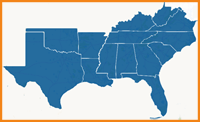 (CFP) — With President Trump’s approval ratings at historically low levels, Democrats have high hopes of taking back the U.S. House in 2018. But those hopes are tempered by a giant geographic obstacle standing in their way — namely, the South.
 To reclaim the House, Democrats need to flip 24 seats, shifting about 10 percent of the seats that Republicans now hold. And nearly half of the GOP caucus — 114 seats — is from the South, where Republican House members outnumber Democrats by 3-to-1.
So a 10 percent shift in the South would require winning 11 seats, in a region where Democrats won just two seats in 2016 (both in Florida and neither yet safe.) If Democrats fall short of that total, they will need to shift an even higher percentage of seats throughout the rest of the country — as much as 19 percent if they come up empty in the South.
And as Democrats plot and plan to add to their meager total of 40 Southern House seats, two recent special elections for open seats offer decidedly mixed omens on their chances for overturning the GOP’s hegemony.
In South Carolina’s 5th District, the swing away from Trump’s 2016 numbers in the special election was nearly 20 percent — not enough for Democrat Archie Parnell to win but a much bigger scare than Republicans had expected. Indeed, if that 20-point swing could be replicated across the South in 2018, 42 GOP-held seats could potentially be in play, more than Democrats would need to return Nancy Pelosi to the speaker’s chair.

Handel
But the results in the other race, in Georgia’s 6th District, pour substantial caution on such irrational exuberance. Republican Karen Handel kept the seat by running slightly ahead of Trump, in a race where Democrats spent a whopping $30 million and still came up short.
And this district in the northern Atlanta suburbs is exactly the kind of place where Democrats will need to compete to claw away at Republican dominance in the South next year — increasingly diverse, maturing suburbs whose upscale, educated voters, though conservative by inclination, are somewhat wary of Trump’s stewardship of the GOP brand.
If Democrats couldn’t win this race for an open seat in a low-turnout special election with a highly energized base and a president with historically low approval ratings, flipping these seats in 2018 will be a tall order indeed, particularly given Trump’s solid base of support in the South.
So where can Democrats start? Their first targets will be three majority Latino districts in metro Miami, all of which have large numbers of Cuban-American voters. Trump lost two of these districts and only narrowly won the third.
Veteran GOP U.S. Rep. Ileana Ros-Lehtinen is retiring, and Republicans will be hard pressed to keep her seat in a district Trump lost by 20 points. But in the other two districts, Democrats will have to unseat incumbents Carlos Curbelo, who has gone out of this way to distance himself from Trump, and Mario Diaz-Balart, who has been winning congressional elections with relative ease since 2002.
Democrats are also likely to target four other Southern districts where Hillary Clinton defeated Trump last year, which include three seats in Texas and one in Virginia. The GOP, however, has held three of these districts, in varying configurations, for decades.

Comstock
The Virginia seat, in the Washington D.C. suburbs, is held by Barbara Comstock, who first won it in 2014 and was narrowly re-elected in 2016. Even at this early date, she has already drawn six Democratic challengers in a district that, like the rest of Virginia, has become more hospitable to Democrats over the last decade.
In Texas, the climb for Democrats will be steeper. Clinton won the 32nd District in suburban Dallas, but that seat is held by Pete Sessions, a GOP titan who won by 52 points in 2016. She also won the 7th District in suburban Houston, where John Culberson ran well ahead of Trump to win by 12 points.
While Democrats appear eager to try to unseat both (Culberson already has seven challengers and Sessions nine), these districts have long Republican pedigrees reminiscent of Georgia’s 6th District, which was once represented by Newt Gingrich. Former President George H.W. Bush began his political career in the 7th District in 1967; former President George W. Bush’s Dallas home is in the 32nd.

Hurd
Democrats may have more luck in Texas’s 23rd District, which stretches from the suburbs of San Antonio across rural West Texas. This district is part of an ongoing legal fight over the state’s 2013 redistricting map, and a panel of federal judges is considering changes that could make it more difficult for Republican Will Hurd to hang on for a third term.
After those Clinton-won districts, the next set of seats Democrats might logically target are those where Trump’s winning margin was less than 10 points and where it would take less than a 10-point swing from the 2016 congressional results to put the seat in Democratic hands. But that list contains a scant eight seats — four in Texas, two in North Carolina and one each in Florida and Virginia. None of them are open at this point.
After that, the pickings get even slimmer — places like Arkansas’s 2nd District, where a Democrat can carry Little Rock only to get swamped by the Republican vote in the suburbs, and Florida’s 3rd District, where liberal-leaning Gainesville is subsumed in a sea of more traditional, conservative Southern voters. To be competitive in these districts, Democrats would have to commit to putting resources into races where chances of victory would appear, at the moment, to be rather remote.
So if Democrats can’t move the playing field into these second and third tiers, they have a reasonable shot at just seven Republican-held Southern seats, five of which have been in GOP hands for decades and all but one of which is likely to have an incumbent. And any anti-Trump tide that helps them in other parts of the country will likely not crest as high in the South.
With a lot of angry voters and a lot of luck, Democrats may indeed swing enough seats in 2018 to win control of the House. But as Republicans try to stop them, their ace in the hole is their dominance across the South, which should give them plenty of reason for confidence.
Republican Karen Handel wins hotly contested U.S. House race in suburban Atlanta
Handel turns back challenge from Democrat Jon Ossoff in most expensive House race ever
♦By Rich Shumate, ChickenFriedPolitics.com editor
ROSWELL, Georgia (CFP) — Republican Karen Handel has won a runoff for Georgia’s 6th District U.S. House seat, dashing Democratic hopes of embarrassing President Trump by snatching away a seat that has been safely in GOP hands for decades.

U.S. Rep.-Elect Karen Handel, R-Georgia
Handel, a former Georgia secretary of state and Fulton County Commission chair, won 52.1 percent in the June 20 vote, defeating Jon Ossoff, a 30-year-old filmmaker and former congressional aide making his first bid for political office, who took 47.9 percent.
She will be the first Republican woman ever to represent Georgia in Congress.
Speaking to supporters at a hotel in Dunwoody, Handel said she was “extraordinarily humbled and honored at the tremendous privilege and high responsibility that you and the people across the 6th District have given to me to represent you.”
She also said Ossoff’s supporters should “know that my commitments, they extend to you.”
“We may have some different beliefs, but we are part of one community,” she said. “My pledge is to be part of the solution to focus on governing, to put my experience to work to help solve the very serious issues we’re facing in this country.”
Handel also thanked Trump, who tweeted on her behalf throughout the race, and Vice President Mike Pence, who traveled to Georgia to campaign with her as national Republicans scrambled to avoid what would have been an embarrassing defeat.

Jon Ossoff, D, Georgia 6th District candidate
Ossoff, speaking to his supporters at a hotel in Sandy Springs hotel after the race had been called for Handel, saluted his volunteers, “more than 12,000 of you who, as darkness has crept across this planet, have provided a beacon of hope for people here in Georgia, for people across the country and for people around the world.”
“At a time when politics have been dominated by fear and hatred and scapegoating and division, this community stood up … and showed the world that in places where nobody thought it was even possible to fight, we could fight. We showed them what courage and kindness and humility are capable of,” he said.
Handel’s win, along with a win by Republican Ralph Norman in the South Carolina 5th District special election on the same night, means Republicans have successfully defended all four of the House seats that became vacant when their occupants were appointed to positions in the Trump administration. The other elections were in Kansas and Montana.
However, in three of those four races, the Republican winners polled substantially worse than did Trump in November. The only exception was Handel, who ran 4 points ahead of Trump.
Ossoff had come in first in the April primary but fell short of the majority needed to win outright. Handel, who edged out a flock of Republican candidates to make the runoff, was able to consolidate GOP support and win the runoff, despite being outspent by 4-to-1 by Ossoff, who tapped anti-Trump sentiment to raise more than $23 million.
In all, total spending by candidates and outside groups in the 6th District race topped $50 million, making it the most expensive House race in U.S. history. But despite all that spending, Ossoff’s vote share was less than a point higher than what Hillary Clinton pulled down in the district in November.
The 6th District arcs across Atlanta’s northern suburbs, taking in parts of Cobb, Fulton and DeKalb counties. Since its present configuration was drawn after the 1990 census, the seat has been held by Newt Gingrich, who went on to become speaker of the House; Johnny Isakson, who went on to the U.S. Senate; and Tom Price, who gave it up when Trump picked him to head the U.S. Department of Health and Human Services.
While Price had won the seat easily in 2016, Trump only carried it by a scant 1.5 percent, on his way to becoming the first Republican to lose Cobb County since 1976. Trump also lost the March 2016 Republican primary in the district to U.S. Senator Marco Rubio of Florida.
For Handel, 55, winning the 6th District seat revives her once-promising political career, which was battered by back-to-back losses to Governor Nathan Deal in a GOP runoff in 2010 and a Republican primary for the U.S. Senate in 2014.
She served as secretary of state from 2007 to 2011 and as chair of the Fulton County Commission from 2003 to 2006.
In her victory speech, Handel thanked House Majority Whip Steve Scalise of Louisiana for his advice during her campaign, and she asked her supporters to “lift up” Scalise and three others wounded June 14 while practicing for a charity baseball game by a shooter with apparent political motives.
“We need to also lift up this nation so that we can find a more civil way to deal with our disagreements because in these United States of America, no one should ever feel their life threatened over their political beliefs,” she said.
Voters give verdict on expensive slugfest in Georgia’s 6th U.S. House District runoff
Democrat Jon Ossoff hoping to wrest away traditionally GOP seat in suburban Atlanta
♦By Rich Shumate, ChickenFriedPolitics.com editor
ROSWELL, Georgia (CFP) — The most expensive U.S. House race in American history is drawing to a close, with Republican Karen Handel and Democrat Jon Ossoff making last-minute pitches in a special election runoff to fill Georgia’s vacant 6th District seat.
Polls in the June 20 runoff open at 7 a.m. and close at 7 p.m. EDT, with the results expected to draw outsized national attention.
A victory by Ossoff in a district the GOP has held for decades will be seen as a harbinger of potential doom for House Republicans in 2018. But a win by Handel would make Republicans three-for-three in winning House special elections this year, possibly tempering the speculation about how much President Trump’s historic unpopularity ratings are really eroding the party’s electoral health.
No matter the outcome, the competitiveness of the race wasn’t what Trump had in mind when he appointed Tom Price to head the U.S. Department of Health and Human Services, leaving an open seat that Republicans expected to defend easily.
Jon Ossoff, D, Georgia 6th District candidate
Fueled by liberal anger at Trump’s election, Ossoff — a 30-year-old filmmaker and former congressional aide seeking office for the first time — raised a staggering $23.6 million by the end of May, according to a report filed with the Federal Elections Commission. That figure doesn’t include any additional money raised during the first three weeks of June, as his runoff with Handel moved toward its climax.
Handel, a former Fulton County Commission chair and secretary of state, raised just $4.5 million by the end of May, although outside GOP-aligned groups have spent additional money on her behalf.
When all of the candidate and outside spending is tallied, the total is expected to approach $50 million, shattering all previous records for U.S. House races. To put that spending in perspective, a $50 million race would come to roughly $71 each for every man, woman and child in the district — and would be the equivalent of a $700 million statewide race in Georgia.
The 6th District arcs across Atlanta’s northern suburbs, taking in parts of Cobb, Fulton and DeKalb counties. Since its present configuration was drawn after the 1990 census, the seat has been held by Newt Gingrich, who went on to become speaker of the House; Johnny Isakson, who went on to the U.S. Senate; and Price, now in Trump’s Cabinet.
While Price won the district by 76,000 votes in November, Democrats smelled blood after Trump only managed to carry it by a scant 1.5 percent, on his way to becoming the first Republican to lose Cobb County since 1976. Trump also lost the March 2016 Republican primary in the district to U.S. Senator Marco Rubio of Florida.
Ossoff had initially begun his campaign with the slogan “Make Trump Furious.” But after coming in first in the April 19 primary, he eschewed nationalizing the campaign and sought to focus on district-specific issues.
Karen Handel, R. Georgia 6th District candidate
For Handel, 55, the second-place finish in the primary was a welcome political comeback after back-to-back losses to Governor Nathan Deal in a GOP runoff in 2010 and a Republican primary for the U.S. Senate in 2014. She served as secretary of state from 2007 to 2011 and as chair of the Fulton County Commission from 2003 to 2006.
Trump has not campaigned in person for Handel, although he did tape an anti-Ossoff robocall before the primary. But Vice President Mike Pence and Price both came down from Washington to make appearances on her behalf.
 Chicken Fried Politics