
Home » Posts tagged 'Greg Abbott' (Page 3)
Tag Archives: Greg Abbott

New poll shows Texas U.S. Senate race shaping up as the most competitive in a generation
Quinnipiac poll finds Democrat Beto O’Rourke within striking distance of Republican incumbent Ted Cruz
♦By Rich Shumate, ChickenFriedPolitics.com editor
 AUSTIN (CFP) — The last time a Democrat was within striking distance in a U.S. Senate contest in Texas, Ronald Reagan was president, people rented movies from a store and tweeting was only for the birds.
Since the last Democratic victory in 1988, the party’s nominees have lost nine Senate races in a row, all by double digits. The average size of their loss? 19 points.

Ted Cruz

Beto O’Rourke
But a new poll shows Democratic U.S. Rep. Beto O’Rourke is closing in on Republican U.S. Senator Ted Cruz, cutting Cruz’s lead in half since May and raising the specter of seeing something this fall that hasn’t been seen deep in the heart of Texas for 30 years — a truly competitive Senate race.
A close race in Texas could also have national implications, as Republicans try to hang on to their slim one-vote majority in the Senate.
A Quinnipiac University poll released August 1 put Cruz at 49 percent and O’Rourke at 43 percent among registered voters in the Senate contest. With a sampling error of plus or minus 3.5 percent, that means that, statistically, Cruz’s lead is small enough to be the result of sampling error, rather than an actual lead.
But perhaps the most alarming bit of data in the poll for the Cruz campaign is that his 6-point lead now is down from an 11-point lead three months ago, and Cruz is now below 50 percent, a danger sign for an incumbent.
“O’Rourke has done a good job making the race competitive,” said Peter Brown, assistant director of Quinnipiac Poll in a statement. “He is clearly in contention. A Democratic victory in the Lone Star State would be a serious blow to GOP hopes of keeping their U.S. Senate majority.”
The poll of 1,118 registered voters found Cruz leading among men and white voters, while O’Rouke was leading among women and African-American voters. O’Rourke has a 12-point lead among Latino voters, and the two men are running even among voters who describe themselves as independent.
The poll found Texans generally have a good opinion of Cruz — 50 percent approve of his job performance and view him favorably, while 42 percent disapprove and view him unfavorably. However, he is polling far behind the Republican running in the other marquis statewide race, Governor Greg Abbott, who had a 13-point lead over his Democratic challenger, former Dallas County Sheriff Lupe Valdez.
By contrast, 43 percent of voters surveyed said the didn’t know enough about O’Rourke to offer an opinion of him, which means he remains something of an unknown quantity. And that could give the Cruz campaign an opening to try to define him negatively with voters over the rest of the campaign.
The poll also found that President Donald Trump’s approval rating in Texas was mixed, with 46 percent approving of his performance and 49 percent disapproving, which was within the margin of error.
The Quinnipiac poll surveyed registered voters rather than likely voters, making the results somewhat less indicative of what might happen on election day. However, two other polls taken in July that surveyed likely voters — by the Texas Lyceum and Gravis Marketing — also found Cruz’s lead in single digits.
Federal Election Commission reports also show that O’Rourke has been competitive with Cruz in fundraising. As of the end of June, he had raised $23.6 million to $23.4 million for Cruz and had $14 million in cash on hand, compared to $9.3 million for the incumbent.
The last time Cruz ran, in 2012, he outraised and outspent his Democratic opponent by a 2-to-1 margin, on his way to a 16-point victory.
O’Rouke, 45, has represented metro El Paso in the House since 2013, after serving on the El Paso City Council. Although he is Irish and his given first name is Robert, he was nicknamed “Beto” — a Spanish nickname for Robert — from childhood.
Cruz, 47, was elected to the Senate in 2012 on his first try for political office. In 2016, he made an unsuccessful run for the Republican presidential nomination, carrying 12 primaries and caucuses and finishing second in the delegate count behind Trump.
The Texas race is one of six Southern states with open seats in 2018; the others are Virginia, West Virginia, Florida, Tennessee and Mississippi, where both seats are on the ballot.
Four of those races are shaping up to be competitive — Florida and West Virginia, which are currently held by Democrats, and Texas and Tennessee, held by Republicans.
State Primary Wrap: Stacey Abrams roars to Democratic governor’s nomination in Georgia; GOP faces runoff
Final fields for governor’s races also set in Arkansas and Texas; incumbent survives in Arkansas Supreme Court contest
♦By Rich Shumate, ChickenFriedPolitics.com editor
 ATLANTA (CFP) — Democrat Stacey Abrams has made history in Georgia’s Democratic primary for governor, crushing her opponent to become the first African American woman ever nominated for governor by a major political party in a U.S. state.
Georgia Republicans are headed to a runoff between Lieutenant Governor Casey Cagle and Secretary of State Brian Kemp, after neither won a majority in the May 22 primary.
Meanwhile, in Arkansas, Republican Governor Asa Hutchinson was nominated for a second term and will be heavily favored over the Democratic winner, political newcomer Jared Henderson. And Texas Democrats picked former Dallas County Sheriff Lupe Valdez to face incumbent Republican Governor Greg Abbott in November, making her the first Latina and first openly lesbian candidate to be nominated by a major party for Texas governor.
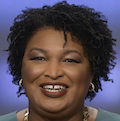
Georgia Democratic governor nominee Stacey Abrams
 In Georgia, Abrams, the former minority leader of the Georgia House whose candidacy has drawn national attention, took 76 percent of the vote to 24 percent for former State Rep. Stacey Evans, winning all but six of the state’s 159 counties.
Speaking to jubilant supporters in Atlanta, Abrams vowed to create a “coalition that reaches across backgrounds, sharing our constant belief in our capacity to win.”
“We have to reach out to those who do not believe their voices matter, who’ve been disappointed again and again by promises made and never kept,” she said. “In the Book of Esther, there is a verse that reminds us that we were born for such a time as this.”
After seeing their party lose four governor’s elections in a row, Democrats who voted in the primary clearly bought into Abrams’s argument that the way to reclaim the governor’s mansion was to expand the electorate, rather than Evans’s argument that Democrats needed a nominee who could appeal to Republican-leaning voters by offering more moderate stands.
But while Abrams did win more votes in the primary than any candidate on either side of the ballot, overall, 54,000 more voters picked up Republican ballots, in a state that has no party registration.

Brian Kemp

Casey Cagle
In the Republican primary, Cagle, serving his third term as lieutenant governor, took 39 percent of the vote to 26 percent for Kemp, who has been secretary of state since 2011. Cagle beat Kemp in the large suburban Atlanta counties, where the bulk of Georgia Republicans live, and in all of the smaller cities except Athens, which Kemp once represented in the Georgia Senate.
However, Georgia has a long history of the second-place finisher in a primary coming from behind to win a runoff, most notably in 2010, when current Governor Nathan Deal defeated Karen Handel, who returned to political office last year by winning a seat in Congress.
The runoff in Georgia in July 24.
In another Georgia race of interest, former Democratic U.S. Rep. John Barrow, who lost his seat in 2014, won his party’s nomination for secretary of state without a runoff. Republicans will have a runoff between former Alpharetta Mayor David Belle Isle and State Rep. Brad Raffensperger of Johns Creek.
 In Arkansas, Hutchinson took 70 percent to 30 percent for Jan Morgan, a gun rights activist and television pundit who ran at the governor from the right, beating him in five rural counties. In November, he will face Henderson, a former NASA scientist who runs a Little Rock non-profit that advocates on education issues.
The most contentious battle in the Natural State was a non-partisan contest for a seat on the Arkansas Supreme Court, where incumbent Justice Courtney Hudson Goodson advanced to a runoff against David Sterling, who was appointed by Hutchinson as chief counsel for the Arkansas Department of Human Services. Goodson took 37 percent of the vote; Sterling, 34 percent.
A week before the election, Goodson filed a defamation lawsuit against the Judicial Crisis Network, a Washington-based conservative legal group, over ads it was running against her on Arkansas TV stations which alleged she accepted gifts for donors and sought a pay raise.
She also asked judges in three jurisdictions to enjoin stations from airing the ads, triggering protests from media organizations, although some of them voluntarily agreed to stop running the ads. JCN also spent more than $500,000 in 2016 to defeat Goodson in a race for chief justice.
Although the JCN’s ads targeted Sterling’s opponents, he has insisted that he has no connection to the group.
Goodson and Sterling will now face each other on the November general election ballot.
In Texas, in the Democratic race for governor, Valdez defeated Andrew White, a Houston businessman and the son of former Governor Mark White, by a margin of 53 percent to 47 percent. Abbott won the Republican nomination outright in the March primary.
Valdez, 70, was elected to four terms as sheriff of Dallas County, the state’s second largest with 2.5 million people. She resigned in 2017 when she launched her campaign for governor.
Valdez starts the race as a decided underdog against Abbott, who has raised more than $43 million for the campaign. Texas has not elected a Democratic governor since 1988.
Texas primaries narrow crowded fields in U.S. House races
Valdez, White face off in Democratic governor’s primary; Cruz, O’Rourke in U.S. Senate race
♦By Rich Shumate, ChickenFriedPolitics.com editor
AUSTIN — Texas primary voters have narrowed crowded fields vying for 11 open or potentially competitive U.S. House seats and the U.S. Senate, while the Democratic race for governor is heading to a May runoff to pick a nominee for an uphill climb against Republican Governor Greg Abbott.
And while Democrats have high hopes of riding a wave of enthusiasm to put a dent into the GOP’s 25-to-11 advantage in the Texas U.S. House delegation, more than 530,000 more voters chose the Republican over the Democratic ballot in the March 6 primaries, although that was a better showing by Democrats than in the last midterm primary in 2014.

O’Rourke

Cruz
In the U.S. Senate race, as expected, Republican incumbent Ted Cruz and Democratic U.S. Rep. Beto O’Rourke both easily won their primaries, setting up a November race likely to draw national attention. O’Rourke took 62 percent, and Cruz, 85 percent.
In the governor’s race, Abbott, seeking a second term, won outright with 90 percent of the vote. The Democratic runoff will be between former Dallas County Sheriff Lupe Valdez and Andrew White, a Houston investment banker and son of the late former Governor Mark White. Valdez had a strong lead in the race, 43 percent to 27 percent, over White.

George P. Bush
Republican incumbents also won in six other statewide races, including Land Commissioner George P. Bush, son of former Florida Governor Jeb Bush, who took 58 percent of the vote to beat back three challengers.
In the U.S. House races, Democrats’ top targets in November are three GOP incumbents who represent districts Hillary Clinton won in 2016: John Culberson in the 7th District in Houston; Pete Sessions in the 32nd District in Dallas; and William Hurd, who represents the 23rd District in West Texas stretching from the suburbs of San Antonio over to El Paso. All three easily won their primaries.
In the 7th District, the two Democrats who qualified for the runoff are Lizzie Pannill Fletcher, a Houston lawyer, and Laura Moser, a journalist who carried the endorsement of Our Revolution, a liberal group that sprang from Bernie Sanders’ failed presidential campaign.
This race heated up when Democratic Congressional Campaign Committee, the campaign arm of House Democrats, intervened by publishing opposition research critical of Moser because of fears she won’t be competitive against Culberson in November. However, she used the DCCC’s memo to raise money and made it past five other Democrats into the runoff with Fletcher.
In the 32nd District, Collin Allred, an attorney and former player for the NFL’s Tennessee Titans, topped the Democratic primary with 39 percent and will face Lillian Salerno, who served as a deputy undersecretary on the U.S. Department of Agriculture during the Obama administration, who got into the runoff with 18 percent.
In the 23rd District, Gina Oritz Jones, an Iraq war veteran from San Antonio who worked as a U.S. trade representative, led the race with 42 percent and will face Rick Trevino, a high school teacher from San Antonio who served as a Sanders delegate in 2016. The majority Latino 23rd District, where Hurd is seeking a third term, is a perennial swing seat that changed hands in 2010, 2012 and 2014.
In addition to the races that Democrats are targeting, there are also eight other open seats in Texas that drew crowded primaries:
- In the Houston-area 2nd District, being vacated by Republican Ted Poe, Republicans will have a runoff between State Rep. Kevin Roberts and David Crenshaw, a retired Navy officer.
- In the Dallas-area 3rd District, being vacated by Republican Sam Johnson, State Senator Van Taylor won the Republican nomination outright in the primary. He will face the winner of a Democratic runoff between attorneys Lorie Burch and Sam Johnson (no relation to the incumbent).
- In the 5th District, also near Dallas, which is being vacated by Republican Jeb Hensarling, Republican State Rep. Lance Gooden will be in a runoff against fundraising consultant Bunni Pounds for the right to take on Democrat Dan Wood, a former city councilman in Terrell. Hensarling has endorsed Pounds.
- In the 6th District south of Dallas, being vacated by Republican Joe Barton, both parties will have runoffs. The Republican runoff pits Jake Elizey, a former fighter pilot, against Tarrant County Tax Assessor Ron Wright. On the Democratic side, journalist Jana Sanchez will square off against Ruby Fay Woodridge, an Arlington pastor who ran for the seat in 2016.
- In the 16th District in El Paso, which O’Rourke is giving up to run for the Senate, former El Paso County Judge Veronica Escobar won the Democratic primary with 61 percent of the vote, making her a prohibitive favorite in this heavily Democratic, majority Latino district. Her Republican opponent will be Rick Seeberger, a strategic planner from Canutillo.
- In the 21st District in the Texas Hill Country, being vacated by Lamar Smith, a 18-candidate Republican field has been narrowed to businessman Matt McCall and Austin attorney Chip Roy. On the Democratic side, attorney and former military officer Joseph Kopser will face minister Mary Wilson.
- In the 27th District, which includes Corpus Christi and much of the Gulf Coast and is being vacated by Republican Blake Farenthold, the Republican primary will feature Bech Bruun, former chairman of the Texas Water Development Board, and Michael Cloud, the former GOP chair in Victoria County. The Democratic runoff will include Raul “Roy” Barrera, a federal court deputy in Corpus Christi, and Eric Holguin, a former congressional aide.
- In the 29th District in Houston, being vacated by Democrat Gene Green, State Senator Sylvia Garcia beat six other Democrats to win the Democratic nomination outright with 63 percent of the vote. She will face the winner of the Republican runoff between Phillip Aronoff, a physician, and Carmen Maria Montiel, a Houston TV journalist who once represented her native Venezuela in the Miss Universe Pageant.
Greg Abbott takes oath of office as Texas governor
In his inaugural address, Abbott takes swipe at Washington for threatening state’s “sovereignty”
♦By Rich Shumate, Chickenfriedpolitcs.com editor
AUSTIN, Texas (CFP) — Republican Greg Abbott took the oath of office as Texas governor with a pledge to keep his state “on a path that ensures that years from now, people will stand on this very ground as grateful to this generation as we are to past generations.”

Texas Attorney General Greg Abbott
During his inauuration as the Lone Star State’s 48th governor January 20, Abbott also took a swipe at Washington’s perceived intrusions into his state’s authority.
“As governor, I will continue my legacy of pushing back against Washington if they spend too much, regulate too much or violate our state sovereignty,” he said. “Any government that uses the guise of fairness to rob us of our freedom will get a uniquely Texas response — ‘Come and take it.'”
“We Texans aren’t spoiling for a fight, but we won’t shrink from one.”
Abbott, 57, who served eight years as state attorney general before winning the governorship in November, said the priorities of his administration would include road construction, increasing the water supply and keeping Texas “number one in the nation for job creation.”
Abbott also noted the unusual nature of his ascent in state politics: His wife wife, Cecelia, is Texas’s first Latina first lady, and Abbott himself uses a wheelchair after being paralyzed in an accident 30 years ago.
“I am living proof that we live in a state where a young man’s life can literally be broken in half, and yet he can still ruse up to become (governor.)”
Abbott succeeds Republican Rick Perry, who served 14 years as governor, the longest tenure in Texas history. Perry is considering a bid for the 2016 Republican presidential nomination.
View video of Abbott’s inaugural address:
Analysis: Midterms a show of woe for Southern Democrats
GOP has a particularly strong showing in the upper South, where Democrats have recently been competitive
♦By Rich Shumate, Chickenfriedpolitics.com editor

(CFP) — One look at a color-coded map of midterm election results in any Southern state tells the story – there’s a tsunami of red and a shrinking pool of blue.
Take Texas, for example, with its 254 counties. Republican U.S. Senator John Cornyn carried 236 of them; the Republican candidate for governor, Attorney General Greg Abbott, carried 235. The only blue is found in Dallas, El Paso, Austin and along the Mexican border.
But that’s still more blue than in Oklahoma, where both Republican U.S. Senate candidates swept all 77 counties, and in West Virginia, where GOP Senate candidate Shelley Moore Capito swept all 55, despite the fact that Democrats have a 350,000-person lead in voter registration.
A deeper look at the numbers from the midterm elections shows just how far Democrats have fallen from the halcyon days when they had an iron grip on the solid South. They’re not just losing; lately, they’re not even competitive.
And perhaps even more troubling for Democrats is the fact that the dam seems to have burst in states in the upper South, where the party had been holding its own at the state level.
This year, 13 of 14 Southern states — all but Florida — had a U.S. Senate election, and two states — Oklahoma and South Carolina — had two. Setting aside Louisiana, which is headed to a runoff, and Alabama, which Democrats didn’t even bother to contest, GOP candidates won by an average of nearly 21 points.
Democrats couldn’t crack 30 percent in either Oklahoma race. They failed to crack 40 percent in six others. In fact, Republicans won by double digits in 10 races. Only Virginia, Georgia and North Carolina were close, with the GOP taking the latter two.
Things were just about as bad in races for governor, where the GOP margin of victory was about 18 percent. Republicans won by double digits in six of the eight governor’s races. Only Florida and Georgia were even remotely close.
The news was particularly bad for Democrats in three upper South states that were politically competitive a decade ago – West Virginia, Arkansas and Tennessee.
In West Virginia, Democrats not only lost the U.S. Senate race, but they lost all three U.S. House seats, and Republicans took control of both houses of the state legislature for the first time since 1931.
With Democratic U.S. Senator Mark Pryor’s loss, Arkansas will have an all-Republican congressional delegation for the first time since Reconstruction. Heading into the election, Democrats held five out of the seven statewide constitutional officers. In the midterm, they lost all seven.
Tennessee used to be split between Republicans in the east and Democrats in the west. Now, the GOP is winning everywhere, holding seven of the state’s nine U.S. House seats. Both Alexander and Governor Bill Haslam, re-elected with 71 percent of the vote, carried Shelby County, which includes the Democratic bastion of Memphis.
Increasingly, Democrats seem to be doing better in the deep South, where they can rely on the support of black voters, than in the upper South, where black populations are smaller.
For example, Republican U.S. Senator Lindsey Graham of South Carolina, despite being a long-time incumbent in a very red state, won by a smaller margin than did Republican Tom Cotton, who beat Pryor like a rug in Arkansas.
Some might attribute Graham’s narrower margin to his Tea Party problems. But Alexander — who faced a similar Tea Party dynamic — managed to win by 30 points in Tennessee.
What is clear from the midterms is that despite recent gains at the presidential level in states such as North Carolina and Virginia, Democrats are becoming less competitive across the region, and the South is becoming more monolithically red.
Indeed, the midterm results support the argument that in most of the South, the two-party system is becoming a relic of the past.
 Chicken Fried Politics