
Home » Posts tagged 'Hillary Clinton' (Page 3)
Tag Archives: Hillary Clinton

Florida U.S. Rep. Ileana Ros-Lehtinen bowing out after three decades in Congress
Her departure opens up a prime opportunity for Democrats to pick up a GOP-held seat
♦By Rich Shumate, Chickenfriedpolitics.com editor
 MIAMI (CFP) — U.S. Rep. Ileana Ros-Lehtinen, the dean of Florida’s House delegation, will not seek re-election in 2018 to her 27th District seat in Miami-Dade County, drawing down the curtain on three decades of service that have made her an icon in the state’s politically powerful Cuban-American community.

U.S. Rep. Ileana Ros-Lehtinen, R-Fla.
The decision means Republicans will now have to defend a seat from a district which Donald Trump lost by 20 points in 2016 but which had continued to return Ros-Lehtinen to office term after term.
“It’s a great job. But there comes a time when you say, you know, even though this is a wonderful life, and even though I’m doing what I love to do, there’s so many other wonderful things,” she said at a May 1 news conference announcing her retirement.
Ros-Lehtinen, a moderate Republican who has found herself at odds with Trump and other members of her own party, also insisted her departure is unrelated to the current political climate in Washington.
“I know it would be a great narrative to say people aren’t civil with each other and that there’s just a lot of infighting,” she said. “But I’ve been there so many years, I don’t recall a time when there hasn’t been infighting.”
“I’m not frustrated by that.”
Ros-Lehtinen, 64, who was born in Cuba and moved to Miami with her parents at the age of 7, won a House seat in a 1989 special election to fill the vacancy created by the death of Claude Pepper, who himself was a political icon in Miami. She became the first Cuban-American ever elected to Congress and the first Republican woman elected to Congress from Florida.
She has faced little opposition since that first election. However, as the Cuban-American community in Miami has become less monolithically Republican in the last 20 years and district lines have been been altered, the GOP has held on to the district largely because of Ros-Lehtinen’s popularity.
Still, in 2016, she won by just 10 points, as Hillary Clinton was pasting Trump in her district. Democrats were expected to try to contest the seat in 2018, although Ros-Lehtinen expressed confidence that she would have won if she had she run again.
Ros-Lehtinen has left signficant daylight between herself and Trump, refusing to endorse him and opposing both his plans to repeal and replace Obamacare and build a wall along the U.S.-Mexico border. As the mother of a transgender son, she has also been a champion for LGBT equality in Congress.
The 27th is one of just six Southern House seats held by Republicans that Clinton carried, and her margin there was the largest win in any GOP-held district in the country. Ros-Lehtinen’s departure means Democrats will have an opportunity to pick up the seat.
The race to replace Ros-Lehtinen will be a wide open affair, likely drawing a number of Cuban-American politicians from both parties into the mix. Among the Republicans being mentioned is Lieutenant Governor Carlos López-Cantera, who has run statewide and is closely allied with the state’s two top Republicans, Governor Rick Scott, and U.S. Senator Marco Rubio.
Several state legislators are also eyeing the race, which may mean that the field won’t begin to fill out until the legislature adjourns later in May.
Race for GOP-held Georgia U.S. House seat closing with Democrat in lead
But polls shows Jon Ossoff may not avoid a runoff that could be fatal in metro Atlanta’s 6th District
 ATLANTA (CFP) — On paper, the outcome of the April 18 special election to fill Georgia’s 6th District U.S. House district should be an foregone conclusion.
This seat in Atlanta’s upscale, leafy northern suburbs has been previously held by former House Speaker Newt Gingrich and Republican U.S. Senator Johnny Isakson. Last November, Tom Price, now secretary of the U.S. Department of Health and Human Services, won it by more than 76,000 votes against a Democrat who didn’t even bother to campaign.
But after seeing the presidential results in the 6th District last November, Democrats smelled blood.
Donald Trump carried the district by a mere 1.5 percentage points, on his way to losing Cobb County, a GOP bastion that hadn’t gone Democratic since 1976. The eastern half of Cobb is in the 6th District, along with the northern portions of Fulton and DeKalb counties, which Hillary Clinton also carried.
When Trump put Price in his Cabinet, Democrats saw an opportunity in the all-party special election to fill this seat, if they could find a candidate who could make the race competitive.

Jon Ossoff, Ga. 6th District candidate
Enter Jon Ossoff, a 30-year-old filmmaker and former congressional aide who had never before run for anything. He galvanized Trump-disaffected Democrats with the slogan “Make Trump Furious.” He raised a staggering $8.3 million in one just one quarter, including $1.25 in crowdfunding from the liberal website Daily Kos — a fundraising haul larger than all of his 11 Republican competitors combined.
Not only has Ossoff proven himself to be competitive, he has shot to a large lead in the polls, a full 20 points ahead of his nearest competitor. But he still may need the political equivalent of a Hail Mary to actually get to Congress.
For to win the seat outright, Ossoff has to clear 50 percent in the April 18 vote against a field with 17 competitors. If he doesn’t pull that off, he’ll face a June 20 runoff against the second-place finisher, who will almost certainly be a Republican.
Recent polls have put Ossoff as high as 43 percent, well short of what he would need to win outright. However, Democrats are hoping that their enthusiasm for Ossoff, along with the low voter turnout typical of special elections, can propel their man over the top.
The results of April 11 special election for a Republican-held congressional seat in Kansas have buoyed those hopes. The Republican in that race won, but there was a 20-point swing toward the Democrat from what Trump posted in November. Even a fraction of that swing could put Ossoff in Congress.
A recent poll by Fox 5 in Atlanta also contained good news for Democrats. In head-to-head match-ups with the four leading Republicans in the race, Ossoff was in a statistical dead heat with all of them, raising hopes he might be able to win even if forced into a runoff.
But Republicans aren’t buying that argument. Given the district’s historical tendencies, they are confident their candidate will prevail in a one-on-one race with Ossoff. One of the Republicans competing for second place, Bob Gray, has gone so far as to dismiss Democratic hopes of poaching the seat as a “fantasy.”
Yet, with Ossoff’s campaign in high gear and Republicans still tussling with each other for second place, the National Republican Congressional Committee began running ads into the district, telling voters that Nancy Pelosi and her fellow liberals are are trying to use this race to stop the Republican agenda. The Republican National Committee has also moved staffers into the district.
Another wild card in Ossoff’s ultimate success will be which Republican he faces in the runoff, who will emerge after an increasingly fractious battle for second place.

Gray

Handel
Polls show the chase for the second spot in the runoff appears to be between Karen Handel, a former secretary of state and chair of the Fulton County Commission, and Gray, a technology executive and former city councilman in Johns Creek, one of the cities in the district.
Handel, a political fixture in North Fulton for the past 15 years, has high name recognition after failed runs for governor in 2010 and U.S. Senate in 2014. She has received a slew of endorsements from city and county officials throughout the district, as well as the support of former U.S. Senator Saxby Chambliss.
Gray has positioned himself as a business-oriented political outsider aligned with Trump, and he is also receiving support from the conservative Club for Growth.
Two other Republicans with an outside shot at the runoff slot are Dan Moody, a former state senator from Johns Creek, who has the backing of U.S .Senator David Perdue, and Judson Hill, a former state senator from East Cobb who has been endorsed by Gingrich and U.S. Senator Marco Rubio of Florida, who carried Cobb, Fulton and DeKalb counties over trump in Georgia’s 2016 Republican presidential primary.
Both Gray and Moody have turned their fire on Handel, with ads that criticize her as an opportunistic office seeker and a flip-flopper in the mode of John Kerry. Handel has responded with an ad touting her experience as county commission chair and secretary of state and criticizing her opponents for being more talk than action.
Oklahoma U.S. Rep. Tom Cole: Trump owes Obama an apology
Oklahoma Republican calls Trump’s wiretap charge against Obama “reckless”
 WASHINGTON (CFP) — Donald Trump may have carried U.S. Rep. Tom Cole’s district by 38 points in November, but the Oklahoma Republican is mincing no words in calling for Trump to apologize to former President Barack Obama over claims that Obama wiretapped Trump Tower during the presidential campaign.
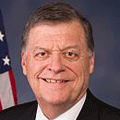
U.S. Rep. Tom Cole, R-Oklahoma
Speaking to reporters in the Capitol March 17, Cole said there is “no indication” that Trump’s allegation against Obama is true.
“It’s not a charge I would ever have made. And frankly, unless you can produce some pretty compelling proof, then I think … President Obama is owed an apology,” said Cole.
“If (Obama) didn’t do it, we shouldn’t be reckless in accusations that he did.”
In a March 4 tweet, Trump claimed that Obama has his “wires tapped” in Trump Tower, his New York home. He followed that up with additional tweets comparing Obama’s conduct to the Watergate scandal that brought down Richard Nixon in 1974.
Trump has so far offered no evidence to back that claim, but he has not retracted it. Leaders of the House and Senate intelligence committees from both parties have said the claim is unsubstantiated. Obama administration officials have also said the claim has no merit.
While other Republican leaders have distanced themselves from Trump’s wiretapping claim, none of them have gone as far as Cole in calling for an apology.
Cole has a place in the GOP leadership as a deputy whip to House Majority Whip Steve Scalise of Louisiana. From 2006 to 2008, he served as chair of the National Republican Congressional Committee, the party’s House campaign arm.
Cole, from Moore, represents Oklahoma’s 4th District, which stretches from the southern Oklahoma City suburbs south to the Texas border. He has held the seat since 2003.
A college history professor before entering politics, Cole, a member of the Chickasaw Nation, is one of only two Native Americans currently serving in Congress. The other is U.S. Rep. Markwayne Mullin, a Republican who represents Oklahoma’s 2nd District.
In the 2016 election, Trump carried 66 percent of the vote in the 4th District, to just 28 percent for Democrat Hillary Clinton.
Analysis: Results in Confederate namesake counties show role of race in Democratic decline
Trump accelerates Republican shift in counties named for Jefferson Davis and Robert E. Lee
♦By Rich Shumate, Chickenfriedpolitics.com editor
 (CFP) — Jefferson Davis and Robert E. Lee loom large as icons of the Southern Confederacy, so much so that 11 Southern counties and one Louisiana parish bear their names. But if these lions of the South are aware of what is happening in their namesake counties today, they may be rotating in their graves.
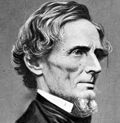
Confederate President Jefferson Davis
Changes in presidential voting in these counties over the past 40 years illustrate just how far the Black Republicans against which Lee and Davis fought are now transcendent—and the alarming (for Democrats) degree to which white Southerners have forsaken their traditional political roots.
Of course, the South’s march toward the GOP is not news. Today, the term “Solid South” has an entirely different connotation than it did during the days of FDR or Lyndon Johnson. However, these namesake counties do provide a window into how these shifts in party preference have occurred over time and the role that race played in them.

Confederate General Robert E. Lee
The 2016 presidential results also show that the Republicanization of the South is accelerating in these counties that bear the mark of Southern heritage, which bodes ill for future Democratic prospects.
In 1976, when Democrat Jimmy Carter became the first Southerner to win the White House since Zachary Taylor in 1848, he carried nine of the 12 Davis and Lee counties. By 1992, Bill Clinton and George H.W. Bush were splitting them six-to-six.
By 2000, Republican George W. Bush had flipped nine of the 12 namesake counties his way; his average share of the total votes cast for the two major party candidates in those counties that year was an impressive 64 percent. But in 2016, Trump trumped the younger Bush, carrying those same nine counties with an average of 70 percent of the two-party vote.
In 1976, Republican President Gerald Ford’s share of the two-party vote topped 50 percent in just three namesake counties (in Florida, Alabama, and Kentucky). But by 2016, Trump’s share of the two-party vote was more than 50 percent in nine counties and parishes; above 60 percent in eight; above 70 percent in four; and above a whopping 80 percent in two (Georgia and Kentucky).
The most dramatic changes were in Jeff Davis County, Georgia, where native Georgian Carter carried 79 percent of the vote in 1976 and Trump won 81 percent in 2016, and Jefferson Davis Parish, Louisiana, where Carter won 62 percent and Trump 75 percent. However, even in majority black Lee County, Arkansas, Trump’s 16-point loss in 2016 was less than half of Ford’s 38-point defeat.
In addition to Lee County, Arkansas, the only namesake counties Trump lost in 2016 were Jefferson Davis County, Mississippi, and Lee County, South Carolina, which are also majority black. However, even in these three counties, Trump carried a larger share of the two-party vote in 2016 than Mitt Romney did in 2012.
In fact, Trump improved on Romney’s result in 11 of the 12 namesake counties, save only Jeff Davis County, Texas, where Trump had to settle for merely matching Romney’s total.
The results in these namesake counties over time also illustrate the role race has played in the political realignment of the South.
In all seven of the overwhelmingly white namesake counties, the Republican share of the two-party vote was higher in 2016 than in 1976, by an average of 29 percent. Trump did better than Romney by an average of 4 percent.
By contrast, in majority-black Lee counties in Mississippi and South Carolina, the Republican two-party share fell by an average 2.5 percent from 1976 to 2016, but Trump outperformed Romney by the same 2.5 percent. These results indicate that the white Southern shift to the Republicans appears stronger than the corresponding black shift to the Democrats.
This is borne out by the results in Lee County, Arkansas, which has the smallest African-American population of any of the majority-black namesake counties (55 percent). There, the Republican share of the two-party vote actually climbed 11 percent between 1976 and 2016, and Trump beat Romney’s total by 5 percent.
Two of the namesake counties—Lee County, Florida, and Jeff Davis County, Texas—are outliers in that they have significant Latino populations. The Republican share of the two-party vote in both of those counties was higher in 2016 than it was in 1976, but Trump’s results were down from the numbers put up in 2000 and 2004 by George W. Bush, who, for a Republican, ran strongly with Latino voters.
The results in the namesake counties also illustrate the mountain which Democrats need to climb if they are to reduce Republican hegemony in the South.
The Democratic base once included small towns and rural areas across the Southern landscape, as well as urban areas. In 2016, Democrats still held the cities (with newfound and welcome signs of life in suburban Atlanta and Houston) and the mostly small rural counties with majority black populations, such as the namesake counties in Arkansas, Mississippi and South Carolina. Democrats also do well in college towns such as Athens, Georgia, and Gainesville, Florida.
But Democrats’ failure to compete for the votes of small town and rural white voters is what is killing them electorally, as the results in the Davis and Lee namesake counties without black majorities vividly illustrates.
Only one of these namesake counties is urban—Lee County, Florida, which includes Fort Myers—and Lee County, Alabama, contains Auburn University. The rest of these counties and parishes are all rural, white areas where Messrs. Davis and Lee are no doubt remembered fondly and Jimmy Carter ran reasonably well—and where Hillary Clinton couldn’t get elected dog catcher if she handed out $20 bills at the polling booth.
As a barometer of the past, these namesake counties illustrate how far Democrats have fallen in their former strongholds. But if Trump’s improved results over Romney’s are a barometer of the future, the bottom may not yet have been reached.
Virginia Governor 2017: Contested primaries shaping up in both parties
Northam, Gillespie face challenges from anti-establishment rivals
♦By Rich Shumate, Chickenfriedpolitics.com editor
 RICHMOND (CFP) — Any hopes Democratic and Republican leaders in Virginia had of avoiding contentious primaries in the governor’s race this year have been dashed, with both parties facing the same establishment-versus-insurgent battles that characterized the 2016 presidential contest.
With two months to go before the filing deadline for the June primary, the Democratic race has already drawn two major contenders, while the Republican race has four. All are vying to replace Democratic Governor Terry McAuliffe, who is barred by state law from seeking re-election.
On the Democratic side, Lieutenant Governor Ralph Northam appeared to be cruising to his party’s nomination unmolested until January, when former U.S. Rep. Tom Perriello jumped into the race and began casting himself as anti-establishment, in contrast to the well-connected Northam.
On the Republican side, Ed Gillespie, a former Republican National Committee chairman who ran a surprisingly strong race for U.S. Senate in 2014, is being challenged by Donald Trump’s former Virginia campaign chairman, a veteran state senator who also worked for Trump, and a Tea Party-aligned distillery owner who has hired the campaign manager who helped take down Eric Cantor in 2014.
A poll from the Wason Center for Public Policy at Christopher Newport University, released February 2, shows both primary races are fluid, with Gillespie and Northam leading but most voters undecided.
The governor’s battle takes place amid changing political currents in the Old Dominion. Once reliably Republican, Democrats have carried the state in the last three presidential elections and hold both U.S. Senate seats. Three of the last four governors have been Democrats.
Virginia also doesn’t have primary runoffs, which means that on the Republican side, the winner is likely to have garnered significantly less than 50 percent of the vote.

Ed Gillespie
Gillespie, 55, from Fairfax County, is a former top lieutenant to President George W. Bush who has run both the national and state GOP. In 2014, he came within 18,000 votes of unseating Democratic U.S. Senator Mark Warner, in what was considered one of the biggest surprises of that election cycle.
Standing in Gillespie’s road to the nomination are Corey Stewart, 48, chairman of the Prince William County Board of Supervisors, who ran Trump’s campaign in Virginia until being fired a month before the 2016 election; State Senator Frank Wagner, 61, from Virginia Beach, a former U.S. Navy officer who has served in the the state legislature for 25 years; and Denver Riggleman, a distillery owner and former Air Force intelligence officer from Afton.

County Supervisor Corey Stewart
Stewart, who instigated a crackdown on undocumented immigrants as county chairman, has boasted that “I was Trump before Trump was Trump.” However, he was removed from the Trump campaign last October after organizing a protest outside of Republican National Committee headquarters demanding that the GOP hierarchy not abandon Trump in the wake of the release of an audiotape in which Trump made sexually suggestive comments.
A key question in the GOP primary will be the extent to which Trump might assist Stewart — and how much good that would actually do in a state Trump lost.

State Senator Frank Wagner
Stewart will also have competition for the pro-Trump banner from Wagner, who was co-chair of Trump’s campaign in southeast Virginia. He has remained a Trump defender, endorsing the president’s controversial ban on refugees from seven predominantly Muslim countries and criticizing Gillespie for not following suit.
In his campaign, Wagner is also touting his legislative experience and the fact that he is the only Republican candidate who is a native Virginian.

Denver Riggleman
Riggleman, the least well-known among the Republican candidates, has hired the campaign manager used by U.S. Rep. Dave Brat in his upset win over then-House Majority Leader Eric Cantor in a GOP primary 2014. Backed by Tea Party activists and talk radio hosts, Brat tossed the powerful Cantor from Congress, in what is now seen as a prelude to the political earthquake that brought Trump to power two years later.
The Wason Center poll found that Gillespie was the choice of 33 percent of Republican or Republican-learning voters, with Wagner at 9 percent, Stewart at 7 percent and Riggleman at 1 percent. However, 50 percent remain undecided.
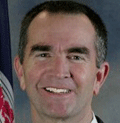
Lieutenant Governor Ralph Northam
On the Democratic side, Northam, 57, a doctor and former U.S. Army major from Norfolk, served in the state senate before winning the lieutenant governorship in 2013. He has the backing of most of the commonwealth’s Democratic leadership, including McAuliffe, Warner and U.S. Senator Tim Kaine.
Perriello, 42, from Charlottesville, served a single term in Congress before being swamped in the Tea Party wave of 2010. His tenure was noteworthy for his vote in favor of Obamacare, which didn’t go down well in the more conservative parts of his central Virginia district.

Former U.S. Rep. Tom Perriello
After leaving Congress, Perriello worked at the Center for American Progress, a liberal think tank, and was appointed by President Obama as a State Department envoy to Africa.
While Perriello’s voting record in Congress was moderate for a Democrat, he has been staking out ground on the progressive left in the governor’s race, saying he wants to make Virginia “a firewall against hate, corruption and an assault on the Virginia values of decency and progress.” He has also changed his position on using federal funds to pay for abortions, which he once voted against but now supports.
The Democratic primary race is likely to feature some of the remaining currents from the bruising 2016 battle between Hillary Clinton and Bernie Sanders.
Northam’s most prominent backer, McAufliffe, is a close confidant of the Clintons, and Northam endorsed Clinton over Sanders in the commonwealth’s presidential primary. That could provide an opening for Perriello, who is also close to Obama and members of the former president’s political brain trust.
The Wason Center poll shoed Northam at 26 percent and Perriello at 15 percent among Democratic and Democratic leaning voters, with 59 percent undecided.
Virginia is one of four Southern states that hold gubernatorial elections in off years but is the only one voting in 2017. Louisiana, Kentucky, and Mississippi will have elections in 2019.
 Chicken Fried Politics