
Home » Posts tagged 'Hillary Clinton' (Page 4)
Tag Archives: Hillary Clinton

Electoral College: Despite protests, Southern electors stick with Trump
Trump carried 165 of the region’s 180 votes; two ‘faithless’ electors in Texas vote for Kasich, Ron Paul
♦By Rich Shumate, Chicken Fried Politics.com editor
 (CFP) — Members of the Electoral College have met at 14 Southern statehouses and, as expected, gave the overwhelming majority of the region’s electoral votes to President-elect Donald Trump, ignoring calls by anti-Trump protestors to stop his elevation to the nation’s highest office.
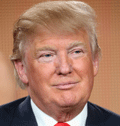
Donald Trump
Trump carried 165 of the South’s 180 electoral votes in the December 19 vote. Hillary Clinton won the 13 electoral votes from Virginia, which was the only Southern state she carried.
The only place where Republican electors broke ranks was in Texas, where the defections of two Republican electors did not stop Trump from securing the 270 votes he needed to win the White House.
Chris Suprun, a Dallas paramedic who had previously announced he would not vote for Trump, cast his ballot for Ohio Governor John Kasich. Elector Bill Greene, who represented the 34th District, which takes in the Gulf Coast between Brownsville and Corpus Christi, voted for former Texas U.S. Rep. Ron Paul.
Afterward, Texas Governor Greg Abbott tweeted his support for a bill that would preclude so-called “faithless” electors by requiring them to vote for the candidate who carried the state on election day, in this case, Trump.
“This charade is over.,” Abbot said. “A bill is already filed to make these commitments binding. I look forward to signing it & ending this circus.
Twenty-nine states have laws binding electors to the popular vote winner in their states, including the Southern states of Oklahoma, Mississippi, Alabama, Florida, South Carolina, North Carolina and Virginia. Currently in Texas, state law doesn’t bind electors, although the Texas GOP required them to take an oath pledging to vote for the popular vote winner.
The Electoral College vote is usually a formality to which scant public attention is paid. However, Trump’s surprise win on November 8, coupled with his loss to Clinton by more than 2.8 million votes in the popular vote, galvanized anti-Trump protests at state capitols around the country.
Small groups of protestors gathered in Tallahassee, Atlanta, Nashville, Raleigh, Austin, Oklahoma City and Montgomery.
In Austin, shouts from protestors were audible inside the State House chamber where electors met, according to local media reports.
In Little Rock, anti-Trump activists took many of the seats in the old Supreme Court chamber in the State Capitol, where the vote took place. According to local media reports, one protestor was removed, although the electors also chatted amiably with the demonstrators before the vote took place.
Second Texas GOP elector bolts from Donald Trump
Elector Chris Suprun says Trump is not qualified to be president
♦By Rich Shumate, Chicken Fried Politics.com editor
 DALLAS (CFP) — A Texas Republican presidential elector has announced he won’t vote for Donald Trump, making his case in a New York Times op-ed in which he argues the president-elect “shows daily he is not qualified for the office.”

Chris Suprin (Photo: Twitter)
“The election of the next president is not yet a done deal,” said Chris Suprun, a paramedic from Dallas. “Electors of conscience can still do the right thing for the good of the county. Presidential electors have the legal right and a constitutional duty to vote their conscience.”
Suprun said that while he has “poured countless hours into serving the party of Lincoln and electing its candidates,” Trump is an divisive demagogue who lacks foreign policy experience and has overseas business interests that would conflict with his role as president.
“I owe no debt to a party,” he said. “I owe a debt to my children to leave them a nation they can trust.”
Suprun did not say who would get his vote when Texas’s 38 electors meet to cast their ballots in Austin on December 19. However, he called on electors to “unify behind a Republican alternative, an honorable and qualified man or woman such as Gov. John Kasich of Ohio.”
Under Texas law, electors are not bound to vote for the candidate who carried the state in the November 8 election. However, the Texas Republican Party required all electors to take an oath pledging to vote for the winner.
Suprun was selected as the elector representing the 30th U.S. House District, a majority-minority area that includes much of the city of Dallas and southern Dallas County. While Trump carried the state, Hillary Clinton won Suprun’s district.
Suprun is the second Texas elector to refuse to vote for Trump, following Art Sisneros, who resigned as an elector rather than cast a ballot for the president-elect, which he said “would bring dishonor to God.
Sisneros will be replaced by the remaining electors when they meet on December 19.
Democratic VP nominee Tim Kaine rules out 2020 White House run
Kaine tells Richmond newspaper he is content representing Virginia in the Senate
♦By Rich Shumate, Chicken Fried Politics.com editor
 RICHMOND (CFP) — U.S. Senator Tim Kaine of Virginia says he is through with presidential-level politics and will not run for the Democratic nomination in 2020.

Tim Kaine
Kaine made those remarks in a November 17 interview with the Richmond Times-Dispatch, his first in-depth interview since he and Hillary Clinton went down to defeat on November 8.
“I want to run and serve in the Senate for a long time,” Kaine said. “I was really honored to be asked by Hillary, and it was a history-making race to be the first woman nominated. And for her to do well in Virginia and win the popular vote, that is all to her credit. And I was really proud to be part of it. But I think the Catholic in me likes to go to the place where there is the most work to be done.”
Kaine told the newspaper that he would like to emulate the career path of former U.S. Senator John Warner, who represented Virginia in the Senate for 30 years before retiring in 2009. Warner never sought the presidency.
Had Kaine been willing to seek the presidency in 2020, he would have been a leading contender on the Democratic side, given his name recognition from the 2016 race.
Kaine is up for re-election in 2018. While Republicans would likely make a charge at him, Virginia has been trending Democrat in statewide races, with the governorship and both U.S. Senate seats in Democratic hands.
The Clinton-Kaine ticket carried Virginia by 5 points. It was the lone Southern state that they won.
Kaine was the only Southerner to make the ticket of either major political party this year, although 10 Southerners unsuccessfully sought their party’s nomination, including two Virginians, former Democratic U.S. Senator Jim Webb and former Republican Governor Jim Gilmore.
Analysis: Election results show Democrats are still a long way from being competitive in the South
Clinton performed worse in the South than Barack Obama in 2012
♦By Rich Shumate, Chickenfriedpolitics.com editor
 (CFP) — Prior to the November 8 election, Democrats were publicly hopeful that they might finally be turning back Republican hegemony in the South, to the degree that pro-Hillary Clinton ads were running not only in the battleground states of Florida and North Carolina but also in reliably Republican Georgia and Texas.
Election results show that thinking was not just wishful, it was magical.
In fact, Clinton did comparatively worse in the South than Barack Obama did four years ago (which, oddly, seems to undercut the notion that the South’s resistance to Obama was based on his race.) A look at regional and state-by-state figures in the presidential race shows just how grim election night was for Southerners with a D attached to their name.
Donald Trump carried 53.3 percent of the vote and 13 out of 14 Southern states. That performance was not as good as Mitt Romney’s in 2012, when he came in with 54.4 percent (although Romney only carried 12 states.) However, the performance gap between Trump and Clinton was actually larger than the gap between Romney and Obama because Clinton’s underperformance was even worse.
She took just 42.5 percent of the Southern vote; Obama won 44.3 percent. Some of that was due to a larger third-party vote which, at 4.2 percent, was about 3 points more than it was in 2012. However, the gap between the Republican and Democratic share of the vote went up everywhere except Texas and Georgia and the lone Southern state Clinton carried, Virginia.
A look at raw vote totals shows the degree to which Clinton hemorrhaged Obama supporters.
In Mississippi, Clinton’s raw vote total was nearly 101,000 less than Obama’s in 2012, a huge shift in a state where less than 1.2 million votes were cast. Given that African-Americans play an outsized role in the state’s Democratic base, Clinton’s numbers are a clear sign that black voters did not turn out for her as they did for Obama.
But if Mississippi was bad for Clinton, Appalachia was even worse — down 51,000 votes in Kentucky, 92,000 in Tennessee, and 52,000 votes in West Virginia, where Trump’s percentage of the vote soared 15 points above Romney’s number. Those three states together have 270 counties; she carried exactly five.
In Arkansas, where Clinton was first lady and her husband governor for 10 years, she lost 16,000 votes and managed just 33.6 percent of the vote, 3.3 points lower than Obama’s vote in 2012. At the same time, Trump’s vote went up 34,000 over Romney’s, a net difference of nearly 50,000 votes.
Even in Virginia, which Clinton won, her vote total was 11,000 less than what Obama put up in 2016. She won because Virginia Trump’s vote total came in less than Romney’s by about 59,000 votes.
Meanwhile, as Clinton’s vote was fading, Trump’s was surging, beating 2012 GOP totals in every state except Virginia and Mississippi.
In Florida, where a growing Latino population was supposed to lead Clinton to victory, Trump added 442,000 votes to Romney’s tally, while Clinton added just 245,000 to Obama’s. In North Carolina, he added 69,000; she lost 16,000 in a battleground state she visited repeatedly.
In total across the South, Trump added more than 1 million votes to Romney’s haul; Clinton managed to add 448,000 by offsetting her losses in 11 states with gains in Texas, Florida and Georgia.
This led to some remarkable net vote changes between the two parties — 128,000 in Alabama, 166,000 in Kentucky, 150,000 in Tennessee and 118,000 in West Virginia.
The only glimmer of light at the end of this dark tunnel for Democrats was their improved performance in both Georgia and Texas.
In the presidential race, Democrats closed the gap with Republicans from 8 to 5 points in Georgia and 16 points to 9 points in Texas. Clinton also carried two big suburban counties in Atlanta, Cobb and Gwinnett, that had not gone Democratic in 40 years, along with Fort Bend County in suburban Houston, normally a no-man’s-land for a Democrat.
So perhaps Democratic wistfulness for those two states may not have been entirely misplaced, although that’s cold comfort when Trump carried Florida and North Carolina on his way to the White House.
And if the presidential results were grim, the U.S. Senate races were just as bad. Republicans went eight-for-eight, with a race in Louisiana heading for a December 10 runoff in which Republican State Treasurer John Kennedy is favored to keep the seat in GOP hands.
Democrats didn’t even bother contesting Alabama, Oklahoma or South Carolina; they did recruit credible candidates in the rest of the races, such as Conner Eldridge in Arkansas, Jim Barksdale in Georgia and Jim Gray in Kentucky. But all lost by double-digit margins.
The Democrats’ best shots to pick up GOP-held seats were thought to be in Florida, where U.S. Rep. Patrick Murphy was challenging Marco Rubio, and in North Carolina, where Deborah Ross was challenging Richard Burr. Murphy lost by 8 points; Ross, by 7. Both actually underperformed Clinton in their states.
The only good news for Democrats came in races for governor in West Virginia, where Jim Justice kept the office in Democratic hands, and in North Carolina, where Democratic Attorney General Roy Cooper appears to have ousted Republican Governor Pat McCrory, although that race may be headed for a recount.
President: Trump rolls across the South, shuts out Clinton in Florida, North Carolina
Clinton takes just one Southern state, Virginia
♦By Rich Shumate, Chickenfriedpolitics.com editor
(CFP) — Republican Donald Trump blazed through the South on his way to the White House, defeating Hillary Clinton in the battleground states of Florida and North Carolina.
Trump won 13 of 14 Southern states, with a combined 167 electoral votes, a better performance than Mitt Romney had in 2012, when he took 12.
Trump’s haul of Southern electoral votes made up 58 percent of his national total.
Clinton’s only Southern victory came in Virginia, where she defeated Trump by a margin of 50-46 percent, thanks to a late vote surge from the Washington, D.C. suburbs.
Trump defeated Clinton by a margin of 49-48 percent in Florida and 51-47 percent in North Carolina.
Across the rest of the South, Trump rolled up double-digit margins, including winning by a whopping 43 points in West Virginia. 36 points in Oklahoma and 30 points in Kentucky.
Trump outperformed Romney’s totals in every Southern state except Georgia and Texas. In Georgia, the GOP result was down 3 points; in Texas, 6 points.
 Chicken Fried Politics