
Home » Posts tagged 'Joe Biden' (Page 4)
Tag Archives: Joe Biden

Decision 2020: Can Joe Biden break through and make the South matter?
Texas and Georgia join North Carolina and Florida on list of 2020 presidential swing states
♦By Rich Shumate, ChickenFriedPolitics.com editor
 (CFP) — Twenty years ago, George W. Bush became the first Republican to sweep the entire South in a non-landslide election, and in the five presidential elections since, a Democrat has carried Virginia three times, Florida twice, and North Carolina once.
Every other state in the region went for the Republican, every time. If you add it up, that’s 64 state wins for the Republican, to just six for the Democrat.

The candidates for president
But if the pre-election polls are correct, the GOP’s lock on the South — which has been a bedrock of the party’s Electoral College fortunes — appears to be loosening, albeit slightly, in 2020. So election night may not be as much of an afterthought in the South as it has been for the past two decades.
Indeed, the results in three Southern states that report results early could point toward who is going to win the White House, even as the rest of the country finishes casting ballots.
Virginia seems almost certain to go Democratic for the fourth election in a row. North Carolina and Florida are, as expected, toss-ups, as they have been in the last three elections. But in 2020, the races in both Texas and Georgia are within the margin of error, which could complicate–if not end–Donald Trump’s hopes of winning re-election if Joe Biden wins either one.
Polls even show that in South Carolina, which hasn’t gone for a Democrat since Jimmy Carter in 1976, Trump’s lead may be in single digits. And while a win in the Palmetto State still seems like a stretch, a close race between Trump and Biden would be a sign that the president’s political fortunes have dipped even in a region he swept four years ago.
The 2020 race is also unusual in another respect — it is the first presidential race since 1972 where neither party has a Southerner on its ticket.
The list of four Southern swing states in 2020 echoes 2016, when Trump took them by single-digit margins while rolling up double-digit victories everywhere else. He won Florida by 1 point, North Carolina by 4, Georgia by 5, and Texas by 9.
In the 2018 midterm elections, Democrats made gains in the suburbs around major cities in Georgia and Texas, which is the template Democrats are using for 2020. However, they had less success in North Carolina, where Republican candidates held up better.
The Biden campaign has been up with ads in Georgia and has spent a token amount in Texas, although it has yet to commit any substantial resources to either state. Both Biden and Trump have campaigned in Georgia, although they have not yet barnstormed Texas.
These Southern states are much more important to Trump than they are to Biden, who can win the White House without them if he flips Pennsylvania, Wisconsin and Michigan back into the blue column. While Trump could survive losing either Georgia or North Carolina, if he can hold the line in the Upper Midwest, a loss in either Florida or Texas would be catastrophic.
Florida and Georgia have two of the earliest poll closing times in the country, at 7 p.m. Eastern (the Florida Panhandle stays open another hour), and North Carolina closes a half hour later. So those three states could be among the first places where winners can be declared, unless the races are extremely close.
If Trump wins these states, the result won’t tell us much about the eventual outcome. But a Biden win in any of them — particularly Florida — will point to a Democratic victory, and we will likely know the Florida result before the results in Pennsylvania, Michigan and Wisconsin.
No matter what happens in 2020, the results will almost certainly change how the presidential game is played in the South in 2024.
Four years from now, Texas and Georgia will be seriously contested by both sides, particularly if Biden wins or comes close this year. That will add two new large states where campaigns have to add significant resources, particularly in Texas, which has more than 20 TV markets.
For Republicans, who have not had to worry about the South at the presidential level for decades, more competition in the region complicates their path to the White House. For Democrats, the ability to win in the South gives them additional paths to 270 that reduce the number of must-win states elsewhere. So the long-term consequences of this election could be enormous.
That’s why, on Nov. 3, the South will matter as it hasn’t mattered in the last 20 years.
We tweet @ChkFriPolitics Join us!

Insight: Will Joe Biden really make a play for Georgia and Texas in 2020?
Why, despite the summertime chatter, putting resources into these states makes little strategic sense
♦By Rich Shumate, ChickenFriedPolitics.com editor
 The last time a Democratic presidential candidate carried Georgia, The Cover Girls (remember them?) were wishing on a star. The last time a Democrat carried Texas, people were still wearing bell bottoms.
Every four years, the pundit class and Democrats in these states insist that this time will be different — this year, finally, these states are going to flip. And every four years, Republicans scoff at their wishful thinking and hubris.
It’s deja vu all over again. Joe Biden’s campaign is making noises about competing in the Peach and Lone Star states, committing significant resources for a serious ground game in places where one hasn’t been seen in a generation.
So what are the chances this will actually happen? Probably pretty slim — not because it isn’t possible for Biden to win these states but because, if they are within reach, winning them won’t be necessary.
First, the numbers. Donald Trump carried Georgia by slightly more than 5 points in 2016, the smallest winning margin for a Republican since Bob Dole won by less than 2 points in 1996 in a three-way race. (By way of contrast, George W. Bush won by nearly 17 points in 2004.)
In Texas, Trump’s margin was larger, just under 9 points, but that was also the smallest winning margin for a Republican since Dole. (Bush won by more than 20 points.)
Clearly, the trend lines are headed in the Democrats’ direction, as even Republicans in these states would concede. These states are within (a long) reach.
However, in considering Electoral College strategy, it is helpful to think of the presidential race as a tug-of-war, with states arrayed along the rope in order from most Democratic to most Republican. The goal is to pull the rope far enough that there are at least 270 electoral votes on your side.
In 2016, six states on Trump’s side of the rope were closer than Georgia — the Southern states of Florida and North Carolina, along with Michigan, Pennsylvania, Wisconsin and Arizona. Those six and Ohio were closer than Texas.
So, if Georgia is truly within reach for Biden in 2020, six Trump states are likely already in Biden’s hands; make that seven if Texas is in play. And if Biden is already carrying all of those states, he won’t need to bother with Georgia or Texas. He’s already won.
This is why, strategically, it would make little sense for the Biden campaign to put resources into Georgia and Texas. But there are three reasons we might see them do it anyway.
First, engaging in these states could help drive up Democratic turnout, which could help in U.S. Senate and down ballot races. However, presidential campaigns aren’t known for their altruism; we’re only likely to see this if the race is a blowout for Biden and he can spare the resources to benefit other candidates.
Second, making a play for Texas or Georgia could be an insurance policy in the event that something unexpected happens in one of the closer states, as happened to Hillary Clinton in 2016 in Michigan and Wisconsin. However, given that experience, Biden won’t be caught napping like Clinton was, making such a surprise less likely.
And third, putting resources into Georgia or Texas could be a way to troll the Trump campaign and force it to engage in these states. Even talking about the possibility forces the Trump forces to consider countermeasures.
However, if Trump needs to shore up either of these states come November, his battle is already lost, and what happens in Texas and Georgia won’t matter (although Biden could make a play for them to run up the score.)
So, all this summertime chatter about competing in Georgia and Texas may make interesting cable news conversation, but the smart money says that in the end, Biden won’t bite.
Then again, betting on presidential politics these days might, admittedly, be a bit of a fool’s errand.
We tweet @ChkFriPolitics Join us!

President Donald Trump returns to campaign trail with raucous rally in Tulsa
Smaller-than-anticipated crowd attends event, the country’s first large-scale indoor gathering since the coronavirus lockdown
♦By Rich Shumate, ChickenFriedPolitics.com editor
 TULSA (CFP) — After being sidelined from the campaign trail for three months by the coronavirus lockdown, President Donald Trump was back in his element Saturday night, addressing thousands of adoring supporters as he returned to the campaign trail in Tulsa.
“I stand before you today to declare that the silent majority is stronger than ever before,” Trump told the crowd at the BOK Center. “We”re going to stop the radical left. We’re going to build a future of safety and opportunity for Americans of every race, color, religion and creed.”

Donald Trump rallies supporters in Tulsa (From Fox News via YouTube)
Trump touted the achievements of his first term, saying that “together, we are taking back our country. We are returning it to you, the American people.”
While the campaign claimed that more than 1 million people had registered for the event and had set expectations of a capacity crowd, parts of the arena were visibly empty. According to the Tulsa Fire Department, only 6,200 people attended, based on a count conducted by the fire marshal.
Trump and Pence had been scheduled to address the crowd in an overflow area set up outside the arena, but that event was canceled, and crews began dismantling the stage as Trump was speaking inside.
Trump campaign officials issued a statement saying “radical protesters, coupled with a relentless onslaught from the media, attempted to frighten off the President’s supporters.” Trump told the audience that “a bunch of maniacs” had interfered with the rally, although news media coverage showed no significant violence or obstructions outside of the arena.
State and local police and National Guard units had been brought in to provide security for the event and separate rally-goers from groups who were protesting the event in downtown Tulsa near the arena.
In his return to active campaigning, Trump, who had promised his supporters a “wild evening,” didn’t disappoint, offering up plenty of political red meat in a speech that lasted for nearly an hour and 50 minutes.
He attacked the “fake news” as “sick,” called coronavirus “kung flu,” complained that an “unhinged left-wing mob is trying to desecrate our history,” and called activists trying to defund the police “stone cold crazy.”
And he heaped particular scorn on the Democrat he will face in November, Joe Biden, repeatedly calling him “Sleepy Joe,” implying that Biden is unwell, and charging that he has “surrendered to the left-wing mob.”
“If Biden is elected, he will surrender the country to these mobsters,” Trump said. “If Democrats gain power, the rioters will gain control.”
Trump also called for a new law mandating jail time for people who burn the American flag and decried protests against police violence from NFL players, saying “we will never kneel to our national anthem or our great American flag.”
The rally was the country’s first large-scale indoor gathering since the coronavirus lockdown began in March. While attendees were screened with temperature checks before entering, there was little social distancing among the crowd, and most people — including Trump — did not wear face masks, which were optional.
The doors of the arena opened four hours before the event began, with people sitting in close proximity the entire time.
Local health officials in Tulsa expressed concerns about holding the rally amid the ongoing coronavirus crisis. The Oklahoma Supreme Court Friday rejected a request to force attendees to abide by guidelines from the Centers for Disease Control and Prevention, which would have required social distancing and masks.
Attendees had to sign a waiver agreeing not to sue the campaign if they were exposed to coronavirus. On the morning of the event, Trump campaign officials acknowledged that six workers who had helped set up the rally tested positive for coronavirus.
In his remarks, Trump did not address the coronavirus concerns surrounding the rally, but he did tout his administration’s response to the pandemic, which he said saved “hundreds of thousands of lives.”
Biden took to Twitter to chide the president for going ahead with the rally despite concerns about exposing attendees to the virus.
“Donald Trump is so eager to get back to his campaign rallies that he’s willing to put people at risk and violate CDC guidelines — as long as they sign a waiver promising not to hold his campaign liable,” Biden said. “Unbelievable.”
We tweet @ChkFriPolitics Join us!
Texas Democrats’ virtual convention full of optimism about finally turning red to blue
Joe Biden and Nancy Pelosi rally the Lone Star party faithful with predictions of fall success
♦By Rich Shumate, ChickenFriedPolitics.com editor
 AUSTIN (CFP) — A Democrat hasn’t carried Texas in a presidential race since 1976, won a Senate race since 1986, or won the governorship since 1988. Republicans hold majorities in both houses of the legislature and control every statewide partisan office.
But you wouldn’t know that from the tone at the week-long virtual Texas Democratic Convention that concluded on Saturday, where past woe was eclipsed by present optimism.
Whether that optimism is cockeyed or not will be decided in November after a political season completely disrupted by the coronavirus crisis.
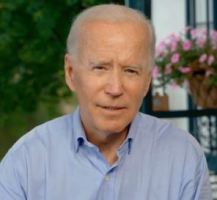
Joe Biden gives virtual address to Texas Democratic Convention
“I think we have a real chance to turn [Texas] blue because of all of the work that you have done,” Democratic presidential nominee Joe Biden said in his address to delegates. “We’re building the diverse coalition to win up and down the ballot in the fall.”
The key to turning Texas blue, according to Biden, will be Latino voters, who make up a quarter of the state’s registered voters.
“Donald Trump‘s anti-Latino, anti-immigrant agenda has targeted Latinos, with dire consequences,” Biden said, pledging to introduce immigration reform on “day one” if he’s elected president.
In her address, House Speaker Nancy Pelosi said “Republicans in Washington know how strong and formidable our members and candidates are” which is why Republicans are “running for the exits” — a reference to the six GOP House members who are retiring in 2020.
“Know your power,” Pelosi said. “Your engagement in organizing today is more important than ever before.”
Republicans, of course, see such bravado from Democrats as wishful thinking. Responding to a debate during the convention between the two Democratic candidates in the U.S. Senate runoff, the Texas GOP chair, James Dickey, called it a “race to socialism, each vying to be the most leftist and most extreme.”
Biden, Dickey said, would lead Democrats “off a cliff” in November.
In 2016, Trump carried Texas by nine points, about 800,000 votes ahead of Hillary Clinton. That would be large margin to overturn in 2020, and, if as Biden says, Latino voters are the key, it is worth noting that Trump’s share of the Latino vote in 2016 nationally was comparable to what Republicans usually earn, despite his position in favor of tighter border controls.
Also, in Texas, about 30 percent of Latinos identify as Republican — higher than in any other state except Florida — and an analysis of polling in 2019 found that partisanship trumps immigration and other issues as a barometer of whether they are likely to shift allegiance.
However, the coronavirus crisis has pushed the entire election process into unpredictable territory, disrupting both conventional wisdom and conventional modes of campaigning — as witnessed by the fact that Texas Democrats opted for a virtual convention with speeches on Facebook, rather than gathering party activists together in a hall.
Texas Republicans, by contrast, are still planning to hold an in-person convention in Houston from July 16-18. Social distancing measures will be in place, although face masks will be optional.
In addition to the presidential race, Texas Democrats are also trying to defeat Republican U.S. Senator John Cornyn and are targeting seven U.S. House seats, three where Republicans are retiring and four where Democrats are trying to unseat incumbents.
State Democrats also have hopes of flipping the nine seats in the Texas House they would need to win to take control for the first time in 18 years.
In the U.S. Senate race, the July 14 Democratic runoff pits MJ Hegar, 44, a former Air Force pilot who narrowly lost a House race in 2018, against State Senator Royce West, 67, one of Dallas’s leading African-American political figures who has served in the legislature since 1993.
Hegar, who has the endorsement of the Democratic Senatorial Campaign Committee, came in first during the first round of primary voting in May but was well short of a majority in the crowded field with 22 percent. West earned a runoff spot with just 15 percent of the vote.
We tweet @ChkFriPolitics Join us!
Joe Biden sweeps to another victory in Florida Democratic presidential primary
Biden has now gone 10-for-10 in Southern primaries; Trump clinches GOP nomination
♦By Rich Shumate, ChickenFriedPolitics.com editor
 MIAMI (CFP) — Former Vice President Joe Biden easily vanquished his last major Democratic rival, U.S. Senator Bernie Sanders of Vermont, in Florida’s Democratic presidential primary Tuesday, in a race overshadowed by the coronavirus pandemic.
Biden took 62 percent of the vote, sweeping every one of the state’s 67 counties. Sanders took just 23 percent.
Meanwhile, President Donald Trump’s victory in the state’s Republican primary, against minor opposition, put him across the delegate threshold to clinch his party’s 2020 nomination. The president changed his residency to Florida earlier last year.
Florida election officials opted to proceed with Tuesday’s primary despite the national coronavirus shutdown. The run-up to election day was subdued, with neither Democratic candidate holding any rallies or campaign events. Trump has also called a halt to rallies with his supporters.

Biden speaks via video after Florida win
Biden’s win in Florida was wide and deep, taking his string of Southern victories to 10. His delegate margin over Sanders from the Sunshine State alone was more than 80 delegates.
The closest Sanders came to Biden was in Alachua County, home to the University of Florida. where Biden won by 11 points. But Sanders was pummeled in the heavily Democratic counties in South Florida, failing to clear 20 percent of the vote in either Broward or Palm Beach counties and getting just 22 percent in Miami-Dade.
Despite the concerns about coronavirus, the total turnout of Democratic voters was 1.7 million, about the same as it was in 2016, when Sanders took 33 percent of the vote in a race against Hillary Clinton. However, Florida makes extensive use of early voting that was less impacted by the pandemic.
Sanders, who was in Washington as the Senate considers emergency legislation to deal with the pandemic, did not make any public appearance after the vote.
With traditional election night celebrations canceled, Biden had to make do with a web video shot in his home in Wilmington, Delaware.
“We’ve moved closer to securing the Democratic Party’s nomination for president, and we’re doing it by building a broad coalition that we need to win in November,” Biden said.
As he did when he swept through the primaries a week ago, Biden also out an olive branch to Sanders and his supporters.
“Senator Sanders and I may disagree on tactics, but we share a common vision,” he said. “Our goal as a campaign, and my goal as a candidate for president, is to unify this party and then unify the nation.”
Four Southern states have yet to vote in the presidential race — Georgia, Louisiana, Kentucky, and West Virginia.
Georgia’s primary, scheduled from March 24, has been moved to May 19; Louisiana’s has been moved from April 4 to June 20; and Kentucky’s has been moved from May 19 to June 23. West Virginia’s primary is still scheduled for May 12.
 Chicken Fried Politics