
Home » Posts tagged 'Marco Rubio' (Page 3)
Tag Archives: Marco Rubio

Race for GOP-held Georgia U.S. House seat closing with Democrat in lead
But polls shows Jon Ossoff may not avoid a runoff that could be fatal in metro Atlanta’s 6th District
 ATLANTA (CFP) — On paper, the outcome of the April 18 special election to fill Georgia’s 6th District U.S. House district should be an foregone conclusion.
This seat in Atlanta’s upscale, leafy northern suburbs has been previously held by former House Speaker Newt Gingrich and Republican U.S. Senator Johnny Isakson. Last November, Tom Price, now secretary of the U.S. Department of Health and Human Services, won it by more than 76,000 votes against a Democrat who didn’t even bother to campaign.
But after seeing the presidential results in the 6th District last November, Democrats smelled blood.
Donald Trump carried the district by a mere 1.5 percentage points, on his way to losing Cobb County, a GOP bastion that hadn’t gone Democratic since 1976. The eastern half of Cobb is in the 6th District, along with the northern portions of Fulton and DeKalb counties, which Hillary Clinton also carried.
When Trump put Price in his Cabinet, Democrats saw an opportunity in the all-party special election to fill this seat, if they could find a candidate who could make the race competitive.
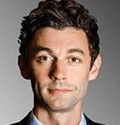
Jon Ossoff, Ga. 6th District candidate
Enter Jon Ossoff, a 30-year-old filmmaker and former congressional aide who had never before run for anything. He galvanized Trump-disaffected Democrats with the slogan “Make Trump Furious.” He raised a staggering $8.3 million in one just one quarter, including $1.25 in crowdfunding from the liberal website Daily Kos — a fundraising haul larger than all of his 11 Republican competitors combined.
Not only has Ossoff proven himself to be competitive, he has shot to a large lead in the polls, a full 20 points ahead of his nearest competitor. But he still may need the political equivalent of a Hail Mary to actually get to Congress.
For to win the seat outright, Ossoff has to clear 50 percent in the April 18 vote against a field with 17 competitors. If he doesn’t pull that off, he’ll face a June 20 runoff against the second-place finisher, who will almost certainly be a Republican.
Recent polls have put Ossoff as high as 43 percent, well short of what he would need to win outright. However, Democrats are hoping that their enthusiasm for Ossoff, along with the low voter turnout typical of special elections, can propel their man over the top.
The results of April 11 special election for a Republican-held congressional seat in Kansas have buoyed those hopes. The Republican in that race won, but there was a 20-point swing toward the Democrat from what Trump posted in November. Even a fraction of that swing could put Ossoff in Congress.
A recent poll by Fox 5 in Atlanta also contained good news for Democrats. In head-to-head match-ups with the four leading Republicans in the race, Ossoff was in a statistical dead heat with all of them, raising hopes he might be able to win even if forced into a runoff.
But Republicans aren’t buying that argument. Given the district’s historical tendencies, they are confident their candidate will prevail in a one-on-one race with Ossoff. One of the Republicans competing for second place, Bob Gray, has gone so far as to dismiss Democratic hopes of poaching the seat as a “fantasy.”
Yet, with Ossoff’s campaign in high gear and Republicans still tussling with each other for second place, the National Republican Congressional Committee began running ads into the district, telling voters that Nancy Pelosi and her fellow liberals are are trying to use this race to stop the Republican agenda. The Republican National Committee has also moved staffers into the district.
Another wild card in Ossoff’s ultimate success will be which Republican he faces in the runoff, who will emerge after an increasingly fractious battle for second place.

Gray

Handel
Polls show the chase for the second spot in the runoff appears to be between Karen Handel, a former secretary of state and chair of the Fulton County Commission, and Gray, a technology executive and former city councilman in Johns Creek, one of the cities in the district.
Handel, a political fixture in North Fulton for the past 15 years, has high name recognition after failed runs for governor in 2010 and U.S. Senate in 2014. She has received a slew of endorsements from city and county officials throughout the district, as well as the support of former U.S. Senator Saxby Chambliss.
Gray has positioned himself as a business-oriented political outsider aligned with Trump, and he is also receiving support from the conservative Club for Growth.
Two other Republicans with an outside shot at the runoff slot are Dan Moody, a former state senator from Johns Creek, who has the backing of U.S .Senator David Perdue, and Judson Hill, a former state senator from East Cobb who has been endorsed by Gingrich and U.S. Senator Marco Rubio of Florida, who carried Cobb, Fulton and DeKalb counties over trump in Georgia’s 2016 Republican presidential primary.
Both Gray and Moody have turned their fire on Handel, with ads that criticize her as an opportunistic office seeker and a flip-flopper in the mode of John Kerry. Handel has responded with an ad touting her experience as county commission chair and secretary of state and criticizing her opponents for being more talk than action.
Trump nominates Florida law school dean Alex Acosta as labor secretary
Acosta selected after Trump’s first nominee for labor post, Andrew Puzder, pulled out
♦By Rich Shumate, Chickenfriedpolitics.com editor
 WASHINGTON (CFP) — Alex Acosta, the dean of Florida International University’s law school and a former federal prosecutor in Miami, has been named by President Donald Trump to be the nation’s next labor secretary.
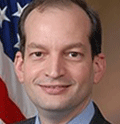
FIU Law Dean Alex Acosta
The selection of Acosta to head the U.S. Department of Labor came a day after Trump’s first pick for the post, fast food magnate Andrew Puzder, withdrew from consideration after it became clear that he lacked enough votes for Senate confirmation.
Trump made the announcement February 16 during a media appearance at the White House, which Acosta did not attend.
“I think he’ll be a tremendous secretary of labor,” Trump said, after briefly ticking off items from Acosta’s resume, including the fact that he had already been confirmed by the U.S. Senate to three executive department posts.
If confirmed, Acosta will be the first, and so far only, Latino in the Trump cabinet.
Acosta, 48, a Cuban-American, has been dean at FIU’s law school since 2009. From 2005 to 2009, he served as U.S. attorney for the Southern District of Florida, which comprises nine counties in the southeastern part of the state.
From 2003 to 2005, Acosta headed up the U.S. Department of Justice’s Civil Rights Division in Washington, the first Latino to serve in that position. From 2002 to 2003, he was a member of the National Labor Relations Board.
Acosta was also a law clerk to now-U.S. Supreme Court Justice Samuel Alito from 1994 to 1995, when Alito was serving on the 3rd U.S. Circuit Court of Appeals.
His two positions in the Justice Department and his stint at the NLRB all required Senate confirmation. One of the senators who will decide on Acosta’s nomination for the labor post, Florida’s Marco Rubio said he was “a phenomenal choice” and predicted he would be approved.
“I look forward to his confirmation hearing, where I’m confident he will impress my colleagues and secure the support necessary to be the next secretary of labor,” Rubio said in a statement.
Henry McMaster sworn in as new governor of South Carolina
McMaster succeeds Nikki Haley, who has been confirmed for U.N. ambassador post
♦By Rich Shumate, Chickenfriedpolics.com editor
 COLUMBIA, South Carolina (CFP) — Republican Henry McMaster has taken the reins as the new governor of South Carolina, after outgoing Governor Nikki Haley’s confirmation to be the next U.S. ambassador to the United Nations.

Governor Henry McMaster
McMaster, who had served as lieutenant governor since 2011, was sworn in during a brief ceremony inside the South Carolina State House on January 24, shortly after the U.S. Senate voted 96 to 4 to confirm Haley and she resigned the post she had held for past six years.
“I am humbled, honored and deeply appreciative of being granted one of the rarest opportunities to serve the people of my state,” McMaster said. “We will do our best, and we will be our best.”
McMaster was introduced by Haley, who looked as her successor was installed.
“I will always have one eye on South Carolina, and I will always be a phone call away,” said Haley, who will now take up her ambassadorship in New York.
McMaster, 69, served as the U.S. attorney in South Carolina from 1981 to 1985 and as state attorney general from 2003 to 2011. After an unsuccessful run for governor against Haley in 2010, he returned to statewide office by being elected lieutenant governor in 2014.
McMaster was an early and enthusiastic supporter of President Donald Trump, delivering one of his nominating speeches at the Republican National Convention. After Trump won, he told the Associated Press that he had been contacted by Trump’s transition team as a possible pick for attorney general, a post which eventually went to U.S. Senator Jeff Sessions of Alabama.
McMaster had been expected to run for governor in 2018 to succeed the term-limited Haley. His ascension to the governorship is likely to give him a significant advantage over any GOP rivals.
McMaster’s ascension also set off an odd scramble to fill the post of lieutenant governor, which ended up going to State Senator Kevin Bryant, R-Anderson.
Under South Carolina’s Constitution, a vacancy in the office of lieutenant governor would normally be filled by the state Senate’s president pro tempore, State Senator Hugh Leatherman, R-Florence. However, Leatherman resigned his Senate leadership job to avoid taking the lieutenant governor’s post, which has limited power.
The Senate then voted to install Bryant as president pro tempore so he could become lieutenant governor. Leatherman is expected to try to reclaim his former post.
The same merry-go-round happened in 2014, when the lieutenant governorship became open after a resignation. At that time, Leatherman and the rest of the Republicans in the Senate refused to take the job, which eventually went to Democrat Yancy McGill.
McGill subsequently switched parties and has announced plans to run for governor in 2018 as a Republican.
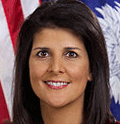
U.N. Ambassador Nikki Haley
Haley, 45, was the first women ever elected governor of the Palmetto State when she won in 2010. The daughter if Sikh immigrants from India, she was only the second Indian-American elected governor, after former Louisiana Governor Bobby Jindal.
Haley is best known nationally for her handling of the aftermath of a shooting at an African-American church in Charleston in 2015 that left nine people dead. Amid national attention to racial tension in her state, Haley persuaded state legislators to remove the Confederate battle flag from the top of the State House in Columbia.
Haley’s decision to take a spot in the Trump administration marks a turn away from her previously frosty relationship with the new president, whom she once called “irresponsible” for suggesting that the election would be rigged.
Last January, as the presidential race was heating up, Haley delivered the Republican response to President Barack Obama’s State of the Union address and gave what was seen at the time as a thinly veiled shot at Trump: “During anxious times, it can be tempting to follow the siren call of the angriest voices. We must resist that temptation.”
Then, just before the South Carolina presidential primary in February, Haley endorsed one of Trump’s GOP rivals, U.S. Senator Marco Rubio of Florida. When Rubio dropped out in March, she then endorsed U.S. Senator Ted Cruz of Texas. Trump responded with a blast on Twitter in which he called her an embarrassment to the people of her state.
Haley never explicitly endorsed Trump during the campaign, although she did tell reporters at the Republican National Convention in July that she intended to vote for her party’s nominee.
U.S. Senate: Republicans hold on to all 8 of their Southern seats
Rubio and Burr beat back challenges in Florida, North Carolina; Kennedy and Campbell will contest runoff in Louisiana
♦By Rich Shumate, Chickenfriedpolitics.com editor
 (CFP) — Republicans held on to all eight of their Southern U.S. Senate seats, with Marco Rubio in Florida and Richard Burr in North Carolina turning back strong Democratic challengers.
Meanwhile, in Louisiana’s all-party “jungle” primary, State Treasurer John Kennedy and Democratic Public Service Commissioner Foster Campbell will advance to a December 10 runoff for the open seat being vacated by Republican U.S. Senator David Vitter.
Kennedy led with 25 percent, with Campbell at 18 percent, edging out Republican U.S. Rep. Charles Boustany at 15 percent.
Because Republicans already secured their 51-seat Senate majority, the Louisiana runoff will not affect the balance of power.
In addition to Rubio and Burr, Republican incumbents also won re-election in Alabama, Arkansas, Georgia, Kentucky, Oklahoma and South Carolina.
With the wins on November 8, Republicans will hold 23 of the 28 Southern Senate seats, with Louisiana still to be decided.
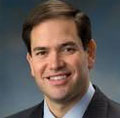
U.S. Senator Marco Rubio
In Florida, Rubio had initially decided to give up his Senate seat to pursue the Republican presidential nomination. But after losing the White House contest, he changed course and filed to run for a second term, improving the GOP ‘s prospects for keeping the seat.
Rubio took 52 percent, defeating Democratic U.S. Rep. Patrick Murphy, who took 44 percent.
Alluding to his withdrawal from the presidential race in March, he told election night supporters in Miami, “This is a lot better than the last time I did one of these.”
Rubio, who had been a critic of Trump before reluctantly endorsing him, did not mention his party’s victorious presidential standard-bearer in his speech, but he did make a plea for civility in politics.
“While we can disagree on issues, we cannot share a country where people hate each other because of their political affiliations,” Rubio said.
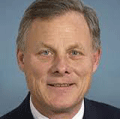
U.S. Senator Richard Burr
In North Carolina, Burr, seeking a third term, took 51 percent of the vote, defeating Deborah Ross, a former state legislator and Duke University law professor, who took 45 percent.
“I am truly humbled by the support I’ve received from people across this state,” Burr said at a victory celebration in Winston-Salem. “This is a victory for all of those who have believed in me.”
In a state notorious for exchanging Senate seats between parties, Burr becomes the first senator to win three consecutive terms since Jesse Helms in 1984.
Here are the other Southern Senate results:

Shelby
Alabama: Republican U.S. Senator Richard Shelby won a seventh term by defeating Democrat Ron Crumpton, a marijuana rights activist. by a margin of 64-36 percent. At the end of his new term, Shelby will be 88 and will have served in Congress for 44 years.

Boozman
Arkansas: Republican U.S. Senator John Boozman won a second term by taking 60-36 percent for Democrat Conner Eldridge, a former federal prosecutor from Fayetteville. Boozman suffered an aortic aneurysm in 2014 that kept him away from Washington for two months.

Isakson
Georgia: Republican U.S. Senator Johnny Isakson won a third term in the Senate by defeating Democrat Jim Barkdale, a wealthy Atlanta businessman, by a 55-41 percent margin. Isakson ran for re-election to a third term despite announcing in 2015 that he had been diagnosed with Parkinson’s disease.

Paul
Kentucky: Republican U.S. Senator Rand Paul defeated Lexington Mayor Jim Gray by a margin of 57-43 percent. Paul had pursued re-election simultaneously with a presidential campaign until he dropped out of the White House race in February.

Lankford
Oklahoma: Republican U.S. Senator James Lankford easily won his first full six-year term by defeating Democrat Mike Workman, a Tulsa political consultant, by a margin of 68-25 percent. In 2014, Lankford was elected to finish out the final two years of Tom Coburn’s term after he resigned.

Scott
South Carolina: Republican U.S. Senator Tim Scott, the only black Republican in the Senate, easily won a full six-year term by defeating Democrat Thomas Dixon, a Charleston pastor, by a margin of 61-36 percent. In 2014, Scott was elected to serve out the remaining two years of Jim DeMint’s term, after he resigned.
Republican U.S. Senate incumbents trying to fight off Democratic challengers
Florida and North Carolina are Senate battlegrounds; Louisiana holds all-party primary for Vitter’s seat
♦By Rich Shumate, Chickenfriedpolitics.com editor
(CFP) — Nine GOP-held Southern U.S. Senate seats are up for grabs in the November 8 election, with Republican incumbents heavily favored in six races.
The exceptions are Florida, where Republican U.S. Senator Marco Rubio is facing off against Democratic U.S. Rep. Patrick Murphy, and in North Carolina, where the GOP incumbent, U.S. Senator Richard Burr, is facing Deborah Ross, a former state legislator and Duke University law professor.
And in Louisiana, 24 candidates are running in an all-party “jungle” primary, with the top two vote-getters advancing to a December 10 runoff, which could potentially decide the balance of power in the Senate.
Pre-election polls have shown Republican State Treasurer John Kennedy in the lead, followed by Public Service Commissioner Foster Campbell, a Democrat; Republican U.S. Rep. Charles Boustany of Lafayette; and Democrat Caroline Fayard, a New Orleans lawyer.
If Kennedy and Boustany can both clear the runoff, the GOP would be guaranteed of keeping the seat, now held by U.S. Senator David Vitter. But if Campbell or Fayard can come through, the December 10 runoff will be the last word on Senate races this year — and, if the Senate is closely divided, decide which party controls the chamber.
In addition to Rubio and Burr, Republican incumbents are seeking re-election in Alabama, Arkansas, Georgia, Kentucky, Oklahoma and South Carolina.
All are heavily favored, although the race in Georgia between U.S. Senator Johnny Isakson and Democratic businessman Jim Barksdale is somewhat more competitive.
In Alabama, Richard Shelby faces Democrat Ron Crumpton, a marijuana rights activist; in Arkansas John Boozman is seeking a second term against Democrat Conner Eldridge, a former federal prosecutor from Fayetteville; and in Kentucky, Rand Paul is running against Lexington Mayor Jim Gray.
In Oklahoma, James Lankford faces Mike Workman, a Tulsa political consultant, and in South Carolina, Tim Scott, the only black Republican in the Senate, faces Democrat Thomas Dixon, a Charleston pastor.
 Chicken Fried Politics