
Home » Posts tagged 'Marco Rubio' (Page 8)
Tag Archives: Marco Rubio

U.S. Senator Lindsey Graham ends bid for GOP presidential nomination
Graham’s decision opens up political space for the February 20 South Carolina primary
♦By Rich Shumate, Chickenfriedpolitics.com
 COLUMBIA, South Carolina (CFP) — Mired in single digits in the polls and relegated to the undercard in the Republican debates, U.S. Senator Lindsey Graham of South Carolina has ended his bid for the 2016 GOP presidential nomination.

U.S. Senator Lindsey Graham
But Graham, who made national security and the battle against ISIS the centerpiece of his White House run, said his campaign has changed the conversation within the Republican field on those issues, pushing the party toward a more hawkish stance.
“I got into this race to put forward a plan to win a war we cannot afford to lose and to turn back the tide of isolationism that was rising in our party,” he said in a YouTube video posted December 22 announcing his departure. “I believe we made enormous progress in this effort.”
Graham said most the Republican candidates have come around to his thinking on one issue in particular–the need to use American ground forces to defeat ISIS in Iraq and Syria.
Graham’s departure allows him to take his name off the ballot for the South Carolina primary, avoiding what could have been an embarrassing defeat in his home state.
South Carolina will hold its pivotal presidential primary on February 20, less than two weeks after the first-in-the-nation New Hampshire primary. The vote in the Palmetto State will be the first test of strength in the South.
After his withdrawal announcement, Graham told CNN that he has no plans to endorse any of the other candidates in the field. However, his departure could free up Graham supporters in South Carolina to sign on with other candidates.
During the campaign, Graham has been a strong critic of GOP front-runner Donald Trump, which could give him a strong incentive to back another candidate who could defeat the real-estate magnate.
Graham, 60, won his third term in the Senate in 2014. He is one of the Senate’s strongest hawks on military and national security issues, but he has also run afoul of some conservatives in his party for supporting immigration reform and crossing the aisle to make bi-partisan deals with Democrats.
He is the third Southern Republican presidential candidate to exit the race so far, after former Texas Governor Rick Perry and Louisiana Governor Bobby Jindal.
The remaining Southern GOP candidates are U.S. Senators Ted Cruz of Texas, Marco Rubio of Florida, Rand Paul of Kentucky and former governors Jeb Bush of Florida, Mike Huckabee of Arkansas and Jim Gilmore of Virginia.
Louisiana Governor Bobby Jindal ends campaign for GOP presidential nomination
Jindal’s decision comes after he was unable to gain traction in the polls or a place in the top-tier debates
♦By Rich Shumate, Chickenfriedpolitics.com editor
 WASHINGTON (CFP) — Saying it was “not my time,” Louisiana Governor Bobby Jindal has ended his campaign for the 2016 Republican presidential nomination.
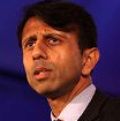
Louisiana Governor Bobby Jindal
“We spend a lot of time developing detailed policy papers, and given this crazy, unpredictable election season, clearly there just wasn’t a lot of interest in those policy papers,” Jindal said in a November 17 appearance on Fox News, where he announced he was suspending his campaign.
“Certainly, we thought it would end differently, but the reality is, this is not my time.”
Jindal, 44, whose term as Louisiana’s chief executive ends in January, said he will return to the think tank he founded, America Next, after he leaves office.
When he was elected in 2007, Jindal, a former congressman and official in the George W. Bush administration, was one of America’s youngest governors and was considered to be a rising star in the GOP.
But amid a budget crisis in Baton Rouge, Jindal saw his approval ratings back home plunge, and he was unable to get out of the low single digits in polling of the crowded Republican presidential field.
Jindal had been relegated to the second tier in the first three GOP debates.
Jindal becomes the second Southern Republican to exit the race, joining former Texas Gov. Rick Perry, who left in September.
The remaining candidates are U.S. Senators Ted Cruz of Texas, Marco Rubio of Florida, Rand Paul of Kentucky and Lindsey Graham of South Carolina and former governors Jeb Bush of Florida, Mike Huckabee of Arkansas and Jim Gilmore of Virginia.
On The Trail: Candidates troop to Concord to file for New Hampshire primary
Southerners Graham, Rubio and Cruz among the candidates filing for February 9 ballot
♦By Patrick Scanlan, Chickenfriedpolitics.com contributor
 CONCORD, New Hampshire (CFP) — Presidential candidates have been spending important time in New Hampshire over the past two weeks, passing through the Secretary of State’s office to file for candidacy and secure a spot on the New Hampshire first-in-the-nation primary ballot. The filing period attracts unknown underdogs and current poll leaders alike, who will all share equal space on the New Hampshire ballot.

U.S. Senator Lindsey Graham in New Hampshire
The majority of candidates filing, including U.S. Senators Lindsey Graham of South Carolina, Ted Cruz of Texas, and Marco Rubio of Florida, expressed support for keeping the New Hampshire primary first in the national nominating calendar, allowing any U.S. citizen the ability to run for president and set the tone for the rest of the election.
Graham called the retail politics of the Granite State “an antidote to big money.”
“This is the last place where you can break through without being rich,” Graham said. He said that increasingly, the modern political process, with an emphasis on national polls and use of social media, is changing the way candidates run for president.
“The way you become heard now is not going to house parties and town halls, it’s whatever you need to say or do to get your national polling up,” he said.
Cruz said that “if our first elections were decided by large states, they would all be decided by slick Hollywood TV ads” and the winners “would just be whoever spends the most money.”
Cruz also took time to talk about larger issues. He stressed the importance of uniting conservatives with “common sense conservative values” and cited his previous record of standing up to Washington and big government, especially dealing with complex current issues such as immigration.
“If the Republican nominee and Hillary Clinton are both advocates of amnesty, millions of working men and women will say, ‘To heck with all of you, you’re a bunch of corrupt Washington cronies, and I ain’t showing up,” Cruz said.
During his tour through the State House in Concord, Rubio defended himself over recent headlines related to the controversy of his use of a Florida GOP credit card for personal expenses, which he said was being drummed up by his political opponents.
“Those aren’t public documents, guys. Those are documents that were leaked by the chairman of the Republican Party, who was supporting my opponents,” Rubio said.
“The main issue in this election is moving forward and understanding the challenges before American and the challenges before our people,” he said.
The New Hampshire primary is February 9.
On The Trail: U.S. Senator Marco Rubio returns to his childhood roots in Nevada
The Florida senator takes his Republican presidential campaign to the Silver State, where he lived as a child
♦By Andy Donohue, Chickenfriedpolitics.com contributor
 LAS VEGAS (CFP)– Florida U.S. Senator Marco Rubio returned to his roots as he brought his presidential campaign to Nevada.
Rubio, who was born in Miami, spent part of his childhood in Las Vegas before his family returned to Florida when he was a teenager The venue for his address to the LIBRE Forum, a Latino libertarian group, was St. Christopher’s Catholic School, where Rubio was once a student.
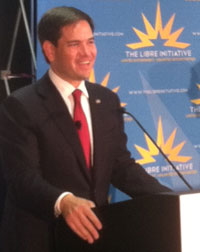
U.S. Senator Marco Rubio campaigns in Nevada.
Recalling his upbringing in Las Vegas, Rubio noted how passing neighborhood pool reminded him that he “learned how to swim in the desert.” This narrative quickly transitioned to his Cuban immigrants parents’ efforts as emblematic of a greater American endeavor.
America is special because “people that will never be rich are successful and able to achieve happiness … if we lose that we are not special anymore,” Rubio said. He added that preserving America as a “country where that opportunity is available to people” is lawmakers’ foremost responsibility.
Inadequate economic expansion aggravated by overregulation inhibits opportunities for working Americans to be happy and successful, Rubio said. Government policies “have not allowed this economy to grow fast enough and create better paying jobs,” he said.
The solutions Rubio is proposing include increasing open and flexible pathways through college and decreasing the amount borrowed “for degrees that do not lead to jobs.” Rubio himself graduated from college with more than $100,000 in debt, which he would not have been able to pay back had he not written a successful book. Rubio quipped that the book is now available in paperback.
The senator used his Cuban roots to make a comparison between the results of centralized and free economies, challenging the audience to “go anywhere in the world where the government dominates the economy” only to see “it is the same families and companies every generation after every generation” controlling power and wealth.
Nevada holds its Republican precinct caucuses February 23, making the state the first early test of strength in the West.
Rubio has built a vibrant state level organization that has enabled him to make political gains in Nevada over the past six months. Early in the year, Lt. Governor Mark Hutchison committed to lead Silver State efforts for Rubio, and he now has one of the most robust state organizations among the GOP contenders.
To engage Nevada voters, the Rubio campaign has developed a social media presence, using “Social Media Super Delegates” such as state Senator Patricia Farley, to engage voters and heighten his profile.
Rubio’s background in Nevada also includes ties to the Mormon Church, which he and his family attended when he lived in Las Vegas. Politico reported in September on his efforts to leverage those ties as he competes for Mormon voters in Nevada, who are influential in state politics in both parties.
State of the Races: U.S. Senate 2016
GOP favored in 7 of 9 Southern contests; Democrats have a shot at 2
♦By Rich Shumate, Chickenfriedpolitics.com editor
 (CFP) — The 2016 election will feature nine contests across 14 Southern states, all of which are currently held by Republicans. And there appears to be precious little opportunity for Democrats to make inroads in the GOP’s regional hegemony.
Florida and North Carolina appear to be the best shots Democrats have to reverse the region’s GOP tide, although the decision by Marco Rubio to run for re-election significantly bolsters Republican chances in the Sunshine State. Louisiana is another possibility if the 24-candidate free-for-all in the Pelican State’s all-party jungle primary creates an unexpected Democratic opportunity. The other six races are foregone conclusions, barring some unforeseen Republican calamity.
Republicans currently hold 24 of the 28 Southern Senate seats, including both seats in 11 out of the 14 Southern states.
Here is the 2016 rundown:

Shelby
Alabama: Republican U.S. Senator Richard Shelby is running for a seventh term. Democrats aren’t putting up a fight, letting their nomination go to a marijuana rights activist. Given that a Democrat hasn’t won a Senate race in the Yellowhammer State since 1990, Shelby is virtually assured of another term, at the end of which he’ll be 88 years old. RATING: SAFE GOP

Boozman
Arkansas: Republican U.S. Senator John Boozman is seeing a second term, despite suffering an aortic aneurysm in 2014 that kept him away from Washington for two months. The Democrats were unsuccessful in getting their top pick, former Governor Mike Beebe, to run, though they did manage to recruit a credible challenger in Conner Eldridge, a former federal prosecutor from Fayetteville. Still, a statewide race is a hard slog these days for a Democrat in the Natural State. RATING: PROBABLY GOP

Rubio

Murphy
Florida: Republican U.S. Senator Marco Rubio’s decision to reverse course and seek re-election significantly improved Republican prospects for keeping this seat. Rubio will face U.S. Rep. Patrick Murphy from Jupiter, who won the primary over liberal firebrand Alan Grayson with support from the Democratic establishment. Rubio has to be considered a favorite here, but if Hillary Clinton turns out to have coattails in the Sunshine State, this could be a race in November. RATING: GOP FAVORED

Isakson
Georgia: Republican U.S. Senator Johnny Isakson is running for re-election, despite publicly disclosing that he has been diagnosed with Parkinson’s disease. Peach State Democrats have recruited Jim Barksdale, the owner of an Atlanta investment firm, to take on Isakson. However, that strategy didn’t work in 2014 with Michelle Nunn, and there is little indication that Isakson is in trouble this time around. RATING: PROBABLY GOP

Paul
Kentucky: Now that Republican U.S. Senator Rand Paul ended his presidential run, he will be a prohibitive favorite for re-election. Democrats have managed to recruit a high-profile challenger with deep pockets, Lexington Mayor Jim Gray. But in a state that hasn’t sent a Democrat to the Senate since 1992, Gray will have a big mountain to climb. RATING: PROBABLY GOP

Vitter
Louisiana: After losing a bid for governor, Republican U.S. Senator David Vitter announced he would not seek re-election to the Senate, leaving his seat up for grabs. A gaggle of 24 candidates are seeking the seat, running in the state’s all-party jungle primary in November, with the top two advancing to a December runoff.
Democrats running include Public Service Commissioner Foster Campbell and Caroline Fayard, a New Orleans lawyer. The Republican side of the ballot includes two sitting U.S. House members, Charles Boustany of Lafayette and John Fleming of Minden; State Treasurer John Kennedy; Joseph Cao, a Vietnamese-American who represented the New Orleans area in Congress from 2009 to 2011; and Rob Maness, who made a spirited but unsuccessful Tea Party-backed bid for the Senate in 2014. White racist David Duke also filed on the GOP ticket.
While Republicans should be favored to keep this seat, Vitter’s loss to a Democrat in the governor’s race shows a flip for the Democrats is possible, if they can unite behind a high-profile challenger. Democrats could also benefit by having fewer candidates dividing up their vote in the primary. RATING: PROBABLY GOP

Lankford
Oklahoma: Republican U.S. Senator James Lankford is facing voters for the second time in two years after being elected to serve out the remainder of former U.S. Senator Tom Coburn’s term in 2014. Given that Lankford cruised to victory with 68 percent of the vote last time and Democrats haven’t won a Senate race in Oklahoma in 25 years, this race is a foregone conclusion. RATING: SAFE GOP

Burr
North Carolina: Republican U.S. Senator Richard Burr is running for a third term, and he dodged a major bullet when former Democratic U.S. Senator Kay Hagan, who was bounced from the Senate in 2014, decided not to run against him. Instead, he will face Deborah Ross, a former state legislator and Duke University law professor. North Carolina is a state where Democrats can still win statewide races, but Ross starts from well behind. RATING: PROBABLY GOP

Scott
South Carolina: Republican U.S. Senator Tim Scott, the only black Republican in the Senate, is facing voters for the second time in two years, after being appointed in 2013 to replace former U.S. Senator Jim DeMint. This time, he’s running for a full term in his own right, and he has not drawn a major challenger. He took 61 percent of the vote in 2014; count this race as a slam dunk. RATING: SAFE GOP
 Chicken Fried Politics