
Home » Posts tagged 'Nancy Pelosi' (Page 4)
Tag Archives: Nancy Pelosi

President Donald Trump stumps for U.S. Rep. Andy Barr in Kentucky
President calls Barr’s opponent in 6th U.S. House District an “extreme liberal” chosen by “Democrat mob”
♦By Rich Shumate, ChickenFriedPolitics.com editor
 RICHMOND, Kentucky (CFP) — President Donald Trump traveled to central Kentucky to excite his followers with a Make America Great Again rally in the commonwealth’s 6th U.S. House District, where Republican U.S. Rep. Andy Barr is in a political dogfight with his Democratic challenger, political newcomer Amy McGrath.
At an October 13 rally at Eastern Kentucky University in Richmond, Trump said re-electing Barr “could make the difference between unbelievable continued success and frankly failure where we fight for two more years with these people, with these obstructionists.”
He also blasted McGrath as an “extreme liberal” who was “chosen by Nancy Pelosi, Maxine Waters — that’s a real beauty — and the radical Democrat mob.”
“Amy supports a socialist takeover of your health care,” he said. “She supports open borders. She needs the tax hikes to cover the through-the-roof garbage that you want no part of.”
For his part, Barr lauded the president, calling him “a man of action.”
“Other people resist, but this president gets results,” he said. “Mr. President, I’m with you to fight for the American people.”
In addition to Barr, the Richmond rally drew all three of Kentucky’s top elected Republicans, U.S. Senators Mitch McConnell and Rand Paul and Governor Matt Bevin, who faces what is likely to be a touch battle for re-election in 2019.
In response to Trump’s characterizations of her, McGrath released a one-sentence statement to the media: “Mr. President, you clearly don’t know me. Yet.”
According to McGrath’s website, she supports reforms of the existing Affordable Care Act, commonly known as Obamacare, rather than its repeal, which Barr has voted for. She also supports the so-called “public option,” a government-run health insurance agency to provide an option for people who cannot get access through the ACA.
McGrath opposes Trump’s plan to build a physical wall at the U.S.-Mexico border, which Barr also supports, and has also criticized the administration’s policy of separating migrant children from their parents.
A day before Trump came to Richmond, former Vice President Joe Biden came to the district to campaign with McGrath.
McGrath, 43, who grew up in the Cincinnati suburbs of Northern Kentucky, is a retired Marine fighter pilot making her first bid for the political office against Barr in the 6th District, which includes Lexington, Frankfort, Richmond and adjacent portions of the Kentucky Bluegrass.
Barr, 45, has represented the 6th District since 2012. Prior to being elected to Congress, he was an attorney in Lexington.
McGrath has raised more than $3 million for the campaign, more than any other Democratic challenger in the South in 2018.
The race is rated as a toss-up by political analysts, although public polling has been sparse.
We tweet @ChkFriPolitics Join us!
Phil Bredensen says he won’t support Chuck Schumer for Democratic leader if elected
Democratic candidate for Tennessee’s open U.S. Senate seat makes announcement during debate with Republican rival
♦By Rich Shumate, ChickenFriedPolitics.com editor
 NASHVILLE (CFP) — Former Governor Phil Bredesen has announced that if elected to Tennessee’s open U.S. Senate seat, he will not support Chuck Schumer of New York to continue as his party’s Senate leader.

Former Governor Phil Bredesen
Bredesen, locked in a close race with Republican U.S. Rep. Marsha Blackburn, told the audience at a September 25 debate that he thinks Congress needs “new leadership.”
“I think a lot of the problem in Washington is with the leadership that we have there now. Whether it be (House Speaker Paul) Ryan or (House Minority Leader Nancy) Pelosi or (Senate Majority Leader Mitch) McConnell or Schumer, they’re not doing the job,” Bredensen said.
Bredensen took specific issue with charges by Blackburn and other Republicans claiming that he would be a rubber stamp for the current Senate Democratic leader.
“You’ve heard a lot recently of this campaign about me, about these crazy ideas about if somehow I’m elected and go to Washington, suddenly I’m going to turn my back on a whole lifetime of thinking for myself and being independent and suddenly become some kind of a political lackey,” Bredesen said. “That’s not going to happen.”
But Blackburn continued to press the line of attack, saying Bredensen’s campaign had been “bought and paid for” by Schumer.
“We all know that Phil had a choice. He could have run as a Republican or independent,” she said. “He’s running as a Democrat, so he will be with Chuck Schumer if he were to go to Washington.”
Bredesen, a former two-term governor, is trying to become the first Democrat to win a Senate seat in the Volunteer State since 1990. The four most recent public polls have shown the race within the margin of error, indicating the closeness of the race.
The seat is open due to the retirement of Republican U.S. Senator Bob Corker.
Bredesen’s stance on Schumer’s tenure is unlikely to threaten the New Yorker’s grip on the Democratic leadership, which requires support from a majority of the Democratic caucus in a non-public vote. Only one other Democratic Senate candidate, U.S. Rep. Kyrsten Sinema in Arizona, has come out against Schumer.
Democrats need to make a net gain of two seats in the Senate to take control, which would make Schumer majority leader. Four GOP-held seats being targeted include Tennessee, Texas, Arizona and Nevada.
Watch the full Bredesen-Blackburn debate:
Analysis: South is the GOP’s ace in the hole in stopping Democratic takeover of U.S. House
Democrats will need to flip 11 Southern seats or make make up the difference elsewhere
♦By Rich Shumate, ChickenFriedPolitics.com editor
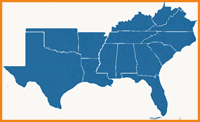 (CFP) — With President Trump’s approval ratings at historically low levels, Democrats have high hopes of taking back the U.S. House in 2018. But those hopes are tempered by a giant geographic obstacle standing in their way — namely, the South.
 To reclaim the House, Democrats need to flip 24 seats, shifting about 10 percent of the seats that Republicans now hold. And nearly half of the GOP caucus — 114 seats — is from the South, where Republican House members outnumber Democrats by 3-to-1.
So a 10 percent shift in the South would require winning 11 seats, in a region where Democrats won just two seats in 2016 (both in Florida and neither yet safe.) If Democrats fall short of that total, they will need to shift an even higher percentage of seats throughout the rest of the country — as much as 19 percent if they come up empty in the South.
And as Democrats plot and plan to add to their meager total of 40 Southern House seats, two recent special elections for open seats offer decidedly mixed omens on their chances for overturning the GOP’s hegemony.
In South Carolina’s 5th District, the swing away from Trump’s 2016 numbers in the special election was nearly 20 percent — not enough for Democrat Archie Parnell to win but a much bigger scare than Republicans had expected. Indeed, if that 20-point swing could be replicated across the South in 2018, 42 GOP-held seats could potentially be in play, more than Democrats would need to return Nancy Pelosi to the speaker’s chair.

Handel
But the results in the other race, in Georgia’s 6th District, pour substantial caution on such irrational exuberance. Republican Karen Handel kept the seat by running slightly ahead of Trump, in a race where Democrats spent a whopping $30 million and still came up short.
And this district in the northern Atlanta suburbs is exactly the kind of place where Democrats will need to compete to claw away at Republican dominance in the South next year — increasingly diverse, maturing suburbs whose upscale, educated voters, though conservative by inclination, are somewhat wary of Trump’s stewardship of the GOP brand.
If Democrats couldn’t win this race for an open seat in a low-turnout special election with a highly energized base and a president with historically low approval ratings, flipping these seats in 2018 will be a tall order indeed, particularly given Trump’s solid base of support in the South.
So where can Democrats start? Their first targets will be three majority Latino districts in metro Miami, all of which have large numbers of Cuban-American voters. Trump lost two of these districts and only narrowly won the third.
Veteran GOP U.S. Rep. Ileana Ros-Lehtinen is retiring, and Republicans will be hard pressed to keep her seat in a district Trump lost by 20 points. But in the other two districts, Democrats will have to unseat incumbents Carlos Curbelo, who has gone out of this way to distance himself from Trump, and Mario Diaz-Balart, who has been winning congressional elections with relative ease since 2002.
Democrats are also likely to target four other Southern districts where Hillary Clinton defeated Trump last year, which include three seats in Texas and one in Virginia. The GOP, however, has held three of these districts, in varying configurations, for decades.

Comstock
The Virginia seat, in the Washington D.C. suburbs, is held by Barbara Comstock, who first won it in 2014 and was narrowly re-elected in 2016. Even at this early date, she has already drawn six Democratic challengers in a district that, like the rest of Virginia, has become more hospitable to Democrats over the last decade.
In Texas, the climb for Democrats will be steeper. Clinton won the 32nd District in suburban Dallas, but that seat is held by Pete Sessions, a GOP titan who won by 52 points in 2016. She also won the 7th District in suburban Houston, where John Culberson ran well ahead of Trump to win by 12 points.
While Democrats appear eager to try to unseat both (Culberson already has seven challengers and Sessions nine), these districts have long Republican pedigrees reminiscent of Georgia’s 6th District, which was once represented by Newt Gingrich. Former President George H.W. Bush began his political career in the 7th District in 1967; former President George W. Bush’s Dallas home is in the 32nd.

Hurd
Democrats may have more luck in Texas’s 23rd District, which stretches from the suburbs of San Antonio across rural West Texas. This district is part of an ongoing legal fight over the state’s 2013 redistricting map, and a panel of federal judges is considering changes that could make it more difficult for Republican Will Hurd to hang on for a third term.
After those Clinton-won districts, the next set of seats Democrats might logically target are those where Trump’s winning margin was less than 10 points and where it would take less than a 10-point swing from the 2016 congressional results to put the seat in Democratic hands. But that list contains a scant eight seats — four in Texas, two in North Carolina and one each in Florida and Virginia. None of them are open at this point.
After that, the pickings get even slimmer — places like Arkansas’s 2nd District, where a Democrat can carry Little Rock only to get swamped by the Republican vote in the suburbs, and Florida’s 3rd District, where liberal-leaning Gainesville is subsumed in a sea of more traditional, conservative Southern voters. To be competitive in these districts, Democrats would have to commit to putting resources into races where chances of victory would appear, at the moment, to be rather remote.
So if Democrats can’t move the playing field into these second and third tiers, they have a reasonable shot at just seven Republican-held Southern seats, five of which have been in GOP hands for decades and all but one of which is likely to have an incumbent. And any anti-Trump tide that helps them in other parts of the country will likely not crest as high in the South.
With a lot of angry voters and a lot of luck, Democrats may indeed swing enough seats in 2018 to win control of the House. But as Republicans try to stop them, their ace in the hole is their dominance across the South, which should give them plenty of reason for confidence.
President Obama joins effort to oust Florida GOP U.S. Rep. John Mica
Obama cuts a commercial for Mica’s Democratic opponent, Stephanie Murphy, in what has become a competitive race
 ORLANDO (CFP) — President Barack Obama has cut a television commercial for Florida congressional candidate Stephanie Murphy, who is giving veteran GOP U.S. Rep. John Mica the fight of his political career in the newly redrawn 7th District.

Murphy
In the commercial, which began airing October 31, Obama recounts Murphy’s background as the daughter of Vietnamese refugees who fled to the United States when she was a small child and became a national security specialist at the Pentagon after 9/11.
“She’ll tackle the tough problems,” Obama says.
Obama is the latest in a string of high-profile endorsements of Murphy, which have included House Minority Leader Nancy Pelosi and former U.S. Rep. Gabby Giffords of Arizona, who became a gun control advocate after being wounded by a would-be assassin in 2011.
Outside groups supporting Murphy have also poured more than $3 million in the effort to oust Mica, 73, who is seeking his 12th term in the House and has never carried less than 59 percent of the vote in any of his re-election bids.

Mica
Mica is vulnerable this year thanks to a redraw of Sunshine State’s congressional map ordered by the Florida Supreme Court. Mica’s old district was centered in the northern and eastern suburbs of Orlando; the redraw pushed his district further south into the city of Orlando, which is more Democratic.
About a quarter of the voters in Mica’s new district were not in his old district, and the minority population is about 30 percent. However, the number of registered Democrats and Republicans is about equal.
Public polling in the race has been sparse, but both campaigns have touted internal polls putting their candidate in the lead.
However, the poll offered by the Mica campaign showed him only 5 points ahead with a margin of error of plus or minus 4.9 percentage votes–essentially, a tie in a Republican poll, a potentially troubling result for a well-known incumbent facing a challenger who has not previously run for political office.
The Cook Political Report, which until recently had rated the race as favoring Mica, now lists it as a toss-up.
Heading into the final three weeks of the campaign, Federal Election Commission filings show Murphy with about $174,000 in cash on hand, compared to $167,000 for Mica. However, both the National Republican Congressional Committee and the Democratic Congressional Campaign Committee are airing ads in the race, and outside spending is expected to eclipse what the campaigns run themselves.
U.S. Rep. Daniel Webster’s bid for speaker crushed by Paul Ryan wave
Webster received only nine votes, eight from his fellow Southerners
♦By Rich Shumate, Chickenfriedpolitics.com editor
 WASHINGTON (CFP) — Florida U.S Rep. Daniel Webster’s longshot bid for House speaker has come up short — 227 votes short, to be exact.

U.S. Rep. Daniel Webster
Webster, a Winter Haven Republican, garnered just nine votes in the October 29 vote, which saw the rise of U.S. Rep. Paul Ryan of Wisconsin into the top leadership spot.
Ryan received support from 236 of the chamber’s 247 Republicans. House Minority Leader Nancy Pelosi, D-California, received support from 184 out of the 188 Democrats.
Webster, 66, launched his campaign for speaker September 28, after former House Speaker John Boehner stepped down amid a rebellion by conservatives in the GOP caucus.
Initially, members of the House Freedom Caucus–made up of the House’s most conservative members–endorsed Webster, a former speaker of the state House in Florida. However, after Ryan entered the race, that support began to melt away.
Of the 38 Freedom Caucus members, only six stuck with Webster on the final vote.
Among the nine House members who supported Webster, eight were Southerners: Dave Brat of Virginia; Curt Clawson, Bill Posey and Ted Yoho of Florida; Louie Gohmert and Randy Weber of Texas; Walter Jones of North Carolina; and Thomas Massie of Kentucky.
 Chicken Fried Politics