
Home » Posts tagged 'North Carolina State Board of Elections' (Page 2)
Tag Archives: North Carolina State Board of Elections

Decision ’18: Fraud allegations swirl around North Carolina 9th District U.S. House race
State elections board refuses to certify Republican Mark Harris’s win, launches investigation
 RALEIGH (CFP) — The North Carolina State Board of Elections has refused to certify the results of the results in the 9th District U.S. House race and will hold a hearing to hear evidence of “claims of numerous irregularities and concerted fraudulent activities” during the November vote.

Dan McCready

Mark Harris
The decision means that Republican Mark Harris’s apparent 905-vote victory over Democrat Dan McCready will not become official for at least three weeks, as elections officials vet claims of possible fraud in Bladen County, a rural outpost at the eastern end of the district that went heavily for Harris.
The Associated Press, which had called the race for Harris, has rescinded its projection. McCready, who had conceded to Harris, said he was “shocked” by the board’s decision.
“The right to vote is the foundation of our democracy,” McCready said in a Twitter post. “Any effort to rob a person of that right should be met with the full force of justice.”
Harris called on the board to certify the results pending the investigation, saying delaying the certification would be a “disservice” to voters in the district, which stretches across eight counties along the South Carolina border from the suburbs of Charlotte toward Fayetteville.
“I support any efforts to investigate allegations of irregularities and/or voter fraud, as long as it is fair and focuses on all political parties,” he said in a statement. “But to date, there is absolutely no public evidence that there are enough ballots in question to affect the outcome of this race.”
 Before voting to delay the certification, the board — which has four Democrats, four Republicans and one unaffiliated member — met in closed session and did not offer any details about the fraud allegations in a statement issued afterward.
However, the Charlotte Observer reported that the board acted after receiving affidavits from voters in Bladen who said they received absentee ballots they did not request or had people appear at their door to collect their absentee ballots, efforts linked to a contractor working for the Harris campaign.
Under state law, absentee ballots can be mailed or delivered directly to county elections offices before election day. But it is illegal for anyone other than a relative or guardian to deliver a voter’s ballot on their behalf.
Harris carried Bladen County by 1,557 votes, more than his entire districtwide margin of victory. However, his margin among absentee voters — 420 to 258 — is less, indicating that absentee fraud in Bladen alone would be unlikely to overturn the final result.
The Observer reported 7.5 percent of registered voters in Bladen requested an absentee ballot, about twice the rate in the rest of the district.
In the GOP primary, Harris ousted incumbent U.S. Rep. Robert Pittenger by just 828 votes, a race in which Harris took 437 absentee votes to just 17 for Pittenger in Bladen County, a whopping margin of 96 percent.
Asked in an interview with Spectrum News about the possibility of fraud, Pittenger said, “It’s been out there. We were fully aware of it. There’s some pretty unsavory people out, particularly in Bladen County. And I didn’t have anything to do with them.”
Harris, 52, former pastor of the First Baptist Church of Charlotte, has been a long-time activist among religious conservatives. He made an unsuccessful run for U.S. Senate in 2014.
McCready, 34, is a businessman and former Marine Corps captain making his first run for political office.
We tweet @ChkFriPolitics Join us!
Pat McCrory continues to fight election challenge in North Carolina
State Board of Elections refuses to intervene in canvass; Cooper’s lead grows in governor’s race
♦By Rich Shumate, Chicken Fried Politics.com editor
 RALEIGH (CFP) — The GOP-controlled North Carolina State Board of Elections has refused to intervene in a canvass of votes in the state’s hotly contested race for governor, a blow to Republican Governor Pat McCrory’s quest to challenge results showing him trailing Democratic Attorney General Roy Cooper.
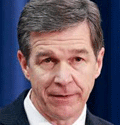
Attorney General Roy Cooper
Meanwhile, Cooper has appointed a transition team and dismissed claims by McCrory and his campaign of voter fraud as “the same kind of misleading and dishonest rhetoric that they’ve used throughout the campaign, rhetoric meant to cause confusion.”
“Governor McCrory is doing everything he can to undermine the results of this election and the will of the people, but we won’t let him,” Cooper said in a video statement posted on Facebook.
But a spokesman for McCrory, Ricky Diaz, said the campaign was trying to ensure that voter fraud had not tainted the process and that “every legal vote is counted properly.”
“Why is Roy Cooper so insistent on circumventing the electoral process and counting the votes of dead people and felons?” Diaz said in a statement. “It may be because he needs those fraudulent votes to count in order to win. Instead of insulting North Carolina voters, we intende to let the process work as it should.”
Should Cooper hang on, North Carolina would be the only state where Democrats flipped a governorship in 2016 and would give them a third Southern governorship, compared to 11 for Republicans.
The latest unofficial vote total from the State Board of Elections shows Cooper with a lead of 6,500 votes, up from the 4,700 vote total Cooper held on election night. Election boards in all of the state’s 100 counties have been adding provisional and absentee ballots to the total.
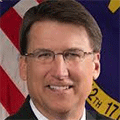
North Carolina Governor Pat McCrory
The McCrory campaign has filed protests in 50 counties, alleged fraudulent absentee ballots and votes by felons and dead people. It asked the state elections panel to oversee official county canvasses across the state, the results of which are scheduled to be certified by the state on November 29. But the board voted to let the counties continue the process on their own.
So far, 40 counties have completed their canvasses and certified final results. However, none of those were large metropolitan counties with vote totals large enough to conceivably allow McCrory to make up ground.
If Cooper’s lead is less than 10,000 votes when the final canvasses are completed, McCrory could request a statewide recount.
In North Carolina, the State Board of Elections and all 100 county boards are appointed by the governor, with the governor’s political party holding a majority on all of those panels, regardless of the political leanings of the county.
The McCrory campaign suffered a major blow when the board in Durham County, despite being controlled by members of his own party, turned down a challenge alleging possible fraud.
On election night, 90,000 votes from the heavily Democratic county came in late, propelling Cooper into the lead and prompting McCrory to cry foul. However, elections officials in Durham said the votes were reported all at once because a technical problem forced them to enter the results from voting machines by hand.
A different technical problem with computerized voter roles in Durham County led the State Board of Elections to extend voting by up to an hour in eight precincts on election day.
While turning down McCrory’s request to get involved in canvasses statewide, the state board did agree to look at allegations of voter fraud in Bladen County, in the southeastern party of the state. However, McCrory actually won in Bladen County and less than 16,000 people voted, making any change there unlikely to alter Cooper’s lead.
McCrory rode a GOP wave into office in 2012, but the Republican-controlled legislature’s passage of a controversial voter ID law and measures favored by religious conservatives made the governor a lightning rod.
The issue that dominated the race was McCrory’s decision to sign a law requiring transgendered students to use bathrooms that match their gender of birth, rather than their gender of identity, in public facilities.
McCrory continued to defend the law, even after a number of businesses scuttled expansion plans and the NCAA, NBA and ACC pulled events from the state.
Cooper not only opposed the measure, but he also refused to defend it in court when students and the federal government took legal action to overturn it.
 Chicken Fried Politics