
Home » Posts tagged 'Pete Sessions' (Page 3)
Tag Archives: Pete Sessions

U.S. House Primary Wrap: Democrats pick female Marine fighter pilot for targeted seat in Kentucky
Voters in Georgia, Arkansas and Texas also pick party nominees for House seats that could help decide balance of power
♦By Rich Shumate, ChickenFriedPolitics.com editor
 LEXINGTON, Kentucky (CFP) — In a year in which women candidates have been making noise nationally, Amy McGrath has made her own statement in Kentucky’s Bluegrass country by winning the Democratic nomination for a U.S. House seat over a candidate recruited by party leaders in Washington.
Meanwhile, in other May 22 primaries in Georgia, Arkansas and Texas, Democrats narrowed the fields in races for seven GOP-held seats that are being targeted in November, while Texas Republicans picked nominees in four open seats that are expected to stay in Republican hands.
 In central Kentucky’s 6th District, which includes Lexington and Frankfort, McGrath took 48 percent of the vote to 40 percent for Lexington Mayor Jim Gray, who had been recruited for the race by the Democratic Congressional Campaign Committee. Kentucky does not have primary runoffs, so McGrath won the nomination with a plurality and will now face GOP U.S. Rep. Andy Barr in November.

Democratic U.S. House nominee Amy McGrath
Declaring victory with her supporters in Richmond, McGrath — a retired Marine Corps fighter pilot whose call sign was “Krusty” — said “what happened tonight is amazing.”
“Six months ago, political pundits and establishment insiders didn’t think we could pull this off,” she said. “What those insiders maybe still don’t know is how this happened. Well, I know how it happened. It’s because you all care about the future of our country.”
McGrath began her campaign in August 2017 with a video in which she told how, as a young girl growing up in Kentucky, she decided she wanted to be a fighter pilot but discovered that women were not allowed to serve in combat. She then wrote letters to members of Congress in which she asked why she was barred from serving, including a letter to Kentucky U.S. Senator Mitch McConnell, which she said was never answered.
After the ban was lifted, McGrath enrolled in the U.S. Naval Academy and served in Iraq and Afghanistan as a Marine Corps aviator before retiring at the rank of lieutenant colonel.
McGrath’s video went viral, triggering a wave of contributions to her long-shot campaign. She now raised almost $2 million in her quest to unseat Barr, who is seeking his fourth term.
Another positive sign for McGrath: More than 100,000 Democrats turned out to vote in the primary, compared to just 49,000 Republicans in a district President Donald Trump carried by 15 points in 2016. However, GOP turnout also lagged behind Democratic turnout in 2016, when Barr took 61 percent.
Meanwhile, in Kentucky’s 3rd District in metro Louisville, Republicans nominated Vickie Glisson, a Louisville attorney who headed the state health department, to face U.S. Rep. John Yarmuth, who has drawn the particular ire of Republicans nationally with his strong criticism of Trump, including introducing articles of impeachment.
 In Georgia, the House races receiving the most attention are in the 6th and 7th districts, where Republican incumbents are seen as possibly vulnerable in districts that President Donald Trump won by narrow margins in 2016.
In the 6th District, in Atlanta’s northern suburbs, where Republican U.S. Rep. Karen Handel won her seat in 2017 after a hard-fought and hugely expensive special election, Democrats have narrowed their field to Lucy McBath, a gun control activist from Cobb County, and Kevin Abel, a Sandy Springs businessman, who will compete in a July 24 runoff.
McBath’s son, Jordan Davis, was shot and killed in 2012 by a man at a gas station in Jacksonville, Florida, over a dispute over loud hip-hop music. His case became part of the nationwide campaign against deadly violence aimed at young African-American men. The shooter, Michael David Dunn, was later convicted of first-degree murder and sentenced to life without parole.
Handel’s chances of keeping the seat — in a district Trump only carried by just 1.5 points — improved when the man she defeated in the special election, Democrat Jon Ossoff, decided against a rematch.
In the 7th District, in northwest metro Atlanta, Democrats Carolyn Bordeaux and David Kim advanced to the runoff for the right to face Republican U.S. Rep. Rob Woodall in November.
Bordeaux, from Suwanee, is a professor at Georgia State University and former budget analyst for the Georgia Senate. Kim, from Duluth, is the son of Korean immigrants who owns a company that provides tutoring for students. If elected, he would become Georgia’s first Asian-American congressman, running in a district with a growing Asian population.
While Woodall took 60 percent of the vote in the 7th District in 2016, Trump only won by 6 points, putting the seat within the realm of possibility for Democrats.
 In Arkansas, the House race drawing the most attention is the 2nd District in metro Little Rock, where Democrats believe they might have a shot at ousting GOP U.S. Rep. French Hill if a national Democratic wave develops.
The Democratic nominee will be State Rep. Clarke Tucker of Little Rock, who won the primary without a runoff.
While Hill won re-election by 11 points in 2016, the 2nd District is the least Republican district in the state, anchored by Pulaski County, which Hillary Clinton carried in 2016. Trump won the district by less than 10 points.
 In Texas, Democrats have picked nominees in four targeted U.S. House seats now in Republican hands that Democrats have hopes of flipping in the fall.
In the 7th District, in metro Houston, attorney Lizzie Pannill Fletcher defeated liberal activist Laura Moser for the right to take on Republican U.S. John Culberson, in a district Hillary Clinton carried in 2016. Fletcher had been backed by the DCCC against Moser, who was seen by Democratic leaders as too liberal for the district.
In the 21st District, which stretches from Austin to San Antonio and takes in part of the Texas Hill Country, Republican Chip Roy will face Democrat Joseph Kosper for the seat now held by retiring U.S. Rep. Lamar Smith, a district which Trump carried by 10 points.
Roy served as chief of staff for U.S. Senator Ted Cruz. Kosper is a former U.S. Army officer and technology entrepreneur.
In the 23rd District — the largest Texas district geographically, sprawling from the suburbs of San Antonio to near El Paso — Democrats picked Gina Ortiz Jones to take on incumbent Republican U.S. Rep. Will Hurd in November. Clinton also carried this majority-Latino swing district, which has changed hands four times in the last 12 years.
Jones is a former military intelligence officer who worked as a U.S. trade representative in the Obama administration. If elected, she would be the first open lesbian, Iraq War veteran and Filipino American to represent Texas in Washington.
In the 32nd District, in metro Dallas, former NFL player Colin Allred defeated businesswoman Lillian Salerno and will now face Republican U.S. Rep. Pete Sessions, who is trying to keep a traditionally Republican seat in a district that Clinton also carried. Allred, a civil rights attorney, played five seasons in the NFL for the Tennessee Titans before his career ended after a neck injury.
Also in Texas, the fields have been set in four other open GOP-held districts that Republicans will be favored to keep in November:
- In the 2nd District, a metro Houston seat given up by retiring U.S. Rep. Ted Poe, the Republican David Crenshaw, a retired Navy officer, will face Democrat Todd Litton, a lawyer and non-profit executive.
- In the 5th District, an East Texas seat now held by U.S. Rep. Jeb Hensarling, State Rep. Lance Gooden defeated Bunni Pounds, a political consultant, in the Republican runoff, despite endorsements of Pound by both Hensarling and Vice President Mike Pence. Gooden will face former Terrell City Councilman Dan Wood in November.
- In the 6th District, a seat in metro Fort Worth now held by U.S. Rep. Joe Barton, Republican Tarrant County Tax Assessor Ron Wright will face Democrat Jana Lynne Sanchez.
- In the 27th District, a South Texas seat that opened up after Republican U.S. Rep. Blake Farenthold resigned in April, Republican Michael Cloud will face Democrat Eric Holguin in November. Cloud is the chair of the Victoria County Republican Party. Holguin, from Corpus Christi, is a former congressional aide.
Barton decided not to seek re-election after after a nude selfie he had exchanged with a woman with whom he was having a consensual extramarital relationship wound up on social media.
Farenthold resigned after news reports that $84,000 in taxpayer dollars had been used to pay a settlement to a former female staffer who alleged that she suffered sexual harassment from Farenthold and another male staffer. The congressman denied the harassment allegations, while conceding that a lax management style in his Washington office created a “decidedly unprofessional” work environment.
A special election is being held in June to fill the remainder of Farenthold’s current term, with Cloud, Holguin and seven other candidates on the ballot.
Texas primaries narrow crowded fields in U.S. House races
Valdez, White face off in Democratic governor’s primary; Cruz, O’Rourke in U.S. Senate race
♦By Rich Shumate, ChickenFriedPolitics.com editor
AUSTIN — Texas primary voters have narrowed crowded fields vying for 11 open or potentially competitive U.S. House seats and the U.S. Senate, while the Democratic race for governor is heading to a May runoff to pick a nominee for an uphill climb against Republican Governor Greg Abbott.
And while Democrats have high hopes of riding a wave of enthusiasm to put a dent into the GOP’s 25-to-11 advantage in the Texas U.S. House delegation, more than 530,000 more voters chose the Republican over the Democratic ballot in the March 6 primaries, although that was a better showing by Democrats than in the last midterm primary in 2014.

O’Rourke

Cruz
In the U.S. Senate race, as expected, Republican incumbent Ted Cruz and Democratic U.S. Rep. Beto O’Rourke both easily won their primaries, setting up a November race likely to draw national attention. O’Rourke took 62 percent, and Cruz, 85 percent.
In the governor’s race, Abbott, seeking a second term, won outright with 90 percent of the vote. The Democratic runoff will be between former Dallas County Sheriff Lupe Valdez and Andrew White, a Houston investment banker and son of the late former Governor Mark White. Valdez had a strong lead in the race, 43 percent to 27 percent, over White.

George P. Bush
Republican incumbents also won in six other statewide races, including Land Commissioner George P. Bush, son of former Florida Governor Jeb Bush, who took 58 percent of the vote to beat back three challengers.
In the U.S. House races, Democrats’ top targets in November are three GOP incumbents who represent districts Hillary Clinton won in 2016: John Culberson in the 7th District in Houston; Pete Sessions in the 32nd District in Dallas; and William Hurd, who represents the 23rd District in West Texas stretching from the suburbs of San Antonio over to El Paso. All three easily won their primaries.
In the 7th District, the two Democrats who qualified for the runoff are Lizzie Pannill Fletcher, a Houston lawyer, and Laura Moser, a journalist who carried the endorsement of Our Revolution, a liberal group that sprang from Bernie Sanders’ failed presidential campaign.
This race heated up when Democratic Congressional Campaign Committee, the campaign arm of House Democrats, intervened by publishing opposition research critical of Moser because of fears she won’t be competitive against Culberson in November. However, she used the DCCC’s memo to raise money and made it past five other Democrats into the runoff with Fletcher.
In the 32nd District, Collin Allred, an attorney and former player for the NFL’s Tennessee Titans, topped the Democratic primary with 39 percent and will face Lillian Salerno, who served as a deputy undersecretary on the U.S. Department of Agriculture during the Obama administration, who got into the runoff with 18 percent.
In the 23rd District, Gina Oritz Jones, an Iraq war veteran from San Antonio who worked as a U.S. trade representative, led the race with 42 percent and will face Rick Trevino, a high school teacher from San Antonio who served as a Sanders delegate in 2016. The majority Latino 23rd District, where Hurd is seeking a third term, is a perennial swing seat that changed hands in 2010, 2012 and 2014.
In addition to the races that Democrats are targeting, there are also eight other open seats in Texas that drew crowded primaries:
- In the Houston-area 2nd District, being vacated by Republican Ted Poe, Republicans will have a runoff between State Rep. Kevin Roberts and David Crenshaw, a retired Navy officer.
- In the Dallas-area 3rd District, being vacated by Republican Sam Johnson, State Senator Van Taylor won the Republican nomination outright in the primary. He will face the winner of a Democratic runoff between attorneys Lorie Burch and Sam Johnson (no relation to the incumbent).
- In the 5th District, also near Dallas, which is being vacated by Republican Jeb Hensarling, Republican State Rep. Lance Gooden will be in a runoff against fundraising consultant Bunni Pounds for the right to take on Democrat Dan Wood, a former city councilman in Terrell. Hensarling has endorsed Pounds.
- In the 6th District south of Dallas, being vacated by Republican Joe Barton, both parties will have runoffs. The Republican runoff pits Jake Elizey, a former fighter pilot, against Tarrant County Tax Assessor Ron Wright. On the Democratic side, journalist Jana Sanchez will square off against Ruby Fay Woodridge, an Arlington pastor who ran for the seat in 2016.
- In the 16th District in El Paso, which O’Rourke is giving up to run for the Senate, former El Paso County Judge Veronica Escobar won the Democratic primary with 61 percent of the vote, making her a prohibitive favorite in this heavily Democratic, majority Latino district. Her Republican opponent will be Rick Seeberger, a strategic planner from Canutillo.
- In the 21st District in the Texas Hill Country, being vacated by Lamar Smith, a 18-candidate Republican field has been narrowed to businessman Matt McCall and Austin attorney Chip Roy. On the Democratic side, attorney and former military officer Joseph Kopser will face minister Mary Wilson.
- In the 27th District, which includes Corpus Christi and much of the Gulf Coast and is being vacated by Republican Blake Farenthold, the Republican primary will feature Bech Bruun, former chairman of the Texas Water Development Board, and Michael Cloud, the former GOP chair in Victoria County. The Democratic runoff will include Raul “Roy” Barrera, a federal court deputy in Corpus Christi, and Eric Holguin, a former congressional aide.
- In the 29th District in Houston, being vacated by Democrat Gene Green, State Senator Sylvia Garcia beat six other Democrats to win the Democratic nomination outright with 63 percent of the vote. She will face the winner of the Republican runoff between Phillip Aronoff, a physician, and Carmen Maria Montiel, a Houston TV journalist who once represented her native Venezuela in the Miss Universe Pageant.
Analysis: South is the GOP’s ace in the hole in stopping Democratic takeover of U.S. House
Democrats will need to flip 11 Southern seats or make make up the difference elsewhere
♦By Rich Shumate, ChickenFriedPolitics.com editor
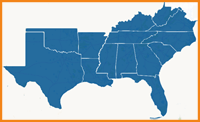 (CFP) — With President Trump’s approval ratings at historically low levels, Democrats have high hopes of taking back the U.S. House in 2018. But those hopes are tempered by a giant geographic obstacle standing in their way — namely, the South.
 To reclaim the House, Democrats need to flip 24 seats, shifting about 10 percent of the seats that Republicans now hold. And nearly half of the GOP caucus — 114 seats — is from the South, where Republican House members outnumber Democrats by 3-to-1.
So a 10 percent shift in the South would require winning 11 seats, in a region where Democrats won just two seats in 2016 (both in Florida and neither yet safe.) If Democrats fall short of that total, they will need to shift an even higher percentage of seats throughout the rest of the country — as much as 19 percent if they come up empty in the South.
And as Democrats plot and plan to add to their meager total of 40 Southern House seats, two recent special elections for open seats offer decidedly mixed omens on their chances for overturning the GOP’s hegemony.
In South Carolina’s 5th District, the swing away from Trump’s 2016 numbers in the special election was nearly 20 percent — not enough for Democrat Archie Parnell to win but a much bigger scare than Republicans had expected. Indeed, if that 20-point swing could be replicated across the South in 2018, 42 GOP-held seats could potentially be in play, more than Democrats would need to return Nancy Pelosi to the speaker’s chair.

Handel
But the results in the other race, in Georgia’s 6th District, pour substantial caution on such irrational exuberance. Republican Karen Handel kept the seat by running slightly ahead of Trump, in a race where Democrats spent a whopping $30 million and still came up short.
And this district in the northern Atlanta suburbs is exactly the kind of place where Democrats will need to compete to claw away at Republican dominance in the South next year — increasingly diverse, maturing suburbs whose upscale, educated voters, though conservative by inclination, are somewhat wary of Trump’s stewardship of the GOP brand.
If Democrats couldn’t win this race for an open seat in a low-turnout special election with a highly energized base and a president with historically low approval ratings, flipping these seats in 2018 will be a tall order indeed, particularly given Trump’s solid base of support in the South.
So where can Democrats start? Their first targets will be three majority Latino districts in metro Miami, all of which have large numbers of Cuban-American voters. Trump lost two of these districts and only narrowly won the third.
Veteran GOP U.S. Rep. Ileana Ros-Lehtinen is retiring, and Republicans will be hard pressed to keep her seat in a district Trump lost by 20 points. But in the other two districts, Democrats will have to unseat incumbents Carlos Curbelo, who has gone out of this way to distance himself from Trump, and Mario Diaz-Balart, who has been winning congressional elections with relative ease since 2002.
Democrats are also likely to target four other Southern districts where Hillary Clinton defeated Trump last year, which include three seats in Texas and one in Virginia. The GOP, however, has held three of these districts, in varying configurations, for decades.

Comstock
The Virginia seat, in the Washington D.C. suburbs, is held by Barbara Comstock, who first won it in 2014 and was narrowly re-elected in 2016. Even at this early date, she has already drawn six Democratic challengers in a district that, like the rest of Virginia, has become more hospitable to Democrats over the last decade.
In Texas, the climb for Democrats will be steeper. Clinton won the 32nd District in suburban Dallas, but that seat is held by Pete Sessions, a GOP titan who won by 52 points in 2016. She also won the 7th District in suburban Houston, where John Culberson ran well ahead of Trump to win by 12 points.
While Democrats appear eager to try to unseat both (Culberson already has seven challengers and Sessions nine), these districts have long Republican pedigrees reminiscent of Georgia’s 6th District, which was once represented by Newt Gingrich. Former President George H.W. Bush began his political career in the 7th District in 1967; former President George W. Bush’s Dallas home is in the 32nd.

Hurd
Democrats may have more luck in Texas’s 23rd District, which stretches from the suburbs of San Antonio across rural West Texas. This district is part of an ongoing legal fight over the state’s 2013 redistricting map, and a panel of federal judges is considering changes that could make it more difficult for Republican Will Hurd to hang on for a third term.
After those Clinton-won districts, the next set of seats Democrats might logically target are those where Trump’s winning margin was less than 10 points and where it would take less than a 10-point swing from the 2016 congressional results to put the seat in Democratic hands. But that list contains a scant eight seats — four in Texas, two in North Carolina and one each in Florida and Virginia. None of them are open at this point.
After that, the pickings get even slimmer — places like Arkansas’s 2nd District, where a Democrat can carry Little Rock only to get swamped by the Republican vote in the suburbs, and Florida’s 3rd District, where liberal-leaning Gainesville is subsumed in a sea of more traditional, conservative Southern voters. To be competitive in these districts, Democrats would have to commit to putting resources into races where chances of victory would appear, at the moment, to be rather remote.
So if Democrats can’t move the playing field into these second and third tiers, they have a reasonable shot at just seven Republican-held Southern seats, five of which have been in GOP hands for decades and all but one of which is likely to have an incumbent. And any anti-Trump tide that helps them in other parts of the country will likely not crest as high in the South.
With a lot of angry voters and a lot of luck, Democrats may indeed swing enough seats in 2018 to win control of the House. But as Republicans try to stop them, their ace in the hole is their dominance across the South, which should give them plenty of reason for confidence.
5 Southern Republicans break ranks to oppose House Obamacare repeal
But 5 GOP lawmakers in other potential swing districts help pass new health care law
♦By Rich Shumate, Chickenfriedpolitics.com editor
 WASHINGTON (CFP) — Five Republican members of the U.S. House defied party leaders and President Donald Trump to oppose a bill to repeal Obamacare and replace it with a new blueprint for U.S. health care, but five other GOP lawmakers holding potentially vulnerable seats took a different tack and voted to go along with the American Health Care Act.
Two of the Southern GOP no votes on May 4 came from Will Hurd of Texas and Barbara Comstock of Virginia, who both represent districts that Hillary Clinton carried in 2016. A third lawmaker from a district Clinton carried, Ileana Ros-Lehtinen of Florida, also voted no but is retiring in 2018.
Hurd
Hurd, whose district stretches across a wide swath of West Texas, issued a statement after the vote saying the plan pushed by GOP leaders “does not address the concerns of many of my constituents, including adequate protections for those with pre-existing conditions and the challenges faced by rural healthcare providers.”
Comstock
Comstock, whose district is anchored in the Washington, D.C. suburbs, said in a statement that her “goals on healthcare reform are to provide patient-centered reforms that provide better access to high quality, affordable care and cover pre-existing conditions without lifetime limits. ”
“I did not support the AHCA today because (of) the many uncertainties in achieving those goals,” she said.
The other two Republicans who voted against the bill, Thomas Massie of Kentucky and Walter Jones of North Carolina, did so not out of any fear of Democratic competition but because they believe the repeal measure doesn’t go far enough.
“As recently as a year ago, Republicans argued that mandates were unconstitutional, bailouts were immoral and subsidies would bankrupt our country,” Massie said in a statement after the vote. “Today, however, the House voted for a healthcare bill that makes these objectionable measures permanent.”
Jones had earlier said the attempt by House Republican leaders to push an Obamacare bill repeal through the House on a rushed schedule was “shameful,” and he called for scrapping the bill in its entirety and starting over.
Of the 138 Southern Republicans in the House, 133 voted in favor of the AHCA. Five of those members represent districts where Democrats could conceivably use their votes for the new health care law to try to unseat them. In fact, if any one of them had voted no, the bill — which passed by just a single vote — would have failed, which will allow Democrats to make the argument that each of them bears responsibility for its passage.

Curbelo
This group of members who supported the bill includes two of the region’s most vulnerable House Republicans, Carlos Curbelo and Brian Mast, both from Florida. Curbelo represents a district in Miami-Dade and Monroe counties that Clinton carried; Mast’s district, which includes St. Lucie, Martin and northern Palm Beach counties, has changed parties in three of the last four election cycles.

Mast
In a statement, Mast said the GOP health care plan “returns control of health care from Washington back to you and restores access to quality, affordable options that are tailored to your individual needs.” He also pushed back against Democratic criticism that a provision in the new law allowing states to waive mandates for coverage of pre-existing conditions would imperil coverage for the sickest Americans.
“This bill mandates that people cannot be denied coverage because of pre-existing conditions and allocates almost $140 billion in additional funding that will subsidize coverage for people with pre-existing conditions to ensure they costs are low,” Mast said. “Those claiming otherwise are the same people who said ‘if you like your doctor, you can keep you doctor,” and they’re putting partisan politics ahead of the people in our community.”
Also voting yes were John Culberson of Texas, whose metro Houston House district was carried by Clinton; Mario Diaz-Balart, whose majority Latino district in metro Miami and southwest Florida went for Trump by less than 2 points; and Ted Budd of North Carolina, whose Greensboro-area district went for Trump by 9 points.
In a statement, Diaz-Balart conceded the AHCA was “far from perfect.” But he said the House needed to act because Obamacare “is collapsing,” leaving just one insurance provider in two of the three counties he represents.
“Knowing the people I represent could very well lose their coverage … is disturbing,” he said. “It would be irresponsible for Congress not to act in order to prevent this from happening.”
Budd also conceded in a statement that “the legislative process is a human process with all the flaws that entails. The results of that process are never perfect, and this bill isn’t either.”
“What I believe it will do is significantly reduce insurance premiums in our state, and help put the individual insurance marketplace on a more sound financial footing,” he said.
Also voting yes was Pete Sessions of Texas, whose metro Dallas district was also won by Clinton. However, Sessions, who has been in the House since 1997 and won re-election by more than 50 points in 2016, is not considered vulnerable to a Democratic challenge.
All 40 of the Democrats representing districts in the South voted against the AHCA.
 Chicken Fried Politics