
Home » Posts tagged 'Rick Scott' (Page 3)
Tag Archives: Rick Scott

Poll: Graham, DeSantis both now clearly front-runners in Florida governor primaries
Mason-Dixon poll shows DeSantis up by double digits in GOP contest; Graham leads by 9 points among Democrats
♦By Rich Shumate, ChickenFriedPolitics.com
 JACKSONVILLE (CFP) — With a month to go before Florida’s primaries for governor, a new poll shows that Democrat Gwen Graham and Republican Ron DeSantis have opened up leads over their party rivals in the chase to be the Sunshine State’s next chief executive.

Governor’s candidate Gwen Graham, D-Florida
The Mason-Dixon poll released July 27 found that Graham, a former congresswoman from Tallahassee and daughter of former U.S. Senator Bob Graham, was the choice of 27 percent of Democrats, leading former Miami Beach Mayor Philip Levine at 18 percent and Palm Beach billionaire real estate investor Jeff Greene at 12 percent.
Trailing in the crowded Democratic field were Tallahassee Mayor Andrew Gillum, at 10 percent, and Chris King, an attorney and real estate investor from Orlando, at 7 percent.
The margin of error in the poll of 500 likely Democratic voters was plus or minus 4.5 percent, which means Graham’s lead over Levin is statistically significant. However, 25 percent of voters said they were still undecided, indicating that the race still remains fluid.
Because Florida does not have primary runoffs, Graham could win the nomination with a plurality in the crowded Democratic field.
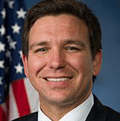
U.S. Rep. Ron DeSantis, R-Florida
On the Republican side, DeSantis, a congressman from metro Jacksonville, holds a more substantial lead over State Agriculture Commissioner Adam Putnam, 41 percent to 29 percent. However, 28 percent of likely Republicans in the poll said they were still undecided.
The margin of error in the poll of 500 likely Republican voters was also plus or minus 4.5 percent.
Putnam, a veteran of state politics from Polk County who served a decade in Congress before being elected agriculture commissioner in 2010, was considered the front-runner in the GOP race until DeSantis announced his run in January, backed with an endorsement from President Donald Trump.
A previous Mason-Dixon poll in February showed Putnam with a 4-point lead over DeSantis, indicating a shift of 16 points in the past five months.
Mason-Dixon did not pit the Republican and Democratic front-runners in a hypothetical matchup. However, the poll did find that among voters as a whole, Graham was viewed more favorably than DeSantis.
Among voters who recognized Graham, 35 percent had a favorable view of her, compared to just 5 percent who did not. For DeSantis, the figures were 32 percent approval and 21 percent disapproval.
The Florida primaries are August 28.
Incumbent Governor Rick Scott is term limited and running instead for the U.S. Senate against Democratic incumbent Bill Nelson.
Florida Governor Rick Scott announces U.S. Senate run
Race between Scott and incumbent U.S. Senator Bill Nelson could be nation’s most expensive
♦By Rich Shumate, ChickenFriedPolitics.com
ORLANDO (CFP) — Republican Florida Governor Rick Scott has made official what was widely expected — he will challenge Democratic incumbent U.S. Senator Bill Nelson in November.

Florida Governor Rick Scott
Scott’s decision, announced April 9 in Orlando, sets up what is likely to be a hard-fought and hugely expensive battle for Florida’s seat, with control of the Senate hanging in the balance.
Calling Washington “dysfunctional” and slamming “career politicians,” Scott called on Floridians to “stop sending talkers to Washington. Let’s send doers to Washington.”
“We shouldn’t be sending the same type of people to Washington. We should say we’re going to make change,” Scott said. “We can change Washington. We must change Washington. We will change Washington.”
The emphasis on changing the culture of Washington was a direct slap at Nelson, who has served in the Senate for 18 years after serving 12 years in the U.S. House.
Scott, who kicked off his campaign at a construction company that has expanded during his eight years in Tallahassee, also touted his record as a “jobs” governor, taking credit for creating 1.5 million new jobs and cutting taxes by $10 billion.
“People are flocking to Florida because this is where you can live the dream of this country,” he said. “Now, we’ve got to take that same mission to D.C.”
Scott, 65, a multimillionaire former for-profit hospital executive, was a political newcomer when he was first elected governor in 2010 after pouring more than $70 million of his own money into the race. He was re-elected by a narrow margin in 2014.
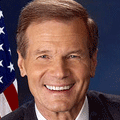
U.S. Senator Bill Nelson of Florida
Nelson, 75, was first elected to the Senate in 2000 and won re-election easily in 2006 and 2012. He is one of just five Democrats representing Southern states, along with U.S. Senators Doug Jones of Alabama, Tim Kaine and Mark Warner of Virginia, and Joe Manchin of West Virginia.
Nelson and Machin, who both represent states President Donald Trump carried in 2016, are among the top Republican targets in the 2018 election cycle. Trump had been publicly urging Scott to run against Nelson.
In response to Scott’s announcement, Nelson issued a statement saying he has “always run every race like there’s no tomorrow — regardless of my opponent” and adding that Scott “will say or do anything to get elected.”
“I’ve always believed that if you just do the right thing, the politics will take care of itself,” he said.
The race in Florida, a state that is closely divided politically and has 10 television markets, is expected to approach or break spending records, particularly because of the personal fortune Scott can bring to bear.
The most expensive Senate race in history was in Pennsylvania in 2016, where more than $160 million was spent by candidates and outside groups.
Democrats will no doubt try to tie Scott to Trump, which could have unpredictable results in what’s shaping up to be a Democratic year. Another wildcard will be the effect of Scott’s support for new restrictions on gun purchases that passed the Florida legislature after 17 people died in a mass shooting at a high school in Parkland.
The new restrictions have drawn the ire of the National Rifle Association and other gun-rights groups, although supporters of stronger controls on guns faulted the measure passed by Florida lawmakers for not going far enough.
Republicans current have a narrow 51-to-49 seat advantage in the Senate, which means all of the seats up in 2018 could be pivotal in deciding which party is in control.
Among Southern seats, Democrats’ best targets are in Texas, Tennessee and a special election for a vacant seat in Mississippi. For Republicans, Nelson and Manchin are at the top of the target list, with an outside shot at Kaine.
No other Southern states have Senate races this year.
Report: Tennessee U.S. Senator Bob Corker to stick with retirement
Decision clears way for Senate showdown between GOP U.S. Rep. Marsha Blackburn and former Democratic Governor Phil Bredesen
♦By Rich Shumate, ChickenFriedPolitics.com editor
 WASHINGTON (CFP) — After reconsidering his decision to retire from the U.S. Senate, Republican Bob Corker has now ruled out seeking another term this year, setting up a general election match-up between U.S. Rep. Marsha Blackburn and former Democratic Governor Phil Bredesen that could determine control of the Senate.

U.S. Senator Bob Corker
In an February 27 interview with Politico, Corker’s chief of staff, Todd Womack, said the senator has decided to stick with the decision he made last September not to seek a third term, despite being urged by other Republicans to reconsider amid fears that Blackburn could have trouble keeping the seat in GOP hands in November.
A week earlier, former U.S. Rep. Stephen Fincher, Blackburn’s chief opponent in the Republican primary, ended his campaign and publicly called on Corker to run again.
Central to the considerations about whether to reverse course was Corker’s contentious relationship with President Donald Trump.
Last August, the senator said Trump “has not yet been able to demonstrate the stability nor some of the competence that he needs to demonstrate in order to be successful” and also referred to the White House as an “adult day care center.” After his criticisms triggered a presidential pillorying on Twitter, Corker said Trump “debases our country” and has “great difficulty with the truth.”

U.S. Rep. Marsha Blackburn
Blackburn, 65, who was first elected in 2002 to represent Tennessee’s 7th District, which takes in Nashville’s southern suburbs and the west-central part of the state, served on Trump’s transition team and has positioned herself as a strong supporter. She has also been critical of the current Republican leadership in the Senate, in which Corker chairs the Foreign Relations Committee.
Although the departures of Fincher and Corker have cleared the Republican field for Blackburn, she will face a formidable obstacle in Bredesen, 74, who served as governor from 2003 to 2011 and has the distinction of being the last Democrat to win a statewide election in the Volunteer State. He is also a multimillionaire who could pour his own resources into the campaign.

Former Governor Phil Bredesen
Bredesen had initially declined to run for the Senate seat after Corker announced his retirement. But in December, a week before Democrats picked up a Senate seat in Alabama that had been thought to be unwinnable, Bredesen jumped into the race. Nashville attorney James Mackler, who had been seen as the presumptive Democratic nominee, then dropped out.
With Republicans holding a slim 51-49 majority in the U.S. Senate, the unexpectedly competitive race in Tennessee complicates the GOP’s efforts to keep control. However, Democrats haven’t won a Senate race in Tennessee in 28 years.
The contest in Tennessee is one of five Southern U.S. Senate races that could potentially be competitive in 2018:
- In Texas, Republican U.S. Senator Ted Cruz will face Democratic U.S. Rep. Beto O’Rourke; Democrats haven’t won a Senate in the Lone Star State since 1988.
- In Florida, Democratic U.S. Senator Bill Nelson appears likely to face a challenge from Republican Governor Rick Scott in what is likely to be the 2018 cycle’s most expensive Senate race.
- In West Virginia, Democratic U.S. Senator Joe Manchin will face the winner of a GOP primary between U.S. Rep. Evan Jenkins and state Attorney General Patrick Morrisey, in a state Trump won by 40 points in 2016.
- In Virginia, five Republicans will vie in a June primary to take on Democratic U.S. Senator Tim Kaine, in an increasingly Democratic state that Hillary Clinton carried.
Of the 28 senators representing Southern states, only four are Democrats, three of whom are up for re-election in 2018. The fourth is Doug Jones, who won a special election in Alabama in December.
Florida U.S. Rep. Ileana Ros-Lehtinen bowing out after three decades in Congress
Her departure opens up a prime opportunity for Democrats to pick up a GOP-held seat
♦By Rich Shumate, Chickenfriedpolitics.com editor
MIAMI (CFP) — U.S. Rep. Ileana Ros-Lehtinen, the dean of Florida’s House delegation, will not seek re-election in 2018 to her 27th District seat in Miami-Dade County, drawing down the curtain on three decades of service that have made her an icon in the state’s politically powerful Cuban-American community.

U.S. Rep. Ileana Ros-Lehtinen, R-Fla.
The decision means Republicans will now have to defend a seat from a district which Donald Trump lost by 20 points in 2016 but which had continued to return Ros-Lehtinen to office term after term.
“It’s a great job. But there comes a time when you say, you know, even though this is a wonderful life, and even though I’m doing what I love to do, there’s so many other wonderful things,” she said at a May 1 news conference announcing her retirement.
Ros-Lehtinen, a moderate Republican who has found herself at odds with Trump and other members of her own party, also insisted her departure is unrelated to the current political climate in Washington.
“I know it would be a great narrative to say people aren’t civil with each other and that there’s just a lot of infighting,” she said. “But I’ve been there so many years, I don’t recall a time when there hasn’t been infighting.”
“I’m not frustrated by that.”
Ros-Lehtinen, 64, who was born in Cuba and moved to Miami with her parents at the age of 7, won a House seat in a 1989 special election to fill the vacancy created by the death of Claude Pepper, who himself was a political icon in Miami. She became the first Cuban-American ever elected to Congress and the first Republican woman elected to Congress from Florida.
She has faced little opposition since that first election. However, as the Cuban-American community in Miami has become less monolithically Republican in the last 20 years and district lines have been been altered, the GOP has held on to the district largely because of Ros-Lehtinen’s popularity.
Still, in 2016, she won by just 10 points, as Hillary Clinton was pasting Trump in her district. Democrats were expected to try to contest the seat in 2018, although Ros-Lehtinen expressed confidence that she would have won if she had she run again.
Ros-Lehtinen has left signficant daylight between herself and Trump, refusing to endorse him and opposing both his plans to repeal and replace Obamacare and build a wall along the U.S.-Mexico border. As the mother of a transgender son, she has also been a champion for LGBT equality in Congress.
The 27th is one of just six Southern House seats held by Republicans that Clinton carried, and her margin there was the largest win in any GOP-held district in the country. Ros-Lehtinen’s departure means Democrats will have an opportunity to pick up the seat.
The race to replace Ros-Lehtinen will be a wide open affair, likely drawing a number of Cuban-American politicians from both parties into the mix. Among the Republicans being mentioned is Lieutenant Governor Carlos López-Cantera, who has run statewide and is closely allied with the state’s two top Republicans, Governor Rick Scott, and U.S. Senator Marco Rubio.
Several state legislators are also eyeing the race, which may mean that the field won’t begin to fill out until the legislature adjourns later in May.
Southern GOP, Democratic senators split on using “nuclear option” in Gorsuch fight
Senate eliminates filibusters of Supreme Court nominees in party-line vote
 WASHINGTON (CFP) — With the support of all 24 Southern Republicans, the U.S. Senate has changed its rules to eliminate filibusters for Supreme Court nominations, clearing the way for confirmation of Neil Gorsuch to a lifetime seat on the high court.

Supreme Court nominee Neil Gorsuch
After Democrats blocked Gorsuch’s nomination with a filibuster, the Republican majority used a parliamentary maneuver to change Senate rules, eliminating the need to reach 60 votes to overcome a filibuster.
That vote fell along party lines, with 52 Republicans in favor, 46 Democrats opposed and two independents who caucus with Democrats also voting against the move.
With the filibuster out of the way, Gorsuch was confirmed by a vote of 54 to 45, with just three Democrats supporting him, including Joe Manchin of West Virginia
Three of the four Southern Democratic senators — Bill Nelson of Florida and Mark Warner and Tim Kaine of Virginia — supported the filibuster and voted against confirming Gorsuch. While Manchin did not join the filibuster and voted for confirmation, he did not support the move by Republican leaders to eliminate filibusters for Supreme Court nominees.

U.S. Senator Joe Manchin of West Virginia
Manchin released a statement blistering both sides for “hypocrisy” and charging that the filibuster fight illustrates “precisely what is wrong with Washington.”
“Frustratingly, both parties have traded talking points: Republicans say it’s about obstructionism and Democrats say it’s a power grab. Their shifting positions and hypocrisy is the one thing that unites them,” he said.
Manchin also noted that in 2013, when Democrats used their majority to end filibusters for executive branch nominees, “every Republican Senator joined me in opposing the rules change then, but now, they stand united to do exactly what they opposed.”
Manchin is up for re-election in 2018 in a state President Donald Trump carried by a whopping 32 points. Warner and Kaine’s opposition to Trump’s first Supreme Court nominee presents less political risk in Virginia, the only Southern state Trump failed to carry last November.
Nelson, however, is also up for re-election in 2018 in a state Trump won and could be facing a formidable Republican foe in Florida Governor Rick Scott.
U.S. Senator Bill Nelson of Florida
In a statement announcing his decision to oppose Gorsuch, Nelson said he has “real concerns with (Gorsuch’s) thinking on protecting the right to vote and allowing unlimited money in political campaigns. In addition, the judge has consistently sided with corporations over employees.”
“I will vote no on the motion to invoke cloture (to end the filibuster) and, if that succeeds, I will vote no on his confirmation,” Nelson said.
The National Republican Senatorial Committee immediately released a statement noting that Nelson had opposed a previous Democratic filibuster of Supreme Court Justice Samuel Alito in 2006 and had previously voted to confirm Gorsuch to a seat on the Denver-based 10th U.S. Circuit Court of Appeals.
“Nelson proved to Floridians today that he no longer shares their values, and instead is more politically aligned with the liberal elite of Washington,” said Katie Martin, an NRSC spokeswoman. “Nelson has been in Washington too long and his move to ignore the will of voters in Florida will cost him his job in 2018.”
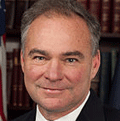
U.S. Senator Tim Kaine
Kaine, who is also up for re-election in 2018, is also being pounded by Republicans, particularly over a remark he made during the 2016 campaign saying he would support the “nuclear option” if Republicans filibustered any of Hillary Clinton’s Supreme Court nominees. At the time, Kaine was Clinton’s running mate.
In a lengthy statement explaining his support for the filibuster, Kaine noted that Republicans refused to consider President Obama’s selection of Merrick Garland for the Supreme Court vacancy created by the death of Justice Antonin Scalia in 2016, for which Gorsuch was nominated. He also said the filibuster, which Gorsuch would need 60 votes to overcome, ensures that high court nominees “receive significant bipartisan support.”
“That is especially important now given the many important issues pending before the court and the clear need to fill a position long held vacant through blatant partisan politics with someone who can bring independence and non-partisanship to the job,” Kaine said.
 Chicken Fried Politics