
Home » Posts tagged 'Roy Cooper' (Page 3)
Tag Archives: Roy Cooper

Federal judges strike down North Carolina’s U.S. House map over gerrymandering
Ruling could have an impact on other Southern states with partisan maps
♦By Rich Shumate, ChickenFriedPolitics.com editor
 RALEIGH (CFP) – In an unprecedented decision, a panel of three federal judges has struck down North Carolina’s U.S. House map, ruling that Republican lawmakers unconstitutionally diluted the voting strength of Democrats by gerrymandering the map for political reasons.
The panel’s majority opinion said partisan gerrymandering – a common political practice in many U.S. states – violates a “core principle of republican government” that “voters should choose their representatives, not the other way around.”
The January 9 ruling gives state lawmakers just 20 days to redraw the map; if they don’t, a new map will be redrawn by a special master appointed by the court. However, GOP legislative leaders are vowing to appeal the ruling to the U.S. Supreme Court, which could leave the current map in place until the appeal can be heard.
If the Supreme Court doesn’t issue a stay, significant chaos will be injected into the Tar Heel State’s 2018 election, with qualifying for candidates supposed to begin Feb. 28 for a May 8 primary.
The ruling marked the first time that a federal court has stuck down a congressional map for being gerrymandered for political, rather than racial, reasons. However, U.S. Supreme Court is currently considering similar cases involving state legislative districts in Wisconsin and Maryland that could set a precedent.
The judicial panel in the North Carolina case found unanimously that the map violated the equal protection clause of the Constitution and ruled 2-1 that it also violated the free speech rights of Democrats.
Should the ruling in North Carolina be upheld on appeal, it could have significant effects in other Southern states where Republican state legislative majorities have gerrymandered maps to their advantage, particularly Florida, Virginia and Texas.
Democrats cheered the ruling, which could help them make a dent in the GOP’s 10-to-3 advantage in North Carolina’s congressional delegation. But Republicans accused the judges of “waging a personal, partisan war” against the state GOP.
Ironically, what may have sunk the North Carolina map was the explicit admission by GOP lawmakers back in 2016 that they were drawing lines to maximize the number of Republican-friendly seats – an admission made to overcome objections to a previous map struck down for improperly using racial considerations.
After the map was redrawn in 2016, several incumbent lawmakers were forced to run in new territory and one, former U.S. Rep. Renee Ellmers, didn’t survive after she was forced to run against another incumbent in a Republican primary. However, the new map did not change the overall party composition in the state’s House delegation.
The 2016 map has allowed Republicans to hold on 77 percent of the state’s congressional seats, even though election results have been closely divided between the parties in recent statewide and presidential elections.
Donald Trump carried North Carolina by just 4 points in 2016, as Democrat Roy Cooper squeaked into the governorship by a margin of less than 1 percent.
The redistricting case was heard by James Wynn, a judge on the 4th U.S. Circuit Court of Appeals; W. Earl Britt, a senior U.S. District Court judge in Raleigh; and William Osteen Jr., a U.S. District Court judge in Greensboro.
Wynn and Britt were appointed by Democratic presidents; Osteen, who dissented from part of the ruling while concurring in striking down the map, is a Republican appointee.
North Carolina legislators pass compromise ending trangendered bathroom ban
But compromise measure prevents cities from passing protections for LGBTQ people
♦By Rich Shumate, Chickenfriedpolitics.com editor
RALEIGH (CFP) — After a year of turmoil and economic boycotts, North Carolina legislators have passed a compromise bill that rolls back HB2, a law which prohibited transgendered people from using restrooms in public facilities that didn’t conform with their their birth gender.
However, the bill hammered out by Democratic Governor Roy Cooper and leaders of the Republican-controlled legislature also forbids local jurisdictions in North Carolina from passing non-discrimination ordinances protecting LGBTQ people until at least 2020, a compromise that left LGBTQ advocates seething.
“Lawmakers and Governor Cooper have failed to resolve the problems with HB2 by doubling down on discrimination,” said Chris Sgro executive director of Equality NC. “Once again, the North Carolina General Assembly has enshrined discrimination into North Carolina law.”
“Lawmakers must reject this disgraceful backroom deal that uses the rights of LGBT people as a bargaining chip,” said Sarah Gillooly, policy director for the ACLU of North Carolina. “It is shameful that legislative leaders and North Carolina’s governor are once again rushing through a discriminatory anti-LGBT measure without proper vetting or an opportunity for public input.”
The bill to repeal HB 2 passed March 30, less than 12 hours after the compromise between Cooper and legislative leaders was unveiled. The House approved the repeal 70 to 48; the Senate, 32 to 16.
Cooper, who as attorney general refused to defend HB2 when it was challenged in court, campaigned for governor in 2016 on a pledge to repeal the law. Just a week before the compromise was reached, Equality NC was lauding Cooper for insisting on full repeal.
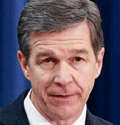
Attorney General Roy Cooper
In a statement issued after the repeal bill was unveiled, the governor conceded that it was a compromise from the outright repeal initially sought.
“It’s not a perfect deal, but it repeals House Bill 2 and begins to repair our reputation,” Cooper said.
The compromise bill was passed the same day that the NCAA was to decide whether to remove all of its events from North Carolina until 2022 in protest of the transgendered bathroom exclusion.
HB2 was pushed through the GOP-controlled legislature in March 2016 in reaction to the decision by the Charlotte City Council to pass a human rights ordinance protecting LGBTQ people, which included the right of transgendered people to use restrooms and locker rooms that comport with their gender identity, rather than their birth gender.
The new law set off a firestorm of controversy. The NBA, ACC and NCAA all pulled events from the state, and a number of businesses halted plans to relocate or expand there.
The governor at the time, Republican Pat McCrory, bore the brunt of the nationwide backlash to the law. Last November, he was the only Republican governor to lose his seat, in a campaign dominated by the HB2 controversy.
Under the repeal measure, local jurisdictions would no longer be able to regulate use of bathroom facilities in public buildings, as Charlotte tried to do. Only the legislature could enact such regulations, but, after repeal of HB 2, no regulations currently exist. In essence, while transgendered people would not specifically be barred from using facilities that comport with their gender identity, they would also not have a legal right to do so.
However, the second part of the repeal bill prevents Charlotte or any other jurisdiction in North Carolina from passing LGBTQ anti-discrimination measure for the next three years.
North Carolina Governor Roy Cooper enters office with call to end partisan friction
But new governor calls for repeal of law regulating transgendered bathroom use
♦By Rich Shumate, Chickenfriedpolitics.com editor
RALEIGH (CFP) — In his inaugural address, incoming North Carolina Governor Roy Cooper issued a call to end the contentious politics that have bedeviled the start in recent years, but he also made it clear that he would push for repeal of a bill that limited use of public restroom facilities for transgendered people.
Attorney General Roy Cooper
“The people of this state are tired of yesterday’s politics. You expect and deserve public servants who reject cynicism, who don’t succumb to political paralysis, who negotiate differences in good faith,” Cooper said.
“I don’t think anyone believes that North Carolina families sit around the kitchen table every night thinking that their lives would change for the better if only the legislature would spend its time on the hot-button social issues of the day,” he said.
“People have bigger concerns, like why they haven’t gotten a raise in eight years or why the cost of health insurance is too much to bear or if they can afford to send their kids to college.”
Because of a snowstorm that paralyzed North Carolina, Cooper delivered his January 7 inaugural address on television, rather than to an outdoor crowd as initially planned.
Cooper, a Democrat, defeated incumbent Republican Governor Pat McCrory by just 10,277 votes out of nearly 4.8 million cast, which was the nation’s closest gubernatorial election this year and the only one that flipped from Republican to Democratic.
The most contentious issue in that election was House Bill 2 — passed by the GOP-controlled legislature and signed by McCrory — which required transgendered people to use bathrooms in public facilities consistent with their birth gender, rather than the gender with which they identify.
Cooper, who was attorney general at the time, opposed the measure and refused to defend it in court. In the wake of the bill’s passage, a number of major companies have dropped plans to move or expand in North Carolina, and the NBA, NCAA and ACC have all pulled sporting events out of the state.
After the election, the legislature met in special session to consider repealing the law, but Republican supporters of the law scuttled the effort. Cooper made in clear in his inaugural address that he would keep trying.
“This law has isolated and hurt a lot of people, damaged our state’s reputation and cost our economy hundreds of millions of dollars that could have paid our teachers and firefighters or built new highways,” he said.
“There are enough bipartisan votes in the legislature right now to fully repeal HB2 with no strings attached. This is not complicated. In fact, it’s very simple. Let them vote.”
Cooper will face a legislature dominated by Republicans. In the Senate, the GOP holds 35 seats to 15 for Democrats; in the House, Republicans have 74 seats and Democrats 46. Those margins are enough to override Cooper’s vetoes, which only requires a three-fifths majority in the Tar Heel State.
However, in late November, a federal judge struck down the state’s legislative districts on the grounds that they were improperly gerrymandered using racial considerations and ordered the legislature to draw new maps.
Unless the U.S. Supreme Court intervenes, new elections for the entire General Assembly will have to be held in 2017, which could allow Democrats to gain back some ground.
After the election, the legislature also passed measures to limit the number of political appointments Cooper can make and require that his cabinet picks to be approved by the legislature. Cooper has gone to court to challenge those new laws.
Cooper, 59, from Nash County in eastern North Carolina, served four terms as attorney general before seeking the governorship, the second longest tenure in that office in state history.
Pat McCrory concedes to Roy Cooper in North Carolina governor’s race
Concession comes after vote recount in Durham County
♦By Rich Shumate, Chicken Fried Politics.com editor
RALEIGH (CFP) — Nearly a month after election day, North Carolina’s hotly contested governor’s race has finally been settled and will flip into Democratic hands.
Attorney General Roy Cooper
Republican Governor Pat McCrory conceded the race to Democratic Attorney General Roy Cooper on December 5, after it became clear that an ongoing recount in Durham County would not overturn Cooper’s lead.
“Despite continued questions that should be answered regarding the voting process, I personally believe that the majority of our citizens have spoken,” McCrory said in a video posted on YouTube. “We now should do everything we can to support (Cooper).”
Cooper welcomed the concession in a Facebook post, bringing to an end a contentious race that became the most expensive governor’s race in state history.
“While this was a divisive election season, I know still that there is more that unites us than divides us,” Cooper said. “I’d like to thank all of the hardworking families in North Carolina, and I look forward to serving the greatest state in the country as your governor.”
Cooper’s lead over McCrory was 10,263 votes, out of more than 4.7 million votes cast, a difference of just .22 percent.
Cooper’s win is a rare moment of good news for Democrats in North Carolina, which went Republican in both the presidential and U.S. Senate races. The Cooper-McCrory contest was the only governor’s race in the country that shifted the office from Republican to Democrat.
Democrats will now hold four out 14 Southern governorships. The others are in Virginia, West Virginia and Louisiana. Republicans hold the remaining 10.
The contention over the results in Durham began on election night, when a batch of 90,000 votes came in all at once, propelling Cooper — who had trailed most of the night — into the lead statewide.
McCrory and his campaign found those results suspicious and demanded a recount. However, Durham election officials said the late reporting of results was caused by a technical problem that forced them to enter the results from voting machines by hand.
The Durham County elections board turned down McCrory’s request for a recount, but the State Board of Elections voted along party lines to order one.
In North Carolina, both state and county elections boards are appointed by the governor, and the governor’s party holds a majority.

North Carolina Governor Pat McCrory
McCrory rode a GOP wave into office in 2012, but the Republican-controlled legislature’s passage of a controversial voter ID law and measures favored by religious conservatives made the governor a lightning rod.
The issue that dominated the race was McCrory’s decision to sign a law requiring transgendered students to use bathrooms that match their gender of birth, rather than their gender of identity, in public facilities.
McCrory continued to defend the law, even after a number of businesses scuttled expansion plans and the NCAA, NBA and ACC pulled events from the state.
Cooper not only opposed the measure, but he also refused to defend it in court when students and the federal government took legal action to overturn it.
Recount begins in North Carolina governor’s race
State board sets Monday deadline for recounting ballots in Durham County
♦By Rich Shumate, Chicken Fried Politics.com editor
RALEIGH (CFP) — The hotly contested North Carolina governor’s race has entered what is likely its final stage, with elections officials in Durham County now recounting ballots to meet a Monday deadline.
Republican Governor Pat McCrory has indicated that he will concede to Democratic Attorney General Roy Cooper if the recount doesn’t overturn Cooper’s slight lead.
With ballots certified in 98 of the state’s 100 counties, Cooper leads McCrory by 10,263 votes, out of more than 4.7 million votes cast.
If that margin holds after the Durham recount, McCrory won’t be entitled to a full statewide recount, which is only triggered if the margin is less than 10,000 votes.
The deadline for finishing the recount is 7 p.m. ET Monday.
Attorney General Roy Cooper
Cooper beat McCrory by a margin of 91,000 votes in Durham County, taking a whopping 79 percent of the vote, which was his best performance in any county.
The contention over the results in Durham began on election night, when a batch of 90,000 votes came in all at once, propelling Cooper — who had trailed most of the night — into the lead statewide.
McCrory and his campaign found those results suspicious and demanded a recount. However, Durham election officials said the late reporting of results was caused by a technical problem that forced them to enter the results from voting machines by hand.
The Durham County elections board turned down McCrory’s request for a recount, but the State Board of Elections voted along party lines to order one.
In North Carolina, both state and county elections boards are appointed by the governor, and the governor’s party holds a majority.
McCrory’s campaign has indicated that he will concede to Cooper if the Durham results don’t change the outcome. He has already filed the paperwork for a statewide recount, although that request would be moot if Cooper’s margin holds.
Cooper’s campaign has been calling on McCrory to concede and bring to an end the three-week drama over who will lead the Tar Heel State.
“It’s clear there is no path to victory for Governor McCrory,” said Cooper campaign manager Trey Nix in a statement posted on Facebook. “It’s time for Governor McCrory to accept the election results and respect the will of the voters.”
Should Cooper hang on, North Carolina would be the only state where Democrats flipped a governorship in 2016 and would give them a third Southern governorship, compared to 11 for Republicans.
North Carolina Governor Pat McCrory
McCrory rode a GOP wave into office in 2012, but the Republican-controlled legislature’s passage of a controversial voter ID law and measures favored by religious conservatives made the governor a lightning rod.
The issue that dominated the race was McCrory’s decision to sign a law requiring transgendered students to use bathrooms that match their gender of birth, rather than their gender of identity, in public facilities.
McCrory continued to defend the law, even after a number of businesses scuttled expansion plans and the NCAA, NBA and ACC pulled events from the state.
Cooper not only opposed the measure, but he also refused to defend it in court when students and the federal government took legal action to overturn it.
 Chicken Fried Politics