
Home » Posts tagged 'Roy Cooper' (Page 4)
Tag Archives: Roy Cooper

Pat McCrory continues to fight election challenge in North Carolina
State Board of Elections refuses to intervene in canvass; Cooper’s lead grows in governor’s race
♦By Rich Shumate, Chicken Fried Politics.com editor
 RALEIGH (CFP) — The GOP-controlled North Carolina State Board of Elections has refused to intervene in a canvass of votes in the state’s hotly contested race for governor, a blow to Republican Governor Pat McCrory’s quest to challenge results showing him trailing Democratic Attorney General Roy Cooper.
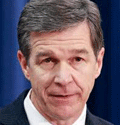
Attorney General Roy Cooper
Meanwhile, Cooper has appointed a transition team and dismissed claims by McCrory and his campaign of voter fraud as “the same kind of misleading and dishonest rhetoric that they’ve used throughout the campaign, rhetoric meant to cause confusion.”
“Governor McCrory is doing everything he can to undermine the results of this election and the will of the people, but we won’t let him,” Cooper said in a video statement posted on Facebook.
But a spokesman for McCrory, Ricky Diaz, said the campaign was trying to ensure that voter fraud had not tainted the process and that “every legal vote is counted properly.”
“Why is Roy Cooper so insistent on circumventing the electoral process and counting the votes of dead people and felons?” Diaz said in a statement. “It may be because he needs those fraudulent votes to count in order to win. Instead of insulting North Carolina voters, we intende to let the process work as it should.”
Should Cooper hang on, North Carolina would be the only state where Democrats flipped a governorship in 2016 and would give them a third Southern governorship, compared to 11 for Republicans.
The latest unofficial vote total from the State Board of Elections shows Cooper with a lead of 6,500 votes, up from the 4,700 vote total Cooper held on election night. Election boards in all of the state’s 100 counties have been adding provisional and absentee ballots to the total.
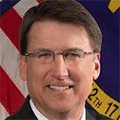
North Carolina Governor Pat McCrory
The McCrory campaign has filed protests in 50 counties, alleged fraudulent absentee ballots and votes by felons and dead people. It asked the state elections panel to oversee official county canvasses across the state, the results of which are scheduled to be certified by the state on November 29. But the board voted to let the counties continue the process on their own.
So far, 40 counties have completed their canvasses and certified final results. However, none of those were large metropolitan counties with vote totals large enough to conceivably allow McCrory to make up ground.
If Cooper’s lead is less than 10,000 votes when the final canvasses are completed, McCrory could request a statewide recount.
In North Carolina, the State Board of Elections and all 100 county boards are appointed by the governor, with the governor’s political party holding a majority on all of those panels, regardless of the political leanings of the county.
The McCrory campaign suffered a major blow when the board in Durham County, despite being controlled by members of his own party, turned down a challenge alleging possible fraud.
On election night, 90,000 votes from the heavily Democratic county came in late, propelling Cooper into the lead and prompting McCrory to cry foul. However, elections officials in Durham said the votes were reported all at once because a technical problem forced them to enter the results from voting machines by hand.
A different technical problem with computerized voter roles in Durham County led the State Board of Elections to extend voting by up to an hour in eight precincts on election day.
While turning down McCrory’s request to get involved in canvasses statewide, the state board did agree to look at allegations of voter fraud in Bladen County, in the southeastern party of the state. However, McCrory actually won in Bladen County and less than 16,000 people voted, making any change there unlikely to alter Cooper’s lead.
McCrory rode a GOP wave into office in 2012, but the Republican-controlled legislature’s passage of a controversial voter ID law and measures favored by religious conservatives made the governor a lightning rod.
The issue that dominated the race was McCrory’s decision to sign a law requiring transgendered students to use bathrooms that match their gender of birth, rather than their gender of identity, in public facilities.
McCrory continued to defend the law, even after a number of businesses scuttled expansion plans and the NCAA, NBA and ACC pulled events from the state.
Cooper not only opposed the measure, but he also refused to defend it in court when students and the federal government took legal action to overturn it.
Governor: North Carolina still up for grabs; Democrats keep West Virginia
Cooper declares victory in North Carolina, but McCrory refuses to concede; Justice has easy win in West Virginia
♦By Rich Shumate, Chickenfriedpolitics.com editor
 (CFP) –Democratic Attorney General Roy Cooper has claimed victory in the North Carolina governor’s race, holding an tiny, unofficial 4,700-vote lead over Governor Pat McCrory with provisional ballots still to be counted.
McCrory, however, is refusing to concede, pending counting of those ballots and a full canvass of the vote.
Meanwhile, in the only other Southern governor’s race this year, in West Virginia, Jim Justice, a billionaire coal mine owner, defeated Republican State Senate President Bill Cole by a margin of 49-42 percent to win an open seat.

Pat McCrory

Roy Cooper
In North Carolina, Cooper, who had trailed for most of the night, declared victory after late-reporting returns from Durham County put him ahead of McCrory.
“Because of your hard work, we have won this race for everyone in North Carolina,” Cooper told jubilant supporters in Raleigh. “This has been a hard-fought race, but the people of North Carolina have spoken, and they want a change in leadership.”
But McCrory refused to concede defeat, specifically mentioning the late Durham County vote as a concern. He said he would wait until seeing the results of the official canvasses in the state’s 100 counties, which won’t be completed until November 18.
“We’re going to check everything,” he told supporters at a Republican election night party in Raleigh. “We’re going to make sure every vote counts in North Carolina.”
The margin between Cooper and McCrory is less than one-tenth of 1 percent, small enough to allow McCrory to request a full recount under state law.
McCrory rode a GOP wave into office in 2012, but the Republican-controlled legislature’s passage of a controversial voter ID law and measures favored by religious conservatives made the governor a lightning rod.
The issue that has dominated the race was McCrory’s decision to sign a law requiring transgendered students to use bathrooms that match their gender of birth, rather than their gender of identity, in public facilities.
McCrory continued to defend the law, even after a number of businesses scuttled expansion plans and the NCAA, NBA and ACC pulled events from the state.
Cooper not only opposed the measure, but he also refused to defend it in court when students and the federal government took legal action to overturn it.

Jim Justice
In West Virginia, Justice’s win was good news for Democrats, who have seen their once dominant hold on state politics slipping away. He won the governorship even as Donald Trump was thumping Hillary Clinton 65-29 percent in the Mountaineer State.
Speaking to supporters at the famed Greenbrier result in White Sulphur Springs, which he owns, Justice pulled out a speech from his pocket and began to read, only to discover that it was a concession speech.
Pulling a victory speech from his other pocket, he said, “We won.”
“I can tell you I’ll work as tirelessly as I possibly can,” Justice said. “We will give it everything we have.”
The seat was open because Democratic Governor Earl Ray Tomblin was term-limited.
Voters in North Carolina, West Virginia to pick governors
GOP’s McCrory tries to stay alive in North Carolina; Justice, Cole battle for open seat in West Virginia
♦By Rich Shumate, Chickenfriedpolitics.com editor
(CFP) — Voters in North Carolina and West Virginia are picking governors in the November 8 election, with polls showing tight races in both states.
In North Carolina, incumbent Republican Gov. Pat McCrory is running for a second term against Democratic Attorney General Roy Cooper in what has become the nation’s most watched — and most expensive — gubernatorial battle.

Coooper

McCrory
McCrory rode a GOP wave into office in 2012, but the Republican-controlled legislature’s passage of a controversial voter ID law and measures favored by religious conservatives have made the governor a lightning rod.
The issue that has dominated the race is McCrory’s decision to sign a law requiring transgendered students to use bathrooms that match their gender of birth, rather than their gender of identity.
McCrory has continued to defend the law, even after a number of businesses scuttled expansion plans and the NCAA, NBA and ACC pulled events from the state.
Cooper not only opposed the measure, but he also refused to defend it in court when students and the federal government took legal action to overturn it.

Justice

Cole
In West Virginia, Democrats who have seen their once dominant hold on state politics slip away are hoping to revive their fortunes with Jim Justice, a billionaire coal mine owner best known for his efforts to revive the state’s famed Greenbrier Resort.
He faces Republican State Senate President Bill Cole, who an auto dealer from Bluefield who became leader of the chamber in 2015 after the GOP captured a Senate majority for the first time in 83 years.
This seat is open because Democratic Governor Earl Ray Tomblin is term-limited. A Republican has not been elected governor in the Mountaineer State since 1996.
Candidates spar over North Carolina’s bathroom bill in governor’s debate
Governor Pat McCrory defends Trump, says Caitlyn Jenner would have to use men’s shower
♦By Rich Shumate, Chickenfriedpolitics.com editor
RALEIGH (CFP) — Facing off in a debate less than a month before voters go to the polls, Republican Governor Pat McCrory and his Democratic challenger, Attorney General Roy Cooper, sparred over a series of controversial laws passed by North Carolina’s GOP-controlled legislature, in particular a controversial measure that requires transgendered people to use bathrooms and shower facilities that conform with their birth gender in public facilities.
North Carolina Governor Pat McCrory
In the October 12 debate, sponsored by the North Carolina Association of Broadcasters and airing on UNC-TV, the governor also continued to defend his endorsement of Donald Trump after video surfaced on October 7 in which the Republican presidential nominee made braggadocious comments about being allowed to grab women’s genitals because of his celebrity.
“Mr. Trump needs to have his mouth washed out with soap, but so does Mrs. Clinton,” McCrory said.
In response, Cooper said that “it’s hard to believe that Governor McCrory continues to support a presidential candidate who condones sexual assault.”
“Governor McCrory and Donald Trump are a lot alike. They both have trouble with the facts, and they both engage in divisive rhetoric.”
McCrory, who has come under national criticism for HB 2, the so-called bathroom bill, defended his support for the law, saying that it was the result of “a major change in culture” initiated by city officials in Charlotte, who had passed a measure outlawing discrimination against transgendered people that HB 2 overturned.
“We never brought this issue up. It was the mayor of Charlotte, with strong support from the attorney general,” the governor said. “It wasn’t called for. It was the liberals that brought it up.”
But Cooper called for the law’s repeal, saying that “it writes discrimination into our law, and it has been a disaster for our economy.”
“This legislation was passed in one day and signed in the middle of the night. And Governor McCrory continues to go across the state telling people that this is not hurting our economy,” Cooper said. “Governor, what planet are you on?”
In response to the passage of the bathroom bill, a number of businesses have cancelled plans to move or expand in North Carolina, and the NBA, NCAA and ACC have all pulled events from the Tar Heel State.
McCrory was asked by the debate’s moderator, NBC’s Chuck Todd, if the law would force Caitlyn Jenner, a former Olympic athlete and the nation’s best-known transgendered women, to use men’s bathroom facilities.
The governor said that while private businesses had the right to decide that for themselves under state law, “If she’s going to shower at a facility at UNC-Chapel Hill after running around the track, she’s going to use the men’s shower. ”
Recent polls in the race have shown Cooper with a slight lead.
Here is the full video of the October 11 debate.
Trump’s Southern firewall shows cracks but no wholesale erosion
Three Alabama politicos flee from Trump; Rubio, Burr and McCrory are non-committal
♦By Rich Shumate, Chickenfriedpolitics.com editor
 (CFP) — Donald Trump’s support among Southern elected officials has begun to crack after the release of an audiotape in which he made offensive comments about women, but, so far, there has been no wholesale deterioration of his Southern support heading into the second presidential debate.
U.S. Senator Shelley Moore Capito of West Virginia is the only Southern senator to distance herself from Trump, calling on him to “reexamine his candidacy” in light of remarks that surfaced on October 9 in which he bragged about being able to sexually assault women because of his celebrity.
“As a woman, a mother and a grandmother to three young girls, I am deeply offended by Mr. Trump’s remarks, and there is no excuse for the disgusting and demeaning language,” Capito said in a statement.

Comstock
Two U.S. House incumbents in tough re-election battles, Reps. Barbara Comstock in Virginia and William Hurd in Texas, both announced they would not vote for Trump and want him to step aside as the Republican nominee.
But three other incumbent Republican politicians locked in tight re-election fights – U.S. Senators Marco Rubio of Florida and Richard Burr of North Carolina and North Carolina Governor Pat McCrory – did not retract their support for Trump, although all three condemned his remarks.
Rubio, who offered Trump a tepid endorsement after losing to him in the GOP presidential primaries, went on Twitter to call Trump’s remarks “vulgar, egregious & impossible to justify.” But his opponent in the Senate race, U.S. Rep. Patrick Murphy, said Rubio’s refusal to unendorse Trump amounted to “political cowardice.”

Murphy
“Donald Trump is a threat to every value this country holds dear,” Murphy said in an op-ed in The Hill newspaper. “If Marco Rubio cannot withdraw his endorsement after this latest sickening news, then he should withdraw from the race.”
The most significant erosion of Trump’s support has come in conservative Alabama, where Republican Governor Robert Bentley has announced he won’t vote for Trump, and two GOP members of the U.S. House delegation, Reps. Martha Roby and Bradley Byrne, have called on him to step aside as their party’s presidential nominee.
“As disappointed as I’ve been with his antics throughout the campaign, I thought supporting the nominee was the best thing for our country and our party,” Roby said in a statement “Now, it is abundantly clear that the best thing for our country and our party is for Trump to step aside and allow a responsible, respectable Republican to lead the ticket.”
Byrne called Trump’s comments “disgraceful and appalling.”
“It is now clear Donald Trump is not fit to be President of the United States and cannot defeat Hillary Clinton,” he said in a statement. “I believe he should step aside and allow Governor Pence to lead the Republican ticket.”
Roby represents parts of metro Montgomery and southeast Alabama. Byrne represents metro Mobile and southwestern parts of the state. Both are seeking re-election, and neither race is expected to be competitive in November.

Bentley
Bentley, who has been mired in his own scandal over a purported affair with a former aide, issued a short statement in which he said, “I certainly won’t vote for Hillary Clinton, but I cannot and will not vote for Donald Trump.”
Notably absent from the list of Alabama politicos distancing themselves from Trump is U.S. Senator Jeff Sessions, one of his staunchest supporters in Congress. Trump announced Sessions would be in New York to help him prepare for his October 9 debate with Hillary Clinton, although Sessions’s office has not confirmed that information.
In Virginia, Comstock, who had not previously endorsed Trump, is in a tough re-election battle in the 10th District, based in the Washington, D.C. suburbs, against Democrat Democrat LuAnn Bennett, a real estate developer who is the ex-wife of former U.S. Rep. Jim Moran.
Comstock called Trump’s comments “disgusting, vile and disqualifying.”
“No woman should ever be subjected to this type of obscene behavior, and it is unbecoming of anybody seeking high office,” she said in a statement. “Donald Trump should step aside and allow our party to replace him with Mike Pence or another appropriate nominee from the Republican Party. I cannot in good conscience vote for Donald Trump, and I would never vote for Hillary Clinton.”
In Texas, Hurd, who had also not endorsed Trump, is battling to keep his 23rd District seat, which stretches from the suburbs of San Antonio across a wide swath of West Texas to the edge of El Paso.
As a black Republican running in a majority Latino district, Trump’s incendiary comments about Latinos had already put Hurd on the defensive in the race against the man he beat in 2014, former U.S. Rep. Pete Gallego.
Hurd issued a statement saying he could not vote for a candidate who degrades women and insults minorities. He said Trump should step aside in favor of “a true conservative to beat Hillary Clinton.”

Burr
Burr, who polls show is neck-and-neck with Democrat Deborah Ross in his re-election race in North Carolina, told Politico that he was “going to watch (Trump’s) level of contrition over the next few days to determine my level of support.”
McCrory, who trails Democratic Attorney General Roy Cooper in recent polls, issued a statement in which he said, “I condemn in the strongest possible terms the comments made by Donald Trump regarding women. I find them disgusting,” But he stopped short of retracting his support for Trump or announcing that he would not vote for him.
 Chicken Fried Politics