
Home » Posts tagged 'Shelley Moore Capito' (Page 2)
Tag Archives: Shelley Moore Capito

Analysis: Midterms a show of woe for Southern Democrats
GOP has a particularly strong showing in the upper South, where Democrats have recently been competitive
♦By Rich Shumate, Chickenfriedpolitics.com editor

(CFP) — One look at a color-coded map of midterm election results in any Southern state tells the story – there’s a tsunami of red and a shrinking pool of blue.
Take Texas, for example, with its 254 counties. Republican U.S. Senator John Cornyn carried 236 of them; the Republican candidate for governor, Attorney General Greg Abbott, carried 235. The only blue is found in Dallas, El Paso, Austin and along the Mexican border.
But that’s still more blue than in Oklahoma, where both Republican U.S. Senate candidates swept all 77 counties, and in West Virginia, where GOP Senate candidate Shelley Moore Capito swept all 55, despite the fact that Democrats have a 350,000-person lead in voter registration.
A deeper look at the numbers from the midterm elections shows just how far Democrats have fallen from the halcyon days when they had an iron grip on the solid South. They’re not just losing; lately, they’re not even competitive.
And perhaps even more troubling for Democrats is the fact that the dam seems to have burst in states in the upper South, where the party had been holding its own at the state level.
This year, 13 of 14 Southern states — all but Florida — had a U.S. Senate election, and two states — Oklahoma and South Carolina — had two. Setting aside Louisiana, which is headed to a runoff, and Alabama, which Democrats didn’t even bother to contest, GOP candidates won by an average of nearly 21 points.
Democrats couldn’t crack 30 percent in either Oklahoma race. They failed to crack 40 percent in six others. In fact, Republicans won by double digits in 10 races. Only Virginia, Georgia and North Carolina were close, with the GOP taking the latter two.
Things were just about as bad in races for governor, where the GOP margin of victory was about 18 percent. Republicans won by double digits in six of the eight governor’s races. Only Florida and Georgia were even remotely close.
The news was particularly bad for Democrats in three upper South states that were politically competitive a decade ago – West Virginia, Arkansas and Tennessee.
In West Virginia, Democrats not only lost the U.S. Senate race, but they lost all three U.S. House seats, and Republicans took control of both houses of the state legislature for the first time since 1931.
With Democratic U.S. Senator Mark Pryor’s loss, Arkansas will have an all-Republican congressional delegation for the first time since Reconstruction. Heading into the election, Democrats held five out of the seven statewide constitutional officers. In the midterm, they lost all seven.
Tennessee used to be split between Republicans in the east and Democrats in the west. Now, the GOP is winning everywhere, holding seven of the state’s nine U.S. House seats. Both Alexander and Governor Bill Haslam, re-elected with 71 percent of the vote, carried Shelby County, which includes the Democratic bastion of Memphis.
Increasingly, Democrats seem to be doing better in the deep South, where they can rely on the support of black voters, than in the upper South, where black populations are smaller.
For example, Republican U.S. Senator Lindsey Graham of South Carolina, despite being a long-time incumbent in a very red state, won by a smaller margin than did Republican Tom Cotton, who beat Pryor like a rug in Arkansas.
Some might attribute Graham’s narrower margin to his Tea Party problems. But Alexander — who faced a similar Tea Party dynamic — managed to win by 30 points in Tennessee.
What is clear from the midterms is that despite recent gains at the presidential level in states such as North Carolina and Virginia, Democrats are becoming less competitive across the region, and the South is becoming more monolithically red.
Indeed, the midterm results support the argument that in most of the South, the two-party system is becoming a relic of the past.
Four southern U.S. Senate races are still too close to call
GOP holding leads in Arkansas and West Virginia; Democrats holding tough in Georgia and Kentucky
♦By Rich Shumate, Chickenfriedpolitics.com editor
 WASHINGTON (CFP) — Two weeks out from election day, races for four southern U.S. Senate seats — two held by each party — are still too close to call, with control of the Senate hanging in the balance.
The latest polling shows races in North Carolina, Kentucky and Georgia are within the margin of error, while the race in Louisiana now seems certain to be heading toward a December runoff.
Depending on how these Southern races turn out, the question of which party will control the Senate could linger for more than a month before runoffs in Louisiana and possibly Georgia.

U.S. Rep. Tom Cotton
However, Republicans appear poised to pick up an open Democratic seat in West Virginia, and GOP U.S. Rep. Tom Cotton appears to have opened up a small lead over incumbent Democratic U.S. Senator Mark Pryor in Arkansas.
Democrats hold only eight out of 28 southern Senate seats. One of those seats, in West Virginia, is likely gone, and three others — in Arkansas, Louisiana and North Carolina — are in jeopardy.
The good news for Democrats is that two GOP-held seats, in Kentucky and Georgia, have turned out to be surprisingly competitive, despite the Republican tilt in both of those states.
Here are the current states of the southern Senate races:
Arkansas: The race between Cotton and Pryor has been neck-and-neck for the better part of a year, as outside groups poured tons of money into the Natural
State. But a Talk Business and Politics/Hendrix College poll released October 15 showed that Cotton has opened up an 8-point lead, the third media poll in a row that put the challenger ahead.
Louisiana: Recent polling shows Democratic U.S. Senator Mary Landrieu and her chief Republican rival, U.S. Rep. Bill Cassidy, about even but both far from the 50 percent either would need to avoid a runoff in the state’s jungle primary, where all candidates from all parties run in the same race. That would set up a December 6 runoff between the two, a head-to-head match-up that’s still too close to call.
West Virginia: This race is to pick a successor to retiring Democratic U.S. Senator Jay Rockefeller, and it looks increasingly like a GOP pickup, with U.S. Rep. Shelley Moore Capito opening up a significant lead over Democratic Secretary of State Natalie Tennant. A CBS News/New York Times/YouGov poll in early October had Capito ahead by 23 points.
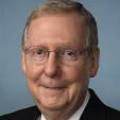
Senate Minority Leader Mitch McConnell
Kentucky: The Senate’s top Republican, Minority Leader Mitch McConnell, is in a pitched battle with Democratic Secretary of State Alison Lundergan Grimes. Recent polls have shown the race as either too close to call or with McConnell slightly in the lead.
Georgia: This race, to pick a successor to retiring Republican U.S. Senator Saxby Chambliss, is a contest between two political newcomers, Republican David Perdue and Democrat Michelle Nunn. Despite Georgia’ GOP tilt, Nunn has run a strong race, and the latest polling shows the contest within the margin of error. An interesting twist in Georgia is that if neither Perdue nor Nunn wins a majority, they would meet in a runoff December 10 — a possibility if the race is close and votes are syphoned off by third-party candidates.
North Carolina: Democratic U.S. Senator Kay Hagan is seeking a second term against Republican State House Speaker Thom Tillis. Recent polling has shown this race is also within the margin of error.
Alex Mooney tops crowded field to win GOP U.S. House primary in West Virgina
Republican primary race in state’s 2nd District featured Tea Party-versus-establishment battle
♦By Rich Shumate, Chickenfriedpolitics.com editor
 CHARLESTON, West Virginia (CFP) — Just a year after moving across the Potomac River from Maryland into West Virginia, Republican Alex Mooney has won his party’s nomination for his new state’s open 2nd District U.S. House seat.
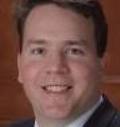
GOP House candidate Alex Mooney
In a seven-way race, Mooney captured 36 percent of the vote, defeating Ken Reed, a pharmacy owner from Berkeley Springs, who came in second at 22 percent, and Charlotte Lane, a Charleston lawyer and international trade commissioner under President George W. Bush, who took 18 percent of the vote.
West Virginia does not have primary runoffs.
The battle for the GOP nod in the 2nd District turned into a closely watched tussle between outside conservative activists and Tea Party groups, who backed Mooney, and business and party leaders who lined up behind Lane. Reed poured more than $500,000 of his own money into the race.
Lane had the backing of the powerful West Virginia Coal Association. Mooney was endorsed by the Senate Conservatives Fund, the Tea Party Express and former Arkansas Governor Mike Huckabee. Despite her establishment credentials, Mooney eclipsed Lane in fundraising by $150,000, according to filings with the Federal Election Commission.
Both Lane and Reed had accused Mooney, who served in the Maryland Senate from 1999 to 2010, of being a carpetbagger who parachuted into West Virginia to seek political office.
He had formed an exploratory committee for a U.S. House race in Maryland in 2012 but eventually decided not to run, and he moved to West Virginia in 2013. His Maryland Senate district was adjacent to the Mountaineer State.
Nick Casey, the former chairman of the West Virginia Democratic Party, easily won his party’s nomination for the 2nd District seat and will face Mooney in November.
The 2nd District meanders across 17 counties from Charleston, the state capital, to the Eastern Panhandle sandwiched between Maryland and Virginia. The seat is currently held by Republican U.S. Rep. Shelley Moore Capito, who is giving it up to run for the U.S. Senate.
Capito easily won her Senate primary and will face Democratic Secretary of State Natalie Tennant in the fall.
Even though Capito has held the seat since 2001 and Mitt Romney captured 60 percent of its presidential votes in 2012, Democrats see the seat as a potential pickup target. Casey has raised more than $890,000 in a district with modest media advertising costs, according to FEC reports.
Capito did not endorse any of the candidates in the Republican primary.
 Chicken Fried Politics