
Home » Posts tagged 'Tim Kaine' (Page 4)
Tag Archives: Tim Kaine

Primaries for Virginia governor echo 2016 presidential race
Establishment-versus-insurgent contests featured on both GOP and Democratic ballots
♦By Rich Shumate, ChickenFriedPolitics.com editor
 RICHMOND (CFP) — The calendar may read 2017, and the names on the ballot may not be the same, but voters in Virginia can be forgiven if the commonwealth’s primaries for governor seem vaguely reminiscent of last year’s presidential contest.
On the Republican side, a party stalwart and former aide in the George W. Bush White House is running against Donald Trump’s one-time Virginia campaign director. On the Democratic side, a Bernie Sanders-backed candidate is offering a stiff challenge to a veteran officeholder who was considered to be a shoo-in just six months ago.
As voters prepare to go to the polls June 13, polls show that many voters in both races are undecided, providing a level of uncertainty and suspense in the South’s only governor’s race this year.
Polls will be open from 6 a.m. to 7 p.m.
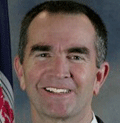
Lieutenant Governor Ralph Northam
On the Democratic side, Lieutenant Governor Ralph Northam appeared to be cruising to his party’s nomination unmolested until January, when former U.S. Rep. Tom Perriello jumped into the race and began casting himself as the anti-establishment alternative, in contrast to the well-connected Northam.
Northam has the backing of Democratic Governor Terry McAuliffe, who is barred by Virginia law from running for re-election, along with both of the commonwealth’s U.S. Senators, Mark Warner and Tim Kaine.

Former U.S. Rep. Tom Perriello, D-Virginia
Perriello has countered with endorsements from Sanders, U.S. Senator Elizabeth Warren of Massachusetts and a slew of former officials from Barack Obama’s administration, in which Perriello served. And while Obama has not offered an endorsement, Perriello has been reminding voters of his connection to the former president every chance he gets.
Polls have shown a close race, although the large numbers of undecided voters means there is no clear leader heading into election day.

Ed Gillespie
On the Republican side, Ed Gillespie, a former Republican National Committee chairman and Bush aide who ran a surprisingly strong race for U.S. Senate in 2014, has held a lead in the polls over his two challengers, Corey Stewart, chairman of the Prince William County Board of Supervisors, and State Senator Frank Wagner, from Virginia Beach, a former U.S. Navy officer who has served in the the state legislature for 25 years.
Because Virginia does not have primary runoffs, Gillespie only has to win a plurality to advance to the general election.

GOP candidate Corey Stewart
Stewart, who was once Trump’s Virginia state chairman, has wrapped himself in the Trump mantle, positioning himself as the man who can “take back Virginia from the establishment,” a not-so-veiled reference to Gillespie.
Stewart lost his job in the Trump campaign in October 2016 after organizing a protest outside of Republican National Committee headquarters demanding that the GOP hierarchy not abandon Trump in the wake of the release of an audiotape in which Trump made sexually suggestive comments. But he still continued to support Trump.
During the campaign, Stewart — an native of Minnesota — has also come out against efforts to remove Confederate monuments, which have sparked controversy in Charlottesville and other cities in the South.
The winners of both primaries will advance to the general election, which is one of only two governor’s races being held this year. The other is in New Jersey.
Once reliably Republican, Virginia is the only Southern state that Hillary Clinton carried in 2016, and it has now gone to the GOP in three successive elections.
Three of the commonwealth’s last four governors have been Democrats — Warner, Kaine and McAuliffe — and Virginia is among just three of 14 Southern states with a Democratic chief executive, the others being West Virginia and Louisiana.
Southern GOP, Democratic senators split on using “nuclear option” in Gorsuch fight
Senate eliminates filibusters of Supreme Court nominees in party-line vote
 WASHINGTON (CFP) — With the support of all 24 Southern Republicans, the U.S. Senate has changed its rules to eliminate filibusters for Supreme Court nominations, clearing the way for confirmation of Neil Gorsuch to a lifetime seat on the high court.

Supreme Court nominee Neil Gorsuch
After Democrats blocked Gorsuch’s nomination with a filibuster, the Republican majority used a parliamentary maneuver to change Senate rules, eliminating the need to reach 60 votes to overcome a filibuster.
That vote fell along party lines, with 52 Republicans in favor, 46 Democrats opposed and two independents who caucus with Democrats also voting against the move.
With the filibuster out of the way, Gorsuch was confirmed by a vote of 54 to 45, with just three Democrats supporting him, including Joe Manchin of West Virginia
Three of the four Southern Democratic senators — Bill Nelson of Florida and Mark Warner and Tim Kaine of Virginia — supported the filibuster and voted against confirming Gorsuch. While Manchin did not join the filibuster and voted for confirmation, he did not support the move by Republican leaders to eliminate filibusters for Supreme Court nominees.

U.S. Senator Joe Manchin of West Virginia
Manchin released a statement blistering both sides for “hypocrisy” and charging that the filibuster fight illustrates “precisely what is wrong with Washington.”
“Frustratingly, both parties have traded talking points: Republicans say it’s about obstructionism and Democrats say it’s a power grab. Their shifting positions and hypocrisy is the one thing that unites them,” he said.
Manchin also noted that in 2013, when Democrats used their majority to end filibusters for executive branch nominees, “every Republican Senator joined me in opposing the rules change then, but now, they stand united to do exactly what they opposed.”
Manchin is up for re-election in 2018 in a state President Donald Trump carried by a whopping 32 points. Warner and Kaine’s opposition to Trump’s first Supreme Court nominee presents less political risk in Virginia, the only Southern state Trump failed to carry last November.
Nelson, however, is also up for re-election in 2018 in a state Trump won and could be facing a formidable Republican foe in Florida Governor Rick Scott.
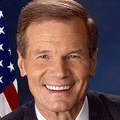
U.S. Senator Bill Nelson of Florida
In a statement announcing his decision to oppose Gorsuch, Nelson said he has “real concerns with (Gorsuch’s) thinking on protecting the right to vote and allowing unlimited money in political campaigns. In addition, the judge has consistently sided with corporations over employees.”
“I will vote no on the motion to invoke cloture (to end the filibuster) and, if that succeeds, I will vote no on his confirmation,” Nelson said.
The National Republican Senatorial Committee immediately released a statement noting that Nelson had opposed a previous Democratic filibuster of Supreme Court Justice Samuel Alito in 2006 and had previously voted to confirm Gorsuch to a seat on the Denver-based 10th U.S. Circuit Court of Appeals.
“Nelson proved to Floridians today that he no longer shares their values, and instead is more politically aligned with the liberal elite of Washington,” said Katie Martin, an NRSC spokeswoman. “Nelson has been in Washington too long and his move to ignore the will of voters in Florida will cost him his job in 2018.”
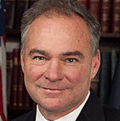
U.S. Senator Tim Kaine
Kaine, who is also up for re-election in 2018, is also being pounded by Republicans, particularly over a remark he made during the 2016 campaign saying he would support the “nuclear option” if Republicans filibustered any of Hillary Clinton’s Supreme Court nominees. At the time, Kaine was Clinton’s running mate.
In a lengthy statement explaining his support for the filibuster, Kaine noted that Republicans refused to consider President Obama’s selection of Merrick Garland for the Supreme Court vacancy created by the death of Justice Antonin Scalia in 2016, for which Gorsuch was nominated. He also said the filibuster, which Gorsuch would need 60 votes to overcome, ensures that high court nominees “receive significant bipartisan support.”
“That is especially important now given the many important issues pending before the court and the clear need to fill a position long held vacant through blatant partisan politics with someone who can bring independence and non-partisanship to the job,” Kaine said.
3 of 4 Southern Senate Democrats supporting Gorsuch filibuster
U.S. Senator Joe Manchin of West Virginia sole supporter of Trump Supreme Court nominee
WASHINGTON (CFP) — With the U.S. Senate headed for an epic showdown over a Democratic filibuster of President Trump’s first Supreme Court nominee, three of the four Democrats who represent Southern states in the Senate have lined up against Neil Gorsuch’s confirmation.
Supreme Court nominee Neil Gorsuch
Senators Bill Nelson of Florida and Mark Warner and Tim Kaine of Virginia have all announced they will support a Democratic filibuster designed to stop the Gorsuch nomination, which will likely prompt GOP leaders to end filibusters for Supreme Court nominees, a move that has come to be known as the “nuclear option.”
The lone supporter of Gorsuch left among Southern Democrats is Senator Joe Manchin of West Virginia. All 24 Southern Republicans in the Senate are expected to vote to end the filibuster and confirm Gorsuch.
Manchin — up for re-election in 2018 in a state Trump carried by a whopping 32 points — said in a statement that Gorsuch “has been consistently rated as a well-qualified jurist, the highest rating a jurist can receive, and I have found him to be an honest and thoughtful man.”
“I hold no illusions that I will agree with every decision Judge Gorsuch may issue in the future, but I have not found any reasons why this jurist should not be a Supreme Court Justice,” he said.
Warner and Kaine’s opposition to Trump’s nominee presents less political risk in Virginia, the only Southern state Trump failed to carry last November. Nelson, however, is up for re-election in 2018 in a state Trump won and could be facing a formidable Republican foe in Florida Governor Rick Scott.
U.S. Senator Bill Nelson of Florida
In a statement announcing his decision to oppose Gorsuch, Nelson said he has “real concerns with (Gorsuch’s) thinking on protecting the right to vote and allowing unlimited money in political campaigns. In addition, the judge has consistently sided with corporations over employees.”
“I will vote no on the motion to invoke cloture (to end the filibuster) and, if that succeeds, I will vote no on his confirmation,” Nelson said.
The National Republican Senatorial Committee immediately released a statement noting that Nelson had opposed a previous Democratic filibuster of Supreme Court Justice Samuel Alito in 2006 and had previously voted to confirm Gorsuch to a seat on the Denver-based 10th U.S. Circuit Court of Appeals.
“Nelson proved to Floridians today that he no longer shares their values, and instead is more politically aligned with the liberal elite of Washington,” said Katie Martin, an NRSC spokeswoman. “Nelson has been in Washington too long and his move to ignore the will of voters in Florida will cost him his job in 2018.”
U.S. Senator Tim Kaine
Kaine, who is also up for re-election in 2018, is also being pounded by Republicans, particularly over a remark he made during the 2016 campaign saying he would support the “nuclear option” if Republicans filibustered any of Hillary Clinton’s Supreme Court nominees. At the time, Kaine was Clinton’s running mate.
In a lengthy statement explaining his support for the filibuster, Kaine noted that Republicans refused to consider President Obama’s selection of Merrick Garland for the Supreme Court vacancy created by the death of Justice Antonin Scalia in 2016, for which Gorsuch has now been nominated. He also said the filibuster, which Gorsuch would need 60 votes to overcome, ensures that high court nominees “receive significant bipartisan support.”
“That is especially important now given the many important issues pending before the court and the clear need to fill a position long held vacant through blatant partisan politics with someone who can bring independence and non-partisanship to the job,” Kaine said.
If Republicans are unable to get 60 votes to end the filibuster against Garland, Republican leaders are expected to change Senate rules to end filibusters for Supreme Court nominees and allow them to be confirmed by a simple majority.
In 2013 when Democrats controlled the Senate, they invoked the so-called “nuclear option” to end filibusters for nominees for positions in the executive branch, after minority Republicans thwarted several of President Obama’s appointments.
Virginia Governor 2017: Contested primaries shaping up in both parties
Northam, Gillespie face challenges from anti-establishment rivals
♦By Rich Shumate, Chickenfriedpolitics.com editor
RICHMOND (CFP) — Any hopes Democratic and Republican leaders in Virginia had of avoiding contentious primaries in the governor’s race this year have been dashed, with both parties facing the same establishment-versus-insurgent battles that characterized the 2016 presidential contest.
With two months to go before the filing deadline for the June primary, the Democratic race has already drawn two major contenders, while the Republican race has four. All are vying to replace Democratic Governor Terry McAuliffe, who is barred by state law from seeking re-election.
On the Democratic side, Lieutenant Governor Ralph Northam appeared to be cruising to his party’s nomination unmolested until January, when former U.S. Rep. Tom Perriello jumped into the race and began casting himself as anti-establishment, in contrast to the well-connected Northam.
On the Republican side, Ed Gillespie, a former Republican National Committee chairman who ran a surprisingly strong race for U.S. Senate in 2014, is being challenged by Donald Trump’s former Virginia campaign chairman, a veteran state senator who also worked for Trump, and a Tea Party-aligned distillery owner who has hired the campaign manager who helped take down Eric Cantor in 2014.
A poll from the Wason Center for Public Policy at Christopher Newport University, released February 2, shows both primary races are fluid, with Gillespie and Northam leading but most voters undecided.
The governor’s battle takes place amid changing political currents in the Old Dominion. Once reliably Republican, Democrats have carried the state in the last three presidential elections and hold both U.S. Senate seats. Three of the last four governors have been Democrats.
Virginia also doesn’t have primary runoffs, which means that on the Republican side, the winner is likely to have garnered significantly less than 50 percent of the vote.
Ed Gillespie
Gillespie, 55, from Fairfax County, is a former top lieutenant to President George W. Bush who has run both the national and state GOP. In 2014, he came within 18,000 votes of unseating Democratic U.S. Senator Mark Warner, in what was considered one of the biggest surprises of that election cycle.
Standing in Gillespie’s road to the nomination are Corey Stewart, 48, chairman of the Prince William County Board of Supervisors, who ran Trump’s campaign in Virginia until being fired a month before the 2016 election; State Senator Frank Wagner, 61, from Virginia Beach, a former U.S. Navy officer who has served in the the state legislature for 25 years; and Denver Riggleman, a distillery owner and former Air Force intelligence officer from Afton.
County Supervisor Corey Stewart
Stewart, who instigated a crackdown on undocumented immigrants as county chairman, has boasted that “I was Trump before Trump was Trump.” However, he was removed from the Trump campaign last October after organizing a protest outside of Republican National Committee headquarters demanding that the GOP hierarchy not abandon Trump in the wake of the release of an audiotape in which Trump made sexually suggestive comments.
A key question in the GOP primary will be the extent to which Trump might assist Stewart — and how much good that would actually do in a state Trump lost.

State Senator Frank Wagner
Stewart will also have competition for the pro-Trump banner from Wagner, who was co-chair of Trump’s campaign in southeast Virginia. He has remained a Trump defender, endorsing the president’s controversial ban on refugees from seven predominantly Muslim countries and criticizing Gillespie for not following suit.
In his campaign, Wagner is also touting his legislative experience and the fact that he is the only Republican candidate who is a native Virginian.

Denver Riggleman
Riggleman, the least well-known among the Republican candidates, has hired the campaign manager used by U.S. Rep. Dave Brat in his upset win over then-House Majority Leader Eric Cantor in a GOP primary 2014. Backed by Tea Party activists and talk radio hosts, Brat tossed the powerful Cantor from Congress, in what is now seen as a prelude to the political earthquake that brought Trump to power two years later.
The Wason Center poll found that Gillespie was the choice of 33 percent of Republican or Republican-learning voters, with Wagner at 9 percent, Stewart at 7 percent and Riggleman at 1 percent. However, 50 percent remain undecided.
Lieutenant Governor Ralph Northam
On the Democratic side, Northam, 57, a doctor and former U.S. Army major from Norfolk, served in the state senate before winning the lieutenant governorship in 2013. He has the backing of most of the commonwealth’s Democratic leadership, including McAuliffe, Warner and U.S. Senator Tim Kaine.
Perriello, 42, from Charlottesville, served a single term in Congress before being swamped in the Tea Party wave of 2010. His tenure was noteworthy for his vote in favor of Obamacare, which didn’t go down well in the more conservative parts of his central Virginia district.
Former U.S. Rep. Tom Perriello
After leaving Congress, Perriello worked at the Center for American Progress, a liberal think tank, and was appointed by President Obama as a State Department envoy to Africa.
While Perriello’s voting record in Congress was moderate for a Democrat, he has been staking out ground on the progressive left in the governor’s race, saying he wants to make Virginia “a firewall against hate, corruption and an assault on the Virginia values of decency and progress.” He has also changed his position on using federal funds to pay for abortions, which he once voted against but now supports.
The Democratic primary race is likely to feature some of the remaining currents from the bruising 2016 battle between Hillary Clinton and Bernie Sanders.
Northam’s most prominent backer, McAufliffe, is a close confidant of the Clintons, and Northam endorsed Clinton over Sanders in the commonwealth’s presidential primary. That could provide an opening for Perriello, who is also close to Obama and members of the former president’s political brain trust.
The Wason Center poll shoed Northam at 26 percent and Perriello at 15 percent among Democratic and Democratic leaning voters, with 59 percent undecided.
Virginia is one of four Southern states that hold gubernatorial elections in off years but is the only one voting in 2017. Louisiana, Kentucky, and Mississippi will have elections in 2019.
Democratic VP nominee Tim Kaine rules out 2020 White House run
Kaine tells Richmond newspaper he is content representing Virginia in the Senate
♦By Rich Shumate, Chicken Fried Politics.com editor
RICHMOND (CFP) — U.S. Senator Tim Kaine of Virginia says he is through with presidential-level politics and will not run for the Democratic nomination in 2020.

Tim Kaine
Kaine made those remarks in a November 17 interview with the Richmond Times-Dispatch, his first in-depth interview since he and Hillary Clinton went down to defeat on November 8.
“I want to run and serve in the Senate for a long time,” Kaine said. “I was really honored to be asked by Hillary, and it was a history-making race to be the first woman nominated. And for her to do well in Virginia and win the popular vote, that is all to her credit. And I was really proud to be part of it. But I think the Catholic in me likes to go to the place where there is the most work to be done.”
Kaine told the newspaper that he would like to emulate the career path of former U.S. Senator John Warner, who represented Virginia in the Senate for 30 years before retiring in 2009. Warner never sought the presidency.
Had Kaine been willing to seek the presidency in 2020, he would have been a leading contender on the Democratic side, given his name recognition from the 2016 race.
Kaine is up for re-election in 2018. While Republicans would likely make a charge at him, Virginia has been trending Democrat in statewide races, with the governorship and both U.S. Senate seats in Democratic hands.
The Clinton-Kaine ticket carried Virginia by 5 points. It was the lone Southern state that they won.
Kaine was the only Southerner to make the ticket of either major political party this year, although 10 Southerners unsuccessfully sought their party’s nomination, including two Virginians, former Democratic U.S. Senator Jim Webb and former Republican Governor Jim Gilmore.
 Chicken Fried Politics