
Home » Posts tagged 'White House 2016' (Page 9)
Tag Archives: White House 2016

On The Trail: Candidates troop to Concord to file for New Hampshire primary
Southerners Graham, Rubio and Cruz among the candidates filing for February 9 ballot
♦By Patrick Scanlan, Chickenfriedpolitics.com contributor
 CONCORD, New Hampshire (CFP) — Presidential candidates have been spending important time in New Hampshire over the past two weeks, passing through the Secretary of State’s office to file for candidacy and secure a spot on the New Hampshire first-in-the-nation primary ballot. The filing period attracts unknown underdogs and current poll leaders alike, who will all share equal space on the New Hampshire ballot.

U.S. Senator Lindsey Graham in New Hampshire
The majority of candidates filing, including U.S. Senators Lindsey Graham of South Carolina, Ted Cruz of Texas, and Marco Rubio of Florida, expressed support for keeping the New Hampshire primary first in the national nominating calendar, allowing any U.S. citizen the ability to run for president and set the tone for the rest of the election.
Graham called the retail politics of the Granite State “an antidote to big money.”
“This is the last place where you can break through without being rich,” Graham said. He said that increasingly, the modern political process, with an emphasis on national polls and use of social media, is changing the way candidates run for president.
“The way you become heard now is not going to house parties and town halls, it’s whatever you need to say or do to get your national polling up,” he said.
Cruz said that “if our first elections were decided by large states, they would all be decided by slick Hollywood TV ads” and the winners “would just be whoever spends the most money.”
Cruz also took time to talk about larger issues. He stressed the importance of uniting conservatives with “common sense conservative values” and cited his previous record of standing up to Washington and big government, especially dealing with complex current issues such as immigration.
“If the Republican nominee and Hillary Clinton are both advocates of amnesty, millions of working men and women will say, ‘To heck with all of you, you’re a bunch of corrupt Washington cronies, and I ain’t showing up,” Cruz said.
During his tour through the State House in Concord, Rubio defended himself over recent headlines related to the controversy of his use of a Florida GOP credit card for personal expenses, which he said was being drummed up by his political opponents.
“Those aren’t public documents, guys. Those are documents that were leaked by the chairman of the Republican Party, who was supporting my opponents,” Rubio said.
“The main issue in this election is moving forward and understanding the challenges before American and the challenges before our people,” he said.
The New Hampshire primary is February 9.
On The Trail: Jeb Bush touts ability to “disrupt the old order” during stop in Nevada
Former Florida governor meets voters at a college in Las Vegas
♦By Andy Donahue, Chickenfriedpolitics.com contributor
 LAS VEGAS (CFP) — In one of his final public appearances before drastically rearranging his presidential campaign, former Florida Governor Jeb Bush visited the College of Southern Nevada in Las Vegas on October 21, saying his experience as governor of Florida shows he has the ability to “disrupt the old order.”

Jeb Bush campaigns in Nevada.
Bush recalled an experience while campaigning for governor of Florida in which he spent four days living with the family of a disabled child that was dependent on a state program. In light of that immersive experience, he requested permission from a judge to work with the legislature when the same program was about to be taken over by the federal government.
Bush credited this assertive action for making his state one of the national “models for the developmentally disabled” and said it was an example of how as “a consistent conservative … taking care of the most vulnerable in or society should be a core value for this country” and “shift power away from Washington.”
Bush also talked about a young woman he met in 2014 who grew up in difficult circumstances but found success with support from a Christian school funded by Florida’s school voucher program, one of the largest in the country. He said implementing the voucher program took a “lot of fighting” to overcome the opposition of teachers’ unions, but it enabled the woman to become the first member of her family to graduate from college.
“Don’t let anyone tell you children can’t learn,” Bush said. “Your precinct, your zip code, the level of income of your family should not create the destiny of your life.”
Bush also recalled a campaign visit to Colorado during which he met with Latino business owners worried about the survival of their “because of Obamacare” and “confusion and uncertainty of regulation.” He said the Obama administration was making things worse by imposing new regulations, citing specifically new EPA measures intended to lower the nation’s carbon footprint.
Bush said a 10 percent reduction in America’s carbon footprint was not the result of “anything government does but because of the revolution of hydraulic fracturing and horizontal drilling.” He said shifting industrial oversight from regulators to innovators could boost annual economic growth could from 2 percent to 4 percent.
The former governor also said he supported a consumer-directed health care system that allows patients to pick doctors, clinics and hospitals with low premiums and higher deductibles for catastrophic coverage. This will “tear down the barriers of innovation,” he said.
Bush also said as president, he would strive to “make legal immigration easier than illegal immigration” so that people will “come out of the shadows.” Specific measures he will take include introducing a guest worker program and an expedited process for so-called Dreamers, children brought to the United States illegally who grew up here.
He said there has been “political motivation to keep this (immigration) as a wedge issue,” but he believes that effort “has run out of gas.”
Bush also commended Nevada’s program of education savings accounts, which he saluted as “incredibly ambitious.”
“It is one of a kind in the country, it is very provocative, it’s bold. It’s the kind of reform you seldom see anymore,” Bush said.
Nevada will hold its presidential caucuses on February 23, 2016, with 30 delegates at stake. It is the fourth event in the 2016 primary calendar–after Iowa, New Hampshire and South Carolina–and the first test of strength in the West.
On The Trail: U.S. Senator Rand Paul barnstorms key early presidential caucus state of Nevada
Kentucky senator makes pitch to Latino libertarian group in Las Vegas
♦By Andy Donahue, Chickenfriedpolitics.com contributor
LAS VEGAS (CFP) – Just hours after CNN’s Republican presidential debate, U.S. Senator Rand Paul of Kentucky barnstormed Nevada, taking his presidential campaign on a four-city sweep of the key early caucus state.
Paul began his Nevada tour in Carson City before attending events in Reno and Ely and wrapping up with an appearance at a Latino public policy forum at the College of Southern Nevada near Las Vegas on September 17.
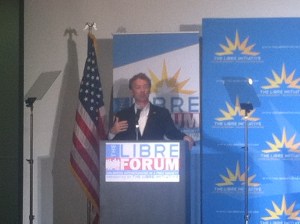
Rand Paul addresses Latino group in Las Vegas.
The event was hosted by the LIBRE Initiative, a non-partisan group that advocates limited government and free enterprise, providing a congenial and receptive audience for Paul, who hails from the libertarian wing of the GOP
Paul made frequent, poignant allusions to Spanish literature throughout his address while telling his own narrative of learning small amounts of Spanish from immigrant children his own age while growing up in Texas. He said the vast wealth and income discrepancies between him and these children were instrumental in his dedication to immigration and border security solutions.
To address these inequalities, Paul is campaigning on an immigration plan built on the economics of supply and demand, advocating for job specific visas that are “proportional” to the number of openings for each job.
Paul saluted the Latino community’s shared commitment to hard work, telling the audience that he “never sees a Hispanic pan-handler.”
Paul also quoted Colombian writer and Nobel laureate Gabriel Garcia Marquez as a source of “advice Republicans might consider,” reciting a line from “Love in the Time of Cholera” to call on his country and his party to seek renewal:
“Human beings are not born once and for all on the day their mothers give birth to them … Life obliges them over and over again to give birth to themselves.”
Nevada will hold its presidential caucuses on February 23, 2016, with 30 delegates at stake. It is the fourth event in the 2016 primary calendar–after Iowa, New Hampshire and South Carolina–and the first test of strength in the West.
Paul is one of eight Southern candidates in the GOP race. The others are U.S. Senators Ted Cruz of Texas, Marco Rubio of Florida and Lindsey Graham of South Carolina; former governors Jeb Bush of Florida, Mike Huckabee of Arkansas and Jim Gilmore of Virginia; and Governor Bobby Jindal of Louisiana.
The lone Southern seeking the Democratic nomination is former U.S. Senator Jim Webb of Virginia.
Rick Perry bows out of 2016 White House race with veiled shot at Trump
Former Texas governor says “no room” for “nativist appeals” in GOP race
♦By Rich Shumate, Chickenfriedpolitics.com editor
 ST. LOUIS (CFP) — Four months before the first vote is cast, former Texas Governor Rick Perry has suspended his campaign for the 2016 GOP presidential nomination — but not before taking a veiled blast at front-runner Donald Trump over his negative comments about Latino immigrants.

Former Texas Governor Rick Perry
“We cannot indulge nativist appeals that divide the nation further,” Perry said, without mentioning Trump by name. “There is no room for debate that denigrates certain people based on their heritage or their origin.”
“We can secure the border of this country and reform our immigration system without inflammatory rhetoric … Demeaning people of Hispanic heritage is not just ignorant, it betrays the example of Christ.”
Perry, who has languished near the bottom of the polls in the crowded GOP field, announced the end of his campaign September 11 in an appearance before the Eagle Forum, a conservative women’s group. The decision to drop out came after news reports that his campaign no longer had enough money to pay staff.
Saying “some things have become clear to me,” Perry went on to laud what he termed “a tremendous field of candidates.”
“I step aside knowing our party’s in good hands as long as we listen to the grassroots, listen to the cause of conservatism,” he said.
Perry, 65, a former Air Force officer who was a cotton farmer in West Texas before getting into politics, left office in January after serving 14 years as governor, the longest tenure in the state’s history.
This was his second try for the White House. He ran in 2012, entering the campaign as one of the favorites only to see his stock plummet after a series of of gaffes, including a moment in a debate when he could not remember the name of a federal agency he had previously pledged to abolish. He later blamed his faltering performance on lack of preparation and the aftereffects of back surgery.
Perry had hoped for political redemption in the 2016 race, but his candidacy never caught fire in the polls. He was one of the most outspoken critics of Trump, particularly over his assertions that many illegal migrants from Mexico were criminals.
Perry was one of nine Southern Republicans seeking the nomination. The other candidates are U.S. Senators Ted Cruz of Texas, Marco Rubio of Florida, Rand Paul of Kentucky and Lindsey Graham of South Carolina; former governors Jeb Bush of Florida, Mike Huckabee of Arkansas and Jim Gilmore of Virginia; and Governor Bobby Jindal of Louisiana.
The lone Southern seeking the Democratic nomination is former U.S. Senator Jim Webb of Virginia.
Watch video of Perry’s withdrawal announcement:
Kentucky GOP switches from presidential primary to caucus to help Rand Paul
Decision means Paul will be able to pursue the White House and re-election to the Senate simultaneously
♦By Rich Shumate, Chickenfriedpolitics.com editor
 FRANKFORT, Kentucky (CFP) — With U.S. Senator Rand Paul looking on, Kentucky’s Republican central committee voted to switch the presidential contest in the Bluegrass State from a May primary to a March caucus, clearing the way for Paul to run for the Senate and the White House at the same time.
U.S. Senator Rand Paul
However, the central committee made the switch contingent on Paul contributing at least $250,000 to defray expenses associated with the caucus, something Paul has promised to do. The committee set a deadline of Sept. 18 for the payment to be made.
The vote, held by secret ballot, was 111-36, more than the two-thirds majority necessary to make the change. After the vote was announced, Paul’s supporters stood and cheered.
Paul release a statement saying “holding a caucus will ensure that Kentucky is relevant and participates early in the process.”
“I am also grateful for the Republican Party’s trust in me, allowing me to run for re-election to the U.S. Senate and seek the nomination for the presidency of the United States,” he said.
The change was necessary because Kentucky law does not allow the same candidate to appear on the ballot twice in the same election. If the Kentucky GOP held a primary, Paul would have faced a choice of whether to seek a second term in the Senate or opt out of a presidential primary contest he is likely to win. The caucus is also earlier in the presidential nominating calendar, which could boost his White House prospects.
Kentucky Democrats, who control the state House and the governorship, have blocked efforts by Paul’s allies to change the state law against political double-dipping. While the change fixes Paul’s problem for the primary, he could still face the same issue in November 2016 if he wins the GOP presidential nomination.
Paul maintains the law is unconstitutional because of a 1995 Supreme Court ruling that a state can’t impose its own restrictions in races for federal offices. He had hinted that he would a federal lawsuit if any attempt is made to keep him from seeking both offices at the same time.
The switch to a caucus was criticized by the Bluegrass State’s top elections official, Democratic Secretary of State Alison Lundergan Grimes, who issued a statement saying “it is unfortunate that today a few insiders were able to disenfranchise over 1.2 million Republican voters.”
“One candidate should not be able to buy an election. Democracy demands that all eligible Kentuckians be a part of the election process. That didn’t happen today and won’t happen with a caucus.
There is historical precedent for running for both the presidency or vice presidency and Congress at the same time, most recently in 2012 when U.S. Rep. Paul Ryan, the GOP’s vice presidential nominee, was re-elected to his House seat in Wisconsin.
Vice President Joe Biden also won Senate re-election in 2008 on the same day he was elected vice president, as did Lyndon Johnson in 1960.
The only other senator up for re-election in 2016 running for president, U.S. Senator Marco Rubio of Florida, is giving up his Senate seat.
 Chicken Fried Politics