
Home » 2018
Yearly Archives: 2018


North Carolina lawmakers give 9th District GOP voters option to dump Mark Harris
General Assembly overrides Governor Roy Cooper’s veto of bill requiring primaries in rerun elections
♦By Rich Shumate, ChickenFriedPolitics.com editor
 RALEIGH (CFP) — North Carolina Republicans will now be able to dump their embattled candidate in the nation’s last undecided U.S. House race, after the General Assembly overrode Governor Roy Cooper’s veto of bill changing state election law.
Under the new law, if state elections officials decide to rerun the 9th District race between Republican Mark Harris and Democrat Dan McCready, both parties will hold primaries, rather than simply redoing the general election.

Mark Harris
That would allow Republicans to replace Harris, whose campaign has become embroiled in an investigation into irregularities in absentee voting in Bladen County, a rural outpost at the edge of the district.
Had the law not been changed, Republicans would have been stuck with Harris as their nominee, raising concerns about losing the seat to McCready in the wake of the investigation.
The controversy over the 9th District race now turns to Washington, where the incoming Democratic majority is expected to refuse to seat Harris pending the outcome of the investigation.
The State Board of Elections. has scheduled a January 11 hearing on the results of the investigation and will then decide whether to order a new election in the 9th District race.
Republicans voted to override Cooper’s veto on December 27, just four days left before they were set to lose their legislative super-majority that has allowed them to override Cooper repeatedly over the last two years.
Cooper’s objection to the law was not over the new primary requirement but a different provision that shielded campaign finance complaints against elected officials from public disclosure.
Republicans hold a two-thirds majority in both houses of the General Assembly, and they have overridden more than 20 of Cooper’s vetoes since he took office in 2017. However, because of Democratic gains in November, the GOP super-majority will go away in January, although Republicans will still control both houses.
The state elections board refused to certify Harris’s unofficial 905-vote lead over McCready after reports surfaced that a political operative working for Harris’s campaign, McRae Dowless, had hired people to collect absentee ballots in Bladen County, a practice that is illegal in North Carolina.
Bladen County also had an unusually high number of absentee ballot requests, and Harris carried the absentee vote by 24 percentage points, a much higher percentage than elsewhere in the district, which stretches across eight counties from suburban Charlotte toward Fayetteville.
Harris has said that he personally made the decision to hire Dowless, but he said he did not know Dowless was doing anything illegal.
Dowless has not spoken publicly about the allegations but has denied any wrongdoing to local media.
McCready, who conceded to Harris on election night, has withdrawn his concession and is now raising money for a rematch.
Also possibly waiting in the wings for Harris in Republican primary is the man who now holds the seat, U.S. Rep. Robert Pittenger, whom Harris defeated by just 828 votes in the May primary after taking 96 percent of the absentee vote in Bladen — results that have come under renewed scrutiny since the state board’s refusal to certify the general election results.
Harris, 52, a Baptist pastor and prominent religious conservative activist, is making his third bid for political office, after losing a U.S. Senate race in 2014 and the 9th District race in 2016.
McCready, 34, a former Marine officer and Iraq War veteran, is making his political debut.
We tweet @ChkFriPolitics Join us!

Democrat Amy McGrath will not run for Kentucky governor in 2019
Recent poll shows Republican Governor Matt Bevin vulnerable to Democratic challenge
 LEXINGTON, Kentucky (CFP) — Amy McGrath will not seek Kentucky’s governorship in 2019, despite the urging of supporters who wanted the rising Democratic star to jump into the race against Republican Governor Matt Bevin, whose sagging popularity has made him vulnerable.

Amy McGrath
In a December 19 email to supporters, McGrath said she was “humbled by the encouragement” to get into the race but decided not to seek the governorship or any other statewide office next year.
“That doesn’t mean I’ll stop working for the values and beliefs we all care about,” she said. “I deeply wish to help move Kentucky and our country forward and I can assure you that I will continue to speak out on the important issues of the day.”
McGrath, 43, a retired Marine combat pilot, burst on the political scene in 2017 when a video announcing her run for the 6th District U.S. House seat went viral.
She went on to win the Democratic primary and raise $8.6 million for the race, the most by any Southern Democratic House challenger in the 2018 election cycle. In the end, she lost to Republican U.S. Rep. Andy Barr by 9,700 votes.
McGrath’s potential candidacy for governor faced a possible hurdle — Kentucky’s Constitution requires six years of continuous residence to run for governor, and McGrath had lived out of state during her military service before returning to run for Congress.
Had she run, the courts would have likely decided if McGrath’s out-of-state military service disqualified her.
However, that state requirement would not bar her from seeking federal office again — including the U.S. Senate seat held by Majority Leader Mitch McConnell, who is up for re-election in 2020.
Bevin announced in August that he plans to run for re-election in 2019. However, he has yet to file the paperwork needed to begin raising money for the race.
A Mason-Dixon poll taken Dec. 12-15 found Bevin’s approval rating at 38 percent, with 53 percent saying they disapproved of the governor’s performance. A year earlier, his approval was 45 percent in the same poll.
Earlier this month, the Kentucky Supreme Court unanimously struck down a pension reform bill crafted by Bevin and Republicans in the legislature, which sparked angry protests by teachers and state employees when it passed last spring.
Bevin then called lawmakers into special session to push through the pension measure again, only to see GOP leaders adjourn after one day without taking any action, which the governor criticized as “one of the worst financial days to have ever descended down on the Commonwealth.”
The legal fight to overturn the pension law was led by Democratic Attorney General Andy Beshear, who is running to unseat Bevin. The Mason-Dixon poll showed Beshear with a 48 percent to 40 percent lead over Bevin in a hypothetical match-up, right at the poll’s margin of error.
Also in the Democratic race is House Minority Leader Rocky Adkins from Sandy Hook. The biggest unknown is whether Secretary of State Alison Lundergan Grimes will run now that her father, Jerry Lundergan, has been indicted on charges of illegally funneling money into her 2014 U.S. Senate campaign.
Grimes, the only Democrat other than Beshear to hold statewide office, has not been implicated in the case. But her father’s trial is scheduled for August, right in the middle of the campaign.
Other Democrats considering the race including former State Auditor Adam Edelen from Lexington and State Rep. Attica Scott from Louisville.
Kentucky is one of five states that elect their governors in off years, along with Mississippi, Louisiana, Virginia, and New Jersey. Among those states, Mississippi and Louisiana are also up in 2019.
While Republicans hold most state and federal offices in Kentucky, and President Donald Trump carried the commonwealth by 30 points in 2016, Democrats have had more success winning the governorship.
Bevin is just the third Republican elected governor in the past 50 years, and no Republican has won re-election since the Constitution was changed in 1992 to allow governors to succeed themselves.
We tweet @ChkFriPolitics Join us!

U.S. Senator Lamar Alexander will retire in 2020
Decision sets up a open Senate race in Tennessee for the second election cycle in a row
♦By Rich Shumate, ChickenFriedPolitics.com editor
 NASHVILLE (CFP) — Republican U.S. Senator Lamar Alexander has announced he will not seek re-election in 2020, bringing down the curtain on a political career that has spanned five decades and setting up another high-octane contest for an open Senate seat in Tennessee.

U.S. Senator Lamar Alexander
“The people of Tennessee have been very generous, electing me to serve more combined years as Governor and Senator than anyone else from our state,” Alexander said in a statement announcing his retirement. ” I am deeply grateful, but now it is time for someone else to have that privilege.”
“I have gotten up every day thinking that I could help make our state and country a little better, and gone to bed most nights thinking that I have. I will continue to serve with that same spirit during the remaining two years of my term.”
Alexander’s decision means that Tennessee will have an open Senate contest for the second election cycle in a row. His longtime seatmate, U.S. Senator Bob Corker, did not seek re-election this year.
The contest will likely draw a large field, particularly on the Republican side. Among candidates being mentioned are outgoing Republican Governor Bill Haslam and two unsuccessful GOP candidates for governor in 2018, U.S. Rep. Diane Black and Randy Boyd.
Given the result of the 2018 Senate election — which Republican U.S. Rep. Marsha Blackburn won by 11 points — the GOP candidate will be heavily favored. No Democrat has won a Senate race in Tennessee since Al Gore in 1990.
Alexander, 78, is serving his third term in the Senate and chairs the Senate Health, Education, Labor and Pensions Committee, where he has been a key player in Republican efforts to repeal and replace Obamacare.
Alexander’s service in political office began in 1978, when he was elected governor on his second try. During that campaign, he walked more than 1,000 miles across the entire length of Tennessee to meet voters, wearing a red-and-black flannel shirt that became his trademark.
After leaving the governorship in 1987, Alexander became president of the University of Tennessee, a post he left in 1991 when he was named education secretary by President George H.W. Bush.
Alexander ran unsuccessfully for the Republican presidential nomination in both 1996 and 2000. In 2002, he was elected to the Senate and was easily re-elected in 2008 and 2014.
He is the only Tennessean ever elected as both governor and senator, and his 2008 vote total — 1.58 million votes — still stands the largest ever recorded by a statewide candidate.
In the Senate, Alexander had a conservative voting record but was also willing to work with Democratic colleagues on bipartisan measures. He drew a Tea Party challenger in his primary in 2014, Joe Carr, but won easily after getting the backing of the entire state GOP establishment.
Unlike Corker, Alexander has not been a vocal critic of President Donald Trump, although he did publicly criticize the president’s executive order banning immigrants from seven mostly-Muslim countries and opposed a program to separate migrant children from their parents at the U.S.-Mexico border.
Alexander is also a trained pianist who has performed at the Grand Ole Opry.
The Tennessee seat will be one of 12 Southern Senate seats open in 2020, 10 of which are held by Republicans. Alexander is so far the only Southern incumbent to announce his retirement.
We tweet @ ChkFriPolitics Join us!

Mick Mulvaney’s biting comments about Trump resurface after he’s named acting White House chief of staff
Former South Carolina congressman called Trump “a terrible human being” during 2016 debate
♦By Rich Shumate, ChickenFriedPolitics.com editor
 WASHINGTON (CFP) — Just hours after President Donald Trump took to Twitter to name Mick Mulvaney acting White House chief of staff, a national news outlet resurrected a video from a 2016 congressional debate in South Carolina in which Mulvaney calls Trump “a terrible human being.”
The Daily Beast posted a short clip from video taken during a debate in York shortly before the 2016 election.
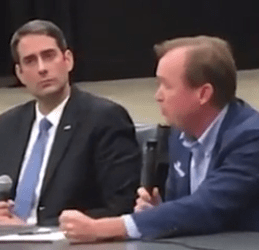
Mick Mulvaney at 2016 congressional debate (Photo from Daily Beast)
“Yes, I am supporting Donald Trump. I’m doing so as enthusiastically as I can despite the fact that I think he’s a terrible human being. But the choice on the other side is just as bad,” Mulvaney said.
Mulvaney’s comments were reported at the time of the debate by The State newspaper in Columbia. In that story, Mulvaney also called Trump and his Democratic rival, Hillary Clinton, “perhaps two of the most flawed human beings running for president in the history of the country.”
The Daily Beast did not say where it obtained the video clip, which did not contain the rest of the debate.
Mulvaney’s comments in 2016 stand in contrast to his December 14 tweet after Trump installed him as chief of staff, albeit in an acting capacity.
“This is a tremendous honor,” he said. “I look forward to working with the President and the entire team. It’s going to be a great 2019!”
Neither the White House nor Trump have responded to the video. But a spokeswoman for Mulvaney called it “old news” and noted that Mulvaney had not yet met the president when he made those remarks.
Mulvaney, 51, represented South Carolina’s 5th District from 2011 until he was named by Trump as director of the Office of Management and Budget in 2017. The White House has said he will not give up the OMB job while serving temporarily as chief of staff.
Neither Trump nor the White House indicated how long Mulvaney might serve in the interim role.
Mulvaney will replace John Kelly, who Trump announced would be leaving the White House by the end of the year.
We tweet @ChkFriPolitics Join us!
North Carolina lawmakers allow GOP to ditch Mark Harris if disputed U.S. House race is rerun
Harris confirms he hired political operative at center of absentee ballot investigation but says he was unaware of illegal activity
♦By Rich Shumate, ChickenFriedPolitics.com editor
CHARLOTTE (CFP) — The Republican-controlled North Carolina legislature has voted to require party primaries if state elections officials order a rerun of the disputed 9th District U.S. House race — a move that would allow the GOP to ditch Mark Harris, their current nominee who is at the center of an absentee voting scandal.
Mark Harris
In another development, Harris — in his first interview since the scandal broke — told Charlotte TV station WTVB that he personally made the decision to hire McRae Dowless, the Bladen County political operative at the center of an investigation by the State Board of Elections. But he said he did not know Dowless was doing anything illegal.
The state board, which has refused to certify Harris’s unofficial 905-vote lead over Democrat Dan McCready, will hold an evidentiary hearing on the election dispute on January 11, which means that Harris is unlikely to be seated when the new Congress convenes on January 3.
Harris told WBTV that he decided to hire Dowless after narrowly losing a Republican primary for the 9th District seat in 2016, in which an opponent who hired Dowless had a strong performance among absentee voters in Bladen, a rural outpost at the eastern end of the district.
“I remember looking at that and going, ‘Wow, that’s unusual,'” Harris said.
Harris said the services Dowless offered included canvassing people to fill out absentee ballot requests and then helping them cast and mail in their ballots — not collecting and returning ballots for them, which is illegal in North Carolina.
“I remember (Dowless) saying specifically that they were not to take a ballot. They were not to touch a ballot,” Harris said, noting that Dowless had been “vouched for by a number of other leaders down there.”
“I had no reason to think that what he was doing was illegal,” Harris said.
The state board refused to certify the election after evidence surfaced that Dowless and workers that he hired had collected ballots during the November vote. Bladen County also had an unusually high number of absentee ballot requests, and Harris carried the absentee vote by 24 percentage points.
Dowless has not spoken publicly about the allegations but has denied any wrongdoing to local media.
Harris said the board’s refusal to certify the election was “frustrating” plans to set up his congressional offices and get committee assignments.
“It’s been very frustrating because I’ve been elected to serve the 9th District, and I don’t feel like the 9th District is getting served,” he said.
In his interview, Harris did not directly criticize GOP legislative leaders for moving to force a new primary. But he did say, “I certainly don’t feel the circling of the wagons around Harris the way I see the Democrats circling the wagons around McCready.”
The bill passed December 13 by the legislature would require Democratic and Republican primaries if a rerun of the 9th District election is ordered. Had the law not been changed, Republicans would have been stuck with Harris as their nominee, raising concerns about losing the seat to McCready in the wake of the investigation.
McCready, who conceded to Harris on election night, has withdrawn his concession and is now raising money for a rematch.
Also possibly waiting in the wings for Harris in Republican primary is the man who now holds the seat, U.S. Rep. Robert Pittenger, whom Harris defeated by just 828 votes in the May primary after taking 96 percent of the absentee vote in Bladen — results that have come under renewed scrutiny since the state board’s refusal to certify the general election results.
The bill mandating a primary — contained in a larger package of election reforms passed during a lame duck legislative session — is awaiting Democratic Governor Roy Cooper’s signature. If Cooper vetoes the bill, Republicans would have the votes to override him.
Because of Democratic gains in November, Republicans will only hold veto-proof majorities until January, when the new legislature takes office.
Harris, 52, a Baptist pastor and prominent religious conservative activist, is making his third bid for political office, after losing a U.S. Senate race in 2014 and the 9th District race in 2016.
McCready, 34, a former Marine officer and Iraq War veteran, is making his political debut.
The 9th District takes in eight counties stretching from the suburbs of Charlotte east toward Fayetteville.
 Chicken Fried Politics