
Home » 2019 (Page 3)
Yearly Archives: 2019


Jeff Sessions wants his old job back as Alabama U.S. Senator
Sessions files to run in GOP primary to reclaim the seat he gave up to become Donald Trump’s attorney general
♦By Rich Shumate, ChickenFriedPolitics.com editor
 MONTGOMERY (CFP) — In 2017, Jeff Sessions gave up the U.S. Senate seat he had held for 20 years to become President Donald Trump’s first attorney general.
Now, after parting with the president on unhappy terms, Sessions wants that job back — but he’ll have to fight through Trump and a field of Alabama Republicans to get it.
Sessions, 72, who represented Alabama in the Senate from 1997 until 2017, announced November 7 that he will file the paperwork to run for his old seat, which is currently held by Democratic U.S. Senator Doug Jones.

Jeff Sessions announces Senate run on Fox News
“It’s not ‘my seat’ in the Senate, but I believe I have something to give,” Sessions said during an appearance on Tucker Carlson’s Fox News show where he announced his Senate run. “I have some convictions that I think need to be pushed.”
“We need to get some of the Republicans moving. They haven’t been pushing hard enough to advance the Trump agenda,” he said.
Sessions also released a campaign ad which made it clear that he will try to run for the Senate as a pro-Trump candidate, despite his rocky tenure and messy split from the administration.
Watch Jeff Session’s campaign ad at the end of this story.
“When I left President Trump’s Cabinet, did I write a tell-all book? No. Did I go on CNN and attack the president? Nope. Have I said a cross word about our president? Not one time,” Sessions said. “I’ll tell you why. First, that would be dishonorable. I was there to serve his agenda, not mine. Second, the president is doing a great job for America and Alabama, and he has my strong support.”
With Sessions in the race, the looming question is how loudly and often Trump might weigh in against a man he repeatedly dismissed as “weak” and disappointing before eventually firing him.
In the wake of Sessions’s interview with Carlson, Trump told reporters Friday that he has not decided whether to get involved in the race and that Sessions “said very nice things about me.” While not endorsing Sessions, he did not unload on him, either.
On Saturday, the president is visiting Tuscaloosa for the Alabama-LSU football game, putting the state’s Senate race top of mind, particularly for Sessions’s new primary rivals who may be vying for demonstrations of Trump’s favor.
Sessions’s last-minute decision to run — on the final day to file — shakes up a Republican primary race that had already attracted eight candidates, including U.S. Rep. Bradley Byrne from Mobile, former Auburn University football coach Tommy Tuberville, Secretary of State John Merrill, and Roy Moore, a former state Supreme Court justice who lost the seat to Jones in 2017 amid allegations of sexual conduct with underage girls.
Perhaps most affected is Byrne, who gave up his House seat to run for the Senate and could now end up out of office if he can’t beat Sessions, a proven vote-getter who has won five statewide races.
Byrne made it clear that Sessions’s fractured relationship with Trump will be part of the upcoming race.
“Alabama deserves a Senator who will stand with the President and won’t run away and hide from the fight,” Byrne said on Twitter.
Tuberville made the same point, calling Sessions “a career politician” who “failed the President at his point of greatest need.”
“[President] Trump said it best when he called Jeff Sessions ‘a disaster’ as AG and an ’embarrassment to [Alabama],” Tuberville said on Twitter.
Trump forced Sessions out as attorney general in 2018 after criticizing him for months for recusing himself from overseeing the investigation by special counsel Robert Mueller. The president called Sessions “weak” and said he regretted elevating him to the post.
Sessions’s candidacy did draw a quick endorsement from Alabama’s senior U.S. Senator, Republican Richard Shelby, who said Sessions would be “formidable candidate.”
“Jeff Sessions is a friend. I worked with him every day up here for 20 years,” Shelby said “He’s a man of integrity. Of course, he’ll have to run his own race, and that’s up to the people of Alabama.”
Sessions’s return is the latest twist in a topsy turvy political saga set off by his resignation to join Trump’s Cabinet.
Then-Governor Robert Bentley appointed Republican Luther Strange to the vacant seat. But when Bentley resigned amid a sex scandal, his successor, Governor Kay Ivey, ordered a special election to fill the vacancy, and Moore defeated Strange for the Republican nomination, despite Trump’s vocal support of Strange.
After Moore’s campaign imploded in scandal, Jones won a narrow victory, become the first Democrat to win a Senate race in the Yellowhammer State in 25 years.
Trump weighed in on the race twice, first to try to help Strange beat Moore and then to try to help Moore beat Jones, neither of which worked.
If Jones loses, the new senator would be the fourth person in four years to hold the seat, in a state that previously had not had a Senate vacancy in 20 years.
Jones is considered to be the most endangered 2020 Senate Democrat, running in a state Trump carried by 28 points, but is likely to benefit from turmoil in the Republican primary.
Watch Jeff Session’s new campaign ad:
We tweet @ChkFriPolitics Join us!

Mississippi Votes: Republican Lieutenant Governor Tate Reeves wins governorship
Reeves defeats Democratic Attorney General Jim Hood with last minute push from President Donald Trump
♦By Rich Shumate, ChickenFriedPolitics.com editor
 JACKSON, Mississippi (CFP) — Mississippi Republican Lieutenant Governor Tate Reeves has capped a 16-year ascent through the ranks of state politics by capturing the governorship, extending the GOP’s lock on the office for another four years.
Reeves — buoyed by a pre-election visit to Tupelo by President Donald Trump — defeated Democratic Attorney General Jim Hood in the November 5 vote by a margin of 52 percent to 47 percent.
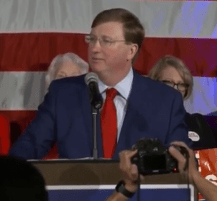
Governor-elect Tate Reeves addresses supporters in Jackson (WJTV via YouTube)
“This is the 12th time I have woke up on a Tuesday morning and put my fate in the hands of the good Lord and the voters of Mississippi,” Reeves told supporters in a victory speech in Jackson. “The Lord always gets it right, and I think the people of Mississippi usually get it right.”
Republicans also swept elections for lieutenant governor, attorney general, secretary of state, auditor, treasurer and agriculture commissioner to continue the GOP’s dominance in the Magnolia State.
Democrats, who last won a governor’s race in 1999, were hoping that Hood — running to the right of national party on contentious social issues such as abortion and gun control — could break through against Reeves, who had to fight his way through a contentious GOP primary and runoff.
Hood, the only Democrat left holding statewide office, had won four races for attorney general but could not make the leap to the state’s top office in a state Trump carried by 28 points in 2016.
In his victory speech, Reeves thanked Trump and Vice President Mike Pence for coming to Mississippi to campaign on his behalf.
“It would have been easy for them to ignore an election for state office in little ol’ Mississippi,” Reeves said. “But they paid atention. They showed up, and they worked hard. And I will never, ever forget their support.”
The win by Reeves, 45, completes an ascent through state politics that began when he was elected as state treasurer in 2003 at age 29. After two terms as treasurer, he was elected twice as lieutenant governor and will now assume the state’s top political job in January.
The incumbent governor, Republican Phil Bryant, was term limited.
Republicans also retained their large majorities in both house of the legislature, although they fell short of getting a two-thirds majority in the House.
We tweet @ChkFriPolitics Join us!

Virginia Democrats flip both houses of General Assembly from red to blue
Democrats will now have total control of reapportionment after 2020 census
♦By Rich Shumate, ChickenFriedPolitics.com editor
 RICHMOND (CFP) — Democrats have won majorities in the Virginia Senate and House of Delegates for the first time in 24 years, completing a takeover of state government that will give them total control of the reapportionment process after the 2020 census.
Democrats won 21 of the 40 seats in the Senate and 54 of the 100 seats in the House in the November 5 vote.
Coupled with the Democratic sweep of all three statewide offices in 2017 and flipping three U.S. House seats in 2018, Tuesday’s result is the latest evidence that political control Old Dominion has slipped away from the GOP and into Democratic hands.
The two legislative chambers in Virginia will also be the only two under Democratic control anywhere in the South; Republicans control the other 26.
Heading into the election, Republicans held a 21-to-19 majority in the Senate and a 51-to-49 majority in the House. Democrats needed to flip two seats to control the House and one seat to control the Senate, where Democratic Lieutenant Governor Justin Fairfax holds the tie-breaking vote.
Their gain in the House was five seats, while they picked up two in the Senate.
As they did in 2017 and 2018, Democrats picked up seats in suburbs of Washington, D.C., Richmond and Hampton Roads. Among the casualties was last Republican left representing a district in the inner D.C. suburbs, Delegate Tim Hugo from Fairfax County, who has been in the legislature for the last 17 years.
The top ranking Republican in the House, Speaker Kirk Cox from Colonial Heights, had to battle to keep his seat, surviving with a narrow 4-point victory that will return him to Richmond, though not to the speaker’s chair.
Republicans retained House control after the 2017 election only after one of their candidates, David Yancey, won a drawing by lot after his race against Democrat Shelly Simonds ended in a tie. This time around in a rematch, Simonds easily beat Yancey, taking nearly 57 percent of the vote.
In addition to now controlling the legislature, Democrats also hold both of Virginia’s U.S. Senate seats, the governorship, and seven out of 11 seats in the congressional delegation. Democrats have also won the last three presidential elections in the state.
With control of the legislature and governorship, Democrats will be in complete control of reapportionment after the 2020 census, allowing them to protect the gains they have made by drawing favorable maps for the next decade.
We tweet @ChkFriPolitics Join us!

Kentucky Votes: Democrat Andy Beshear ousts Republican Governor Matt Bevin
Beshear won despite President Donald Trump going all in for Bevin
♦By Rich Shumate, ChickenFriedPolitics.com editor
 LOUISVILLE (CFP) — Democratic Attorney General Andy Beshear has defeated Kentucky’s Republican Governor Matt Bevin, who could not overcome his personal unpopularity to hang on to his job despite vocal support from President Donald Trump and a Republican wave further down the ballot.
Beshear took 49.2 percent in the November 5 vote to 48.9 percent for Bevin, who saw his approval ratings tank after a tumultuous four years in Frankfort during which he sparred with his fellow Republicans in the legislature, fought with his own lieutenant governor, and heaped criticism on public school teachers.
However, Bevin, trailing by 4,700 votes, refused to concede, telling his supporters that “we know for a fact that there have been more than a few irregularities” in the election.
The governor did not give specifics, saying only that the nature of the irregularities “will be determined according to law that’s well established.”
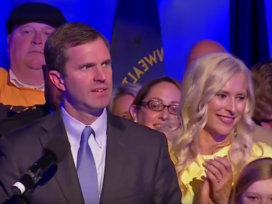
Kentucky Governor-elect Andy Beshear speaks to supporters in Louisville (Fox News via YouTube)
Beshear, speaking to jubilant supporters at a victory celebration in Louisville, said “my expectation is that [Bevin] will honor the election that was held tonight, that he will help us make this transition.”
The hotly contested governor’s race sparked a voter turnout more than 400,000 higher than in the last governor’s race in 2015, with Beshear crushing Bevin by 2-to-1 margins in the urban centers of Louisville and Lexington.
Republicans got better news in the race to succeed Beshear as attorney general, as Daniel Cameron, a protegé and former aide to the state’s senior Republican, Senate Majority Leader Mitch McConnell, won the post, marking the first time in 76 years that it has gone to a Republican.
Despite losing the governorship, GOP candidates swept the rest of the statewide offices on the ballot Tuesday. Beshear will also have to work with large Republican majorities in the legislature to push through his agenda.
Beshear, 41, will now follow in the footsteps of his father, Steve, who served as governor from 2010 to 2016.
In his victory speech, Beshear said the result showed “that our values and how we treat each other is still more important than our party, that what unites us as Kentuckians is still stronger than any national divisions.”
“Tonight, I think we showed this country that in Kentucky, we can disagree with each other while still respecting one another,” Beshear said.
The gubernatorial contest became a bitter grudge match between Bevin and Beshear, who had sued the governor repeatedly over the past four years as attorney general.
Beshear had portrayed Bevin as a bully, particularly for his critical comments about public school teachers who have been protesting Republican-backed pension reform plans. To emphasize the point, he selected a public school teacher, Jacqueline Coleman, as his running mate for lieutenant governor, and he saluted teachers in his election night speech.
“Your courage to stand up and fight against all the bullying and name calling helped galvanize our entire state,” Beshear said. “This is your victory. From now on, the doors of your State Capitol will always be open.”
Bevin had painted Beshear as a far-left liberal and wrapped himself firmly in the mantle of Trump, who carried the Bluegrass State by 30 points in 2016.
Trump was featured prominently in Bevin’s ads, and he dropped into Lexington on the night before the election to hold a rally with the governor in which he urged supporters to come out for Bevin because “if you lose, it sends a really bad message … You can’t let that happen to me.”
The president offered no immediate reaction on Twitter to the results in the governor’s race, although he did tweet congratulations to Cameron for his victory in the attorney general’s contest.
Bevin, like Trump, did well in rural parts of the state. However, Beshear rolled up a margin of more than 130,000 votes in Louisville and Lexington and also won two of the three counties in suburban Cincinnati along with Frankfort and Bowling Green.
In the attorney general’s race, Cameron ran well ahead of Bevin to defeat Democrat Greg Stumbo in by a margin of 57 percent to 43 percent. Stumbo served as attorney general from 2004 to 2008.
Cameron, making his first bid for political office, is also the first African American to win a statewide race in Kentucky in his own right. (Current Lieutenant Governor Jenean Hampton was elected on a ticket with Bevin in 2015; he bounced her from his re-election ticket earlier this year.)
A Republican had not been elected attorney general since 1943, a string of 15 consecutive defeats which Cameron finally ended.
Republican incumbents swept other statewide races for auditor, treasurer and agriculture commissioner.
In the open race for secretary of state, Republican Michael Adams defeated Democrat Heather French Henry, a former Miss America.
We tweet @ChkFriPolitics Join us!
Governorships, legislative control on ballot in 3 Southern states Tuesday
Voters in Kentucky, Mississippi and Virginia will cast ballots in off-year elections for state offices
♦By Rich Shumate, ChickenFriedPolitics.com editor
Voters in three Southern states will troop to the polls Tuesday to decide their state’s balance of power and give a first indication of how the current fractious state of American politics might play out in the 2020 election.
In Kentucky and Mississippi, Democratic candidates have a shot at wresting governorships out of GOP hands. In Virginia, Democrats will be trying to complete a takeover of state government by gaining the handful of seats they need to flip both houses of the legislature — which would give them unfettered power to draw political maps after the 2020 census.
Towering over all of these races is President Donald Trump, who has put his personal political prestige on the line by going all in for Republican candidates in Kentucky and Mississippi. Although Trump is not in any trouble in either state in 2020, Democrats will no doubt crow if Trump proves unable to carry his preferred candidates over the line.
In Kentucky, Republican Governor Matt Bevin is seeking re-election after a tumultuous four years in Frankfort that have left him among the nation’s least popular chief executives. He is being challenged by his archenemy, Democratic Attorney General Andy Beshear, who has repeatedly sued the governor and now hopes to replace him.
Bevin has tried to counter his low approval ratings by wrapping himself in the Trump mantle and painting Beshear as a far-left liberal, particularly on the issue of abortion. Bevin opposes legal abortion, which Beshear supports.
Beshear has countered by painting Bevin as a bully, particularly in his critical comments about public school teachers who have been protesting Republican-backed pension reform plans.
The other race of note in Kentucky is the contest to replace Beshear as attorney general between Republican Daniel Cameron, a protegé of Senator Majority Leader Mitch McConnell, and Democrat Greg Stumbo, who held the office from 2004 to 2008.
Although Republicans have become dominant in Kentucky politics in recent decades, the last time a Republican won a race for attorney general was 1943 — a streak of 15 consecutive wins that Cameron hopes to snap.
Cameron would also be the first African American to win a statewide race in Kentucky in his own right. (Current Lieutenant Governor Jenean Hampton was elected on a ticket with Bevin in 2015; he bounced her from his re-election ticket earlier this year.)
In Mississippi, two men who have served alongside each other in statewide office for the past 16 years, Republican Lieutenant Governor Tate Reeves and Democratic Attorney General Jim Hood, are facing off in the governor’s race.
Democrats, who haven’t won a governor’s race in the Magnolia State since 1999, are hoping that Hood — running to the right of national party on contentious social issues such as abortion and gun control — can break through against Reeves, who had to fight his way through a contentious GOP primary and runoff.
However, a wrinkle in Mississippi law may prove Hood’s undoing — to win, a candidate not only has to win the most votes on Tuesday but must also carry a majority of state House districts. If that threshold isn’t meant, the next governor will be selected by the Republican-controlled legislature, which will almost certainly give the job to Reeves.
The threshold requirement — implemented during the era of Jim Crow to prevent black candidates from winning statewide offices — is currently being challenged in federal court, a suit that will take on new resonance if Hood wins the most votes but doesn’t carry enough districts.
In Virginia, statewide offices aren’t on the ballot, but all 100 House seats and 40 Senate seats are up for grabs.
Currently, Republicans hold a narrow 21-19 in the Senate and a 51-49 majority in the House, which means a net shift of two seats in either house could switch it to Democratic control.
Virginia has been trending Democratic in recent years, and two years ago, Democrats made huge gains to nearly take control of the House while also sweeping statewide races for governor, lieutenant governor and attorney general.
Democrats haven’t controlled the House since 1997 or the Senate since 2014. Should they take both chambers Tuesday, it will be the first time since 1993 that Democrats have controlled the legislature and the governorship, which will allow them to redraw legislative and congressional districts after the 2020 census.
Virginia’s congressional delegation currently has seven Democrats and four Republicans, after Democrats flipped three GOP-held seats in 2018. Controlling reapportionment would allow Democrats to protect those gains by drawing more favorable maps, as well as drawing new maps to cement their control of the legislature.
 Chicken Fried Politics