
Home » 2021 (Page 5)
Yearly Archives: 2021


Big Risk: Ron DeSantis and Greg Abbott double down on mandates despite unpredictability of COVID crisis
Will short-term gain for leading charge against COVID-19 restrictions backfire if cases surge in schools?
♦By Rich Shumate, ChickenFriedPolitics.com editor
 (CFP) — A number of Southern Republican political leaders — most notably, Florida Governor Ron DeSantis and Texas Governor Greg Abbott — have decided to take a huge gamble; namely, to lead the charge against new COVID-19 restrictions, despite the Delta variant ripping across their states, filling up hospitals and stretching front-line workers to their breaking point.
It’s an experiment — literally — that is particularly risky given that one of the populations being experimented are hundreds of thousands of school children, whose parents cannot get them COVID-19 vaccinations even if they want to.

Governors Ron DeSantis of Florida and Greg Abbott of Texas
If DeSantis and Abbott are right — that all of the doomsaying and caterwauling by public health officials is an overblown overreaction — their gamble is likely to delight their base and pay dividends when they come up for re-election next year.
But if they are wrong — if busloads of children start getting sick or dying — these current prohibitive favorites could find themselves in electoral trouble. Which begs the question, is it worth the risk?
To see the possible pitfalls of this strategy, one need only look at the school district in Marion, Arkansas, where, after just the first week of classes in August, 900 students and staff were in quarantine.
That was enough to convince Republican Governor Asa Hutchinson that his decision back in April to sign into law a ban on mask mandates, pushed through by Republican lawmakers, was a mistake. It was not, however, enough to convince those lawmakers to reverse the mask ban when Hutchinson summoned them back to Little Rock for a special session to do so.
To be clear, neither DeSantis and Abbott are anti-vaxxers. On the other hand, they are not merely taking a personal political stand against mask and vaccine mandates — they are aggressively pushing back against local officials and even private businesses who want to put these measures into place themselves.
Two hallmarks of traditional conservatism are giving power to local officials to make decisions they think best for their communities (particularly school boards) and giving businesses free hand to run their enterprises as they see fit. Both have gone out the window amid a conservative backlash to mask and vaccine mandates, a wave which DeSantis and Abbott seem eager to ride.
DeSantis has gone so far as to oppose hospitals requiring staff on the front lines of the pandemic to get vaccinations, and he has gone to court to block cruise lines from requiring vaccinations for passengers, which the cruise companies desperately want.
Given the devastating outbreaks of COVID-19 among cruise ship passengers during the early days of the pandemic, cruise companies want to err on the side of caution; DeSantis is coming down instead on the side of an expansive sense of personal liberty, even at the expense of public health.
Both Abbott and DeSantis are responding to a part of their base that is skeptical of vaccines and vehemently opposed to mask mandates and lockdowns. Some of these people even argue that masks are harmful for children, an assertion not supported by any reputable medical research.
The irony, of course, if that if these people had gotten vaccinated, the COVID-19 might now be mostly over, eliminating the possibility of mandates or lockdowns.
It makes sense, with perverted logic, for people who believe COVID is a hoax to support dispensing with restrictions even though most people are still unvaccinated. But if the last 18 months have taught Abbott and DeSantis anything, it is surely that COVID isn’t a hoax.
Abbott is facing primary challengers who already complain that he’s taken too many COVID precautions, perhaps explaining why he’s so resistant to more. DeSantis is not yet being primaried on this issue, so taking a hard line here is perhaps a way to stopping a challenge from getting off the ground — not to mention helping him with a possible 2024 presidential run.
Still, a recent Florida polled showed DeSantis’s job approval under water, in a state where the last three governor’s races were decided by 1 point or less. Texas is more Republican but not out of reach for Democrats if the public comes to believe people have died needlessly under Abbott’s stewardship.
Two other facts call into question the wisdom of DeSantis and Abbott’s big risk.
First, the fallout from the COVID pandemic likely cost Donald Trump re-election, something even the former president has been willing to concede. So, perhaps this is a lesson to which more attention needs to be paid.
And second, COVID has proven to not only be tremendously deadly but highly unpredictable. So, climbing out on a political limb and hoping that the worst public health crisis in a century will turn out all right in the end would seem a dubious long-term strategy, even if the base lustily cheers in the short term.
However, for better or worse, both DeSantis and Abbott have embraced this risk. So in that bed they will now have to lie.
We tweet @ChkFriPolitics.com Join us!

Texas State Rep. Jake Ellzey wins U.S. House runoff, defeats Trump-backed Susan Wright
Ellzey will replace the late U.S. Rep. Ron Wright, who died from COVID-19 in February
 ARLINGTON, Texas (CFP) — State Rep. Jake Ellzey claimed Texas’s 6th U.S. House District seat in Tuesday’s all-Republican runoff, defeating Susan Wright, who was trying to keep the seat of her late husband, U.S. Rep. Ron Wright.
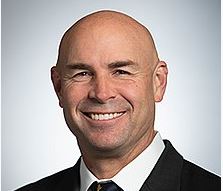
U.S. Rep.-elect Jake Ellzey, R-Texas
The result was a blow to former President Donald Trump, who endorsed Wright and publicly supported her candidacy in the final stretch. His super PAC also dropped $100,000 in a last minute advertising buy.
Ellzey took 53% in the runoff to 47% for Wright to win a district that includes Arlington and parts of Tarrant County, along with Ellis and Navarro counties to the south.
The all-party special election was called after Ron Wright’s death from COVID-19, while undergoing cancer treatment in February.
In the first round of voting in May, Wright and Ellzey claimed both spots in the runoff. Democrats were boxed out when the party’s 2018 nominee for the seat, Jana Lynne Sanchez, came in third, just 350 votes behind Ellzey.
Democrats had hopes of flipping the seat in suburban Dallas-Fort Worth, which Trump carried by just 3 points in 2020. But two other Democrats in the race took 10,000 votes from Sanchez, securing the seat for the GOP.
Tuesday’s runoff was something of a rematch from the 2018 election for the post, when Ron Wright defeated Ellzey to win an open seat.
The district’s previous long-time congressman, Joe Barton, endorsed Ellzey, as did Governor Greg Abbott and former Governor Rick Perry. But Trump went all in for Wright.
We tweet @ChkFriPolitics Join us!

Second time’s a charm? Charles Booker makes new run for Kentucky U.S. Senate seat
Former Democratic legislator from Louisville will face uphill climb to unseat Republican U.S. Senator Rand in 2022
♦By Rich Shumate, ChickenFriedPolitics.com editor
 LOUISVILLE (CFP) — When he launched his first run for the U.S. Senate in 2020, few observers gave Charles Booker a snowball’s chance in a Kentucky August.
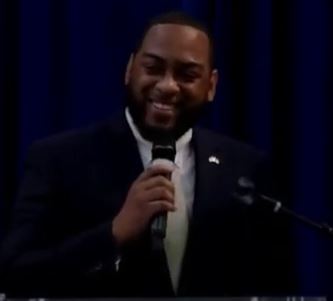
Democrat Charles Booker announces U.S. Senate run
He was just 32, had served in the legislature for just one year, and was trying to wrestle the Democratic nomination away from Amy McGrath, a fundraising powerhouse who had the full backing of Senate Democrats and their leader, Chuck Schumer.
But then, Booker took a leading role in social justice protests in Louisville after the shooting death of Breonna Taylor, his charismatic style caught the imagination of the Democratic left, and — amid an uneven, uninspiring and hyper-cautious campaign from McGrath — he came within 16,000 votes of pulling off what would have one of the year’s biggest primary upsets.
Exiting the race, Booker told his supporters, “Don’t ever let someone tell you what’s impossible.”
A year later, he’s trying the impossible again, this time with a run for the state’s other U.S. Senate seat, held by Republican U.S. Senator Rand Paul.
“A lot of people don’t believe that change is possible in Kentucky. We’re going to prove the doubters wrong,” Booker told supporters at his kickoff rally in Louisville July 1. “We’re going to win this race, and we’re going to transform Kentucky, and it starts right now. Let’s go.”
Video of Booker’s announcement speech at end of story.
And Booker made it clear that whether or not his optimism is borne out, or whether or not the race against Paul ends up being competitive in the end, his quest to unseat Paul will be fiery, unapologetically liberal and in-your-face, in a way McGrath never was.
“Randal Howard Paul — I see you. I see you, but you don’t see us,” Booker said. “Rand Paul thinks we are a joke. He mocks us whenever he opens his mouth. He’s mocking us. He’s an embarrassment to Kentucky because he does not care.”
“He thinks his job is to stir dysfunction, to weaponize hate and essentially dismiss Kentuckians altogether.”
Rand’s response to Booker’s announcement telegraphed the likely Republican strategy against him; namely, pounding him on his more left-wing positions in a conservative state: “I just don’t think defunding the police and forcing taxpayers to pay for reparations will be very popular in Kentucky.”
What happened to McGrath in 2020 illustrates the decidedly uphill nature of Booker’s quest in 2022. She spent $90 million to lose to Senate Republican Leader Mitch McConnell by 20 points, failing to even break 40%.
Of course, McConnell is a more formidable political force than Paul, and McGrath’s near loss to Booker in the Democratic primary — in which he beat her in Louisville-Jefferson County by 36,000 votes — was a glaring sign of her weakness as a candidate. Booker does have stronger political skills, and it seems likely at this point that he won’t have to battle through a primary.
Still, Donald Trump carried Kentucky by 26 points in 2020, and Paul heads into the race with Trump’s endorsement. And a Democrat has not won a Senate race in the commonwealth for 30 years.
Booker’s theory of the race is that he can reach, rally and motivate voters on the left, rather than trimming his sails to appear more moderate, which did not work for McGrath. To that end, he has hired two campaign operatives involved in Democratic U.S. Senator Raphael Warnock’s runoff win in January, which won with a rallying-the-base strategy.
Booker, like Warnock, is a charismatic African-American candidate with an engaging, pulpit speaking style. However, Kentucky has a much smaller black population than Georgia and is much less urban. Louisville’s impact on the statewide vote will not be as determinative as Atlanta’s was.
Indeed, Booker’s loss to McGrath shows the challenges of a base-centric style in the Bluegrass. He beat her in Louisville and Lexington, but she won the primary by carrying most of the rest of the state.
So, the key question for 2022 is, can he find enough votes in more heavily populated parts of the state to overcome Paul’s margins in more rural areas? Or can he cut into those margins with an economic appeal to rural voters in poorer counties in Eastern Kentucky, where Democrats still have local influence?
Another wild card in this race is the amount of institutional support Booker might get from national Democrats, for a race that is seen as rather less than winnable. The powers-that-be who went all in for McGrath may be wary of going down that road again, although, as Paul’s foil, Booker should be able to raise enough money on his own to be competitive.
It is not impossible for a Democrat to win statewide in Kentucky, as Governor Andy Beshear proved in 2019. Then again, Beshear was running against Matt Bevin, whose performance as governor had made him as popular as a bad rash. Paul starts the race in much better shape.
Booker starts the race with an audacious belief in his own chances, and he has clearly decided that caution is not the better part of valor. While that may or may not end up making a senator, it will make the Kentucky Senate race among them most compelling of the 2022 cycle.
Video of Charles Booker’s announcement
We tweet @ChkFriPolitics Join us!

Murder plot? Secret recording roils Florida U.S. House race
District 13 candidate William Braddock reportedly brags about having access to a “hit squad” to make rival Anna Paulina Luna “disappear”
♦By Rich Shumate, ChickenFriedPolitics.com editor
 ST. PETERSBURG (CFP) — Florida Republican congressional candidate Anna Paulina Luna’s claim that her political rivals were plotting to murder her raised skeptical eyebrows when she made the charge in a court application asking for stalking protection.
“I really think that she’s exhibiting behavior that I would say is concerning,” said one. “This woman is off her rocker,” said another.
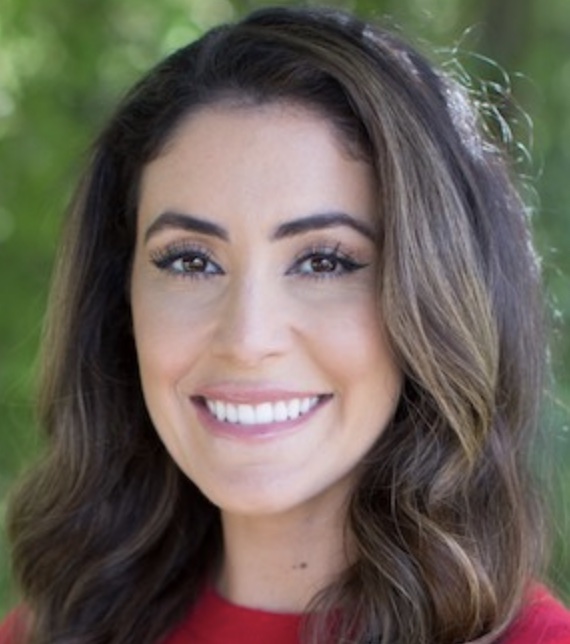
Florida GOP congressional candidate Anna Paulina Luna
But then, Politico obtained a recording in which a man identified as her political rival, William Braddock, is heard bragging that he has access to a “hit squad” of “Ukrainians and Russians” prepared to make Luna “disappear” if she closes in on the Republican nomination in the 13th U.S. House District in Pinellas County.
“I really don’t want to have to end anybody’s life for the good of the people of the United States of America,” says the man identified as Braddock in the secretly recorded telephone conversation. “That will break my heart. But if it needs to be done, it needs to be done.”
“Luna is a f—ing speed bump in the road,” the man identified as Braddock says. “She’s a dead squirrel you run over every day when you leave the neighborhood.”
When contacted by Politico, Braddock declined to say whether the voice on the recording, made June 9 by conservative activist Erin Olszewski, is him or whether he threatened to kill Luna. But he said, “This is a dirty political tactic that has caused a lot of people a lot of stress and is completely unnecessary.”
Florida’s 13th District seat, which Democratic U.S. Rep. Charlie Crist is vacating to run for governor, is perhaps the GOP’s best pick-up opportunity next year in the Sunshine State. It is perhaps not helpful, then, that the two Republican candidates currently in the race — Luna and Braddock — are now involved in a police investigation over a possible murder plot.
A hearing has been scheduled for June 22 on whether to extend the injunction Luna got that bars Braddock from both her speaking events and Conservative Grounds, a coffee shop in Largo frequented by Pinellas conservatives.
After losing to Crist in November in the swing district, Luna, 32, a businesswoman and Air Force veteran, decided to make another run, encouraged by the prospect that Florida’s GOP-led legislature may make the district more Republican during redistricting.
Braddock, 37, a St. Petersburg attorney and former Marine, entered the race last week after Luna’s allegations became public.
Olszewski said that in her phone call with Braddock, he tried to dissuade her from supporting Luna in next year’s GOP primary; she recorded the call and turned it over to St. Petersburg police because she said she was concerned about Braddock’s “unhinged” dislike of Luna.
However, in Florida, secretly recording a phone call without the other person’s knowledge is a felony, and Braddock told Politico that he would seek civil damages and criminal charges against “folks in possession of whatever recording they think they have of myself or someone else.”
In her request for protection, Luna also said that Braddock claimed he was “working together” with two other Pinellas Republicans — Amanda Makki, whom Luna defeated in the 13th District GOP primary in 2020, and Matt Tito, a conservative political commentator who lost a Florida House race last year.
Both Makki and Tito have denied having any role in a plot against Luna (Makki is the person who called Luna’s behavior “concerning”), and Tito has said he’s talked to a lawyer about pursuing a defamation claim.
Tito told the Tampa Bay Times that although he knows Braddock and Makki, he has infrequent contact with both.
“[Luna’s] goal was to embarrass us, it was to get us to keep us out of the race, to intimidate us,” he told the Times.
In the meantime, the four Democratis in the race — State Reps. Ben Diamond and Michele Rayner, Christian Hotchkiss and Eric Lynn — continue their campaign, without any mention of political assassination or Russian and Ukrainian hit squads.
We tweet @ChkFriPolitics Join us!
Terry McAuliffe wins Democratic nomination for Virginia governor
Attorney General Mark Herring survives primary challenge; Hala Ayala’s victory sets up all-female contest for lieutenant governor
♦By Rich Shumate, ChickenFriedPolitics.com editor
 RICHMOND (CFP) — Terry McAuliffe has won a chance to reclaim Virginia’s governorship, easily winning Tuesday’s Democratic primary to set up what is likely to be a bruising general election campaign against Republican newcomer Glenn Youngkin.
Attorney General Mark Herring also saw off a challenge from the left in his quest to win a third term, and State Delegate Hala Ayala made history by winning the Democratic nod for lieutenant governor.
Ayala, who identifies as an Afro-Latina, is the first Hispanic woman to win nomination to statewide office, and her win also insures that Virginia will have its first female lieutenant governor, as Republicans chose Winsome Sears, an African-American woman, in a nominating convention in May.
McAuliffe coasted to an easy win in the governor’s race, taking 62% and carrying every county and independent city in the commonwealth. Former Delegate Jennifer Carroll Foy came in second at 20%.
Lieutenant Governor Justin Fairfax, whose once promising political career crashed amid allegations from two women that he sexually assaulted them, mustered less than 4% in his bid for the state’s top job.

Former Virginia Governor Terry McAuliffe
McAuliffe, 64, a Clinton confidante and prolific Democratic fundraiser, served as governor from 2014 to 2018 but was forced from office by a rule unique to Virginia that doesn’t allow governors to run for a second term.
If his comeback is successful, it will mark only the second time that a former governor has reclaimed the office (the other was Democrat Mills Godwin elected in 1965 and 1973).
Youngkin, 57, a wealthy private equity executive from the Washington D.C. suburbs, is trying to become the first Republican since 2009 to break the Democrats’ lock on the state’s top office.
In the attorney general’s race, Herring faced a stiff primary challenge from Delegate Jay Jones from Norfolk, who centered his campaign on criminal justice reform, including repealing qualified immunity for police officers.
Jones’s upstart campaign was boosted by endorsements from term-limited Democratic Governor Ralph Northam and New Jersey U.S. Senator Cory Booker, along with support from Democracy for America, a grassroots advocacy group on the Democratic left. But in the end, Jones could only muster 43% of the primary vote, to 57% for Herring.
Herring will face Republican Delegate Jason Miyares from Virginia Beach in November.
In the lieutenant governor’s race, Ayala, from Prince William County, snagged endorsements from Northam and much of the Democratic establishment. She took 39% of the vote, defeating Delegates Sam Rasoul of Roanoke, with 26%, and Mark Levine from Alexandria, with 12% and Norfolk City Councilwoman Andria McClellan with 11%
Rasoul, who led the race in fundraising, was trying to become the first Muslim to win statewide office. Levine would have been the first openly gay and Jewish nominee.
Sears, 57, who served a single term in the legislature nearly 20 years ago and hasn’t held office since, was the biggest surprise to come out of the Republican convention, dispatching five rivals.
A Jamaican immigrant and former Marine from Winchester, she served as national chair of Black Americans to Re-Elect President Trump in 2020, and her campaign posters and Twitter feed showed her carrying an assault rifle.
Since the lieutenant governorship became an elected office in the 1850s, all of its occupants have been men and all but two have been white. The incumbent, Justin Fairfax, is one of the two, along with Douglas Wilder, who went on to become governor.
Because of the single-term limit for governors, the lieutenant governorship is often a stepping stone to that office, as it was for Northam, who served under McAuliffle.
 Chicken Fried Politics