

Congressional candidate who embraced QAnon, posted racist videos wins Georgia GOP runoff
Marjorie Taylor Green’s victory in the 14th District primary puts her on track to go to Washington; Andrew Clyde wins GOP runoff in 9th District
♦By Rich Shumate, ChickenFriedPolitics.com
 ROME, Georgia (CFP) — In what may become an ongoing headache for Republican leaders in Washington, Marjorie Taylor Greene — who has been denounced for posting racist and anti-Muslim videos, peddling an anti-Semitic trope and giving credence to the QAnon conspiracy theory — has won the party’s nomination for the 14th District in northwest Georgia, putting her on track to win a seat in Congress in November from the heavily Republican district.
Greene, a businesswoman from Milton who did not even live in the district when the race began, took 60 percent in the Republican runoff to defeat John Cowan, a Rome neurosurgeon who had denounced her as “crazy” and a “circus act.”

Marjorie Taylor Greene
After Greene came in first place in June, videos she posted on social media surfaced in which she decried an “Islamic invasion,” said African Americans were “slaves” to the Democratic Party, and pushed a false conspiracy theory that liberal megadonor George Soros had collaborated with the Nazis during the Holocaust.
She also expressed her belief in the validity of QAnon, a conspiracy theory that posits that a secret “deep state” is working to undermine President Donald Trump.
Greene pushed back against the string of negative stories by denouncing them as “fake news” pushed by news media outlets trying to derail her campaign.
House Minority Leader Kevin McCarthy — who may soon have Greene in his caucus — called the videos “appalling” but did not get directly involved in the runoff. House Minority Whip Steve Scalise supported Cowan and raised money for him.
The 14th District is solidly Republican. The only person standing between Greene and Congress is Democrat Kevin Van Ausdel, a financial technology professional from Catoosa who has raised less than $20,000 for the race.
The seat opened when Republican U.S. Rep. Tom Graves announced his retirement. Greene was initially running in the 6th District, where she lived, but switched to the 14th District race after Graves announced his departure.
In the other race of note in the Peach State Tuesday, GOP leaders were successful in blocking State Rep. Matt Gurtler from the party nomination in the 9th District in northeast Georgia.
Gurtler, from Tiger, was defeated by Andrew Clyde, who owns a firearms business in Jackson County.
During his four years in the legislature, Gurtler had so irritated Republican leaders that they unsuccessfully tried to defeat him in a primary in 2018. Party leaders who did not want to see Gurtler in Congress pulled out all the stops to support Clyde, who was making his first run for political office and had little public profile before the race began.
Clyde will now face Democrat Devin Pandy, a retired Army veteran and actor from Commerce, who won his party’s runoff.
Like the 14th District, the 9th is also solidly Republican. The seat is currently held by U.S. Rep. Doug Collins, who gave it up to run for the U.S. Senate.
We tweet @ChkFriPolitics Join us!
Establishment pick Bill Hagerty wins Tennessee Republican U.S. Senate primary
Republicans in East Tennessee pick Diana Harshbarger as a successor for retiring GOP U.S. Rep. Phil Roe
♦By Rich Shumate, ChickenFriedPolitics.com editor
 NASHVILLE (CFP) — With the backing of President Donald Trump and the Republican establishment, Bill Hagerty, the former U.S. ambassador to Japan, has won his party’s nomination for an open U.S. Senate seat in Tennessee.
Hagerty took 51% in Thursday’s vote to 39% for Manny Sethi, a Nashville orthopedic trauma surgeon. He will now face Democrat Marquita Bradshaw, a Memphis environmental activist, in November’s general election.
Bradshaw, who spent less than $10,000 on her primary campaign, was the surprise winner of the Democratic primary over Nashville attorney James Mackler, who had raised more than $2 million for the race but could only muster a third-place finish.
Also in Thursday’s primary, Republicans in the 1st U.S. House District in East Tennessee picked Kingsport pharmacist Diana Harshbarger as their nominee to replace retiring Republican U.S. Rep. Phil Roe, making her a prohibitive favorite to win in November in the state’s most Republican district.
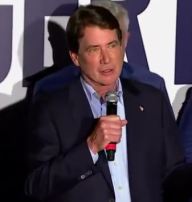
Hagerty speaks at victory rally in Gallatin (WBIR via YouTube)
Hagerty, 60, a former private equity executive and state economic development official, left his post in Tokyo to pursue the Senate seat after incumbent U.S. Senator Lamar Alexander announced his retirement last summer.
He received an immediate endorsement from Trump, despite the fact that Hagerty had backed Trump rival Jeb Bush in the 2016 election and has a long association with 2012 GOP nominee Mitt Romney, the only Republican senator to vote for Trump’s impeachment.
Speaking to supporters at a victory celebration in his hometown of Gallatin, Hagerty thanked Trump, who he said “had my back since before the beginning of this.”
“Thank you for being the inspiration for me, President Trump. I look forward to help you continue moving forward,” he said. “We’ve got to stand up to the radicals in Washington that want to push us off the cliff into socialism.”
Hagerty had put together a collection of disparate supporters that included not only Trump, his son Donald Jr., and Fox News host Sean Hannity, but also support from Bush, Romney and Senate Majority Leader Mitch McConnell.
Sethi countered with endorsements of his own from U.S. Senators Ted Cruz of Texas and Rand Paul of Kentucky, along with conservative groups such as the Family Research Council, Gun Owners of America, and the anti-abortion Tennessee Heartbeat Coalition.
The race grew contentious and both men competed for the Trump mantle. Hagerty’s campaign branded Sethi as a “Never Trumper” and highlighted the fact that he was a finalist for a White House fellowship under former President Barack Obama; Sethi’s returned the favor by highlighting Hagerty’s ties to Romney and Bush.
Given that Tennessee hasn’t elected a Democrat to the Senate in 30 years, Hagerty will be a heavy favorite in November against Bradshaw, who won her primary with 36% of the vote.
In the 1st District, which stretches from the Tri-Cities west toward Knoxville, the Republican primary to replace Roe turned into a 14-candidate free-for-all. Harshbarger won with 19%, followed by State Rep. Timothy Hill from Blountville at 17% and State Senator Rusty Crowe from Johnson City at 16%.
Because Tennessee does not have primary runoffs, Harshberg won with a plurality and will now face Democrat Blair Walsingham, a farmer from Hawkins County, in November.
The Republican nominee will be the prohibitive favorite in the state’s most Republican district, which the party has held continuously for 140 years.
In other races in Thursday’s primary, the two Democrats in the Volunteer State’s congressional delegation — U.S. Reps. Jim Cooper of Nashville and Steve Cohen of Memphis — both easily turned back primary challenges, although Cooper was held to 54%.
Uniquely among states, Tennessee holds its primary elections on Thursdays, rather than Tuesdays, although the general election in November will be held on a Tuesday as it is in the rest of the country.
We tweet at ChkFriPolitics Join us!
The fundraising leader in the race is Diana Harshbarger, a Kingsport pharmacist who has raised nearly $1.5 million. She’s followed by Josh Gapp, a Knoxville pathologist who had initially run in the Senate primary until Roe announced his retirement, and former Kingsport Mayor John Clark.
Also in the race are State Senator Rusty Crowe from Johnson City; State Rep. David Hawk from Greeneville; State Rep. Timothy Hill from Blountville; and former Johnson City Mayor Steve Darden.

Hotly contested Republican U.S. Senate race highlights Thursday’s primary ballot in Tennessee
Voters in East Tennessee will also pick a successor for retiring GOP U.S. Rep. Phil Roe
♦By Rich Shumate, ChickenFriedPolitics.com editor
 NASHVILLE (CFP) — Tennessee Republicans will decide a contentious battle for an open U.S. Senate seat in Thursday’s primary election, settling what has become a proxy battle between libertarian and establishment voices within the national GOP.
Also, Thursday, 14 Republicans are competing for the nomination in the 1st U.S. House District in East Tennessee, with the winner a prohibitive favorite to take over the seat of retiring Republican U.S. Rep. Phil Roe.
Poll opening times in the Volunteer State vary by county; polls close in the Eastern time zone at 8 p.m. and at 7 p.m. in the Central time zone.

Bill Hagerty and Manny Sethi
In the Senate race, Bill Hagerty, the former U.S. ambassador to Japan, is locked in a tight race for the Republican nomination against Manny Sethi, a Nashville orthopedic trauma surgeon.
Thirteen other Republicans are also in the race, including former Shelby County commissioner and unsuccessful 2018 U.S. House candidate George Flinn, who has poured $5 million of his own money into the contest.
The seat is open because of the retirement of Republican U.S. Senator Lamar Alexander, who has held it for the past 18 years.
Hagerty, the establishment choice, has put together a collection of disparate endorsements that includes not only President Donald Trump, his son Donald Jr., and Fox News host Sean Hannity, but also support from Senate Majority Leader Mitch McConnell, former Republican presidential nominee Mitt Romney, and former Florida Governor Jeb Bush.
Sethi has countered with endorsements of his own from U.S. Senators Ted Cruz of Texas and Rand Paul of Kentucky, along with conservative groups such as the Family Research Council, Gun Owners of America, and the anti-abortion Tennessee Heartbeat Coalition.
Hagerty’s campaign has branded Sethi as a “Never Trumper” and highlighted the fact that he was a finalist for a White House fellowship under former President Barack Obama. Sethi has returned the favor by noting that Hagerty gave large campaign contributions to Romney’s presidential campaigns and served as a delegate for Jeb Bush during his 2016 race against Trump.
Tennessee does not have primary runoffs, so whichever candidate emerges from Thursday’s vote with a plurality will be the party’s nominee.
The Democratic contest features six candidates, with Nashville attorney James Mackler, who is backed by the Democratic Senatorial Campaign Committee, seen as the favorite.
Tennessee hasn’t elected a Democrat to the Senate in 30 years, and the nominee who emerges from the Republican will be a prohibitive favorite in November, although Mackler has raised more than $2 million so far.
In the 1st District, which stretches from the Tri-Cities west toward Knoxville, the Republican primary has turned into a 14-candidate free-for-all.
The fundraising leader in the race is Diana Harshbarger, a Kingsport pharmacist who has raised nearly $1.5 million. She’s followed by Josh Gapp, a Knoxville pathologist who had initially run in the Senate primary until Roe announced his retirement, and former Kingsport Mayor John Clark.
Also in the race are State Senator Rusty Crowe from Johnson City; State Rep. David Hawk from Greeneville; State Rep. Timothy Hill from Blountville; and former Johnson City Mayor Steve Darden.
The winner of the Republican contest will face Democrat Blair Walsingham, a farmer from Hawkins County. The Republican nominee will be the prohibitive favorite in the state’s most Republican district, which the party has held continuously for 140 years.
Uniquely among states, Tennessee holds its primary elections on Thursdays, rather than Tuesdays, although the general election in November will be held on a Tuesday as it is in the rest of the country.
We tweet at ChkFriPolitics Join us!

Georgia U.S Rep. John Lewis honored and remembered at funeral service in Atlanta
Former presidents Obama, Bush and Clinton eulogize civil rights icon at Ebenezer Baptist Church
♦By Rich Shumate, ChickenFriedPolitics.com editor
 ATLANTA (CFP) — Three former U.S. presidents and more than 50 U.S. House colleagues gathered in Atlanta Thursday to say a final farewell to U.S. Rep. John Lewis, the civil rights icon who represented the city for more than 30 years in Congress.
From the pulpit of Ebeneezer Baptist Church, once pastored by the Rev. Martin Luther King Jr., former President Barack Obama called Lewis “perhaps [King’s] finest disciple.”
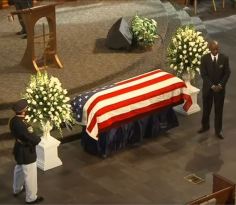
Casket of John Lewis in repose at Ebenezer Baptist Church (From Washington Post via YouTube)
Lewis’s life redeemed “that most American of ideas — the idea that any of us, ordinary people without rank or wealth or title or fame, can somehow point out the imperfections of this nation and come together and challenge the status quo and decide that it is within our power to remake this country that we love,” Obama said.
“He believed that in all of us there exists the capacity for great courage, and in all of us, there is a longing to do what’s right,” Obama said. “He knew that non-violent protest is patriotic, a way to raise public awareness and to put the spotlight on injustice and make the powers that be uncomfortable.”
“What a gift John Lewis was. We are all so lucky to have had him walk with us for a while and show us the way.”
Former President George W. Bush said Lewis “believed in the Lord, he believed in humanity, and he believed in America.”
“His lesson for us is that we must all keep ourselves to hearing the call of love, the call of service, and the call to sacrifice for others,” Bush said.
Bush noted that while he and Lewis often disagreed politically, “in the America John Lewis fought for, and the America I believe in, differences of opinion are inevitable elements and evidence of democracy in action.”
Joining Obama and Bush to speak at the funeral service were former President Bill Clinton and House Speaker Nancy Pelosi, who grew emotional when she presented his family with the flag that was flying over the Capitol on the night that Lewis died.
“When this flag flew there, it said good-bye. It waved good-bye to John, our friend, our mentor, our colleague, this beautiful man we had the privilege of serving with,” said Pelosi, who served with Lewis in Congress for 33 years.
“Every time he stood up to speak [in the House], we knew that he was going to take us to a higher place of our understanding, of what our responsibilities were and what our opportunities were,” Pelosi said. “When he spoke, people listened. When he led, people followed.”
Not attending Thursday’s event was President Donald Trump, whose impeachment Lewis had vigorously supported last year. Trump also did not join he crowds who paid tribute to Lewis when his casket was displayed at the U.S. Capitol.
The funeral was the culmination of nearly a week of events honoring Lewis, including a memorial service in his hometown of Troy, Alabama, and lying in state at both the Alabama and Georgia state capitols.
The crowd inside the church for the private service was limited due to coronavirus, and mourners wore masks. The service was broadcast on a television screen outside of Ebenezer, where crowds gathered in the summer heat.
Lewis, 80, died on July 24 after a battle with pancreatic cancer.
During his long and illustrious life, Lewis, who grew up on a farm in rural Alabama during the Jim Crow era, had a first-hand presence at some of the most pivotal moments of American history.
In 1960, as a student at Fisk University, he participated in protests to desegregate lunch counters in Nashville, and, a year later, became of the original “freedom riders,” risking his life to desegregate buses in the South.
By 1963, he had risen to a leadership position in the civil rights movement, as president of the Student Nonviolent Coordinating Committee, and, at just 23, was the youngest person to address the historic March on Washington, led by the Rev. Martin Luther King Jr.
During the summer of 1964, he went to Mississippi to register black voters, part of the “Freedom Summer” to break the power of segregation in its most redoubtable citadel.
In 1965, baton-wielding state troopers fractured Lewis’s skull as as he tried to lead marchers over the Edmund Pettus Bridge in Selma, Alabama, a shocking scene captured on national television that led to passage of the Voting Rights Act.
A campaign is now underway to rename the bridge for Lewis.
In 1968, he was in Los Angeles working for the presidential campaign of U.S. Senator Robert Kennedy when Kennedy was gunned down after winning the California primary.
Lewis had eventually extended his activism into politics, winning a seat in the U.S. House in 1986 that he held for more than three decades, becoming known as the “conscience of Congress” — opposing military action, supporting gay rights, leading a sit-in for gun safety.
Through all the beatings and tragedies, and the twists and turns of political life, Lewis never wavered from the philosophy of non-violence — and never stopped advocating for equality. He made his last public appearance in June at the dedication of a “Black Lives Matter” mural in Washington, the latest incarnation of the cause to which he had dedicated his adult life.
In his eulogy, Obama exhorted the audience to honor Lewis’s legacy by working to “revitalize” the Voting Rights Act and fighting against restrictions on voting access.
“Even as we sit here, there are those in power who are doing their darndest to discourage people from voting, by closing polling locations and targeting minorities and students with restrictive ID laws and attacking our voting rights with surgical precision — even undermining the postal service in an election that’s going to be dependent on mail-in ballots so people don’t get sick,” he said.
Georgia Democrats have selected State Senator Nikema Williams to replace Lewis on the November ballot and take his place in Congress representing the 5th District, which includes much of the city of Atlanta and suburbs to the west and south.
We tweet @ChkFriPolitics Join us!

17 Southern U.S. House Republicans vote with Democrats to remove Confederate statues from Capitol
11 other Southern Republicans missed vote on measure that passed House Wednesday
♦By Rich Shumate, ChickenFriedPolitics.com editor
 WASHINGTON (CNN) — Seventeen Southern Republicans in the U.S. House joined with all of the region’s Democrats to support a resolution calling for removal of Confederate statues from the U.S. Capitol, along with a statue of the U.S. Supreme Court Justice Roger Taney, who wrote the infamous Dred Scott decision.
Eleven other Southern Republicans did not vote on the measure when it came to the floor Wednesday.
Among those supporting the measure were 15 Southern Republicans who represent former Confederate states, including:
- Florida: Gus Bilirakis, Vern Buchanan, Daniel Webster and Mario Diaz-Balart.
- Texas: Michael Burgess, Dan Crenshaw, Will Hurd, Mike McCaul, Pete Olson, and Van Taylor.
- North Carolina: Virginia Foxx, Greg Murphy, and Mark Walker.
- Arkansas: French Hill
- Louisiana: House Minority Whip Steve Scalise
Also voting for the measure was Brett Guthrie from Kentucky and Carol Miller of West Virginia, who represent Southern states that stayed in the Union during the Civil War.
Among the Republicans members who did not cast a vote were Ralph Abraham of Louisiana; Bradley Bryne and Martha Roby of Alabama; George Holding and Richard Hudson of North Carolina; Morgan Griffith of Virginia, Barry Loudermilk of Georgia; Francis Rooney of Florida; Denver Riggleman of Virginia; William Timmons of South Carolina; and Markwayne Mullin of Oklahoma.
Hurd, Olson, Walker, Abraham, Byrne, Roby, Holding and Rooney are all retiring in November; Riggleman was defeated for re-election. The rest are all seeking re-election.
The bill, which passed the House by a vote of 305 to 113, instructs the Capitol architect to remove statues of “individuals who voluntarily served Confederate States of America” and to replace the statute of Taney with one of Thurgood Marshall, the first African American to serve on the Supreme Court.
All of the votes against the measure were cast by Republicans, who opposed the resolution by a vote of 113 to 72.
Taney authored the Dred Scott decision in 1857, which declared African Americans were not citizens even if they had been freed from slavery.
The House bill now goes to the Senate, where it is unclear if the Republican leadership will bring it to the floor. President Donald Trump has also not taken a position on the measure, although he had come out against renaming Southern military bases that were named for Confederates.
 Chicken Fried Politics