
Home » Decision 2020 (Page 4)
Category Archives: Decision 2020

Establishment pick Bill Hagerty wins Tennessee Republican U.S. Senate primary
Republicans in East Tennessee pick Diana Harshbarger as a successor for retiring GOP U.S. Rep. Phil Roe
♦By Rich Shumate, ChickenFriedPolitics.com editor
 NASHVILLE (CFP) — With the backing of President Donald Trump and the Republican establishment, Bill Hagerty, the former U.S. ambassador to Japan, has won his party’s nomination for an open U.S. Senate seat in Tennessee.
Hagerty took 51% in Thursday’s vote to 39% for Manny Sethi, a Nashville orthopedic trauma surgeon. He will now face Democrat Marquita Bradshaw, a Memphis environmental activist, in November’s general election.
Bradshaw, who spent less than $10,000 on her primary campaign, was the surprise winner of the Democratic primary over Nashville attorney James Mackler, who had raised more than $2 million for the race but could only muster a third-place finish.
Also in Thursday’s primary, Republicans in the 1st U.S. House District in East Tennessee picked Kingsport pharmacist Diana Harshbarger as their nominee to replace retiring Republican U.S. Rep. Phil Roe, making her a prohibitive favorite to win in November in the state’s most Republican district.
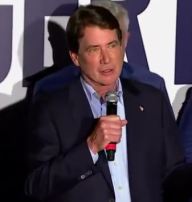
Hagerty speaks at victory rally in Gallatin (WBIR via YouTube)
Hagerty, 60, a former private equity executive and state economic development official, left his post in Tokyo to pursue the Senate seat after incumbent U.S. Senator Lamar Alexander announced his retirement last summer.
He received an immediate endorsement from Trump, despite the fact that Hagerty had backed Trump rival Jeb Bush in the 2016 election and has a long association with 2012 GOP nominee Mitt Romney, the only Republican senator to vote for Trump’s impeachment.
Speaking to supporters at a victory celebration in his hometown of Gallatin, Hagerty thanked Trump, who he said “had my back since before the beginning of this.”
“Thank you for being the inspiration for me, President Trump. I look forward to help you continue moving forward,” he said. “We’ve got to stand up to the radicals in Washington that want to push us off the cliff into socialism.”
Hagerty had put together a collection of disparate supporters that included not only Trump, his son Donald Jr., and Fox News host Sean Hannity, but also support from Bush, Romney and Senate Majority Leader Mitch McConnell.
Sethi countered with endorsements of his own from U.S. Senators Ted Cruz of Texas and Rand Paul of Kentucky, along with conservative groups such as the Family Research Council, Gun Owners of America, and the anti-abortion Tennessee Heartbeat Coalition.
The race grew contentious and both men competed for the Trump mantle. Hagerty’s campaign branded Sethi as a “Never Trumper” and highlighted the fact that he was a finalist for a White House fellowship under former President Barack Obama; Sethi’s returned the favor by highlighting Hagerty’s ties to Romney and Bush.
Given that Tennessee hasn’t elected a Democrat to the Senate in 30 years, Hagerty will be a heavy favorite in November against Bradshaw, who won her primary with 36% of the vote.
In the 1st District, which stretches from the Tri-Cities west toward Knoxville, the Republican primary to replace Roe turned into a 14-candidate free-for-all. Harshbarger won with 19%, followed by State Rep. Timothy Hill from Blountville at 17% and State Senator Rusty Crowe from Johnson City at 16%.
Because Tennessee does not have primary runoffs, Harshberg won with a plurality and will now face Democrat Blair Walsingham, a farmer from Hawkins County, in November.
The Republican nominee will be the prohibitive favorite in the state’s most Republican district, which the party has held continuously for 140 years.
In other races in Thursday’s primary, the two Democrats in the Volunteer State’s congressional delegation — U.S. Reps. Jim Cooper of Nashville and Steve Cohen of Memphis — both easily turned back primary challenges, although Cooper was held to 54%.
Uniquely among states, Tennessee holds its primary elections on Thursdays, rather than Tuesdays, although the general election in November will be held on a Tuesday as it is in the rest of the country.
We tweet at ChkFriPolitics Join us!
The fundraising leader in the race is Diana Harshbarger, a Kingsport pharmacist who has raised nearly $1.5 million. She’s followed by Josh Gapp, a Knoxville pathologist who had initially run in the Senate primary until Roe announced his retirement, and former Kingsport Mayor John Clark.
Also in the race are State Senator Rusty Crowe from Johnson City; State Rep. David Hawk from Greeneville; State Rep. Timothy Hill from Blountville; and former Johnson City Mayor Steve Darden.

Hotly contested Republican U.S. Senate race highlights Thursday’s primary ballot in Tennessee
Voters in East Tennessee will also pick a successor for retiring GOP U.S. Rep. Phil Roe
♦By Rich Shumate, ChickenFriedPolitics.com editor
 NASHVILLE (CFP) — Tennessee Republicans will decide a contentious battle for an open U.S. Senate seat in Thursday’s primary election, settling what has become a proxy battle between libertarian and establishment voices within the national GOP.
Also, Thursday, 14 Republicans are competing for the nomination in the 1st U.S. House District in East Tennessee, with the winner a prohibitive favorite to take over the seat of retiring Republican U.S. Rep. Phil Roe.
Poll opening times in the Volunteer State vary by county; polls close in the Eastern time zone at 8 p.m. and at 7 p.m. in the Central time zone.

Bill Hagerty and Manny Sethi
In the Senate race, Bill Hagerty, the former U.S. ambassador to Japan, is locked in a tight race for the Republican nomination against Manny Sethi, a Nashville orthopedic trauma surgeon.
Thirteen other Republicans are also in the race, including former Shelby County commissioner and unsuccessful 2018 U.S. House candidate George Flinn, who has poured $5 million of his own money into the contest.
The seat is open because of the retirement of Republican U.S. Senator Lamar Alexander, who has held it for the past 18 years.
Hagerty, the establishment choice, has put together a collection of disparate endorsements that includes not only President Donald Trump, his son Donald Jr., and Fox News host Sean Hannity, but also support from Senate Majority Leader Mitch McConnell, former Republican presidential nominee Mitt Romney, and former Florida Governor Jeb Bush.
Sethi has countered with endorsements of his own from U.S. Senators Ted Cruz of Texas and Rand Paul of Kentucky, along with conservative groups such as the Family Research Council, Gun Owners of America, and the anti-abortion Tennessee Heartbeat Coalition.
Hagerty’s campaign has branded Sethi as a “Never Trumper” and highlighted the fact that he was a finalist for a White House fellowship under former President Barack Obama. Sethi has returned the favor by noting that Hagerty gave large campaign contributions to Romney’s presidential campaigns and served as a delegate for Jeb Bush during his 2016 race against Trump.
Tennessee does not have primary runoffs, so whichever candidate emerges from Thursday’s vote with a plurality will be the party’s nominee.
The Democratic contest features six candidates, with Nashville attorney James Mackler, who is backed by the Democratic Senatorial Campaign Committee, seen as the favorite.
Tennessee hasn’t elected a Democrat to the Senate in 30 years, and the nominee who emerges from the Republican will be a prohibitive favorite in November, although Mackler has raised more than $2 million so far.
In the 1st District, which stretches from the Tri-Cities west toward Knoxville, the Republican primary has turned into a 14-candidate free-for-all.
The fundraising leader in the race is Diana Harshbarger, a Kingsport pharmacist who has raised nearly $1.5 million. She’s followed by Josh Gapp, a Knoxville pathologist who had initially run in the Senate primary until Roe announced his retirement, and former Kingsport Mayor John Clark.
Also in the race are State Senator Rusty Crowe from Johnson City; State Rep. David Hawk from Greeneville; State Rep. Timothy Hill from Blountville; and former Johnson City Mayor Steve Darden.
The winner of the Republican contest will face Democrat Blair Walsingham, a farmer from Hawkins County. The Republican nominee will be the prohibitive favorite in the state’s most Republican district, which the party has held continuously for 140 years.
Uniquely among states, Tennessee holds its primary elections on Thursdays, rather than Tuesdays, although the general election in November will be held on a Tuesday as it is in the rest of the country.
We tweet at ChkFriPolitics Join us!

Donald Trump gets his revenge as Jeff Sessions goes down to defeat
Sessions crushed by Tommy Tuberville in Alabama U.S. Senate GOP runoff
♦By Rich Shumate, ChickenFriedPolitics.com editor
 MONTGOMERY (CFP) — Former U.S. Attorney General Jeff Sessions was crushed Tuesday in his quest to reclaim the U.S. Senate seat he gave up to serve in Donald Trump’s Cabinet, in a sweeping triumph for the president and his Twitter feed.
Tommy Tuberville, the former head football coach at Auburn University who was making his first run for elective office, took 61% to 39% for Sessions, carrying 64 of the state’s 67 counties.
“Thank you for your trust, your confidence. Your message of change is loud and clear,” Tuberville told supporters at a victory party in Montgomery, where he went directly after his November opponent, Democratic U.S. Senator Doug Jones.
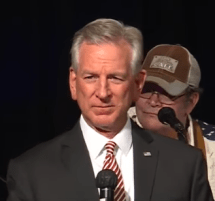
Republican Alabama U.S. Senate nominee Tommy Tuberville addresses supporters in Montgomery (WVTM via YouTube)
“In Doug Jones’ Alabama, you take your marching orders from Joe Biden, Nancy Pelosi, Chuck Schumer, and the bartender AOC,” Tuberville said, referring to New York U.S. Rep. Alexandria Ocasio-Cortez.
“Doug Jones’ Alabama is not the conservative state we love and embrace and defend. It’s a liberal fantasy,” he said.
Jones won a special election in 2017 in deep red Alabama after the Republican nominee, Roy Moore, imploded in a sex scandal. He is considered the most endangered Democratic incumbent in the country this year.
Jones issued a statement after Tuberville’s win saying Alabama voters will have a choice in November between “an unprepared hyper partisan that will add to the divide in Washington, or my proven track-record to find common ground and get things done.”
Tuesday’s result was an ignominious defeat for Sessions, who represented Alabama in the Senate for 20 years and built a political brand so potent that Democrats didn’t even both to contest his election the last time he ran in 2014.
But this time around, he could not overcome the implacable opposition of Trump, who has never forgiven Sessions for recusing himself from the investigation into Russian interference in the 2016 election.
Trump endorsed Tuberville, made robocalls on his behalf, and used his Twitter feed to needle Sessions throughout the campaign. But Sessions continued to insist that he fully supported the president and his agenda.
“The people of Alabama have spoken, and they want a new leader, a new fresh face to go to Washington,” Sessions said at an election night event in Mobile where he was surrounded by eight of his grandchildren. “We felt like we were beginning to make some progress here at the very end, but it wasn’t enough.”
Sessions said he had “no regrets” about the decision to recuse himself, insisting that legally, he had no other choice.
“I was honored to serve the people of Alabama in the Senate, and I was extraordinarily proud of the accomplishments we had as attorney general,” he said. “I leave elective office with my integrity intact.”
Trump took to Twitter to congratulate Tuberville on the result, refraining from any direct attack on Sessions, although he dismissed Jones as “a terrible Senator who is just a Super Liberal puppet for Schumer & Pelosi.”
Alabama Republicans also decided competitive runoffs for two open U.S. House seats Tuesday.
In the 1st District (Mobile and southwest Alabama), Mobile County Commissioner Jerry Carl edged out former State Senator Bill Hightower for the Republican nomination. On the Democratic side of the ballot, James Averhart, a retired Marine who runs a non-profit that works to reintegrate former prisoners into society, won the Democratic nomiination over Kiani Gardner.
Carl will be the favorite in November in the heavily Republican district. U.S. Rep. Bradley Byrne gave up the seat to make a losing U.S. Senate bid against Sessions and Tuberville.
In the 2nd District (Montgomery and southeast Alabama), former State Rep. Barry Moore defeated businessman Jeff Coleman and will be a heavy favorite in the fall against Democrat Phyllis Harvey-Hall. The seat opened up with the retirement of Republican U.S. Rep. Martha Roby.
We tweet @ChkFriPolitics Join us!

U.S. Senate runoffs top Tuesday’s primary ballots in Alabama, Texas
Jeff Sessions tries to survive Trump headwinds in Alabama, while Texas Democrats pick a foe for U.S. Senator John Cornyn
♦By Rich Shumate, ChickenFriedPolitics.com editor
(CFP) — Voters in Alabama and Texas go to the polls Tuesday to decide two hotly contested U.S. Senate runoffs, including a Republican runoff in Alabama where former U.S. Attorney General Jeff Sessions is trying to reclaim his old Senate seat over the fervent opposition of President Donald Trump.
Trump also features in a U.S. House runoff in Texas, where former White House doctor Ronny Jackson — whom the president tried and failed to install as Veterans’ Affairs secretary in 2018 — is competing in a Republican runoff in the Panhandle, with the president’s endorsement.
Also in Texas, Democratic State Senator Royce West from Dallas is competing with former Air Force combat pilot MJ Hegar for the right to take on incumbent Republican U.S. Senator John Cornyn for a seat that Democrats hope to flip in November.
Former Republican U.S. Rep. Pete Sessions, who rose to the Republican leadership during two decades in Congress before losing his Dallas-area seat in 2018, is also trying to make a comeback in a runoff in a different Waco-area district.
Polls are open in both states from 7 a.m. to 7 p.m. local time.
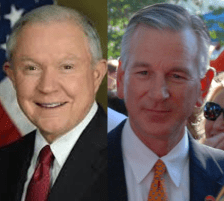
Jeff Sessions and Tommy Tuberville
Tuesday’s marquee race is in Alabama, where sessions is competing with former Auburn University football coach Tommy Tuberville for the right to take on Democratic U.S. Senator Doug Jones, considered the nation’s most endangered incumbent senator as he seeks re-election in deep red Alabama.
In 2017, Sessions gave up the Senate seat he had held for 20 years to become Trump’s attorney general, only to see that relationship sour after Sessions recused himself from the investigation into Russian interference in the 2016 election.
Trump fired Sessions in 2018 and has continued to take shots at him, even though Sessions had continued to insist that he fully supports the president and his agenda.
With Trump’s endorsement, Tuberville is considered the favorite in the race, although Sessions may have reclaimed some ground in the closing weeks of the runoff amid headlines about Tuberville’s ties to a hedge fund fraud scheme.
Tuesday’s ballot also features two Republican runoffs for safe U.S. House seats in Alabama, as well runoffs in 11 districts in Texas, including five that Democrats hope to flip.
Those races include:
Alabama 1st District (Mobile and southwest Alabama): In the race to replace Republican U.S. Rep. Bradley Byrne, who gave up the seat to make a losing U.S. Senate bid, the Republican runoff features Mobile County Commissioner Jerry Carl and former State Senator Bill Hightower. On the Democratic side of the ballot, James Averhart faces Kiani Gardner. The Republican nominee will be heavily favored in November.
Alabama 2nd District (Montgomery and southeast Alabama): In the race to replace retiring Republican U.S. Rep. Martha Roby, businessman Jeff Coleman faces former State Rep. Barry Moore. The winner will be a heavy favorite in the fall against Democrat Phyllis Harvey-Hall.
Texas 10th District (East Texas between Austin and Houston): Democrats Pritesh Gandhi and Mike Siegel are competing in Democratic runoff for the right to face incumbent Republican U.S. Rep. Michael McCaul in a race that Democrats have targeted as a pickup opportunity.
Texas 13th District (Panhandle and part of North Texas): Both parties are holding runoffs in this district, where incumbent Republican U.S. Rep. Mac Thornberry is retiring. Among Republicans, Jackson faces Josh Winegarner, a former congressional aide. Among Democrats, Greg Sagan will face Gus Trujillo. The Republican runoff winner will be heavily favored in the fall.
Texas 17th District (Waco and parts of Central Texas): Both parties are also holding runoffs in this district, where incumbent Republican U.S. Rep. Bill Flores is retiring. Among Republicans, Sessions is facing businesswoman Renee Swann. Among Democrats, David Jaramillo will face Rick Kennedy. The Republican winner will be favored in the fall.
Texas 22nd District (Southern Houston suburbs): In the race to replace retiring Republican U.S. Rep. Pete Olson, Republicans will choose between Fort Bend County Sheriff Troy Nehls and businesswoman Kathaleen Wall. The winner will face Democrat Sri Preston Kulkarni in a race that Democrats have targeted as a pickup opportunity.
Texas 23rd District (West Texas between San Antonio and El Paso): In a race to replace retiring Republican U.S. Rep. Will Hurd, Iraq War veteran Tony Gonzales will face Raul Reyes, a builder and retired Air Force officer, in the Republican runoff. The winner will face Democrat Gina Ortiz Jones, who nearly defeated Hurd in 2018.
Texas 24th District (Metro Dallas-Ft. Worth): Democrats Kim Olson, a retired Air Force colonel and former Weatherford school board member, will face Candace Valenzuela, who serves on the school board in Carrollton-Farmers Branch. The winner will face the Republican nominee, former Irving Mayor Beth Van Duyne, for the race to succeed incumbent Republican U.S. Rep. Kenny Marchant in a race Democrats have targeted.
Texas 31st District (Northern Austin suburbs): In the Democratic runoff, Donna Imam, an Austin computer engineer, will face Christine Mann, a physician from Williamson County who lost the party’s runoff in this district in 2018. The winner will face incumbent Republican U.S. Rep. John Carter, who is also on the Democrats’ target list.
We tweet @ChkFriPolitics Join us!

Insight: Will Joe Biden really make a play for Georgia and Texas in 2020?
Why, despite the summertime chatter, putting resources into these states makes little strategic sense
♦By Rich Shumate, ChickenFriedPolitics.com editor
 The last time a Democratic presidential candidate carried Georgia, The Cover Girls (remember them?) were wishing on a star. The last time a Democrat carried Texas, people were still wearing bell bottoms.
Every four years, the pundit class and Democrats in these states insist that this time will be different — this year, finally, these states are going to flip. And every four years, Republicans scoff at their wishful thinking and hubris.
It’s deja vu all over again. Joe Biden’s campaign is making noises about competing in the Peach and Lone Star states, committing significant resources for a serious ground game in places where one hasn’t been seen in a generation.
So what are the chances this will actually happen? Probably pretty slim — not because it isn’t possible for Biden to win these states but because, if they are within reach, winning them won’t be necessary.
First, the numbers. Donald Trump carried Georgia by slightly more than 5 points in 2016, the smallest winning margin for a Republican since Bob Dole won by less than 2 points in 1996 in a three-way race. (By way of contrast, George W. Bush won by nearly 17 points in 2004.)
In Texas, Trump’s margin was larger, just under 9 points, but that was also the smallest winning margin for a Republican since Dole. (Bush won by more than 20 points.)
Clearly, the trend lines are headed in the Democrats’ direction, as even Republicans in these states would concede. These states are within (a long) reach.
However, in considering Electoral College strategy, it is helpful to think of the presidential race as a tug-of-war, with states arrayed along the rope in order from most Democratic to most Republican. The goal is to pull the rope far enough that there are at least 270 electoral votes on your side.
In 2016, six states on Trump’s side of the rope were closer than Georgia — the Southern states of Florida and North Carolina, along with Michigan, Pennsylvania, Wisconsin and Arizona. Those six and Ohio were closer than Texas.
So, if Georgia is truly within reach for Biden in 2020, six Trump states are likely already in Biden’s hands; make that seven if Texas is in play. And if Biden is already carrying all of those states, he won’t need to bother with Georgia or Texas. He’s already won.
This is why, strategically, it would make little sense for the Biden campaign to put resources into Georgia and Texas. But there are three reasons we might see them do it anyway.
First, engaging in these states could help drive up Democratic turnout, which could help in U.S. Senate and down ballot races. However, presidential campaigns aren’t known for their altruism; we’re only likely to see this if the race is a blowout for Biden and he can spare the resources to benefit other candidates.
Second, making a play for Texas or Georgia could be an insurance policy in the event that something unexpected happens in one of the closer states, as happened to Hillary Clinton in 2016 in Michigan and Wisconsin. However, given that experience, Biden won’t be caught napping like Clinton was, making such a surprise less likely.
And third, putting resources into Georgia or Texas could be a way to troll the Trump campaign and force it to engage in these states. Even talking about the possibility forces the Trump forces to consider countermeasures.
However, if Trump needs to shore up either of these states come November, his battle is already lost, and what happens in Texas and Georgia won’t matter (although Biden could make a play for them to run up the score.)
So, all this summertime chatter about competing in Georgia and Texas may make interesting cable news conversation, but the smart money says that in the end, Biden won’t bite.
Then again, betting on presidential politics these days might, admittedly, be a bit of a fool’s errand.
 Chicken Fried Politics