
Home » Decision 2020 (Page 9)
Category Archives: Decision 2020


U.S. Senate nominations up for grabs Tuesday in 3 Southern states
Republicans will sort out the Senate race in Alabama, while Democrats tussle in Texas, North Carolina
 (CFP) — Alabama Republicans will decide Tuesday whether to reward or punish former Attorney General Jeff Sessions for his love-hate relationship with Donald Trump, while a gaggle of 12 Democrats jockey for the right to take on Texas Republican U.S. Senator John Cornyn in November.
Meanwhile, in North Carolina, the establishment pick for the Democratic nomination, Cal Cunningham, is trying to hold off two challengers, one of whom received unsolicited support from an unlikely source — a PAC affiliated with Senate Majority Leader Mitch McConnell.
Polls in Alabama and Texas are open from 7 a.m. to 7 p.m. local time; in North Carolina, the polls open at 6:30 a.m. and close at 6:30 p.m.
In Alabama, the Republican primary pits Sessions against U.S. Rep. Bradley Byrne, a Mobile Republican, and Tommy Tuberville, the former head football coach at Auburn University making his political debut. The winner will face Democratic U.S. Senator Doug Jones in November.
Sessions held the Senate seat for 20 years before giving it up in 2017 to become Trump’s attorney general, only to resign in late 2018 after his relationship with the president turned acrimonious in the wake of Sessions’s decision to recuse himself from the investigation into Russian meddling in the 2016 election.
Sessions parachuted into the Senate race last November, after Byrne and Tuberville had already been running for months. Since then, Sessions has gone out of his way to express fervent support for Trump, who carried Alabama by 28 points in 2016.
Trump has so far held his fire in the race, which polls show is likely headed to a runoff between Sessions and one of his two competitors on April 14.
Also in the race is Roy Moore, the former chief justice of the Alabama Supreme Court who lost to Jones in a special election in 2017 amid allegations of inappropriate sexual contact with underage girls, which he has denied. Polls show Moore lagging the rest of the field.
In Texas, the Democratic primary race in appears to be headed toward a runoff between MJ Hegar, who holds a strong lead the polls, and one of her 11 competitors.
Hegar, 43, a retired Air Force combat pilot, burst onto the political scene in 2018 when she nearly unseated Republican U.S. Rep. John Carter in his central Texas district. She entered the Senate race against Cornyn last April and raised nearly $4 million for the primary, which earned her an endorsement from the Senate Democrats’ campaign arm, the Democratic Senatorial Campaign Committee.
Battling for the second spot in the runoff are veteran State Senator Royce West from Dallas; Cristina Tzintzún Ramirez, a labor organizer from Austin who has garnered endorsements from a host of groups and figures on the left of the party, including New York U.S. Rep. Alexandria Ocasio Cortez; former U.S. Rep. Chris Bell from Houston; and Houston City Councilwoman Amanda Edwards.
If no candidate gets a majority, the top two competitors will face off in a May 26 primary.
In North Carolina, Cunningham, a Raleigh attorney and former state senator, is running against State Senator Erika Smith from Gaston and Mecklenberg County Commissioner Trevor Fuller.
A group called the Faith and Power PAC poured spent more than $2 million airing ads promoting Smith as the “progressive” in the race. Federal financial disclosure records show that the group was largely financed by the Senate Leadership Fund, a PAC closely aligned with McConnell that appeared to be trying to complicate Cunningham’s bid to unseat GOP U.S. Senator Thom Tillis.
Smith has denounced the ads, accusing Republicans of trying to meddle in the Democratic primary.
Under state law, Cunningham needs to win only 30 percent of the vote on Tuesday to avoid a runoff on May 12.
We tweet @ChkFriPolitics Join us!
Former Vice President Joe Biden makes comeback with blowout win in South Carolina
Biden revives his fortunes heading into Super Tuesday with nearly 30-point triumph in the Palmetto State
♦By Rich Shumate, ChickenFriedPolitics.com editor
COLUMBIA, South Carolina (CFP) — Former Vice President Joe Biden revived his flagging presidential campaign Saturday with a clear, convincing win in South Carolina’s first-in-the-South presidential primary, giving him crucial momentum heading into next week’s Super Tuesday contests.
Biden won 48 percent of the vote and carried all 46 counties, defeating Vermont U.S. Senator Bernie Sanders, who came in a distant second at 20 percent.
“Just days ago, the press and the pundits had declared this candidacy dead,” Biden told jubilant supporters in Columbia. “Now, thanks to you, the heart of the Democratic Party, we’ve just won, and we won big.”
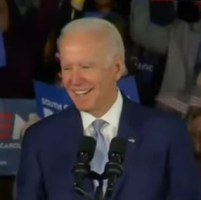
Joe Biden declares victory in South Carolina (From SkyNews via YouTube)
Biden used his victory speech to draw a contrast with Sanders, urging Democrats in the Super Tuesday states to “nominate someone who will build on Obamacare, not scrap it; take on the NRA and gun manufacturers, not protect them; [and] stand up to give the poor a fighting chance and have the middle class restored, not raise their taxes.”
The result in South Carolina was welcome news for Biden, who finished fourth in Iowa, fifth in New Hampshire, and a distant second to Sanders in Nevada. It also marked the first ever primary win for Biden in his third try for the White House.
The key to his win Saturday was a strong performance among African American voters, who made up 56 percent of the Palmetto State electorate. Exit polls showed that Biden took 60 percent of the black vote, running more than 40 points ahead of his nearest rival, Sanders.
Coming in third place in the statewide results was California billionaire Tom Steyer at 11 percent; followed by former South Bend, Indiana Mayor Pete Buttegieg, 8 percent; U.S. Senator Elizabeth Warren of Massachusetts, 7 percent; U.S. Senator Amy Klobuchar of Minnesota at 3 percent; and U.S. Rep. Tulsi Gabbard of Hawaii at 1 percent.
After the results came in, Steyer dropped out of the race.
Biden and Sanders were the only two candidates on the ballot Saturday who cleared the 15 percent threshold needed statewide and in congressional districts to claim delegates to this summer’s Democratic National Convention. Biden took 39 delegates, to 14 for Sanders.
However, former New York City Mayor Mike Bloomberg, who has spent nearly $500 million of his own fortune on his campaign, did not compete in South Carolina. He will make his debut in contests on Tuesday in 14 states, including seven in the South.
Only Democrats had a primary in South Carolina; Republicans canceled their primary in deference to President Donald Trump.
For Sanders, South Carolina marked his first defeat of the campaign, after tying for first in Iowa and winning outright in New Hampshire and Nevada. He also got a smaller percentage of the vote in than he did in 2016, when he won 26 percent in a two-way race against Hillary Clinton, and once again lost every county in the state.
Speaking to supporters in Virginia Beach, Sanders offered his congratulations to Biden before pivoting to make the case that he and not Biden offers the kind of revolutionary change that can lead to a Democratic victory in November.
“In order to defeat Trump, we are going to need the largest voter turnout in the history of this country,” Sanders said. “Old-fashioned politics — the same old, same old type of politics that doesn’t excite anybody, that doesn’t energize anybody — that is not going to be the campaign that beats Trump.”
Biden, Sanders and the rest of the field now turn their attention to Super Tuesday, with more than 1,300 delegates at stake nationwide, including 621 across the South.
The list of Southern states holding primaries Tuesday includes Virginia, North Carolina, Tennessee, Alabama, Texas, Oklahoma and Arkansas. Outside the region, primaries will be held in California, Colorado, Massachusetts, Minnesota, Maine, Utah and Vermont.
The state of the races in Alabama, Tennessee, Arkansas and Oklahoma is a big unknown, given a paucity of public polling in any of those states. The polling that has been done in Texas, North Carolina and Virginia shows Biden, Sanders and Bloomberg bunched at the top, with the other candidates trailing behind.
The question for Biden is whether his win in South Carolina will give him the momentum to push through in the Super Tuesday states, where he is being outspent by Bloomberg and will face Sanders’s formidable ground operation.
One of the biggest factors in who can carry these Southern states will be performance among African American voters, who make up a majority of the Democratic electorate in Alabama and more than a quarter in Arkansas, Tennessee, North Carolina and Virginia.
While Biden ran away with the black vote in South Carolina, he will face new competition Tuesday from Bloomberg, who has been organizing across the region and getting endorsements from African American elected officials.
We tweet @ChkFriPolitics Join us!
South Carolina Democrats deciding first-in-the-South presidential primary
Joe Biden faces crucial test against Bernie Sanders in the Palmetto State
♦By Rich Shumate, ChickenFriedPolitics.com editor
 CHARLESTON (CFP) — Democrats are going to the polls across South Carolina Saturday to pick their favorite for the party’s presidential nomination, which former Vice President Joe Biden hoping to revive his flagging fortunes heading into Super Tuesday and Vermont U.S. Senator Bernie Sanders hoping to add to his list of victories.
Not on the ballot in Saturday’s first-in-the-South primary is former New York City Mayor Mike Bloomberg, who has spent nearly $500 million of his own fortune on his campaign and will make his debut in contests on Tuesday in 14 states, including seven in the South.
Polls in the Palmetto State close at 7 p.m. ET. Only Democrats are voting; South Carolina Republicans opted to cancel their primary in support of President Donald Trump.
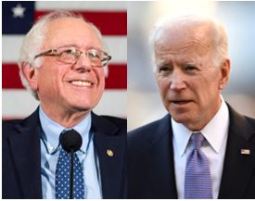
Sanders and Biden compete in South Carolina
After finishing fourth in Iowa and New Hampshire and a distant second to Sanders in Iowa, Biden’s campaign hopes his strong support among African American voters — who will make up about 60 percent of the electorate in South Carolina — will propel him to his first victory of the presidential race.
Four years ago, Sanders was crushed nearly 3-to-1 in South Carolina by Hillary Clinton, who carried all 46 counties. But this time around, his chances will be helped by a more fractured field and a strong statewide organization built since his defeat last time around.
Most public polling in the last week of the race showed no statistically significant difference between Biden and Sanders, although some polls showed the former vice president had built a lead.
Five other candidates are on the ballot Saturday: California businessman Tom Steyer, former South Bend, Indiana Mayor Pete Buttegieg, U.S. Senators Elizabeth Warren of Massachusetts and Amy Klobuchar of Minnesota, and U.S. Rep. Tulsi Gabbard of Hawaii.
Polls show Steyer, who wasn’t a factor in the first three contests, in third place behind Biden and Sanders in South Carolina, with the rest of the candidates trailing.
A pot of 54 delegates are at stake Saturday, 12 allocated proportionally based on the statewide results and 35 allocated proportionally based on the results in the state’s seven congressional districts. However, only candidates who win at least 15 percent of the vote statewide or in a congressional district qualify for any delegates.
Pre-election polling indicates that Biden and Sanders could end up splitting all 54 delegates between them, although that will depend on district-level results, where public polling has not been done.
After Saturday, the presidential race in the South turns to seven Super Tuesday states where delegates will be selected — Virginia, North Carolina, Tennessee, Alabama, Arkansas, Texas and Oklahoma.
We tweet @ChkFriPolitics Join us!
March Madness: Presidential primary season turns South with a vengeance
10 Southern states hold primaries during March, with nearly 1,000 Democratic delegates at stake
♦By Rich Shumate, ChickenFriedPolitics.com editor
 The 2020 presidential primary calendar finally turns to the South on the last day of February, when South Carolina Democrats cast their ballots in their state’s first-in-the-South primary.
Then, buckle up. The political version of March Madness is about to take off.
During March, 10 Southern states will hold Democratic presidential primaries, with 981 delegates at stake — nearly 25 percent of the total pledged delegates who will officially pick the party’s presidential nominee in Milwaukee in July.
Louisiana, which votes in April, and West Virginia and Kentucky, which vote in May, are the only three Southern states who won’t pick delegates in March.
On March 3, seven Southern states — Arkansas, Alabama, Oklahoma, Tennessee, Virginia, Texas and North Carolina — will vote, with 621 Democratic delegates on the line, including 228 alone in the Lone Star State. Florida, with 219 delegates, goes two weeks later, and Georgia, with 105, goes the week after that.
In most of these states, the amount of public polling on the Democratic race has been sparse to non-existent. That, combined with the fluidity of the race after Iowa and New Hampshire, means all of the Southern races are shrouded in uncertainty.
So the presidential race takes on a twang, here are some things to watch for:
If Biden Bites the Dust: The former vice president’s campaign will be on life support, or worse, if he loses in South Carolina, which will particularly shake up the landscape in the South because of his heretofore solid support among African American voters.
Black voters make up a majority of the Democratic electorate in South Carolina, Georgia, Alabama, Mississippi and Louisiana; they are a smaller but still powerful group everywhere else. If Biden exits after South Carolina, his African American supporters will be looking for a new home, opening up an avenue for someone to come in and hoover up a crop of Southern delegates. Or, the black vote could fracture between multiple candidates, adding even more uncertainty to the overall race.
Bloomberg’s Debut: The March 3 Super Tuesday primaries (seven in the South and seven in other parts of the country) will be the first test for former New York City Mayor Michael Bloomberg, who has been building staff and airing ads across the region while his competitors dallied and debated in the early states. If he can tap into Biden’s African American support, Bloomberg could become an unstoppable force; his performance across the South will tell us whether that’s probable or even possible.
Bernie, Bless His Heart: Four years ago, Hillary Clinton plum wore out Bernie Sanders all across the South. The only states he carried were West Virginia and Oklahoma (and how on earth did a self-described socialist win Oklahoma?), a haul that gave her an insurmountable delegate lead. Against a much more fractured field, Sanders is likely to improve on that dismal performance, but if Bloomberg or one of the other candidates puts together a coalition that sweeps the South, it could be deja vu all over again for Bernie and his ‘bros.
Wave the Rainbow Shirt: Pete Buttigieg is the first openly gay man to make a serious run for the presidential nomination in either political party. How will this play in the evangelical South? Or among culturally conservative African American voters? Polling to date has shed little light on this; the results in March might, although there are a myriad of reasons Buttigieg might falter in the South that have nothing to do with his sexual identity, particularly his sparse political resume.
Danged Yankees: The 2020 Democratic race features one current (Bloomberg) and one former (Sanders) New Yorker, along with candidates from Boston, Delaware, Minnesota, and Indiana. Indeed, for the first time since the modern primary process took root in the 1950s, a competitive Democratic primary race is taking off with nary a Southerner among the major players (if one remembers that for all her New York bona fides, Hillary Clinton was once first lady of Arkansas.) So to the degree that any regional political affinity remains, it won’t be in play in 2020, although Elizabeth Warren does try to remind folks at every opportunity that she grew up in Oklahoma. (As if that compensates for moving to Boston and becoming a Red Sox fan.)
Expanding The Map: If one considers that the primary — perhaps only — purpose of a presidential primary process is to pick a candidate who can win in November, the outcomes of Democratic primary season would seem a poor barometer to predict what might happen in the general election. After all, no matter how well a Democrat does in Arkansas or Alabama or Mississippi in March, she or he is not going to carry these states in November, unless something goes catastrophically wrong on the Republican side.
However, Florida and North Carolina will be hotly contested in the general election, and Democrats have hopes of flipping Texas and Georgia. So time, energy and money (think Bloomberg) expended in those states in the primary seasons could pay dividends down the line. (It’s worth noting that after Barack Obama organized in Virginia and Indiana to compete against Hillary Clinton during the 2008 primaries, he flipped both of those states in November.)
What About Trump? The GOP is holding primaries at the same time as Democrats in all of the Southern states except for South Carolina and Virginia, where they have been cancelled in deference to President Donald Trump. Trump, of course, has no serious opposition, but his campaign has embarked on a strategy of trying to drive up his vote totals in uncontested primaries as a sign of strength. So don’t be surprised if you see Trump parachuting into the South during March to rally his faithful — and, as a delightful bonus, to irritate the Democrats.
 Chicken Fried Politics