
Home » Florida (Page 10)
Category Archives: Florida

Election Preview: Four Southern U.S. Senate races are key in battle for control
Republicans are defending seats in Texas and Tennessee; Democrats in Florida and West Virginia
♦By Rich Shumate, ChickenFriedPolitics.com editor
 (CFP) — With the balance of power in the U.S. Senate hanging in the balance, voters in four Southern states will decide hotly contested races in Tuesday’s midterm elections.
Republicans are defending seats in Texas and Tennessee that have turned out to be much more competitive than expected in two very Republican states. Meanwhile, Democratic incumbents are defending turf in Florida and West Virginia, states which President Donald Trump carried in 2016.
Another Senate seat is up in Virginia, where Democratic U.S. Senator Tim Kaine is favored to win re-election. Both seats are up this year in Mississippi, and Republican candidates are favored to hold both.
In Texas, Republican U.S. Senator Ted Cruz is seeking a second term against Democratic U.S. Rep. Beto O’Rourke, a race in which the challenger has sparked the imagination of Democratic activists around the country.
Cruz, who came in second to Trump in the 2016 Republican presidential nomination, was heavily favored for re-election at the beginning of 2018. But O’Rourke — trying to take advantage of a changing political electorate in fast-growing Texas, including more younger and Latino voters — has made the race competitive, even though Texas hasn’t elected a Democrat to the Senate in 30 years.
O’Rouke has raised more than $70 million for the race, the largest haul of any Senate candidate this cycle, according to Federal Election Commission records. Cruz has raised $40 million.
Despite Cruz’s often contentious relationship with Trump during the 2016 presidential primaries, which famously included Trump dubbing him “Lyin’ Ted,” the president has gone all out for Cruz in this race, even traveling to Houston for a campaign rally.
In Tennessee, Republican U.S. Rep. Marsha Blackburn is vying with former Democratic Governor Phil Bredesen for a seat which opened after the retirement of U.S. Senator Bob Corker, one of Trump’s strongest critics in Congress.
After first rebuffing calls for him to run after Corker announced he was leaving the Senate, Bredesen changed course last December and jumped into the race, giving Volunteer State Democrats a shot at capturing the seat behind the candidacy of a popular two-term moderate.
But Blackburn has fought back by trying to tie Bredesen to national Democratic leaders who are unpopular in Tennessee, in particular Hillary Clinton and Senate Minority Leader Chuck Schumer of New York.
Republicans currently have a slim one-vote majority in the Senate. However, because Democrats are defending more seats this cycle than Republicans, it is unlikely they can capture a Senate majority — and depose Kentucky’s Mitch McConnell as Senate majority leader — without winning in either Texas and Tennessee.
In Florida, Democratic U.S. Senator Bill Nelson is facing off against Republican Governor Rick Scott, who has served as the Sunshine State’s chief executive for the past eight years.
Nelson, who first arrived in Congress during the Carter administration, is a proven vote-getter seeking his fourth term. Scott’s two wins for governor were narrow, although his approval ratings have ticked up during the final year of his administration.
Florida is more evenly divided than either Texas or Tennessee, generally sending one senator from each party to Washington since the 1980s. Trump’s win in Florida in 2016 was by a single point, compared to a 9-point win in Texas and a 26-point win in Tennessee.
In West Virginia, Democratic U.S. Senator Joe Manchin was seen as particularly vulnerable given Trump’s 40-point win in the Mountaineer State. But Machin kept himself in contention by avoiding criticism of the president and supporting him on a number of high-profile issues, including both of Trump’s Supreme Court picks.
Manchin may have also benefited from the Republicans’ selection of a standard-bearer — State Attorney General Patrick Morrisey, who grew up in New Jersey, has only lived in West Virginia since 2006 and spent nearly a decade as a Washington lobbyist.
The folksy Manchin, a West Virginia native who served as governor before being elected to the Senate, has made much of that contrast. Morrisey has responded much the way Blackburn has in Tennessee — by trying to tie the incumbent to liberal establishment Democrats.
In Mississippi, both Senate seats are up this year due to the retirement of former U.S. Senator Thad Cochran. One race is a special election to fill the remainder of Cochran’s term; the other is for the seat occupied by Republican U.S. Senator Roger Wicker.
While Wicker is heavily favored over his Democratic challenger, State House Minority Leader David Baria, the special election features a three-way race in which candidates from all parties will compete and a runoff held between the top two vote-getters if no one captures a majority.
The special election is a three-way contest between Republican U.S. Senator Cindy Hyde-Smith, Cochran’s temporary replacement; Republican State Senator Chris McDaniel, who lost a bitter primary against Cochran in 2014; and Democrat Mike Espy, a former congressman who served as secretary of agriculture in the Clinton administration.
Depending on how evenly the Republican vote is divided, the top GOP candidate could face Espy in a November 27 runoff. But polls have showed Hyde-Smith with a wide lead over McDaniel, which could be enough for her to win the seat outright on Tuesday.
Although McDaniel was a vocal supporter of Trump in 2016, the president snubbed McDaniel and endorsed Hyde-Smith, who had been a Democrat until 2010. McDaniel has charged that Trump was “forced” into making the endorsement by Senate Republican leaders.
In Virginia, Kaine is facing Corey Stewart, chairman of the Prince William County Board of Supervisors, who served as Trump’s Virginia coordinator in 2016.
When he kicked off his campaign in July 2017, Stewart vowed to “run the most vicious, ruthless campaign” that he could against Kaine. However, public polling in the race has shown that strategy has failed to gain traction, and Kaine enjoys a wide lead.
See ChickenFriedPolitics.com’s latest ratings for hot U.S. Senate races
We tweet @ChkFriPolitics Join us!
Election Preview: Governor’s races could make history in Florida, Georgia
Democrats within shooting distance in Oklahoma, Tennessee; GOP incumbents heavily favored in Alabama, Arkansas, Texas and South Carolina
♦By Rich Shumate, ChickenFriedPolitics.com editor
(CFP) — Eight Southern governorships are on the ballot in Tuesday’s midterm elections, highlighted by close and contentious races in Florida and Georgia that have garnered national attention.

Abrams

Gillum
Democrats are hoping to make history: If Democrat Andrew Gillum wins in Florida, he will be the Sunshine State’s first African-American governor, while a victory by Democrat Stacey Abrams in Georgia would make her not only its first black governor but also the first woman to hold the post and the first black female governor in U.S. history.
However, in both states, Democratic nominees will have to overcome a long history of Republican control. The last time a Democrat won a governor’s race in Florida was 1994; in Georgia, 1998.

Kemp

DeSantis
In Florida, the Republican nominee is former U.S. Rep. Ron DeSantis, who has received considerable help in his quest for the governorship from President Donald Trump. The president stopped twice in Florida to campaign for DeSantis in the closing days of the campaign.
The Republican nominee in Georgia is Secretary of State Brian Kemp, who has also benefited from a Trump endorsement and a presidential visit on the Sunday before the vote.
Public polling has shown both races are within the statistical margin of error, which means neither race can be forecast with certainty heading into election day.
In 2016, Trump carried Florida by a single point and Georgia by 5 points. While Florida has long been a swing state, the result in Georgia was the smallest win by a Republican in the Peach State since 1996, giving Democrats hope that it might be in play in 2020.
A win by either Abrams or Gillum would be a boon to Democratic prospects in 2020. It will also give them a say in redrawing congressional districts after the 2020 census — a process that Republicans have totally controlled in both states for the past decade.
And if the race in Georgia is close, it might not be decided on election night. State law requires a candidate to win an outright majority to claim the governorship. With a Libertarian in the race, neither major-party candidate could reach that threshold, triggering a December 4 runoff between them.
The remaining six Southern governorships up this year — all held by Republicans — look to be more secure, though Democrats may have outside shots in Oklahoma and Tennessee.
 In the Sooner State, where Republican Governor Mary Fallin is term-limited, Republican businessman Kevin Stitt is facing former Democratic Attorney General Drew Edmondson, who comes to the race having served 16 years in statewide office.
Approval polling has pegged Fallin as America’s most unpopular governor, which has not helped Stitt’s cause. Oklahoma teachers also went on strike last year in a public display of protest that has reverberated through state politics.
Public polling has shown Stitt with a small lead near the edge of the margin of error. While Stitt is still regarded as the favorite, one prominent national prognosticator, The Cook Political Report, rates the race as a toss-up.
 In Tennessee, where voters are also filling an open seat for a term-limited incumbent, Governor Bill Haslam, Republican Bill Lee, a first-time candidate who worked in Haslam’s administration, is facing Democrat Karl Dean, the former mayor of Nashville.
Public polling has shown Lee above 50 percent and with a statistically significant lead over Dean.
Four other governor’s races on the midterm ballot — in Arkansas, Alabama, Texas and South Carolina — all feature Republican incumbents who are expected to easily win re-election:
- In Arkansas, Governor Asa Hutchinson is facing Jared Henderson, a non-profit executive and former NASA research scientist.
- In Alabama, Governor Kay Ivey is being challenged by Tuscaloosa Mayor Walt Maddox. Ivey became governor in 2017 after her predecessor, Robert Bentley, resigned after a sex scandal. Since then, Ivey ridden a wave of public approval for her handling of the aftermath.
- In Texas, Governor Greg Abbott is squaring off against former Dallas County Sheriff Lupe Valdez.
- In South Carolina, Governor Henry McMaster is running against Democratic State Rep. James Smith from Columbia. McMaster became governor in 2017 after Nikki Haley left office to become Trump’s U.N. ambassador.
Heading into Tuesday’s election, Republicans hold 11 of the 14 Southern governorships; Democrats are in charge in North Carolina, Louisiana and Virginia.
See ChickenFriedPolitics.com’s latest ratings for hot governor’s races.
We tweet @ChkFriPolitics Join us!
Florida governor’s debate: Gillum, DeSantis get personal in verbal slugfest
Democrat Gillum offers a new explanation for”Hamilton” tickets provided by undercover FBI agent
♦By Rich Shumate, ChickenFriedPolitics.com editor
 DAVIE, Florida (CFP) – On a day when bombs arrived at the doors of political leaders across America, the two candidates vying to be Florida’s next governor made little effort to cool the political temperature, engaging in a personal, verbal slugfest that included allegations of lying, corruption and was capped off by the spelling out of a racial slur on statewide television.
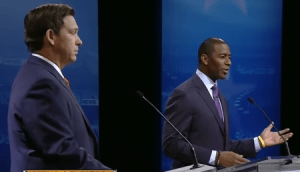
DeSantis, Gillum meet for second debate (Courtesy WPBF)
In their second and final debate at Broward College, Democrat Andrew Gillum was forced to explain how he wound up accepting a pricey Broadway ticket from an undercover FBI agent investigating corruption in a community redevelopment agency in Tallahassee, where he is the mayor.
Republican Ron DeSantis later got into an argument with the debate’s moderator when he tried to ask a question about appearances DeSantis made before a conservative group whose members have expressed anti-Muslim and racist views.
“How the hell am I supposed to know every single statement somebody makes?” DeSantis snapped, drawing boos from the crowd. “I am not going to bow down to the altar of political correctness. I’m not going to let the media smear me like they like to do with so many other people.”
At that, Gillum pounced.
“(DeSantis) has spoken at racist conferences. He has accepted a contribution and would not return it from someone who referred to the former president of the United States as a Muslim n-i-g-g-e-r,” Gillum said. “Now I’m not calling Mr. DeSantis a racist. I’m simply saying the racists believe he’s a racist.”
DeSantis responded in kind: “I’m not going to sit here and take this nonsense from a guy like Andrew Gillum, who always plays the victim … who’s aligning himself with groups who attack our men and women in law enforcement, attack our military.”
During a previous debate on Sunday, Gillum refused to answer DeSantis’s repeated questions about who paid for his ticket to the hit musical “Hamilton.”
He attended the play in New York in 2016 while traveling with an undercover FBI agent posing as a developer as part of an investigation into alleged kickbacks at Tallahassee’s community redevelopment agency.
Before the second debate, emails released as part of an ethics probe showed that Gillum had been told that the tickets had been arranged by the FBI agent – a revelation which DeSantis said showed that Gillum had lied during the first debate.
“He wouldn’t accept responsibility from getting a $1,000 ticket from an FBI agent at the last debate. We now know that he lied about that,” DeSantis said. “At some point, you’ve got to demonstrate leadership and accept responsibility for what you’ve done.”
While Gillum’s campaign had previously said that he thought his brother had paid for their tickets, he told the debate audience that he was aware that the agent and a lobbyist friend who was also on the trip had arranged for the tickets.
However, he said his brother repaid the men who arranged the “Hamilton” tickets with tickets to an upcoming Jay-Z/Beyoncé concert.
“I understood that to have solved whatever the issue was with regard to the expenses associated with it,” Gillum said. “I take responsibility for not having asked more questions.”
After insisting that he is not under FBI investigation, Gillum sought to downplay the “Hamilton” issue by saying it was a distraction from the real issues in the campaign.
“In the state of Florida, we got a lot of issues. In fact, we have 99 issues, and ‘Hamilton’ ain’t one of them,” he said.
DeSantis was also asked by the moderator, Todd McDermott of WPBF-TV in West Palm Beach, about how he could maintain that Gillum was unfit to be governor due to the FBI investigation in Tallahassee while remaining a strong supporter of President Donald Trump, who is the subject of investigations with the FBI, special counsel Robert Mueller and Congress.
DeSantis did not answer the question, choosing instead to defend his role in efforts by House Republicans to investigate FBI agents for alleged improprieties in the Russia probe.
As he did in the first debate, DeSantis continued to hammer Gillum on immigration, saying that his unwillingness to cooperate with Immigration and Customs Enforcement if he is elected governor would put Floridians at risk to indulge his “hate” of Trump.
“Say you’re convicted of child molestation. You’re here illegally. You’ve served your sentence, state prison. Are you going to hand them over to ICE or not?” he said. “He will not commit to doing that. That means that child molester convicted gets released back on the streets after serving the sentence. And guess what? That child molester will re-offend, and someone’s son or daughter in Florida will end up paying the price.”
At that point, the audience booed, and Gillum replied, “Shame on you.”
At another point in the debate, after DeSantis criticized Gillum for not doing more to bring down Tallahassee’s murder rate, Gillum retorted, “I would suggest the congressmen might want to reconsider whether he wants to be governor. The governor’s mansion is in Tallahassee. I’d hate for you to be hurt.”
The debate in Davie is the last scheduled face-to-face meeting for the candidates before the November 6 vote.
DeSantis, 40, served six years in the U.S. House representing a Jacksonville-area district. Gillum, 39, has been mayor of Tallahassee since 2014.
Recent public polling has put the race within the margin of error, which means neither man has a statistically significant lead. However, the most recent poll has shown some movement toward Gillum in the race.
Democrats have not won a governor’s race in Florida since 1994.
We tweet @ChkFriPolitics Join us!
Florida governor’s debate: Gillum, DeSantis joust over Trump, racism and corruption
Gillum calls Trump “weak,” accuses DeSantis of injecting race into the campaign
♦By Rich Shumate, ChickenFriedPolitics.com editor
TAMPA (CFP) — Meeting in their first face-to-face debate, Democrat Andrew Gillum and Republican Ron DeSantis disagreed as expected on hot-button issues such as immigration and taxes — but they threw their sharpest elbows over charges of racism and very divergent views of President Donald Trump.
In the October 21 debate in Tampa, televised nationally by CNN, Gillum, who is African American, accused DeSantis of trying to make his race an issue in the campaign, beginning with a comment on the day after he won the Republican nomination that Floridians shouldn’t “monkey up” their future prospects by electing Gillum.

Gillum and DeSantis meet for first debate in Tampa (Courtesy CNN)
“The congressman let us know exactly where he was going to take this race the day after he won the nomination. The ‘monkey up’ comment said it all. And he has only continued in the course of his campaign to draw all the attention he can to the color of my skin,” Gillum said.
“And the truth is, you know it, I’m black. I’ve been black all of my life. So far as I know, I will die black.”
If elected, Gillum would become Florida’s first African American governor.
But DeSantis insisted that his public record, including his service in the military and as a Navy prosecutor, demonstrated racial tolerance.
“Floridians can know that I’ll be a governor for all Floridians,” he said.
When it came to Trump, DeSantis — one of the president’s staunchest allies in Congress whose campaign benefited in the GOP primary from a Trump tweet — noted that Gillum has said publicly that he would support Trump’s impeachment, which would hinder his ability to get things done in Washington as governor.
“Andrew wants to lead the Trump impeachment from Tallahassee,” DeSantis said. “You need to be able to work with the administration to get the dollars we deserve … I think I will be better positioned to advance Florida’s priorities because I have a productive relationship with the administration.”
At that, Gillum doubled down on his biting criticism of Trump, who carried Florida in 2016.
“Donald Trump is weak, and he performs as all weak people do – they become bullies. And Mr. DeSantis is his acolyte. He’s trying out to be the Trump apprentice at every turn,” Gillum said.
“You shouldn’t have to kiss the ring of the president of the United States for the president to see to the good and the goodwill of the third-largest state in all of America.”
DeSantis, 40, served six years in the U.S. House representing a Jacksonville-area district. Gillum, 39, has been mayor of Tallahassee since 2014.
DeSantis took Gillum to task for his stewardship of Florida’s capital city, noting that it has an historically high murder rate. He also tried to associate the mayor with an ongoing FBI investigation into corruption that has ensnared a Gillum associate.
“Andrew’s a failed mayor. He’s presided over a crime-ridden city. He’s involved in corruption,” DeSantis said. “He’s not the guy to lead our state.”
But Gillum insisted that overall crime has actually dropped in Tallahassee and that neither he nor his administration are under investigation by the FBI.
DeSantis responded, “You went to a Broadway show with an undercover FBI agent,” a reference to a photograph that has emerged of a trip Gillum took to New York with an FBI agent who was investigating the corruption case.
When DeSantis repeatedly pressed Gillum on who had paid for tickets to the Broadway play “Hamilton,” the mayor did not answer. Instead, he tried to turn the tables by asking DeSantis to produce receipts for his travel as a congressman, which Gillum said about to become subject of an ethics investigation before DeSantis resigned in August.
“That’s a lie,” DeSantis said.
DeSantis also hit Gillum for wanting to raise taxes, pointing to his support for higher sales and property taxes as mayor. He also insisted that Gillum’s plans for expanding state spending would lead to a sharp increase in the state sales taxes or perhaps even imposition of an income tax.
“Andrew has a lifetime of supporting higher taxes,” DeSantis said. “If you believe with that record that he ain’t gonna raise your taxes, then I’ve got some ocean front property in Arizona that I’d like to sell you.”
Gillum quickly shot down any suggestion of an income tax, which would be politically explosive in the Sunshine State. He said his plan is to increase taxes on the wealthiest 3 percent of Florida businesses, who he charged had reaped a $5 billion windfall from the Republican tax cut plan that DeSantis supported in Congress.
“We’re going to take a billion of that and invest in public education in this state,” Gillum said.
The candidates also disagreed sharply on immigration, with DeSantis charging that Gillum and Democrats supported open borders, abolishing Immigration and Customers Enforcement and turning Florida into a sanctuary state, which DeSantis said would be “a wet kiss to the drug cartels.”
“Andrew during the primary said he wanted to abolish ICE, said he would not cooperate with the Trump administration vis-à-vis illegal immigration,” DeSantis said. “That means you’re going to have more crime in Florida.”
Gillum denied that he was for open borders and said he supported enforcement of immigration laws. But he took issue with the Trump adminsitration’s hard-line stance on immigration enforcement.
“What I’ve simply said is that what we’re not going to become here in the state of Florida is a state where basically become a show-us-your-papers state based on the color of somebody’s skin, the language that they speak, what neighborhood they live in,” he said. “That’s not the American way. That’s not who we are as Floridians.”
Gillum also criticized the Trump administration’s policy of separating migrant children from their parents at the U.S.-Mexico border, saying “we should not be terrorizing people who are here in this country who are babies that are nursing with their parents, with their mothers.”
Despite campaigning for the same office for nearly a year, Gillum and DeSantis had not actually met until just before the debate.
They are scheduled to meet for a second and final debate on October 24 in Davie.
We tweet @ChkFriPolitics Join us!
Watch full debate:
Insight: Donna Shalala poised to follow Hillary playbook and lose an unloseable race
Lack of Latino connection, combined with 2018’s worst political gaffe, could keep Florida’s 27th District in GOP hands
♦By Rich Shumate, ChickenFriedPolitics.com editor
MIAMI (CFP) — Miami Democrats may be about to learn that hard way that even in a race where the odds seem decidedly in your favor, your candidate and her campaign matter. A lot.

ChickenFriedPolitics.com editor Rich Shumate
On paper, Florida’s 27th U.S. House District should have been an easy layup for Democrats. Ileana Ros-Lehtinen, a fixture in Cuban-American politics for more than three decades, was retiring. Hillary Clinton carried the district by 20 points, giving the 27th the distinction of being the location of Donald Trump’s worst loss in a Republican-held congressional district anywhere in the country. And younger Cuban voters have been showing less fealty to the GOP in recent election than did their ferociously anti-communist elders.
Yet, despite all that, when the smoke clears on November 6, there is a very good chance that the new congresswoman from the 27th District will be a Republican, and a race Democrats thought they couldn’t lose will be lost.
So what happened? Donna Shalala happened.
After months of ambitious Miami-Dade Democrats plotting and jockeying for position in what was assumed to be a wide-open race for a sure seat in Congress, Shalala big-footed her way into the contest in March, deciding to enter elective politics at age 77 after a career spent in academia and eight years as Bill Clinton’s health secretary and two years as head of his foundation.
She instantly became the “big name” in the race and the favorite. Three Democratic rivals withdrew; another switched to a congressional race in another district.
Among the candidates who withdrew was popular State Senator José Javier Rodríguez, and his departure left Democrats with a handicap that has since turned into an albatross — he had been the only Latino Democrat running in a district in which seven out of 10 residents, and nearly six in 10 voters, are Latino.
In the end, the Democratic primary in August came down to a race between Shalala and State Rep. David Richardson, the first openly gay man to serve in the Florida legislature. She won, but with only 31 percent of the vote against a field of four rivals.
Meanwhile, in the Republican primary, Maria Elvira Salazar — running against eight rivals — was taking 40 percent of the vote, and her total vote was nearly 1,700 more than Shalala’s total, even though more people had voted in the Democratic primary than the Republican primary.
Salazar is no Trump-loving ideologue. As a journalist for 35 years, she has pushed back against the president’s characterization of the news media as the enemy of the people, and she is for immigration reform and a pathway to citizenship for Dreamers and against separating migrant families at the U.S.-Mexico border.
And perhaps more significantly, Salazar has three qualities Shalala can’t match: She’s a Latina. She speaks Spanish. And she has deep roots in Miami, where she was born and has been in the living rooms of her Latino constituents as an anchor and reporter on Spanish-language television.
Shalala’s inability to speak Spanish has given Salazar the advantage of being able to speak to Latino constituents in the district in their own language. And while someone entering a race in March probably can’t be expected to be fluent in October, those constituents probably found it telling that Shalala has lived in a bilingual city for 17 years, and served as president of its namesake university, without bothering to enough Spanish to give a simple speech. (Even George W. Bush speaks enough Spanish to make do in a pinch.)
More inexplicable was the decision by Shalala’s campaign not to begin running Spanish language ads until mid-October, an egregious oversight in a district where Spanish is ubiquitous.
And then, the campaign invited Democratic U.S. Rep. Barbara Lee appear at an event with Shalala and House Minority Leader Nancy Pelosi.
The same Barbara Lee who said, after Cuban dictator Fidel Castro died, “we need to stop and pause and mourn his loss.” The same Barbara Lee who wrote lobbied against placing sanctions on the socialist dictatorship in Venezuela, many of whose victims have sought refuge in Miami.
Shalala’s campaign managed to extricate themselves from Lee actually appearing, but the damage was already done. When Pelosi and Shalala arrived at a Miami restaurant for the October 18 event, they were greeted by protestors calling them “communists” and “witches” — and much worse that isn’t printable here.
After news broke of Lee’s aborted visit, Salazar and Shalala met in a Spanish-language debate, where Shalala had to rely on an interpreter for the particulars of a rather vigorous denunciation from her Republican rival — a scene that summed up all that has gone wrong for Democrats in the 27th District.
There is a curious echo here: A woman with an impeccable resume handed a Democratic nomination on the basis of her presumed invincibility, only to see it turn to ashes thanks to personal deficiency and questionable strategy.
After 2016, Democrats waxed wistful of the might-have-beens if Vice President Joe Biden or another big name Democrat had challenged Hillary Clinton for the nomination in 2016. If Shalala loses, we will see the same wistfulness for a different outcome with Rodríguez, or even Richardson who, although not Latino, has won election twice to a majority-Latino Florida House seat.
Perhaps Shalala will squeak through in the end. If so, she’ll have some serious fences to mend, not to mention a new language to learn.
But if she loses, Miami Democrats will have created a new Republican political star who will be exceedingly difficult to dislodge.
Your candidate and her campaign matter. A lot.
 Chicken Fried Politics