
Home » Georgia (Page 13)
Category Archives: Georgia

Decision ’18: Last uncalled Southern U.S. House seat heading for recount
With Georgia’s 7th District remaining to be called, Democrats have netted 10 seats in the South
♦By Rich Shumate, ChickenFriedPolitics.com
 (CFP) — The South’s last uncalled U.S. House race, in Georgia’s 7th District, is headed for a recount with the Republican incumbent, Rob Woodall, holding a slender 419-vote lead over his Democratic challenger, Carolyn Bourdeaux.
With that race in the balance, Democrats’ overall gain in the South stands at 10, just a third of the total number of seats that they had targeted heading into the November 6 vote. All of those seats were in urban and suburban areas where the Democratic vote surged.

Bourdeaux

Woodall
Bourdeaux said Friday that she will ask for a recount. Under state law, a losing candidate can seek a recount if the winning margin is less than 1 percent; Woodall’s lead is 0.14 percent.
State election officials have not announced a timetable for the recount. But Georgia uses electronic voting machines without paper ballots, so recounts tend to be finished quickly.
The 7th District is located in Atlanta’s northwest suburbs, in Gwinnett and Forsyth counties.
Across the South, Democrats’ best results came in Virginia, where they ousted Republican incumbents in the 2nd, 7th and 10th Districts, which are located in the suburbs of Washington, D.C., Richmond and Hampton Roads.
Democrats also scored surprise wins in South Carolina’s 1st District, which includes Charleston, and Oklahoma’s 5th District, centered in Oklahoma City.
However, Democrats went 0-for-4 in targeted seats in North Carolina, 2-for-9 in Florida and 2-for-8 in Texas. They also fell short in targeted races in the upper South states of Arkansas, Kentucky and West Virginia, where Republicans continue to hold 12 out of 13 House seats.

McBath

Hurd
Democrats did win five of the six GOP-held Southern seats that Hillary Clinton carried in 2016; the lone exception was in Texas’s 23rd District, in West Texas, where Republican Will Hurd won a narrow victory. Democrat Lucy McBath also ousted Republican Karen Handel in Georgia’s 6th District, where Donald Trump won by just 1.5 points in 2016.
Four Republican House members, with a combined 48 years of service, went down in the Clinton districts, including Pete Sessions and John Culberson in Texas, Barbara Comstock of Virginia, and Carlos Curbelo in Florida. Republicans also lost in Florida’s 27th District, which U.S. Rep. Ileana Ros-Lehtinen had held for 30 years before deciding to retire.
Democrats kept all of the 40 seats they held going into the election. With the 10 Democratic gains, Southern Republicans will hold 102 seats to 50 for Democrats when Congress reconvenes in January.
In the last Congress, just 13 white Democrats who were not Latino or Asian represented Southern districts. That number will go up to 20 in January, as seven white Democrats displaced Republicans. Two of the flipped seats were won by African-American candidates and one by a Latina.
Hurd, who represents a majority Latino district, will be the only African-American Republican in the next House. Three Southern Republicans are Latino — Mario Diaz-Balart of Florida, Bill Flores of Texas, and Alex Mooney of West Virginia, whose mother is Cuban.
We tweet @ChkFriPolitics Join us!
Decision ’18: Stacey Abrams “acknowledges” defeat in Georgia governor’s race but won’t concede
Abrams says she will sue over “malpractice” by Republican Brian Kemp in managing election
♦By Rich Shumate, ChickenFriedPolitics.com editor

 ATLANTA (CFP) — Saying she sees “no further remedy” to allow her to overcome Republican Brian Kemp’s lead in Georgia’s governor’s race, Democrat Stacey Abrams has acknowledged Kemp’s win but is refusing to concede and vowing to file a federal lawsuit over what she sees as his mismanagement of the election.
“This is not a speech of concession because concession means to acknowledge an action is right and proper,” she said amid a somber assembly of supporters in Atlanta Friday afternoon. “As a woman of conscience and faith, I cannot accept that.”
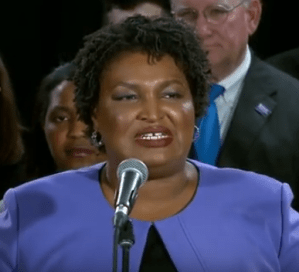
Democrat Stacey Abrams acknowledges defeat in Atlanta (From YouTube)
Abrams offered blistering criticism of Kemp, who as Georgia’s secretary of state oversaw the election until resigning two days after the November 6 vote.
“Under the watch of the now former secretary of state, democracy failed Georgia,” she said. “To watch an elected official who claims to represent the people in this state baldly pin his hopes for election on the suppression of the people’s democratic right to vote has been truly appalling.”
She announced the formation of a new group, Fair Fight Georgia, which she said would file a federal lawsuit over “gross mismanagement” of the election. It was unclear what remedy the lawsuit would seek, although Abrams indicated the suit would not seek to overturn the results in the governor’s race.
Abrams and Democrats have complained that Kemp purged eligible voters from the polls and improperly rejected registrations from voters because of relatively minor discrepancies with other records. Democrats have also hit elections officials for long lines on election day and for rejecting provisional votes based on discrepancies in handwriting on documents.
“Ballots were rejected by the handwriting police,” Abrams said. “Citizens tried to exercise their constitutional rights and were still denied the ability to elect their leaders.”

Georgia Governor-elect Brian Kemp
Kemp has denied that his office sought to suppress or intimidate voters. In his response to Abrams’s non-concession concession, he said he appreciated “her passion, hard work and commitment to public service.”
“The election is over, and hardworking Georgians are ready to move forward,” he said in a statement. “We can no longer dwell on the divisive politics of the past but must focus on Georgia’s bright and promising future.”
Abrams acknowledgement of defeat came as Kemp’s successor as secretary of state, Robyn Crittenden, was poised to certify Kemp as the winner of the governor’s race. His final margin of victory over Abrams was 55,000 votes out of 3.9 million votes cast.
Under a law unique to Georgia, Kemp needed to win a majority of the votes cast, or he would have faced a December runoff against Abrams. He cleared that threshold by about 10,500 votes.
The certification was delayed two days after a federal judge in Atlanta ordered the state to give more time for voters who cast provisional ballots that had been rejected to remedy the errors.
Abrams, 44, from Atlanta, is the former Democratic leader in the Georgia House. Had she been elected, she would have been Georgia’s first black or female governor and the first black woman in U.S. history elected as a state governor.
Kemp, 55, from Athens, served two terms as secretary of state after serving in the Georgia Senate.
Kemp’s victory keeps the governor’s office in Republican hands and marks the fifth straight GOP victory for governor in the Peach State. The incumbent, Governor Nathan Deal, was term limited.
We tweet @ChkFriPolitics Join us!
Decision ’18: Federal judge stops Georgia from certifying election results
Democrat Stacey Abrams faces daunting math in quest for runoff in governor’s race; 7th District U.S. House race still too close to call
 ATLANTA (CFP) — A federal judge has stopped Georgia’s secretary of state from certifying election results, extending for at least two more days Democrat Stacey Abrams’s slender hope of forcing her race against Republican Brian Kemp for governor into a runoff.
Meanwhile, a different federal judge ordered elections officials in suburban Gwinnett County to stop rejecting absentee ballots with incorrect or missing birth dates. The 7th U.S. House District, in which incumbent Republican Rob Woodall holds a small lead over Democrat Carolyn Bourdeaux, is centered in Gwinnett.
Ruling in a lawsuit filed by Common Cause Georgia, U.S. District Judge Amy Totenberg delayed the state’s certification of results until at least Friday at 5 p.m. to give voters who cast provisional ballots in the November 6 election more time to validate their registration information so that their votes can count. The certification of results from the state’s 159 counties had been expected Wednesday.
Totenberg also ordered the state to create a secure phone line or website where voters who cast provisional ballots can find out if their ballot has been rejected and, if so, why. Under state law, voters who cast provisional ballots have until Friday to provide documentation that would validate their votes.
Totenberg was appointed to the federal bench by President Barack Obama. She is the sister of Nina Totenberg, NPR’s Supreme Court correspondent.
According to the Secretary of State’s office, 21,700 provisional ballots were cast statewide, usually by voters who were not listed on the registration rolls of the precinct where they tried to vote or who could not provide an accepted form of identification. However, the Abrams campaign believes the number of provisional ballots is at least 30,820.

Stacey Abrams

Brian Kemp
The latest results show Kemp with a lead of 57,863 votes over Abrams, well beyond the number of provisional ballots. But if Kemp’s margin can be reduced to the point where he no longer has a majority of votes, under a law unique to Georgia, the two would face each other again in a runoff in December.
However the math for Abrams is daunting — if there are 30,800 provisional ballots, as her campaign claims, and all of them are valid, she would have to win 83 percent of them just to get the race to a runoff. If there are 21,700, she would have to win 98 percent.
And in court filings, state elections officials have said that usually only half of provisional ballots can be verified to count. If that is the case with the outstanding provisional ballots, a runoff is a mathematical impossibility unless more provisional ballots are found.
Kemp served as secretary of state during the election but resigned after claiming victory in the governor’s race. His campaign has been insisting that Abrams has no viable path to overcome his lead. His current lead is also large enough that Abrams cannot ask for a recount.
But the Abrams camp — which had criticized Kemp’s stewardship of the election process while serving as both secretary of state and a candidate for governor — established a hotline to locate voters who say they had trouble voting on election day, hoping to locate more potential provisional ballots.
In the 7th District race, Woodall holds a 900-vote lead over Bordeaux. With no third-party candidate in the race, a runoff is not a possibility, but the race is currently close enough to trigger a runoff.
Gwinnett County, the state’s second-largest located northeast of Atlanta, is the population center of the district, which also includes parts of Fulton and Forsyth counties. The county’s handling of absentee ballots has been contentious throughout the election, amid news reports that the county was rejecting absentee ballots at a higher rate than any other county in Georgia.
Bordeaux had gone to court alleging that the county had rejected more than 1,000 absentee ballots for “trivial” reasons. United States District Judge Leigh Martin May agreed with that argument, but only for some 220 ballots that had errors in birth dates.
May is also an Obama appointee.
We tweet @ChkFriPolitics Join us!
Republican U.S. Rep. Karen Handel’s hard-won stay in Congress comes to a swift end
After winning her seat in 2017 in the most expensive U.S. House race in history, Georgia Republican concedes to political newcomer Lucy McBath
By Rich Shumate, ChickenFriedPolitics.com editor
 ROSWELL, Georgia (CFP) — In April 2017, veteran Georgia Republican politico Karen Handel, after twice losing races for statewide office, had arrived at the promised land, at end of a very long road.
She won a special election to fill Georgia’s 6th District U.S. House seat, narrowly defeating Democratic newcomer Jon Ossoff after $50 million was spent in a race fueled by Democratic anger over the election of Donald Trump.
Her future seemed assured in the 6th, anchored in Atlanta’s wealthy northern suburbs. The historically Republican seat had been previously held by former House Speaker Newt Gingrich and former U.S. Rep. Tom Price, who gave it up to serve in Trump’s cabinet. And when Ossoff decided not to challenge Handel again in the midterm election, her seat seemed secure and her political career restored.

Lucy McBath

Karen Handel
Until Tuesday’s midterm election, when Handel lost her seat to Democrat Lucy McBath, who didn’t have Handel’s political pedigree but did have a compelling personal story and an issue — gun control.
“After carefully reviewing all of the election results data, it is clear that I came up a bit short on Tuesday,” Handel said in a letter to Atlanta’s WSB-TV. “Congratulations to Representative-Elect Lucy McBath and send her only good thoughts and much prayer for the journey that lies ahead for her.”
The final result was close. Unofficial results showed McBath with a 2,900-vote lead, out of 316,000 votes cast. For Handel, it was déjà vu all over again — in 2010, she lost a Republican primary runoff for governor by 2,500 votes.
McBath, 58, a former flight attendant, had never held political office before. But she became a gun control activist after her 17-year-old son, Jordan Davis, was shot to death outside a convenience store in Jacksonville, Florida, by a man upset about loud hip-hop music played by Davis and three of his friends.
The shooter, Michael David Dunn, was convicted of first-degree murder in Jordan’s death and sentenced to life in prison.
After her son’s death, McBath became a national spokeswoman for Moms Demand Action for Gun Sense in America and was part of a group of mothers of slain African-American teens who appeared at the 2016 Democratic Convention. She decided to run for Congress after last February’s shooting at a high school in Parkland, Florida, in which 17 people died.
“Six years ago, I went from a Marietta mom to a mom on a mission,” McBath said in a statement declaring victory. “After my son was lost to gun violence, I stood up and started demanding more. After Parkland, I was compelled to enter this race for Congress — to provide leadership that would be about the business of putting lives over profit.”
McBath’s quest seemed implausible, running as she was against someone who had been county commission chair in the state’s largest country (Fulton) and secretary of state and came just a percentage point short in a race that would likely have made her governor. Gun control is also not an issue that generally helps Democrats, or anybody else, in Georgia.
Yet, McBath’s victory did not come completely out of left field. The district has become more diverse in recent years, with growing African-Amercian, Latino and Asian populations. Trump had only carried the 6th by 1.5 points in 2016, and Handel had to fight hard to win it in 2017. And toward the end of the campaign, McBath was winning the money chase, outraising Handel by a substantial margin.
Handel also wasn’t the only suburban Southern Republican who found tough sledding in the midterms. Incumbents lost in the Virginia suburbs of Washington, D.C., Richmond, Dallas, Houston and Miamia and even in Oklahoma City and Charleston, S.C..
But Handel’s loss, and a close call in the adjoining 7th District for Republican U.S. Rep. Rob Woodall, harbors a new reality for Georgia Republicans — in the age of Trump, suburbs are no longer safe GOP territory, even in the South.
The race for Georgia governor showed the ominous portents that may await. Democrat Stacey Abrams carried not only Fulton and DeKalb counties, both with large African-American populations, but also seven surrounding suburban counties, including the two biggest, Cobb and Gwinnett. Of the eight congressional districts that contain parts of metro Atlanta, four will now be held by Democrats, and a fifth was very nearly lost.
Republicans will, no doubt, come after McBath in 2020; the 6th is now truly a swing district. But she will have two years to build up her political profile, and she will be running for re-election in a presidential election year, which usually helps Democrats.
And Lucy McBath will always be the woman who won a race she wasn’t supposed to win, against a woman who wasn’t supposed to lose.
Election Preview: Governor’s races could make history in Florida, Georgia
Democrats within shooting distance in Oklahoma, Tennessee; GOP incumbents heavily favored in Alabama, Arkansas, Texas and South Carolina
♦By Rich Shumate, ChickenFriedPolitics.com editor
(CFP) — Eight Southern governorships are on the ballot in Tuesday’s midterm elections, highlighted by close and contentious races in Florida and Georgia that have garnered national attention.

Abrams

Gillum
Democrats are hoping to make history: If Democrat Andrew Gillum wins in Florida, he will be the Sunshine State’s first African-American governor, while a victory by Democrat Stacey Abrams in Georgia would make her not only its first black governor but also the first woman to hold the post and the first black female governor in U.S. history.
However, in both states, Democratic nominees will have to overcome a long history of Republican control. The last time a Democrat won a governor’s race in Florida was 1994; in Georgia, 1998.

Kemp

DeSantis
In Florida, the Republican nominee is former U.S. Rep. Ron DeSantis, who has received considerable help in his quest for the governorship from President Donald Trump. The president stopped twice in Florida to campaign for DeSantis in the closing days of the campaign.
The Republican nominee in Georgia is Secretary of State Brian Kemp, who has also benefited from a Trump endorsement and a presidential visit on the Sunday before the vote.
Public polling has shown both races are within the statistical margin of error, which means neither race can be forecast with certainty heading into election day.
In 2016, Trump carried Florida by a single point and Georgia by 5 points. While Florida has long been a swing state, the result in Georgia was the smallest win by a Republican in the Peach State since 1996, giving Democrats hope that it might be in play in 2020.
A win by either Abrams or Gillum would be a boon to Democratic prospects in 2020. It will also give them a say in redrawing congressional districts after the 2020 census — a process that Republicans have totally controlled in both states for the past decade.
And if the race in Georgia is close, it might not be decided on election night. State law requires a candidate to win an outright majority to claim the governorship. With a Libertarian in the race, neither major-party candidate could reach that threshold, triggering a December 4 runoff between them.
The remaining six Southern governorships up this year — all held by Republicans — look to be more secure, though Democrats may have outside shots in Oklahoma and Tennessee.
 In the Sooner State, where Republican Governor Mary Fallin is term-limited, Republican businessman Kevin Stitt is facing former Democratic Attorney General Drew Edmondson, who comes to the race having served 16 years in statewide office.
Approval polling has pegged Fallin as America’s most unpopular governor, which has not helped Stitt’s cause. Oklahoma teachers also went on strike last year in a public display of protest that has reverberated through state politics.
Public polling has shown Stitt with a small lead near the edge of the margin of error. While Stitt is still regarded as the favorite, one prominent national prognosticator, The Cook Political Report, rates the race as a toss-up.
 In Tennessee, where voters are also filling an open seat for a term-limited incumbent, Governor Bill Haslam, Republican Bill Lee, a first-time candidate who worked in Haslam’s administration, is facing Democrat Karl Dean, the former mayor of Nashville.
Public polling has shown Lee above 50 percent and with a statistically significant lead over Dean.
Four other governor’s races on the midterm ballot — in Arkansas, Alabama, Texas and South Carolina — all feature Republican incumbents who are expected to easily win re-election:
- In Arkansas, Governor Asa Hutchinson is facing Jared Henderson, a non-profit executive and former NASA research scientist.
- In Alabama, Governor Kay Ivey is being challenged by Tuscaloosa Mayor Walt Maddox. Ivey became governor in 2017 after her predecessor, Robert Bentley, resigned after a sex scandal. Since then, Ivey ridden a wave of public approval for her handling of the aftermath.
- In Texas, Governor Greg Abbott is squaring off against former Dallas County Sheriff Lupe Valdez.
- In South Carolina, Governor Henry McMaster is running against Democratic State Rep. James Smith from Columbia. McMaster became governor in 2017 after Nikki Haley left office to become Trump’s U.N. ambassador.
Heading into Tuesday’s election, Republicans hold 11 of the 14 Southern governorships; Democrats are in charge in North Carolina, Louisiana and Virginia.
See ChickenFriedPolitics.com’s latest ratings for hot governor’s races.
 Chicken Fried Politics