
Home » Kentucky (Page 7)
Category Archives: Kentucky


Kentucky U.S. Senator Rand Paul will oppose President Trump on border emergency vote
Rand’s defection means resolution to overturn Trump’s emergency declaration can pass Senate
♦By Rich Shumate, ChickenFriedPolitics.com editor
 BOWLING GREEN, Kentucky (CFP) — U.S. Senator Rand Paul of Kentucky will break with Donald Trump and vote to overturn the president’s declaration of a national emergency to find money to construct a wall along the U.S.-Mexico border.

U.S. Senator Rand Paul
Paul is the fourth Republican senator to come out in favor of a resolution overturning the declaration, enough defections to get the measure through the Senate and force Trump to veto it.
Speaking at a Republican dinner Saturday in his hometown of Bowling Green, Paul cited constitutional objections to Trump’s plan to shift money to wall construction that has been earmarked by Congress for other purposes.
“We may want more money for border security, but Congress didn’t authorize it,” Paul said, according to a report in the Bowling Green Daily News. “If we take away those checks and balances, it’s a dangerous thing.”
Paul is the second Southern Republican senator to announce support for the resolution, joining North Carolina’s Thom Tillis in bolting from the party line.
Trump, frustrated by the unwillingness of the Democrat-controlled House to vote money for the border wall, declared a national emergency on February 15, which would allow him to shift $8 billion from other federal programs and use it for wall construction. Most of the money will come from appropriations for military construction and drug interdiction.
Under the law that governs national emergencies, Congress can overturn an emergency declaration with a majority vote in both houses. The House approved the measure by a vote of 245-182.
Only three of 101 Southern Republicans in the House opposed Trump’s declaration — Thomas Massie of Kentucky, Will Hurd of Texas, and Francis Rooney of Florida.
Republicans hold a 53-47 advantage in the Senate. With Paul, Tillis, Susan Collins of Maine and Lisa Murkowski of Alaska publicly opposed, the resolution overturning the declaration will pass the Senate if Democrats unite against it.
Trump has vowed to veto the resolution and has more than enough support in both houses to prevent his veto from being overridden. The battle will then move to federal court, where opponents are challenging the legality of the emergency declaration.
Paul, who doesn’t come up for re-election until 2022, had been seen as a likely yes vote on overturning the declaration. A libertarian known for opposing his party leadership on constitutional issues, Paul reportedly argued with Vice President Mike Pence about the declaration at a recent GOP party lunch.
The Southern Republicans in the Senate still deciding about whether to oppose the emergency declaration include Ted Cruz of Texas, Marco Rubio of Florida, and Lamar Alexander of Tennessee.
Paul, Cruz and Rubio were all presidential candidates against Trump in 2016. Alexander has announced he will retire in 2020.
We tweet @ChkFriPolitics Join us!

Kentucky governor: School cancellations over Arctic cold are a sign Americans are “getting soft”
Matt Bevin says young people are being told they can “curl up in the fetal position” when life gets hard
♦By Rich Shumate, ChickenFriedPolitics.com editor
LOUISVILLE (CFP) — Kentucky Governor Matt Bevin is under fire for publicly lamenting the decision of school officials across his state to close amid subzero wind chills, which he said was as a sign that Americans are “getting soft.”

Kentucky Governor Matt Bevin
“C’mon now, I mean, there’s no ice going with it or any snow,” Bevin said during a January 29 interview with Louisville radio station WHAS-AM. “What’s happened to America? We’re getting soft.”
The cold snap, which pushed temperatures down into single digits across Kentucky and wind chills below zero in some places, was accompanied by light snow in parts of the state, including Louisville.
While saying he was “being only slightly facetious” and conceding that it might have been “better to err on the side of being safe,” the governor, who grew up in New Hampshire, went on to express his concern about the message that the school closings were sending.
“It does concern me a little bit that in America, on this and a number of other fronts, we’re sending messages to our young people that if life is hard, you can curl up in the fetal position somewhere in a warm place and just wait ’til it stops being hard,” he said.
“That isn’t reality. It just isn’t.”
Bevin, who faces re-election in November amid sagging approval ratings, faced immediate blowback over the remarks, with legendary NBC weatherman Al Roker calling him a “nitwit” on national television and one of his Democratic challengers, Adam Edelen, calling him “dumb and mean.”
The Kentucky Education Association, which sparred with Bevin last year over his controversial plan to change the pension system for state teachers, tweeted that “we will always support decisions made for the health & safety of Kentucky’s children. Always.”
Doug Stafford, a well-known Republican political consultant and adviser to U.S. Senator Rand Paul, took to Twitter to tell Bevin to “hush.”
“No one wants to hear your old man stories about walking uphill both ways in that (cold) when you were a kid,” Stafford said.
Bevin made his remarks on the afternoon before the cold snap moved into Kentucky, as school districts in Louisville and across the state begin announcing that they would be closed the next day. All eight state universities also closed.
Bevin was elected in 2015, and his first term has been tumultuous, including a statewide teachers strike and sometimes testy relations with Republicans in the legislature. Just days before his Arctic weather musings, he made headlines by dumping Lieutenant Governor Jenean Hampton from his re-election ticket.
Last April, after protests shut down a number of school districts, Bevin drew the ire of teachers when he asserted that with schools closed, children had been sexually assaulted or “physically harmed or ingested poison because they were left alone because a single parent didn’t have any money to take care of them.”
The governor later apologized for the comments, which prompted the Republican-controlled legislature to formally rebuke him.
Bevin is facing a GOP primary challenge from State Rep. Robert Goforth from London.
Three Democrats are also running for their party’s nomination to oppose Bevin — Edelen, Attorney General Andy Beshear, and House Minority Leader Rocky Adkins from Sandy Hook.
All the controversies have taken a toll on Bevin’s approval rating, which stood at just 38 percent in a December Mason-Dixon poll, making him the least popular chief executive among incumbent governors.
No Republican has ever won a second term as governor in Kentucky.
We tweet @ChkFriPolitics Join us!!!

Kentucky Governor Matt Bevin dumps Lieutenant Governor Jenean Hampton from ticket
Hampton, a Tea Party favorite, was first African American to hold statewide office
♦By Rich Shumate, ChickenFriedPolitics.com editor
FRANKFORT, Kentucky (CFP) — Kentucky Governor Matt Bevin has switched running mates for his 2019 re-election bid, dropping Lieutenant Governor Jenean Hampton in favor of State Senator Ralph Alvarado.
At a January 25 news conference in the Capitol rotunda unveiling the new team, Bevin did not offer a detailed explanation for the change, saying only that he chose not to run with Hampton “because I chose to run with Ralph Alvarado.”
He described Hampton — the first African American to ever hold statewide office in Kentucky — as a “dear and personal friend” and “an extraordinary lieutenant governor.”
Tea Party groups who backed Bevin in his 2015 race had been lobbying him to keep Hampton, an Air Force veteran and Tea Party activist from Bowling Green who had never held elected office before Bevin picked her as his running mate.
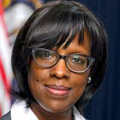
Kentucky Lieutenant Governor Jenean Hampton
Hampton did not make any immediate comment about her departure from Bevin’s gubernatorial ticket, although she told her hometown paper, the Bowling Green Daily News, that she wanted to continue as lieutenant governor.
Alvarado, 48, is a physician from Winchester who was first elected to the Senate in 2014, becoming the first Latino to serve in the commonwealth’s legislature. The son of immigrant parents, he gave an address at the 2016 Republican National Convention, partially in Spanish.
“I’m humbled the governor has even considered me,” Alvarado said of his selection. “I think the vision that he has had for this state needs to be carried on and carried forward.”
Alvarado’s presence on the ticket could help Bevin mend his frayed relations with Republicans in the legislature, with whom he has sparred over pension reform, an issue that has roiled politics in the Bluegrass over the past two years.
Bevin, whose job approval rating in a December Mason-Dixon poll lagged at just 38 percent, is facing a GOP primary challenge from one of Alvarado’s legislative colleagues, State Rep. Robert Goforth from London.
However, Alvarado could also become a target for Bevin’s Democratic opponents due to his record in the legislature.
Alvarado helped push through a controversial law that made it more difficult for patients to pursue malpractice claims against doctors, which was unanimously struck down by the Kentucky Supreme Court.
The Lexington Herald-Leader also reported that Alvarado works for several nursing homes that have been rated as being of substandard quality by federal inspectors while pushing legislation that would make it more difficult for nursing home patients to sue.
Three Democrats are running for their party’s nomination to oppose Bevin — Attorney General Andy Beshear, House Minority Leader Rocky Adkins from Sandy Hook and former State Auditor Adam Edelen.
The primary is May 21.
The Mason-Dixon poll in December showed Beshear with an 8-point lead over Bevin in a head-to-head match up, right at the poll’s margin of error; Adkins and Bevin were even.
Kentucky is one of 13 states where candidates for governor select a running mate, rather than electing lieutenant governors separately. The only other Southern state using this system is Florida.
In Kentucky, the duties of the lieutenant governor are limited to participation on several state boards and taking over in the event a governor cannot continue in office. The lieutenant governor does not preside of the State Senate, as is the case in 26 other states
We tweet @ChkFriPolitics Join us!

7 new Southern U.S House Democrats who ousted Republicans support Nancy Pelosi for speaker
Cunningham of South Carolina and Spanberger of Virginia keep vow to oppose Pelosi; North Carolina’s 9th District remains vacant
♦By Rich Shumate, ChickenFriedPolitics.com
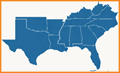 WASHINGTON (CFP) — Seven Southern Democratic U.S. House freshmen who ousted GOP incumbents in November supported Nancy Pelosi’s bid to reclaim the gavel as speaker of the U.S. House — handing Republicans an issue to use against them in 2020.
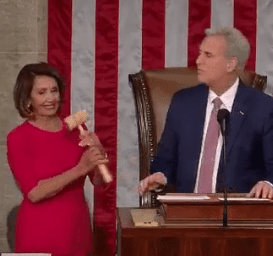
Incoming Speaker Nancy Pelosi accepts gavel from GOP Leader Kevin McCarthy (From Twitter)
Colin Allred and Lizzie Pannill Fletcher of Texas, Kendra Horn of Oklahoma, Lucy McBath of Georgia, Elaine Luria and Jennifer Wexton of Virginia, and Debbie Mucarsel-Powell of Florida all supported Pelosi in the January 3 vote.
Two other freshmen Democrats who had vowed during their campaign that they would not support Pelosi — Joe Cunningham of South Carolina and Abigail Spanberger of Virginia — kept that promise, voting instead for Cheri Bustos of Illinois.
And despite signing a letter in November calling for new leadership in the House, Filemon Vela of Texas switched course to vote for Pelosi.
Meanwhile, as the new Congress convened in Washington with 29 new Southern members, one seat sat empty — the representative from North Carolina’s 9th District, where state elections officials have refused to certify Republican Mark Harris’s narrow win over Democrat Dan McCready amid allegations of absentee ballot fraud.
In the vote for speaker, just three Southern Democratic members did not support Pelosi — Cunningham and Spanberger, who voted for Bustos, and Jim Cooper of Tennessee, who voted present.
Cooper, who has been in Congress since 1983, had been a long-time opponent of Pelosi’s speakership, having voted against her five times previously.
After the November election, a group of 16 Democratic members, including Cooper, Cunningham and Vela, signed a letter calling for “new leadership” in the Democratic caucus.
Vela changed course after Pelosi agreed to support term limits for the House Democratic leadership, which will limit her speakership to no more than four years.
Pelosi needed a majority of the 430 votes cast for speaker. In the end, she got 220 votes, four more than necessary.
Of the seven Southern Democrats who ousted Republicans and voted for Pelosi, McBath, Horn and Luria represent districts carried by President Donald Trump in 2016, while Allred and Fletcher represent districts he lost by less than 2 points.
Hillary Clinton carried Murcasel-Powell’s district in South Florida by 16 points and Wexton’s district in the Virginia suburbs of Washington, D.C. by 10 points.
Three other Southern Democratic newcomers who won open seats in November also supported Pelosi — Veronica Escobar and Sylvia Garcia of Texas, and Donna Shalala of Florida. All three represent districts Clinton carried handily.
Among Southern Republicans, only three did not support their candidate for speaker, House Minority Leader Kevin McCarthy of California.
Thomas Massie of Kentucky and Jody Hice of Georgia supported Jim Jordan of Ohio, one of the founders of the House Freedom Caucus, a grouping of the most conservative Republican members.
Walter Jones of North Carolina did not vote. He has been absent from Congress since September because of an undisclosed illness.
Of the 29 new Southern members of the House, 17 are Republicans and 12 are Democrats. Republicans hold 101 Southern seats, compared to 50 for Democrats, with North Carolina’s 9th District vacant.
The 9th District seat is likely to remain vacant until after the state elections board completes its investigation into the allegations of absentee ballot irregularities, which has been delayed until February because of a new law revamping the board.
Harris has filed a lawsuit seeking for force certification of the election.
We tweet @ChkFriPolitics Join us!

Change in party control of U.S. House diminishes Southern clout
Just five House committees in new Congress will have Southerners at the helm
♦By Rich Shumate, ChickenFriedPolitics.com
WASHINGTON (CFP) — When it comes to Southern clout in the U.S. House, what a difference an election makes.
In the recently departed Congress, with Republicans in control, 13 of the 22 committee chairs hailed from the 14 Southern states; in the newly installed Congress, with Democrats in charge, that number will fall to just five.
Five Southern Republican chairs retired, and one, Pete Sessions of Texas, went down to defeat in November. Those who stayed find themselves in the minority for the first time in eight years.
The switch in control has shifted power from the GOP, in which Southerners made up nearly half of the caucus, to the Democrats, where Southerners only make up a fifth. And that has led to reduced numbers of Southerners among committee chairs.
All five of the committees that will be chaired by Southern Democrats in the new Congress were chaired by Southern Republicans in the last Congress, so there will be no loss of influence on those panels.
Also, the outgoing majority whip, Republican Steve Scalise of Louisiana, will be replaced by the incoming majority whip, Democrat Jim Clyburn of South Carolina. Both men remain the only Southern members in their party’s top leadership.
But eight other committees that had GOP chairmen will now be headed by lawmakers from outside the region. And that list contains a number of the most powerful and high-profile chairmanships in Washington, including Judiciary, Rules, Ways and Means, and Oversight and Reform.
The five Southern Democratic committee chairmen are John Yarmuth of Kentucky, Budget; Ted Deutch of Florida, Ethics; Bobby Scott of Virginia, Education and Labor; Bennie Thompson of Mississippi, Homeland Security; and Eddie Bernice Johnson of Texas, Science, Space and Technology.
Unlike Republicans, who select committee chairs by voting within the caucus, Democrats use seniority. All five of the Southern Democrats ascending to chairmanships had been the ranking Democratic member when Democrats were in the minority.
Scott, Thompson and Johnson, all members of the Congressional Black Caucus, are among eight new chairs who are African American or Latino. In the departing Republican Congress, all of the chairs were white, and 20 were men.
Southerners will make up a slight majority within the Republican caucus in the new Congress, which is reflected in the GOP’s new committee leadership. On 14 of the 22 House committees, the ranking Republican in the new Congress will be from the South.
Among the notable newcomers to that group are Kay Granger of Texas, who will be ranking member on Appropriations, and Doug Collins of Georgia, on Judiciary–the committee that would handle any impeachment proceedings against President Donald Trump.
Michael McCaul of Texas, who had been chairman of Homeland Security, has shifted to become the new ranking member of Foreign Affairs.
Six Southern Republicans who had been chairs of their committees will continue as ranking members in the new Congress–Mike Conaway of Texas, Agriculture; Mac Thornberry of Texas, Armed Services; Steve Womack of Arkansas, Budget; Virginia Foxx of North Carolina, Education and Labor; Phil Roe of Tennessee, Veterans’ Affairs; and Kevin Brady of Texas, Ways and Means.
In addition to Granger and Collins, five other Southern Republicans were also newly named as ranking members–Patrick McHenry of North Carolina, Financial Services; Kenny Marchant of Texas, Ethics; Mike Rogers of Alabama, Homeland Security; Tom Cole of Oklahoma, Rules; and Frank Lucas of Oklahoma, Science, Space and Technology.
 Chicken Fried Politics