
Home » South Carolina (Page 4)
Category Archives: South Carolina


4 Southern U.S. House Democrats in Trump seats break with party on coronavirus vote
Georgia’s Lucy McBath is only Southern Democrat in a seat Trump carried to vote for $3 trillion spending bill
♦By Rich Shumate, ChickenFriedPolitics.com editor
 WASHINGTON (CFP) — Four of the five Southern Democrats trying to hold seats from U.S. House districts that President Donald Trump carried in 2016 have voted against a $3 trillion coronavirus relief package pushed through the House by Democratic leaders late Friday.
The lone Southern Democrat in a Trump seat who voted for the measure was U.S. Rep. Lucy McBath, who represents a district in Atlanta’s near northwest suburbs. She came under immediate fire from her leading GOP opponent for supporting “her San Francisco buddy,” House Speaker Nancy Pelosi, in the vote.
Voting no were U.S. Reps. Joe Cunningham of South Carolina, Kendra Horn of Oklahoma, and Elaine Luria and Abigail Spanberger, both from Virginia.
Five other Democrats who in 2018 flipped Republican-held districts that Trump didn’t carry in 2016 voted for the measure, including Donna Shalala and Debbie Mucarsel-Powell of Florida, Jennifer Wexton of Virginia, and Colin Allred and Lizzie Fletcher of Texas.
The measure, dubbed as the HEROES Act by its sponsors, passed the House on a mostly party-line vote of 208-199. It would provide nearly $1 billion to state, local and tribal governments that have seen their tax revenues plunge during the coronavirus shutdown, along with $100 billion for farmers who have faced market dislocations.
The measure would also provide another round of $1,200 stimulus payments to Americans, including undocumented immigrants; extend supplemental federal unemployment payments until January; forgive $10,000 in student loan debt for every borrower; provide money for election security; and inject $25 billion into the U.S. Postal Service.
The $3 trillion price tag for the package — along with the provisions on student loan debt, election security, and including undocumented immigrants in stimulus payments — have drawn strong opposition from Republican leaders in the Senate, who have pronounced the plan dead on arrival.
By voting against the bill, the Southern Democrats in Trump districts were trying to avoid being tagged with support for a doomed, partisan spending plan that could be weaponized by their Republican opponents in the fall.
Cunningham, who represents the 1st District in South Carolina’s Lowcountry, called the bill “Washington politics at its worst.”
“While South Carolina families, small business owners, and workers are struggling, now is not the time to advance a partisan wish list or refuse to come to the negotiating table,” Cunningham said in a statement. “At a time when our country is in real trouble, we should not be spending precious time on one-sided solutions that aren’t going anywhere.
Horn, who represents the 5th District in and around Oklahoma City, called the measure “a messaging bill” that lacked bi-partisan support and was “a disservice to the American people, especially during a time of crisis.”
“This is not the time for partisan gamesmanship, this is the time to find common ground and deliver help where it is needed most,” Horn said in a statement. “In response to COVID-19, our relief efforts must be targeted, timely, and transparent. The HEROES Act does not meet those standards.”
Luria, who represents Virginia’s 2nd district in the Hampton Roads area, noted that the bill would double federal spending this year “and spending of this scale requires careful consideration and input from all members, not just one party.”
“Relief legislation must address the challenges created by the COVID-19 pandemic as well as pave the path to economic recovery,” Luria said in a statement. “Unfortunately, there are many elements of the bill that are unrelated to addressing Americans’ most immediate needs associated with COVID-19, which distract from addressing our most urgent priorities during this pandemic.”
Spanberger, who represents the 7th District in and around Richmond, said some of her Democratic colleagues “have decided to use this package as an opportunity to make political statements and propose a bill that goes far beyond pandemic relief and has no chance at becoming law, further delaying the help so many need.”
“We must come together to build a targeted, timely relief package that avoids partisan posturing and instead prioritizes combating our nationwide public health emergency, addressing catastrophic unemployment rates, and protecting the security of the next generation,” Spanberger said in a statement.
After the vote, McBath released a statement in which she did not offer a detailed explanation for her support of the bill, beyond saying that she was “fighting” for more funding for hospitals, first responders and the unemployed.
“This pandemic has caused grief for thousands, financial difficulty for millions, and drastic changes to the lives of every American,” she said. “Families across the country agree that more must be done to protect the health and financial well-being of our loved ones.”
But her leading Republican opponent, Karen Handel, charged that McBath “voted with the far left of her party to approve a $3 trillion partisan spending spree on out-of-touch, liberal priorities.”
“Nancy Pelosi has a true and loyal friend in Lucy McBath,” Handel said in a statement posted on Twitter. “When faced with backing the Speaker’s extreme agenda or representing the interests of [her district], McBath chooses her San Francisco buddy every time.”
McBath unseated Handel in 2018 in the 6th District, which Trump narrowly carried in 2016. Handel will face four other GOP candidates in the June 9 primary for the right to take on McBath again in November.
We tweet @ChkFriPolitics Join us!
Former Vice President Joe Biden makes comeback with blowout win in South Carolina
Biden revives his fortunes heading into Super Tuesday with nearly 30-point triumph in the Palmetto State
♦By Rich Shumate, ChickenFriedPolitics.com editor
 COLUMBIA, South Carolina (CFP) — Former Vice President Joe Biden revived his flagging presidential campaign Saturday with a clear, convincing win in South Carolina’s first-in-the-South presidential primary, giving him crucial momentum heading into next week’s Super Tuesday contests.
Biden won 48 percent of the vote and carried all 46 counties, defeating Vermont U.S. Senator Bernie Sanders, who came in a distant second at 20 percent.
“Just days ago, the press and the pundits had declared this candidacy dead,” Biden told jubilant supporters in Columbia. “Now, thanks to you, the heart of the Democratic Party, we’ve just won, and we won big.”
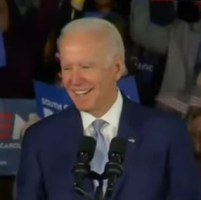
Joe Biden declares victory in South Carolina (From SkyNews via YouTube)
Biden used his victory speech to draw a contrast with Sanders, urging Democrats in the Super Tuesday states to “nominate someone who will build on Obamacare, not scrap it; take on the NRA and gun manufacturers, not protect them; [and] stand up to give the poor a fighting chance and have the middle class restored, not raise their taxes.”
The result in South Carolina was welcome news for Biden, who finished fourth in Iowa, fifth in New Hampshire, and a distant second to Sanders in Nevada. It also marked the first ever primary win for Biden in his third try for the White House.
The key to his win Saturday was a strong performance among African American voters, who made up 56 percent of the Palmetto State electorate. Exit polls showed that Biden took 60 percent of the black vote, running more than 40 points ahead of his nearest rival, Sanders.
Coming in third place in the statewide results was California billionaire Tom Steyer at 11 percent; followed by former South Bend, Indiana Mayor Pete Buttegieg, 8 percent; U.S. Senator Elizabeth Warren of Massachusetts, 7 percent; U.S. Senator Amy Klobuchar of Minnesota at 3 percent; and U.S. Rep. Tulsi Gabbard of Hawaii at 1 percent.
After the results came in, Steyer dropped out of the race.
Biden and Sanders were the only two candidates on the ballot Saturday who cleared the 15 percent threshold needed statewide and in congressional districts to claim delegates to this summer’s Democratic National Convention. Biden took 39 delegates, to 14 for Sanders.
However, former New York City Mayor Mike Bloomberg, who has spent nearly $500 million of his own fortune on his campaign, did not compete in South Carolina. He will make his debut in contests on Tuesday in 14 states, including seven in the South.
Only Democrats had a primary in South Carolina; Republicans canceled their primary in deference to President Donald Trump.
For Sanders, South Carolina marked his first defeat of the campaign, after tying for first in Iowa and winning outright in New Hampshire and Nevada. He also got a smaller percentage of the vote in than he did in 2016, when he won 26 percent in a two-way race against Hillary Clinton, and once again lost every county in the state.
Speaking to supporters in Virginia Beach, Sanders offered his congratulations to Biden before pivoting to make the case that he and not Biden offers the kind of revolutionary change that can lead to a Democratic victory in November.
“In order to defeat Trump, we are going to need the largest voter turnout in the history of this country,” Sanders said. “Old-fashioned politics — the same old, same old type of politics that doesn’t excite anybody, that doesn’t energize anybody — that is not going to be the campaign that beats Trump.”
Biden, Sanders and the rest of the field now turn their attention to Super Tuesday, with more than 1,300 delegates at stake nationwide, including 621 across the South.
The list of Southern states holding primaries Tuesday includes Virginia, North Carolina, Tennessee, Alabama, Texas, Oklahoma and Arkansas. Outside the region, primaries will be held in California, Colorado, Massachusetts, Minnesota, Maine, Utah and Vermont.
The state of the races in Alabama, Tennessee, Arkansas and Oklahoma is a big unknown, given a paucity of public polling in any of those states. The polling that has been done in Texas, North Carolina and Virginia shows Biden, Sanders and Bloomberg bunched at the top, with the other candidates trailing behind.
The question for Biden is whether his win in South Carolina will give him the momentum to push through in the Super Tuesday states, where he is being outspent by Bloomberg and will face Sanders’s formidable ground operation.
One of the biggest factors in who can carry these Southern states will be performance among African American voters, who make up a majority of the Democratic electorate in Alabama and more than a quarter in Arkansas, Tennessee, North Carolina and Virginia.
While Biden ran away with the black vote in South Carolina, he will face new competition Tuesday from Bloomberg, who has been organizing across the region and getting endorsements from African American elected officials.
We tweet @ChkFriPolitics Join us!
South Carolina Democrats deciding first-in-the-South presidential primary
Joe Biden faces crucial test against Bernie Sanders in the Palmetto State
♦By Rich Shumate, ChickenFriedPolitics.com editor
 CHARLESTON (CFP) — Democrats are going to the polls across South Carolina Saturday to pick their favorite for the party’s presidential nomination, which former Vice President Joe Biden hoping to revive his flagging fortunes heading into Super Tuesday and Vermont U.S. Senator Bernie Sanders hoping to add to his list of victories.
Not on the ballot in Saturday’s first-in-the-South primary is former New York City Mayor Mike Bloomberg, who has spent nearly $500 million of his own fortune on his campaign and will make his debut in contests on Tuesday in 14 states, including seven in the South.
Polls in the Palmetto State close at 7 p.m. ET. Only Democrats are voting; South Carolina Republicans opted to cancel their primary in support of President Donald Trump.
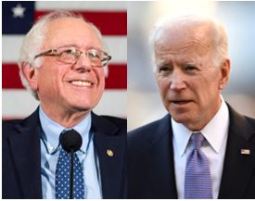
Sanders and Biden compete in South Carolina
After finishing fourth in Iowa and New Hampshire and a distant second to Sanders in Iowa, Biden’s campaign hopes his strong support among African American voters — who will make up about 60 percent of the electorate in South Carolina — will propel him to his first victory of the presidential race.
Four years ago, Sanders was crushed nearly 3-to-1 in South Carolina by Hillary Clinton, who carried all 46 counties. But this time around, his chances will be helped by a more fractured field and a strong statewide organization built since his defeat last time around.
Most public polling in the last week of the race showed no statistically significant difference between Biden and Sanders, although some polls showed the former vice president had built a lead.
Five other candidates are on the ballot Saturday: California businessman Tom Steyer, former South Bend, Indiana Mayor Pete Buttegieg, U.S. Senators Elizabeth Warren of Massachusetts and Amy Klobuchar of Minnesota, and U.S. Rep. Tulsi Gabbard of Hawaii.
Polls show Steyer, who wasn’t a factor in the first three contests, in third place behind Biden and Sanders in South Carolina, with the rest of the candidates trailing.
A pot of 54 delegates are at stake Saturday, 12 allocated proportionally based on the statewide results and 35 allocated proportionally based on the results in the state’s seven congressional districts. However, only candidates who win at least 15 percent of the vote statewide or in a congressional district qualify for any delegates.
Pre-election polling indicates that Biden and Sanders could end up splitting all 54 delegates between them, although that will depend on district-level results, where public polling has not been done.
After Saturday, the presidential race in the South turns to seven Super Tuesday states where delegates will be selected — Virginia, North Carolina, Tennessee, Alabama, Arkansas, Texas and Oklahoma.
We tweet @ChkFriPolitics Join us!
10 Southern U.S. House Democrats in seats flipped in 2018 all vote to impeach
List of supporters includes 5 Democrats who represent districts Trump carried in 2016
♦By Rich Shumate, ChickenFriedPolitics.com
 WASHINGTON (CFP) — All 10 Southern U.S. House Democratic freshmen who flipped seats in 2018 voted in favor of impeaching President Donald Trump Wednesday, including five who represent districts the president carried in 2016.
The impeachment vote is likely to become a pivotal issue next year as these Democrats try to hang on to their seats against Republican challengers, in an election where Trump is at the top of the ballot.
After more than 10 hours of often acrimonious debate, all 50 Southern Democrats in the House voted for both of the articles of impeachment, which charge Trump with abusing his power and obstructing Congress.
Southern Republicans stuck with the president, with all 102 voting no.
The Democrats from districts Trump carried who voted yes were Abigail Spanberger and Elaine Luria of Virginia, Lucy McBath of Georgia, Kendra Horn of Oklahoma, and Joe Cunningham of South Carolina.
All of them had announced prior to the vote that they would support impeachment; McBath had already voted in favor in the House Judiciary Committee.
The two articles of impeachment were also supported by five other Democrats who flipped GOP-held seats in 2018 in districts that Trump did not carry — Colin Allred and Lizzie Fletcher of Texas, Jennifer Wexton of Virginia, and Debbie Mucarsel-Powell and Donna Shalala of Florida.
Two other Democrats who hold seats the GOP is targeting in 2020 — Stephanie Murphy and Charlie Crist from Florida — also voted for impeachment.
The lone Republican in a Southern seat carried by Hillary Clinton in 2016, Will Hurd of Texas, who is retiring in 2020, voted no, as did 13 other Southern Republicans who have announced they won’t seek another term next year.
The two articles of impeachment now move to the Senate for a trial, which is expected to begin in January. Trump will be removed from office if two-thirds of the senators vote to convict him on either article.
The final vote on the first article of impeachment was 230 to 197, with just two Democrats — Jeff Van Drew of New Jersey and Collin Peterson of Minnesota voting no. No Republicans voted yes.
The second article of impeachment passed 229 to 198, with another Democrat — Jared Golden of Maine — joining the GOP in voting no.
We tweet @ChkFriPolitics Join us!
5 Southern U.S. House Democrats from pro-Trump districts support impeachment bill
Vote on bill outlining procedures for impeachment process breaks down along party lines
♦By Rich Shumate, ChickenFriedPolitics.com
 WASHINGTON (CFP) — Five Southern U.S. House Democrats who hold seats from districts President Donald Trump carried in 2016 voted with their party Thursday to approve procedures for his possible impeachment, a vote they’ll have to defend as they fight to keep their seats next year.
The Democrats from Trump districts who voted yes included Abigail Spanberger and Elaine Luria of Virginia, Lucy McBath of Georgia, Kendra Horn of Oklahoma, and Joe Cunningham of South Carolina.
Cunningham, Horn and McBath had not previously expressed support for the impeachment inquiry; Spanberger and Luria had.
Five other Democrats who also flipped GOP-held seats in 2018 — Colin Alled and Lizzie Fletcher of Texas, Jennifer Wexton of Virginia, and Debbie Mucarsel-Powell and Donna Shalala of Florida — also voted for the resolution. Those districts were carried by Hillary Clinton in 2016.
These 10 seats are at the top of the GOP target list for 2020, with the impeachment vote certain to be an issue in those races.
Two other GOP 2020 targets — Democrats Stephanie Murphy and Charlie Crist from Florida — also voted in favor of the impeachment measure.
The lone Republican in a Southern seat Clinton carried, Will Hurd of Texas, voted no, as did eight other Southern Republicans who have announced they won’t seek another term in 2020.
The overall vote among Southern House members on the bill broke down entirely along party lines. Across the whole House, no Republicans supported the measure, while two Democrats — Collin Peterson from Minnesota and Jeff Van Drew of New Jersey — voted no.
Thursday’s vote was the first formal move by House Democrats to advance the impeachment of Trump over his overture to the president of Ukraine to investigate corruption allegations against his Democratic rival, Joe Biden.
Cunningham told the Post and Courier newspaper of Charleston that he was voting for the bill in order to make the investigation into Trump more transparent, as Republicans have been demanding.
“Overall it’s a good measure to shine some light on these hearings and make sure that we respect due process,” Cunningham told the Post and Courier.
Horn, announcing her support for the bill on Twitter, stressed that she was only supporting an investigation, not Trump’s actual impeachment.
“It is a vote to create clear rules for effective public hearings and ensure transparency for the American people,” she said. “As I’ve said all along, I always look at the facts in front of me and vote in the best interests of Oklahomans.”
Even before the vote, McBath had felt the potential sting of the impeachment fight when unhappy Trump supporters picketed her district office in suburban Atlanta earlier this month. In response, McBath took to Twitter to say she refused “to be intimidated, I will do what is right,” and included a fundraising solicitation in her post.
Three Southern House members did not vote on the impeachment bill — Jody Hice of Georgia, John Rose of Tennessee, Don McEachin of Virginia.
 Chicken Fried Politics