
Home » U.S. Senate Races (Page 6)
Category Archives: U.S. Senate Races


Racist? Georgia U.S. Senator David Perdue under fire for mocking Kamala Harris
Perdue mispronounces first name of Democratic vice presidential nominee
♦By Rich Shumate, ChickenFriedPolitics.com editor
 MACON, Georgia (CFP) — In the middle of a close re-election race, Georgia Republican U.S. Senator David Perdue is under fire for mispronouncing the name of Democratic vice presidential nominee Kamala Harris during a rally with President Donald Trump Friday in Macon.
“KA-ma-la or Ka-MA-la? Ka-MA-la-ma-la-ma-la? I don’t know. Whatever,” Perdue told the crowd of cheering Trump supporters, creating a video that has since gone viral–and drawn rebukes from critics who are calling the mispronunciation deliberate and racist.
Video at end of story
“Senator Perdue never would have done this to a male colleague. Or a white colleague,” his Democratic challenger Jon Ossoff said on Twitter. “And everyone knows it.”
Harris is the first woman of color, and only the third woman, on a presidential ticket.
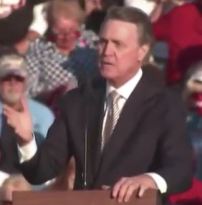
U.S. Senator David Perdue, R-Georgia, speaks at Trump rally (YouTube)
Perdue has served alongside Harris in the Senate since 2017. They also are both members of the Senate Budget Committee, which has just 19 members.
A spokesman for Perdue’s campaign, John Burke, responded on Twitter that “Senator Perdue simply mispronounced Senator Harris’ name, and he didn’t mean anything by it. He was making an argument against the radical socialist agenda that she and her endorsed candidate Jon Ossoff are pushing.”
President Trump also mispronounces Harris’s name during rallies to draw a response from the crowd.
Less than three weeks before the November election, Perdue and Ossoff are locked in a tight race, with polls showing no clear leader. Trump also appears in danger of losing Georgia, which prompted his visit to Macon.
A Democrat hasn’t won the presidential race in Georgia since 1992 or a Senate race since 2000.
The effect Friday’s viral moment might have on the outcome is unclear. Nearly a third of the state’s voters are African American.
In 2006, in a U.S. Senate race in Virginia, the Republican incumbent, George Allen, created a firestorm after being captured on video calling an Indian-American supporter of his challenger “Macaca.” Allen lost.
Coronavirus, sexual texts upend North Carolina U.S. Senate race
Republican U.S. Senator Thom Tillis tests positive; Democratic challenger Cal Cunningham apologizes for racy text messages
♦By Rich Shumate, ChickenFriedPolitics.com editor
 RALEIGH (CFP) — A month before election day, the big money, high octane race for the U.S. Senate in North Carolina has been upended by a positive coronavirus test and a sexting scandal.
Republican U.S. Senator Thom Tillis announced Friday that he has been tested positive for the coronavirus, which will force him off the campaign trail for at least 10 days, although he remains asymptomatic.
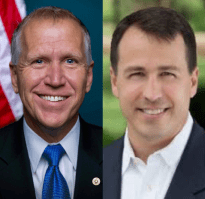
U.S. Senator Thom Tillis and Democratic challenger Cal Cunningham
Hours later, the campaign of his Democratic challenger, Cal Cunningham, a married father of two, confirmed that he was the author of suggestive text messages exchanged with a female public relations consultant from California that indicated he was engaged in an ongoing extramarital affair.
“I have hurt my family, disappointed my friends, and am deeply sorry,” Cunningham said in a statement. “The first step in repairing those relationships is taking complete responsibility, which I do.”
Cunningham indicated that he would stay in the race, saying he was “grateful and humbled by the ongoing support that North Carolinians have extended in this campaign, and in the remaining weeks before this election I will continue to work to earn the opportunity to fight for the people of our state.”
What may further complicate the situation for Cunningham is that he is a lieutenant colonel in the U.S. Army Reserves, and extramarital affairs violate the Uniform Code of Military Justice.
Prior to Friday, Cunningham had a consistent lead in the polls, and his campaign had just announced that it had raised a staggering $28.3 million in the third quarter, shattering a record for the largest fundraising quarter by a Senate candidate in state history.
Tillis’s positive coronavirus test will also force Cunningham to undergo testing because the two men met in a debate Thursday night, during which they were socially distanced but did not wear masks.
The North Carolina race is key to Democratic hopes of taking control of the Senate from Republicans. The Democratic Senatorial Campaign Committee issued a statement saying it was standing behind Cunningham.
The undated texts between Cunningham and Arlene Guzman Todd were first revealed on the conservative news website NationalFile.com. The site did not explain how the texts were obtained, attributing information to a friend of Todd’s who spoke with one of its sources.
In the texts, the two talk about arranging a meeting, with Todd saying at one point that “the only thing I want on my to do list is you” and Cunningham saying “I’ve had the most amazing dreams of our time together.”
Cunningham also texted Todd that he was “nervous about the next 100 days,” which, if a reference to the election, would put the date of the text in late July.
We tweet at @ChkFriPolitics Join us!

Decision 2020: 14 Southern U.S. Senate seats on November ballot, with 4 possible flips
Races in North Carolina, Alabama on national radar; Lindsey Graham faces stiff challenge in South Carolina
♦By Rich Shumate, ChickenFriedPolitics.com editor
 Fourteen Southern U.S. Senate seats will be on the ballot in November, putting half of the South’s seats in play with control of the chamber very much up for grabs.
Of these seats, one presents a likely pickup opportunity for Republicans, while three Republican incumbents are facing stiff challenges. Three other seats are somewhat competitive but with incumbents still favored, including Senate Majority Leader Mitch McConnell‘s race in Kentucky.
Five senators — four Republicans and one Democrat — are cruising toward re-election, with Republicans also likely to keep an open seat in Tennessee. A special election in Georgia with candidates from both parties running in the same race is a wild card that will be difficult to predict — and could potentially decide which part controls the Senate when the dust clears.
Here is your guide to the 2020 Southern Senate races.
Possible Flips
1. Alabama: U.S. Senator Doug Jones (D) vs. Tommy Tuberville (R)
Jones has had a target on his back since he won a special election in 2017 over Republican Roy Moore, whose candidacy imploded in a sex scandal. Jones was the first Democrat elected to a Senate seat in the Yellowhammer State since 1992; his vote to convict President Donald Trump in his impeachment trial has put his continued tenure in jeopardy. Tuberville, the former head football coach at Auburn University, is making his political debut, impressively taking out a field of prominent Republicans in the primary, including Jeff Sessions, who held this seat for 20 years before leaving to join the Trump administration. If Jones somehow manages to hang on, it will be perhaps the biggest surprise on election night.
2. North Carolina: U.S. Senator Thom Tillis (R) vs. Cal Cunningham (D)
Cunningham, an attorney who served a single term in the legislature 20 years ago and made an unsuccessful Senate bid in 2010, was recruited by Democratic leaders in Washington to run against Tillis, who is seeking a second term after ousting former Democratic Senator Kay Hagin in 2014. This seat was once held by Jesse Helms, and no one has managed to win a second term since he gave it up in 2002. Cunningham has raised $15 million, slightly more than Tillis, and has led consistently in polls. The outcome of the presidential race in this battleground state may be key here. If Donald Trump wins, Tillis is likely to keep his seat as well; if he doesn’t, Cunningham will be in the driver’s seat.
3. South Carolina: U.S. Senator Lindsey Graham (R) vs. Jaime Harrison (D)
Over the past four years, Graham has become one of Trump’s biggest cheerleaders, after spending much of the 2016 campaign trashing him. That about-face spared him from the kind of primary challenge he had to beat back in 2014, but Harrison, a former state Democratic party chair, is hoping Graham’s association with the president will turn off enough Palmetto State voters to put him over the top. Harrison has raised a staggering $30 million — an unheard of sum for a Democrat in South Carolina — to stay even with the incumbent in the money chase. While polling shows the race is competitive, Trump is expected to carry the state, and the universe of Trump-Harrison voters may be too small to flip this seat.
4. Georgia: U.S Senator David Perdue (R) vs. Jon Ossoff (D)
It’s been a long time since Georgia has been competitive in a presidential or senatorial contest, but polling has shown Ossoff within striking distance of Perdue, who is seeking a second term. Ossoff built a national profile by raising more than $30 million for a special U.S. House election in 2017 that he narrowly lost. He hasn’t raised anywhere near that kind of money this time around, and Perdue enjoys a 2-to-1 fundraising advantage. Democrats insist that the Peach State’s changing demographics and an influx of newly energized, newly registered Democratic voters will lead to victory for Ossoff and Democratic nominee Joe Biden; Republicans scoff at such a scenario as delusional. If Biden makes a serious play for Georgia, it could help Ossoff; if Biden wins, Perdue will need to run ahead of Trump to survive.
Less Competitive
1. Texas: U.S. Senator John Cornyn (R) vs. MJ Hegar (D)
Democrats had high hopes for flipping this seat, particularly after Beto O’Rourke nearly took out Ted Cruz in 2018. But O’Rourke passed on the Senate race to make a quixotic bid for president, and Hegar, a former military chopper pilot and Afghan war veteran who lost a House race in 2018, had to spend time and money fighting her way through a primary runoff. Cornyn entered the fall campaign with the benefit of incumbency and a huge financial advantage, in a state that hasn’t sent a Democrat to the Senate since 1988. This could turn out to be a might-have-been race for Democrats — what might have been if O’Rouke had run instead.
2. Kentucky: Senate Majority Leader Mitch McConnell (R) vs. Amy McGrath (D)
Democratic leaders recruited McGrath for this race, enthused by her prodigious fundraising during an unsuccessful House race in 2018. But running against McConnell in Kentucky is a tall order, and she has not always seemed up to the task. Her campaign had an unsteady launch when she flipped positions on confirming Brett Kavanaugh, and she very nearly lost the Democratic primary after mishandling her response to racial justice protests that have roiled Louisville. After an uneven campaign, she decided change campaign managers in August, which is never a good sign. There’s a reason Mitch McConnell has been a senator since 1985 — he is perhaps the wiliest politician of his generation. His tenure in Washington seems likely to endure.
3. Mississippi: U.S. Senator Cindy Hyde-Smith (R) vs. former U.S. Agriculture Secretary Mike Espy (D)
This race is a rematch of 2018, when Hyde-Smith beat Espy by 8 points in a special election runoff, running nearly 10 points behind what Trump did in 2016. Espy was encouraged enough by his showing to try to take her down again, hoping that the energy unleashed by social justice protests will galvanize black voters, who make up 37percent of the state’s electorate, the highest percentage in the country. However, if he couldn’t beat Hyde-Smith in a lower turnout midterm election, beating her with the presidential election on the ballot, in a very pro-Trump state, is likely to be a tall order.
Wild Card
Georgia: U.S. Senator Kelly Loeffler (R) vs. U.S. Rep. Doug Collins (R), Raphael Warnock (D) and Matt Lieberman (D)
In this special election to fill the seat vacated by Johnny Isakson, candidates from all parties run in the same race, with the top two vote-getters advancing to a December runoff. Loeffler is trying to keep this seat after being appointed to the post by Gov. Brian Kemp, who opted to pick the political newcomer instead of Collins, one of Trump’s biggest champions in the House. Collins defied the governor to run against Loeffler, splitting Peach State Republicans into two camps.
On the Democratic side, Warnock, the pastor of Ebenezer Baptist Church, has drawn support from the party establishment who see him as the best option to win the seat. But Lieberman, the son of former Connecticut U.S. Senator Joe Lieberman, has resisted pressure to leave the race in favor of Warnock, and polls have shown him remaining competitive. If Warnock and Lieberman split the Democratic vote, it could clear the way for both Loeffler and Collins to meet in an all-GOP second round. If one Republican and one Democrat get through, the outcome of the race is likely to depend on who those two candidates are.
Shoo-Ins
Arkansas: U.S. Senator Tom Cotton (R) faces no Democratic competition after the lone Democrat who qualified abruptly left the race. The only person standing between Cotton and re-election is Libertarian Ricky Harrington.
Tennessee: Republican Bill Hagerty, the former U.S. ambassador to Japan, has a much easier path to Washington after the Democrat recruited and financed by party leaders to challenge for the seat lost his primary. He will now face Marquita Bradshaw, an environmental activist from Memphis who harnessed grassroots support to win the primary.
West Virginia: U.S. Senator Shelley Moore Capito (R) is not expected to have much trouble against Democrat Paula Jean Swearengin, an environmental activist who gained national exposure when her 2018 race against the state’s other U.S. senator, Joe Manchin, was featured in the Netflix documentary “Knock Down The House.”
Oklahoma: If U.S. Senator Jim Inhofe (R), as expected, wins a fifth full term over Democrat Abby Broyles, he will be 92 when this term ends in 2026. Broyles, a former TV reporter in Oklahoma City, has run a spirited campaign in which she’s needled the senator for refusing to debate her.
Virginia: Giving the Old Dominion’s increasingly Democratic tilt, U.S. Senator Mark Warner (D) is a clear favorite over Republican Daniel Gade, a former Army officer who was wounded in Iraq and now teaches at American University in Washington.
Louisiana: U.S. Senator Bill Cassidy (R) is competing in a jungle primary in November and will face a runoff in December if he doesn’t clear 50%. He avoided any major Republican opposition; the biggest Democratic name in the race is Shreveport Mayor Adrian Perkins.
We tweet @ChkFriPolitics Join us!
Establishment pick Bill Hagerty wins Tennessee Republican U.S. Senate primary
Republicans in East Tennessee pick Diana Harshbarger as a successor for retiring GOP U.S. Rep. Phil Roe
♦By Rich Shumate, ChickenFriedPolitics.com editor
 NASHVILLE (CFP) — With the backing of President Donald Trump and the Republican establishment, Bill Hagerty, the former U.S. ambassador to Japan, has won his party’s nomination for an open U.S. Senate seat in Tennessee.
Hagerty took 51% in Thursday’s vote to 39% for Manny Sethi, a Nashville orthopedic trauma surgeon. He will now face Democrat Marquita Bradshaw, a Memphis environmental activist, in November’s general election.
Bradshaw, who spent less than $10,000 on her primary campaign, was the surprise winner of the Democratic primary over Nashville attorney James Mackler, who had raised more than $2 million for the race but could only muster a third-place finish.
Also in Thursday’s primary, Republicans in the 1st U.S. House District in East Tennessee picked Kingsport pharmacist Diana Harshbarger as their nominee to replace retiring Republican U.S. Rep. Phil Roe, making her a prohibitive favorite to win in November in the state’s most Republican district.
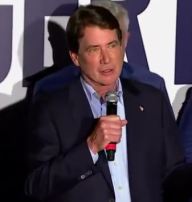
Hagerty speaks at victory rally in Gallatin (WBIR via YouTube)
Hagerty, 60, a former private equity executive and state economic development official, left his post in Tokyo to pursue the Senate seat after incumbent U.S. Senator Lamar Alexander announced his retirement last summer.
He received an immediate endorsement from Trump, despite the fact that Hagerty had backed Trump rival Jeb Bush in the 2016 election and has a long association with 2012 GOP nominee Mitt Romney, the only Republican senator to vote for Trump’s impeachment.
Speaking to supporters at a victory celebration in his hometown of Gallatin, Hagerty thanked Trump, who he said “had my back since before the beginning of this.”
“Thank you for being the inspiration for me, President Trump. I look forward to help you continue moving forward,” he said. “We’ve got to stand up to the radicals in Washington that want to push us off the cliff into socialism.”
Hagerty had put together a collection of disparate supporters that included not only Trump, his son Donald Jr., and Fox News host Sean Hannity, but also support from Bush, Romney and Senate Majority Leader Mitch McConnell.
Sethi countered with endorsements of his own from U.S. Senators Ted Cruz of Texas and Rand Paul of Kentucky, along with conservative groups such as the Family Research Council, Gun Owners of America, and the anti-abortion Tennessee Heartbeat Coalition.
The race grew contentious and both men competed for the Trump mantle. Hagerty’s campaign branded Sethi as a “Never Trumper” and highlighted the fact that he was a finalist for a White House fellowship under former President Barack Obama; Sethi’s returned the favor by highlighting Hagerty’s ties to Romney and Bush.
Given that Tennessee hasn’t elected a Democrat to the Senate in 30 years, Hagerty will be a heavy favorite in November against Bradshaw, who won her primary with 36% of the vote.
In the 1st District, which stretches from the Tri-Cities west toward Knoxville, the Republican primary to replace Roe turned into a 14-candidate free-for-all. Harshbarger won with 19%, followed by State Rep. Timothy Hill from Blountville at 17% and State Senator Rusty Crowe from Johnson City at 16%.
Because Tennessee does not have primary runoffs, Harshberg won with a plurality and will now face Democrat Blair Walsingham, a farmer from Hawkins County, in November.
The Republican nominee will be the prohibitive favorite in the state’s most Republican district, which the party has held continuously for 140 years.
In other races in Thursday’s primary, the two Democrats in the Volunteer State’s congressional delegation — U.S. Reps. Jim Cooper of Nashville and Steve Cohen of Memphis — both easily turned back primary challenges, although Cooper was held to 54%.
Uniquely among states, Tennessee holds its primary elections on Thursdays, rather than Tuesdays, although the general election in November will be held on a Tuesday as it is in the rest of the country.
We tweet at ChkFriPolitics Join us!
The fundraising leader in the race is Diana Harshbarger, a Kingsport pharmacist who has raised nearly $1.5 million. She’s followed by Josh Gapp, a Knoxville pathologist who had initially run in the Senate primary until Roe announced his retirement, and former Kingsport Mayor John Clark.
Also in the race are State Senator Rusty Crowe from Johnson City; State Rep. David Hawk from Greeneville; State Rep. Timothy Hill from Blountville; and former Johnson City Mayor Steve Darden.

Hotly contested Republican U.S. Senate race highlights Thursday’s primary ballot in Tennessee
Voters in East Tennessee will also pick a successor for retiring GOP U.S. Rep. Phil Roe
♦By Rich Shumate, ChickenFriedPolitics.com editor
 NASHVILLE (CFP) — Tennessee Republicans will decide a contentious battle for an open U.S. Senate seat in Thursday’s primary election, settling what has become a proxy battle between libertarian and establishment voices within the national GOP.
Also, Thursday, 14 Republicans are competing for the nomination in the 1st U.S. House District in East Tennessee, with the winner a prohibitive favorite to take over the seat of retiring Republican U.S. Rep. Phil Roe.
Poll opening times in the Volunteer State vary by county; polls close in the Eastern time zone at 8 p.m. and at 7 p.m. in the Central time zone.

Bill Hagerty and Manny Sethi
In the Senate race, Bill Hagerty, the former U.S. ambassador to Japan, is locked in a tight race for the Republican nomination against Manny Sethi, a Nashville orthopedic trauma surgeon.
Thirteen other Republicans are also in the race, including former Shelby County commissioner and unsuccessful 2018 U.S. House candidate George Flinn, who has poured $5 million of his own money into the contest.
The seat is open because of the retirement of Republican U.S. Senator Lamar Alexander, who has held it for the past 18 years.
Hagerty, the establishment choice, has put together a collection of disparate endorsements that includes not only President Donald Trump, his son Donald Jr., and Fox News host Sean Hannity, but also support from Senate Majority Leader Mitch McConnell, former Republican presidential nominee Mitt Romney, and former Florida Governor Jeb Bush.
Sethi has countered with endorsements of his own from U.S. Senators Ted Cruz of Texas and Rand Paul of Kentucky, along with conservative groups such as the Family Research Council, Gun Owners of America, and the anti-abortion Tennessee Heartbeat Coalition.
Hagerty’s campaign has branded Sethi as a “Never Trumper” and highlighted the fact that he was a finalist for a White House fellowship under former President Barack Obama. Sethi has returned the favor by noting that Hagerty gave large campaign contributions to Romney’s presidential campaigns and served as a delegate for Jeb Bush during his 2016 race against Trump.
Tennessee does not have primary runoffs, so whichever candidate emerges from Thursday’s vote with a plurality will be the party’s nominee.
The Democratic contest features six candidates, with Nashville attorney James Mackler, who is backed by the Democratic Senatorial Campaign Committee, seen as the favorite.
Tennessee hasn’t elected a Democrat to the Senate in 30 years, and the nominee who emerges from the Republican will be a prohibitive favorite in November, although Mackler has raised more than $2 million so far.
In the 1st District, which stretches from the Tri-Cities west toward Knoxville, the Republican primary has turned into a 14-candidate free-for-all.
The fundraising leader in the race is Diana Harshbarger, a Kingsport pharmacist who has raised nearly $1.5 million. She’s followed by Josh Gapp, a Knoxville pathologist who had initially run in the Senate primary until Roe announced his retirement, and former Kingsport Mayor John Clark.
Also in the race are State Senator Rusty Crowe from Johnson City; State Rep. David Hawk from Greeneville; State Rep. Timothy Hill from Blountville; and former Johnson City Mayor Steve Darden.
The winner of the Republican contest will face Democrat Blair Walsingham, a farmer from Hawkins County. The Republican nominee will be the prohibitive favorite in the state’s most Republican district, which the party has held continuously for 140 years.
Uniquely among states, Tennessee holds its primary elections on Thursdays, rather than Tuesdays, although the general election in November will be held on a Tuesday as it is in the rest of the country.
 Chicken Fried Politics