
Home » Virginia (Page 7)
Category Archives: Virginia

Insight: Are the politics of Obamacare changing in the South?
Cracks are starting to show in the wall of Southern opposition to Medicaid expansion
♦By Rich Shumate, ChickenFriedPolitics.com editor
 After Obamacare made its way through Congress in 2009, triggering the Tea Party rebellion, Republican-controlled Southern statehouses became a redoubt of opposition to what critics saw as meddlesome socialist overreach.

ChickenFriedPolitics editor Rich Shumate
When, three years later, the U.S. Supreme Court ruled that the Obama administration couldn’t force states to enact a key Obamacare provision — expanding Medicaid to cover more low-income residents — most Southern states took advantage of the decision and didn’t.
Today, nine of the 14 states that haven’t expanded Medicaid are in the South, leaving more than 2.3 million low-income Southerners who would qualify for Medicaid without health care coverage, according to researchers at the Kaiser Family Foundation.
But there are some signs that the blanket opposition to expanding Medicaid in the South may be retreating, albeit slightly and slowly.
Louisiana and Virginia expanded Medicaid after electing Democratic governors in 2017. In Arkansas and Kentucky, where expansion passed under Democratic governors, it has endured despite their replacement by more skeptical Republicans.
In Florida and Oklahoma, petition drives are underway to put expansion on the ballot in 2020, doing an end-run around recalcitrant GOP leaders. And in Mississippi, a Democrat is trying to use expansion as a wedge issue to end a 16-year Republican lock on the governor’s office.
In states with expanded Medicaid, low-income people making up to 138 percent of the federal poverty level — about $17,000 for an individual — can get coverage. In states without expansion, the income limit for a family of three is just under $9,000; single people are excluded entirely.
Most of the singles and families who are not eligible for traditional Medicaid don’t make enough money to get the tax credits they need to buy insurance on the Obamacare insurance exchanges. According to estimates from Kaiser, 92 percent of all Americans who fall into this coverage gap live in Southern states that haven’t expanded Medicaid, including nearly 800,000 people in Texas, 450,000 in Florida, 275,000 in Georgia, and 225,000 in North Carolina.
The federal government pays 90 percent of the cost of Medicaid expansion; states must pick up the rest. Republican leaders who oppose the idea have balked at making a financial commitment to such an open-ended entitlement, which Congress could change at any time.
But that argument didn’t hold in Virginia after Democrats campaigning on expansion nearly took control of the legislature in 2017. When expansion came up for a vote, 18 House Republicans who survived that blue wave joined Democrats to pass it.
Louisiana Governor John Bel Edwards, who issued an executive order on his first day in office to expand Medicaid, is now running for re-election touting that decision; voters will give their verdict in October.
In Mississippi, Attorney General Jim Hood is also making expanded Medicaid the centerpiece of his gubernatorial campaign this year, arguing that his state, with the nation’s highest poverty rate, is cutting off its nose to spite its face by refusing to extend coverage to people who would benefit from it.
In Arkansas and Kentucky, where Democratic governors managed to push through expansion in 2014, the Republicans who replaced them have left the programs essentially intact, although they have fiddled at the edges by imposing premiums and work requirements on recipients. (Federal judges have blocked those changes.)
Die-hard Obamacare opponents have not been able to scuttle the program in either state — even in Arkansas, where the program has to be reauthorized annually by a three-fourths majority in both houses of the legislature.
In Florida and Oklahoma, supporters of expansion — including groups representing doctors, nurses and hospitals — are trying to put constitutional amendments expanding Medicaid coverage on the ballot in 2020.
Those ballot measures will be a key test of whether the public mood is more sympathetic to the idea of expansion than are the states’ conservative leaders, who have argued that the program is unaffordable and discourages people from seeking employment to secure health care.
However, the strategy of pursuing ballot initiatives is of limited use in the South because among states that haven’t expanded Medicaid, only Florida, Oklahoma and Mississippi allow the public to put measures on the ballot via petition. Texas, Georgia, Alabama, Tennessee, North Carolina, and South Carolina do not.
In Florida, the ballot measure will also need to get approval from 60 percent of the voters to pass.
The question to be answered this year and next is whether the fiscal and philosophical arguments against expansion will hold against the argument that low-income Southerners — rural and urban, black and white — deserve health care coverage and will benefit from it, in spite of its association with Obamacare.
We tweet @ChkFriPolitics Join us!
Southern House Democrats in targeted seats vote to turn up pressure on Trump
House Judiciary Committee can now sue to force compliance with requests for documents, testimony
♦By Rich Shumate, ChickenFriedPolitics.com editor
 WASHINGTON (CFP) — In the first major test of how Southern Democrats in vulnerable seats will navigate through ongoing House investigations of President Donald Trump, all of them stuck to the party line in supporting new powers that could escalate those inquiries.
By a vote of 229-191 on June 11, the House authorized the Judiciary Committee to go into federal court and demand that the Justice Department comply with requests for documents and witness testimony.
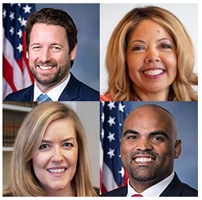
From top left clockwise: Cunningham, McBath, Allred, Weston
All 10 Southern House Democrats who flipped seats in 2018 and are at the top of the GOP hit list in 2020 agreed to give the committee the power to sue to force compliance, although none of them yet support moving toward impeaching the president.
That list includes Reps. Joe Cunningham of South Carolina; Lucy McBath of Georgia; Kendra Horn of Oklahoma; Elaine Luria, Jennifer Wexton and Abigail Spanberger of Virginia; Colin Allred and Lizzie Fletcher of Texas; and Debbie Mucarsel-Powell and Donna Shalala of Florida.
Not a single Southern Republican supported the resolution, including 11 GOP members who are on the Democrats’ target list for 2020.
The resolution is aimed squarely at Attorney General William Barr, who has refused to comply with some document requests, and former White House counsel Don McGahn, who has refused to testify at a committee hearing under instructions fro the White House.
The resolution ratchets up the pressure on the Trump administration, as an increasing number of House Democrats are calling for an impeachment inquiry.
While none of the Southern Democrats in competitive seats have so far come out in favor of an impeachment inquiry, 14 members in safe seats have done so.
That list includes Steve Cohen of Tennessee; Val Demings of Florida; Veronica Escobar, Sheila Jackson Lee, Joaquin Castro, Lloyd Doggett, Al Green, and Filemon Vela of Texas; Cedric Richmond of Louisiana; Alma Adams and G.K. Butterfield of North Carolina; Don Beyer of Virginia; Bennie Thompson of Mississippi; and John Yarmuth of Kentucky.
We tweet @ChkFriPolitics Join us!
Virginia Governor Ralph Northam calls special session in response to gun violence
Northam needs GOP support to pass gun control measures in the wake of Virginia Beach mass murder
By Rich Shumate, ChickenFriedPolitics.com editor
 RICHMOND (CFP) — Just four days after a mass shooting in Virginia Beach left 12 people dead, Democratic Governor Ralph Northam has launched a renewed push for gun control.
But he needs Republican support to get anything through the legislature — and GOP leaders are giving a frosty reception to a sure-to-be contentious initiative from the commonwealth’s politically wounded chief executive.
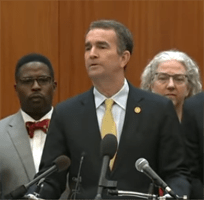
Northam calls for special session on gun control (From CBSN via YouTube)
Saying “no one should go to work, to school or to church wondering if they will come home,” Northam announced at a June 4 news conference that he will call state lawmakers in a special session to consider gun control measures, including universal background checks and limits on ammunition magazines.
“We must do more than give our thoughts and prayers. We must give Virginians the action they deserve,” Northam said. “I will be asking for votes and laws, not thoughts and prayers.”
However, Republicans control both houses of the legislature, and GOP leaders quickly pushed back.
House Speaker Kirk Cox called the special session “hasty and suspect when considered against the backdrop of the last few months” — a not-so-subtle reference to Northam’s ongoing political troubles since a photo surfaced in January of a man in blackface on his medical school yearbook page.
Northam has since resisted calls for him to resign, including from a number of fellow Democrats.
The Republican Party of Virginia denounced Northam’s “gun-grab session” as “craven” and accused him in a statement of trying to “take advantage of this tragedy to try and boost his own disgraced image.”
Cox also noted that while the governor can summon lawmakers into special session, “he cannot specify what the General Assembly chooses to consider or how we do our work.”
“We intend to use that time to take productive steps to address gun violence by holding criminals accountable with tougher sentences — including mandatory minimums,” he said in a statement.
Northam has previously vetoed bills establishing mandatory minimum sentences for criminal offenders, which he says disproportionately affect people of color.
Republicans hold a 51-49 majority in the House of Delegates and a 21-19 majority in the Senate, which means Northam’s gun control proposals would need at least two Republican votes in each chamber to pass.
The governor said he would propose bans on magazines holding more than 10 rounds of ammunition, bump stocks and silencers; universal background checks; new “extreme risk” protective orders to keep guns out of the hands of people who might be violent; and a limit on purchases of handguns to no more than one a month.
Those proposals failed to pass in the last regular session of the legislature, but Northam said he would try to pass them again because “it is wrong, it is outrageous, it is unforgivable to turn our municipal centers, our schools, our churches and synagogues and mosques into battlefields.”
However, the National Rifle Association noted in a statement that “none of the governor’s gun control proposals would have prevented the horrible tragedy at Virginia Beach.”
According to police, the shooter who killed 12 people in a Virginia Beach municipal building had legally purchased his weapons and had no criminal convictions or mental health issues that would have resulted in a protective order.
He did, however, use a silencer, which may have contributed to the death toll by delaying the law enforcement response to the sound of gunfire.
The murders in Virginia Beach marked the second time the commonwealth has been rocked by mass violence.
In 2007, a mentally ill Virginia Tech student killed 32 people in two campus buildings, in what remains the deadliest school shooting in U.S. history.
We tweet @ChkFriPolitics Join us!
Insight: Democrats display collective amnesia by blocking public testimony of Justin Fairfax’s accusers
Legislators need to hear Vanessa Tyson and Meredith Watson’s accusations against Virginia’s lieutenant governor
♦By Rich Shumate, ChickenFriedPolitics.com editor
 (CFP) — Collective amnesia is on display these days in Richmond, where Lieutenant Governor Justin Fairfax and Democrats in the House of Delegates are resisting calls to allow two women who have accused Fairfax of sexual assault to testify publicly.
ChickenFriedPolitics editor Rich Shumate
Why, it’s as if they don’t remember Brett Kavanaugh and Christine Blasey Ford. Even though that political drama played out a mere six months ago.
Instead of the public testimony by his accusers, Fairfax wants prosecutors in North Carolina and Boston — where the alleged assaults took place — to investigate cases that are 19 and 15 years old, respectively, knowing full well that said prosecutors have absolutely no incentive to get involved in cases that involve no one now living in their jurisdictions and are unlikely to lead to criminal prosecution.
Fairfax knows this because he used to be a prosecutor. He has also trotted out results of two polygraph tests that he passed as proof of vindication, conveniently ignoring the fact that there is a reason these tests aren’t allowed in court — because every scientific study that has looked at the technology has concluded it’s not reliable.
Virginia House Democrats are resisting public testimony because, in the words of Minority Leader Eileen Filler-Corn, the hearing proposed by Republicans would turn into “a politically motivated and unprecedented spectacle.”
Unprecedented? Really? Why, it’s as if they don’t remember Brett Kavanagh and Christine Blasey Ford.
Advocates in the #MeToo movement have also long asserted, with considerable justification, that victims of sexual assault should be believed because they have nothing to gain, and a lot to lose, from cooking up false claims against powerful men. And multiple claims increase credibility because they corroborate a pattern of behavior (just ask Al Franken and Roy Moore, neither of whom is a senator.)
In this case, Vanessa Tyson and Meredith Watson — who did not know each other and had never met before being swept up in this maelstrom — tell remarkably similar stories. How Fairfax disarmed them with friendliness, got them alone, and then pounced on them using physical force. How he may have targeted them because he knew both women had suffered sexual abuse in their pasts. How traumatized both women still are, more than 15 years later.
To dismiss their claims, you have to believe that these two women, one living in California and the other living in Maryland, both decided to make up similar allegations against the same man years later; in Watson’s case, you also have to believe that she told people Fairfax assaulted her back in 2000 (as she says she did) in anticipation, apparently, of the day she would spring her sinister trap and make him pay.
For what reason? To what end? Fairfax himself has not speculated on this. But surely he must have a theory. Why do Tyson and Watson feel such white hot hatred toward him that they would put themselves in jeopardy for revenge, years and years after their interactions with him?
One theory that has emerged with a vengeance on social media is that this is all an effort by Republicans to bring down a powerful black man rising through the political ranks. But these women are unlikely conspirators — Watson and Tyson are also black, and Tyson met Fairfax when both were working at the 2004 Democratic National Convention.
Perhaps the most pernicious bit of nonsense in all of this is the assertion being made, mostly on social media, that because Watson had accused another man of rape before accusing Fairfax, she is somehow less credible. So, rather than saying, “Oh my God, this poor woman has been raped twice,” we should say, “this b**** must be making this up”? Does that make any sense, particularly when Watson claims that Fairfax himself told her that he thought her previous rape would make her less likely to call police?
Or does it make more sense to conclude that Fairfax did what he’s accused of doing and is now paddling furiously to save what’s left of his political career?
In his recent news conference where he released the polygraph results, Fairfax said, “Let me begin by emphasizing how important it is to listen to women when they come forward withe allegations of sexual assault or harassment.” OK, if you truly believe that, then what possible reason can Democrats have for not letting Tyson and Watson testify publicly and letting the chips fall where they may? After all, Brett Kavanaugh sits on the Supreme Court today.
Letting Tyson and Watson and Fairfax all testify before legislators would, no doubt, create a media circus. But what is the alternative? Prosecutors in North Carolina and Boston probably won’t, and certainly shouldn’t, waste their time and taxpayers’ money investigating claims that aren’t likely to lead to a criminal prosecution. And this is no longer about whether Fairfax should go to jail — it’s about whether he’s fit to remain in high political office, a question that certainly falls under the purview of Virginia legislators.
The legal standard is guilt beyond a reasonable doubt. But the political standard is, do we believe these women? And if we do, what should happen to Justin Fairfax?
In the Kavanaugh case, Republicans did not let credible allegations keep him from a lifetime on the Supreme Court. But at least they allowed Ford to have her say and let the public judge her credibility. Do Watson and Tyson deserve any less?
Virginia House Republicans have been reluctant to proceed with hearings without Democratic participation, no doubt because doing so would be seen as nakedly partisan. But should Democratic recalcitrance trump the need to fully and publicly vet serious, credible allegations against the second most powerful man in state government?
And can anyone say, with a straight face, how much we need to listen to sexual assault victims while at the same time thwarting efforts to let them be heard?
We tweet @ChkFriPolitics Join us!

4 Southern GOP senators defy Trump on border emergency; North Carolina’s Thom Tillis makes about face to support president
Rubio, Paul, Wicker and Alexander break with Trump in voting to overturn emergency declaration
♦By Rich Shumate, ChickenFriedPolitics.com editor
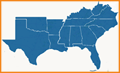 WASHINGTON (CFP) — With the support of four Southern Republicans and all four Southern Democrats, the U.S. Senate has voted to overturn President Trump’s declaration of a national emergency in order to find money for a barrier along the U.S.-Mexico border.

U.S. Senator Thom Tillis
But one GOP senator who had come out publicly in favor of overturning the declaration — Thom Tillis of North Carolina — reversed course and voted no, after intense lobbying from the White House and an avalanche of criticism from Trump partisans back home.
Trump has vowed to veto the resolution overturning the declaration, which passed by a 59-41 margin in the Republican-controlled Senate on March 14. The House passed it in late February by a vote of 254-182.
However, opponents of the declaration do not have enough support in either House to override Trump’s veto, which will be the first of his presidency.
The four Southern Republicans who broke the with president were Rand Paul of Kentucky, Marco Rubio of Florida, Roger Wicker of Mississippi, and Lamar Alexander of Tennessee.
All four Southern Democrats in the Senate also voted yes — Mark Warner and Tim Kaine of Virginia, Joe Manchin of West Virginia, and Doug Jones of Alabama.
Frustrated by the unwillingness of the Democrat-controlled House to vote money for the border wall, Trump declared a national emergency on February 15, which will allow him to shift $8 billion from other federal programs and use it for wall construction. Most of the money will come from appropriations for military construction and drug interdiction.

Alexander
In a floor speech before the vote, Alexander said he objected to Trump’s use of an emergency declaration to provide border wall funding after Congress failed to appropriate the money.
“The problem with this is that after a Revolutionary War against a king, our nation’s founders gave to Congress the power to approve all spending so that the president would not have too much power. This check on the executive is a crucial source of our freedom,” Alexander said.

Rubio
Rubio said he agreed with Trump that an emergency exists at the border but said he objected to shifting money out of the military construction budget to finance the border barrier.
“This would create a precedent a future president may abuse to jumpstart programs like the Green New Deal, especially given the embrace of socialism we are seeing on the political left,” he said in a statement on Twitter.
Paul and Wicker also cited constitutional considerations as the reason for their vote to overturn the declaration.

Wicker

Paul
“I stand with President Trump on the need for a border wall and stronger border security, but the Constitution clearly states that money cannot be spent unless Congress has passed a law to do so,” Paul said in a statement.
Wicker said he regretted “that we were not able to find a solution that would have averted a challenge to the balance of power as defined by the Constitution.”
“The system of checks and balances established by the Founders has preserved our democracy. It is essential that we protect this balance even when it is frustrating or inconvenient,” he said in a statement.
Tillis made a splash when he published an op-ed piece in the Washington Post on February 25 saying he would vote to overturn the emergency declaration because it would set a precedent that “future left-wing presidents will exploit to advance radical policies that will erode economic and individual freedoms.”
Tillis faced an avalanche of criticism from the president’s supporters in the Tar Heel State and was facing the likelihood of a primary challenge in his 2020 re-election race.
“A lot has changed over the last three weeks — a discussion with the vice president, a number of senior administration officials … a serious discussion about changing the National Emergencies Act in a way that will have Congress speak on emergency actions in the future,” Tillis said.
Republican senators had considered changing the National Emergencies Act to make it more difficult to declare emergencies in the future, but the plan faltered when House Democrats came out against it.
Tillis said he concluded that the crisis at the border was sufficiently serious to warrant the emergency declaration.
“We have narcotics flooding our country, poisoning our children and adults of all ages, and a lot of it has to do with the porous border and the seemingly out of control crossings,” Tillis said.
But Democrats back home pounced on Tillis for his change of heart.
“Tillis again reminded the entire state who he is — a spineless politician who won’t keep his promises and looks out for himself instead of North Carolina,” said Democratic Party spokesman Robert Howard in a statement.
Rubio and Paul do not face re-election until 2022; Wicker’s current term lasts through 2024.
Among the Democrats who voted against Trump, Jones is the only one who is running for re-election in 2020. Warner isn’t up for re-election until 2022, and Manchin and Kaine’s current terms last through 2024.
Jones is considered among the most vulnerable Democrats up for election in 2020, in a state where Trump remains popular.
 Chicken Fried Politics