
Latest Posts
Latest Coverage
-
Symbolic solution in search of an actual problem
Support of 9 Southern Republicans for Respect for Marriage Act shows why Supreme Court isn’t about to ban same-sex marriage ♦By Rich Shumate, ChickenFriedPolitics.com editor…
-

West Virginia stubborn, or playing hard to get
U.S. Senator Joe Manchin pisses off his party yet again … to what end? ♦By Rich Shumate, ChickenFriedPolitics.com editor Also in this report: Atlanta DA…
-

2 Mississippi Republican U.S. House members forced into runoffs after weak primary showings
Michael Guest narrowly trails challenger in 3rd District; Steven Palazzo clears just 32% in 4th District ♦By Rich Shumate, ChickenFriedPolitics.com editor JACKSON, Mississippi (CFP) –…
-

Mississippi Republican U.S. Rep. Steven Palazzo facing Tuesday primary fight amid ethics investigation
6 opponents hitting “No-Show Palazzo” over inattention to district, ethics problems ♦By Rich Shumate, ChickenFriedPolitics.com editor GULFPORT (CFP) — Mississippi U.S. Rep. Steven Palazzo —…
-

Primary Wrap: Kemp, Raffensperger survive Trump’s ire; Brooks makes Alabama U.S. Senate runoff
Texas Democratic U.S. Rep. Henry Cuellar survives challenge from the left; George P. Bush gets blown out by Attorney General Ken Paxton ♦By Rich Shumate,…
-

U.S. House’s last pro-life Democrat, Texas’s Henry Cuellar, fighting to keep seat in Tuesday primary runoff
Challenger Jessica Cisneros wanted House Democratic leaders to rescind Cuellar endorsement; they refused ♦By Rich Shumate, ChickenFriedPolitics.com editor LAREDO, Texas (CFP) — Amid the newly…
Genius or gimmick? Georgia GOP puts its Senate hopes on Herschel Walker
With Donald Trump’s blessing, untested Walker poised to claim U.S. Senate nomination. But is he too much of a risk?
♦By Rich Shumate, ChickenFriedPolitics.com editor
 ATLANTA (CFP) — Are Georgia Republicans ready to hand their U.S. Senate nomination to a man who has never run for political office, hasn’t lived in the Peach State for decades, and has a personal history that includes mental health struggles and an ex-wife with a restraining order?
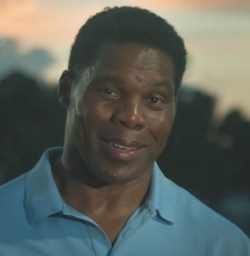
U.S. Senate candidate Herschel Walker, R-Georgia
With Donald Trump’s enthusiastic endorsement, Hall of Fame football hero Herschel Walker enters the race as the clear front-runner for the Republican nomination to take on Democratic U.S. Senator Raphael Warnock next year. But with control of the Senate on the line, nominating Walker is certainly not the safest path, given the questions he will face about his politics and his past.
Will a Walker candidacy end in strategic triumph or bitter regret? Trump clearly believes the former; Senate Republican leader Mitch McConnell is reportedly nervous about the latter.
“I’m a kid from a small town in Georgia who’s lived the American dream, and I’m ready to fight to keep that dream alive for you,” said Walker in a campaign kickoff video posted August 25, which contained footage of his Heisman-winning exploits at the University of Georgia, spliced with workouts in the gym.
“I’m a conservative not because someone told me to be. I’m a conservative because I believe in smaller government, a strong military, personal responsibility and making sure all people have the opportunity to pursue their dreams.”
Watch Walker’s announcement video at bottom of page
The video did not mention Trump, who has been encouraging Walker to make a Senate run for months. But his campaign website features a famous photo of Walker doing an elbow bump with the former president during the 2020 presidential campaign.
The campaign rollout was unusual in that Walker entered the race quietly, with a statement and website, rather that with a public event in front of reporters, who might have asked uncomfortable questions.
Walker, 59, was born and raised in Wrightsville, a small town in Middle Georgia. He led UGA’s football team to its only consensus national title in 1980 and, in 1982, won the Heisman Trophy as the nation’s top college football player.
He went on to play professional football, first in the USFL (where he played for a team Trump owned) and then in the NFL, where he retired from the Dallas Cowboys in 1997.
Since his retirement, Walker had been living in Texas, where he established a poultry business. He registered to vote in Georgia just days before entering the Senate race.
In a 2008 book, Walker disclosed that he has suffered from dissociative identity disorder, which used to be called multiple personality disorder. He credited therapy and his Christian faith for his recovery.
In July, the Associated Press published an extensive investigative profile of Walker, based on business and court records. According to the report, Walker’s ex-wife got a protective order in 2005, alleging violent and threatening behavior. Walker was also involved in several contentious disputes with his business partners and may have made exaggerated claims about his record as a businessman.
Walker did not respond to the AP’s requests for comment for the story. Refusing to address the allegations will be much harder to do in the heat of a political campaign.
Walker’s current wife, Julie Blanchard, is also under investigation by Georgia election officials for casting an absentee ballot in the 2020 election, despite residing in Texas. As one of Walker’s rivals for the GOP Senate nomination, Agriculture Commissioner Gary Black, noted, “it makes it very difficult to talk about voter fraud after that.”
Black, who has won statewide office three times, will certainly be no pushover for Walker. But Trump’s full-throated support for Walker will make his task that much harder, as evidenced by Black’s tepid fundraising in what will become one of the most expensive races of the 2022 cycle. (He’s raised $703,000, compared to $34 million for Warnock.)
The Republican field had been frozen for months as potential Senate candidates waited for Walker’s decision, with several members of Georgia’s U.S. House delegation looking at bids. But there will be very little appetite to take on the Trump-Walker duo.
In a sense, Georgia Republicans find themselves in this situation because of Republican Governor Brian Kemp’s decision to think outside the box and pick uber-wealthy businesswoman Kelly Loeffler for a Senate seat in 2020. She quickly proved to be out of her element against Warnock — with debate performances that were painful to watch — and could not hold the seat.
So is it wise for Georgia Republicans to think outside the box again with Walker, having no idea what kind of political candidate he will make? Particularly against Warnock, equipped as he is with the power of incumbency, a mountain of money, and Barack Obama-level political skills?
Georgia Bulldog fans view Walker fondly, even reverently. But it has been 40 years since he led them to glory — years in which the state has changed almost beyond recognition.
Trump, of course, is the ultimate example of using celebrity to gain political power, which is no doubt why he thinks Walker is a slam-dunk Senate choice.
But time will tell whether nominating Walker is strategic genius or an ill-fated gimmick. Control of the Senate may very well hang on the answer.
We tweet @ChkFriPolitics Join us!
Is demography destiny? Census data shows challenges ahead for Southern GOP
2020 figures show increases among voting groups that have been swinging to Democrats
By Rich Shumate, ChickenFriedPolitics.com editor
 (CFP) — Take a map showing population shifts across the South over the last 10 years and put it over a map of where Joe Biden performed best in 2020, and the connection will appear obvious.
The counties in the South that have gained population — large cities and surrounding suburbs — are the same places where Biden did well; the counties that shrank — rural areas and small towns — were places where Donald Trump rolled.
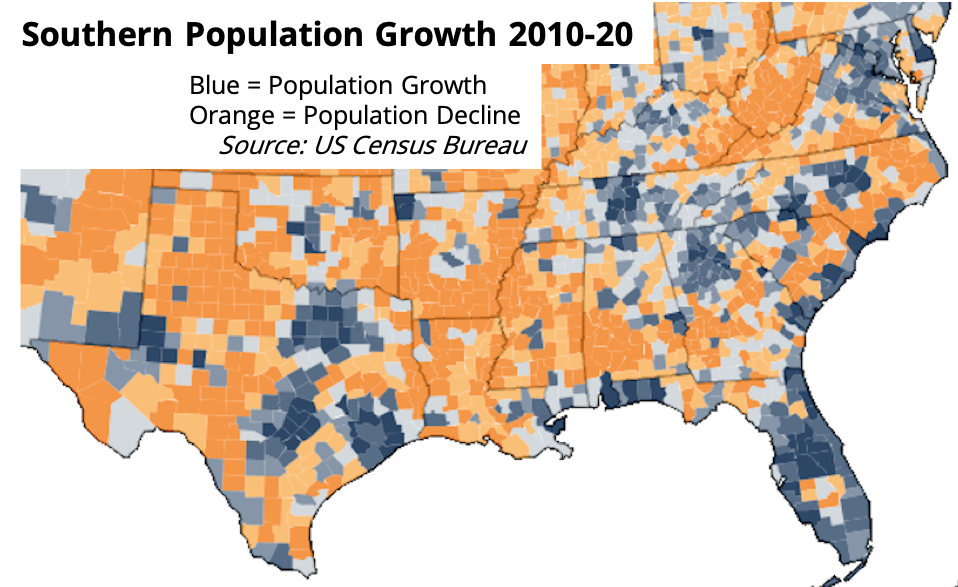
New, detailed, local-level data released August 12 by the U.S. Census Bureau show that when Republicans across the South redraw lines for congressional and legislative districts to equalize population, maximizing their partisan advantage will be much trickier than it was a decade ago.
True, Republicans will still control the entire process in every Southern state except Louisiana and Virginia, which will give them ample opportunity to draw favorable maps. But this slicing and dicing will still have to account for the fact that the sheer number of hostile voters is growing at such a pace that gerrymandering will become ever more difficult.
The geographic partisan divide reflects another shift that has negative implications for the GOP — the Southern electorate is becoming less white.
In every Southern state except for South Carolina and Tennessee, the percentage of the population that self-classifies as white dropped — in some cases, dramatically. In Texas, it dropped 17.5%; in Florida, 12%. There are now five Southern states — Texas, Florida, Georgia, Mississippi and Louisiana — where the white population is less than 60%, giving Democrats a base on which to build.
While the black population nationwide has been relatively stable since 2010, it grew faster than the national average in every Southern state except Kentucky, West Virginia and Oklahoma, as the reverse migration of African Americans back to the region continues.
The most notable population change in the 2020 census was among Hispanic residents, who grew nationwide by 23% and now make up nearly 19% of the total population. But every Southern state except Texas saw the Hispanic population grow even faster than the national average, making them a much more visible presence in areas where they have previous had little political impact.
For decades, the bedrock of Republican strength in the South has been white voters in rural areas, small towns and suburbs, offsetting Democrat strength among African American voters and inner-city urban voters. Maps featuring suburban-rural districts have thus been used to maximum effect.
However, the population shifts in the new census numbers will dictate that rural districts with shrinking populations will have to expand to include more suburban territory, at the same time that Southern suburbs are becoming less reliably Republican.
In Georgia, for example, three counties in the Atlanta urban-suburban core — Fulton, Gwinnett and Cobb — added 376,000 people over the last decade. Joe Biden carried all three, and Democrats have flipped two U.S. House seats here and gained a dozen state legislative seats. So can new lines be drawn to account for both the population boost and the political shift?
In Texas, eight counties added more than 200,000 each during the decade, a total of 2.5 million people combined, and all were in major metro areas — Dallas-Ft. Worth, Houston, San Antonio and Austin. By contrast, 144 counties lost population. So when legislators draw two new U.S. House districts, they will almost certainly have to be rooted in metro areas where Democrats have made gains.
This is not to suggest, of course, that Republican hegemony in the South is threatened in the short-term by these population shifts. Hispanic voters remain a relatively small part of the electorate outside of Florida and Texas, white voters are more monolithically Republican than in much of the rest of the country, and the suburbs remain competitive.
But amid unprecedented scrutiny of the map-making process — with activist groups ready to pounce on maps they feel are unfair — drawing new political lines that maximize Republican gains will be a fraught process.
The legal fight over Texas’s 2010 maps didn’t end until 2018. We can expect the same this time around, and probably in more places.
We tweet @ChkFriPolitics Join us!

Big Risk: Ron DeSantis and Greg Abbott double down on mandates despite unpredictability of COVID crisis
Will short-term gain for leading charge against COVID-19 restrictions backfire if cases surge in schools?
♦By Rich Shumate, ChickenFriedPolitics.com editor
(CFP) — A number of Southern Republican political leaders — most notably, Florida Governor Ron DeSantis and Texas Governor Greg Abbott — have decided to take a huge gamble; namely, to lead the charge against new COVID-19 restrictions, despite the Delta variant ripping across their states, filling up hospitals and stretching front-line workers to their breaking point.
It’s an experiment — literally — that is particularly risky given that one of the populations being experimented are hundreds of thousands of school children, whose parents cannot get them COVID-19 vaccinations even if they want to.

Governors Ron DeSantis of Florida and Greg Abbott of Texas
If DeSantis and Abbott are right — that all of the doomsaying and caterwauling by public health officials is an overblown overreaction — their gamble is likely to delight their base and pay dividends when they come up for re-election next year.
But if they are wrong — if busloads of children start getting sick or dying — these current prohibitive favorites could find themselves in electoral trouble. Which begs the question, is it worth the risk?
To see the possible pitfalls of this strategy, one need only look at the school district in Marion, Arkansas, where, after just the first week of classes in August, 900 students and staff were in quarantine.
That was enough to convince Republican Governor Asa Hutchinson that his decision back in April to sign into law a ban on mask mandates, pushed through by Republican lawmakers, was a mistake. It was not, however, enough to convince those lawmakers to reverse the mask ban when Hutchinson summoned them back to Little Rock for a special session to do so.
To be clear, neither DeSantis and Abbott are anti-vaxxers. On the other hand, they are not merely taking a personal political stand against mask and vaccine mandates — they are aggressively pushing back against local officials and even private businesses who want to put these measures into place themselves.
Two hallmarks of traditional conservatism are giving power to local officials to make decisions they think best for their communities (particularly school boards) and giving businesses free hand to run their enterprises as they see fit. Both have gone out the window amid a conservative backlash to mask and vaccine mandates, a wave which DeSantis and Abbott seem eager to ride.
DeSantis has gone so far as to oppose hospitals requiring staff on the front lines of the pandemic to get vaccinations, and he has gone to court to block cruise lines from requiring vaccinations for passengers, which the cruise companies desperately want.
Given the devastating outbreaks of COVID-19 among cruise ship passengers during the early days of the pandemic, cruise companies want to err on the side of caution; DeSantis is coming down instead on the side of an expansive sense of personal liberty, even at the expense of public health.
Both Abbott and DeSantis are responding to a part of their base that is skeptical of vaccines and vehemently opposed to mask mandates and lockdowns. Some of these people even argue that masks are harmful for children, an assertion not supported by any reputable medical research.
The irony, of course, if that if these people had gotten vaccinated, the COVID-19 might now be mostly over, eliminating the possibility of mandates or lockdowns.
It makes sense, with perverted logic, for people who believe COVID is a hoax to support dispensing with restrictions even though most people are still unvaccinated. But if the last 18 months have taught Abbott and DeSantis anything, it is surely that COVID isn’t a hoax.
Abbott is facing primary challengers who already complain that he’s taken too many COVID precautions, perhaps explaining why he’s so resistant to more. DeSantis is not yet being primaried on this issue, so taking a hard line here is perhaps a way to stopping a challenge from getting off the ground — not to mention helping him with a possible 2024 presidential run.
Still, a recent Florida polled showed DeSantis’s job approval under water, in a state where the last three governor’s races were decided by 1 point or less. Texas is more Republican but not out of reach for Democrats if the public comes to believe people have died needlessly under Abbott’s stewardship.
Two other facts call into question the wisdom of DeSantis and Abbott’s big risk.
First, the fallout from the COVID pandemic likely cost Donald Trump re-election, something even the former president has been willing to concede. So, perhaps this is a lesson to which more attention needs to be paid.
And second, COVID has proven to not only be tremendously deadly but highly unpredictable. So, climbing out on a political limb and hoping that the worst public health crisis in a century will turn out all right in the end would seem a dubious long-term strategy, even if the base lustily cheers in the short term.
However, for better or worse, both DeSantis and Abbott have embraced this risk. So in that bed they will now have to lie.
We tweet @ChkFriPolitics.com Join us!

Texas State Rep. Jake Ellzey wins U.S. House runoff, defeats Trump-backed Susan Wright
Ellzey will replace the late U.S. Rep. Ron Wright, who died from COVID-19 in February
 ARLINGTON, Texas (CFP) — State Rep. Jake Ellzey claimed Texas’s 6th U.S. House District seat in Tuesday’s all-Republican runoff, defeating Susan Wright, who was trying to keep the seat of her late husband, U.S. Rep. Ron Wright.
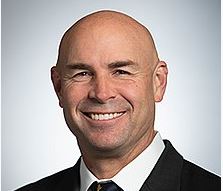
U.S. Rep.-elect Jake Ellzey, R-Texas
The result was a blow to former President Donald Trump, who endorsed Wright and publicly supported her candidacy in the final stretch. His super PAC also dropped $100,000 in a last minute advertising buy.
Ellzey took 53% in the runoff to 47% for Wright to win a district that includes Arlington and parts of Tarrant County, along with Ellis and Navarro counties to the south.
The all-party special election was called after Ron Wright’s death from COVID-19, while undergoing cancer treatment in February.
In the first round of voting in May, Wright and Ellzey claimed both spots in the runoff. Democrats were boxed out when the party’s 2018 nominee for the seat, Jana Lynne Sanchez, came in third, just 350 votes behind Ellzey.
Democrats had hopes of flipping the seat in suburban Dallas-Fort Worth, which Trump carried by just 3 points in 2020. But two other Democrats in the race took 10,000 votes from Sanchez, securing the seat for the GOP.
Tuesday’s runoff was something of a rematch from the 2018 election for the post, when Ron Wright defeated Ellzey to win an open seat.
The district’s previous long-time congressman, Joe Barton, endorsed Ellzey, as did Governor Greg Abbott and former Governor Rick Perry. But Trump went all in for Wright.
We tweet @ChkFriPolitics Join us!

Second time’s a charm? Charles Booker makes new run for Kentucky U.S. Senate seat
Former Democratic legislator from Louisville will face uphill climb to unseat Republican U.S. Senator Rand in 2022
♦By Rich Shumate, ChickenFriedPolitics.com editor
 LOUISVILLE (CFP) — When he launched his first run for the U.S. Senate in 2020, few observers gave Charles Booker a snowball’s chance in a Kentucky August.
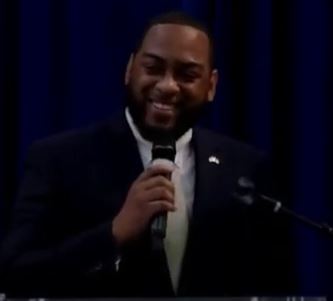
Democrat Charles Booker announces U.S. Senate run
He was just 32, had served in the legislature for just one year, and was trying to wrestle the Democratic nomination away from Amy McGrath, a fundraising powerhouse who had the full backing of Senate Democrats and their leader, Chuck Schumer.
But then, Booker took a leading role in social justice protests in Louisville after the shooting death of Breonna Taylor, his charismatic style caught the imagination of the Democratic left, and — amid an uneven, uninspiring and hyper-cautious campaign from McGrath — he came within 16,000 votes of pulling off what would have one of the year’s biggest primary upsets.
Exiting the race, Booker told his supporters, “Don’t ever let someone tell you what’s impossible.”
A year later, he’s trying the impossible again, this time with a run for the state’s other U.S. Senate seat, held by Republican U.S. Senator Rand Paul.
“A lot of people don’t believe that change is possible in Kentucky. We’re going to prove the doubters wrong,” Booker told supporters at his kickoff rally in Louisville July 1. “We’re going to win this race, and we’re going to transform Kentucky, and it starts right now. Let’s go.”
Video of Booker’s announcement speech at end of story.
And Booker made it clear that whether or not his optimism is borne out, or whether or not the race against Paul ends up being competitive in the end, his quest to unseat Paul will be fiery, unapologetically liberal and in-your-face, in a way McGrath never was.
“Randal Howard Paul — I see you. I see you, but you don’t see us,” Booker said. “Rand Paul thinks we are a joke. He mocks us whenever he opens his mouth. He’s mocking us. He’s an embarrassment to Kentucky because he does not care.”
“He thinks his job is to stir dysfunction, to weaponize hate and essentially dismiss Kentuckians altogether.”
Rand’s response to Booker’s announcement telegraphed the likely Republican strategy against him; namely, pounding him on his more left-wing positions in a conservative state: “I just don’t think defunding the police and forcing taxpayers to pay for reparations will be very popular in Kentucky.”
What happened to McGrath in 2020 illustrates the decidedly uphill nature of Booker’s quest in 2022. She spent $90 million to lose to Senate Republican Leader Mitch McConnell by 20 points, failing to even break 40%.
Of course, McConnell is a more formidable political force than Paul, and McGrath’s near loss to Booker in the Democratic primary — in which he beat her in Louisville-Jefferson County by 36,000 votes — was a glaring sign of her weakness as a candidate. Booker does have stronger political skills, and it seems likely at this point that he won’t have to battle through a primary.
Still, Donald Trump carried Kentucky by 26 points in 2020, and Paul heads into the race with Trump’s endorsement. And a Democrat has not won a Senate race in the commonwealth for 30 years.
Booker’s theory of the race is that he can reach, rally and motivate voters on the left, rather than trimming his sails to appear more moderate, which did not work for McGrath. To that end, he has hired two campaign operatives involved in Democratic U.S. Senator Raphael Warnock’s runoff win in January, which won with a rallying-the-base strategy.
Booker, like Warnock, is a charismatic African-American candidate with an engaging, pulpit speaking style. However, Kentucky has a much smaller black population than Georgia and is much less urban. Louisville’s impact on the statewide vote will not be as determinative as Atlanta’s was.
Indeed, Booker’s loss to McGrath shows the challenges of a base-centric style in the Bluegrass. He beat her in Louisville and Lexington, but she won the primary by carrying most of the rest of the state.
So, the key question for 2022 is, can he find enough votes in more heavily populated parts of the state to overcome Paul’s margins in more rural areas? Or can he cut into those margins with an economic appeal to rural voters in poorer counties in Eastern Kentucky, where Democrats still have local influence?
Another wild card in this race is the amount of institutional support Booker might get from national Democrats, for a race that is seen as rather less than winnable. The powers-that-be who went all in for McGrath may be wary of going down that road again, although, as Paul’s foil, Booker should be able to raise enough money on his own to be competitive.
It is not impossible for a Democrat to win statewide in Kentucky, as Governor Andy Beshear proved in 2019. Then again, Beshear was running against Matt Bevin, whose performance as governor had made him as popular as a bad rash. Paul starts the race in much better shape.
Booker starts the race with an audacious belief in his own chances, and he has clearly decided that caution is not the better part of valor. While that may or may not end up making a senator, it will make the Kentucky Senate race among them most compelling of the 2022 cycle.
Video of Charles Booker’s announcement

 Chicken Fried Politics