
Latest Posts
Latest Coverage
-
Symbolic solution in search of an actual problem
Support of 9 Southern Republicans for Respect for Marriage Act shows why Supreme Court isn’t about to ban same-sex marriage ♦By Rich Shumate, ChickenFriedPolitics.com editor…
-

West Virginia stubborn, or playing hard to get
U.S. Senator Joe Manchin pisses off his party yet again … to what end? ♦By Rich Shumate, ChickenFriedPolitics.com editor Also in this report: Atlanta DA…
-

2 Mississippi Republican U.S. House members forced into runoffs after weak primary showings
Michael Guest narrowly trails challenger in 3rd District; Steven Palazzo clears just 32% in 4th District ♦By Rich Shumate, ChickenFriedPolitics.com editor JACKSON, Mississippi (CFP) –…
-
Mississippi Republican U.S. Rep. Steven Palazzo facing Tuesday primary fight amid ethics investigation
6 opponents hitting “No-Show Palazzo” over inattention to district, ethics problems ♦By Rich Shumate, ChickenFriedPolitics.com editor GULFPORT (CFP) — Mississippi U.S. Rep. Steven Palazzo —…
-

Primary Wrap: Kemp, Raffensperger survive Trump’s ire; Brooks makes Alabama U.S. Senate runoff
Texas Democratic U.S. Rep. Henry Cuellar survives challenge from the left; George P. Bush gets blown out by Attorney General Ken Paxton ♦By Rich Shumate,…
-

U.S. House’s last pro-life Democrat, Texas’s Henry Cuellar, fighting to keep seat in Tuesday primary runoff
Challenger Jessica Cisneros wanted House Democratic leaders to rescind Cuellar endorsement; they refused ♦By Rich Shumate, ChickenFriedPolitics.com editor LAREDO, Texas (CFP) — Amid the newly…
Democratic VP nominee Tim Kaine rules out 2020 White House run
Kaine tells Richmond newspaper he is content representing Virginia in the Senate
♦By Rich Shumate, Chicken Fried Politics.com editor
 RICHMOND (CFP) — U.S. Senator Tim Kaine of Virginia says he is through with presidential-level politics and will not run for the Democratic nomination in 2020.

Tim Kaine
Kaine made those remarks in a November 17 interview with the Richmond Times-Dispatch, his first in-depth interview since he and Hillary Clinton went down to defeat on November 8.
“I want to run and serve in the Senate for a long time,” Kaine said. “I was really honored to be asked by Hillary, and it was a history-making race to be the first woman nominated. And for her to do well in Virginia and win the popular vote, that is all to her credit. And I was really proud to be part of it. But I think the Catholic in me likes to go to the place where there is the most work to be done.”
Kaine told the newspaper that he would like to emulate the career path of former U.S. Senator John Warner, who represented Virginia in the Senate for 30 years before retiring in 2009. Warner never sought the presidency.
Had Kaine been willing to seek the presidency in 2020, he would have been a leading contender on the Democratic side, given his name recognition from the 2016 race.
Kaine is up for re-election in 2018. While Republicans would likely make a charge at him, Virginia has been trending Democrat in statewide races, with the governorship and both U.S. Senate seats in Democratic hands.
The Clinton-Kaine ticket carried Virginia by 5 points. It was the lone Southern state that they won.
Kaine was the only Southerner to make the ticket of either major political party this year, although 10 Southerners unsuccessfully sought their party’s nomination, including two Virginians, former Democratic U.S. Senator Jim Webb and former Republican Governor Jim Gilmore.
Alabama U.S. Senator Jeff Sessions nominated for U.S. attorney general
Appointment could trigger a special election for Session’s Senate seat
♦By Rich Shumate, Chicken Fried Politics.com editor
 WASHINGTON (CFP) — President-elect Donald Trump has picked U.S. Senator Jeff Sessions of Alabama as his choice for attorney general.
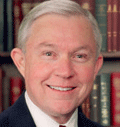
U.S. Senator Jeff Sessions
If Sessions is confirmed by the Senate, where he has served for the past 20 years, his vacant seat will be filled temporarily by Alabama Governor Robert Bentley. State law then requires that a special election be called for voters to select a permanent replacement for the remainder of Session’s term, which ends in 2020.
As Bentley and Sessions are both Republicans, the seat will remain in GOP hands.
In a November 18 statement announcing the pick, Trump called Sessions “a world-class legal mind” who is “greatly admired by legal scholars and virtually everyone who knows him.”
Sessions, who was a federal prosecutor in Alabama from 1975 to 1983, said he was looking forward to returning to the Justice Department.
“I love the department, its people and its mission. I can think of no greater honor than to lead them,” he said in a statement. “With the support of my Senate colleagues, I will give all my strength to advance the department’s highest ideals.
Sessions, 69, who was first elected to the Senate in 1996, was the first senator to endorse Trump and has become a close adviser. He shares with Trump a hard-line stance on immigration, opposing a path to citizenship for undocumented immigrants.
In 1986, President Ronald Reagan nominated Session to serve as a federal judge in Alabama. But his nomination was killed in the Senate Judiciary Committee after several lawyers who worked with Sessions claimed he had made racist statements, which Sessions denied.
That controversy is likely to be resurrected during Session’s confirmation because the Justice Department is the key enforcement agency for civil rights.
Sessions was elected Alabama’s attorney general in 1994 and went to the Senate two years later, becoming only the second Republican elected from the Yellowhammer State since Reconstruction.
U.S. Senate, House races will be decided in Louisiana runoff
Democrats face uphill climbs in 2 races; 2 Republicans face off in the other
♦By Rich Shumate, Chickenfriedpolitics.com editor
 NEW ORLEANS (CFP) — Voters in Louisiana will go to the polls one more time on December 10 to choose a new U.S. Senator and two members of the U.S. House for the northwestern and southwestern parts of the state, in the last federal elections of the 2016 cycle.
After the state’s all-party “jungle” primary on November 8, the Senate race features Republican State Treasurer John Kennedy and Democratic Public Service Commissioner Foster Campbell, pitting two of the state’s longest serving and best-known politicians against each other.

State Treasurer John Kennedy
Kennedy came in first in the primary with 25 percent, with Campbell at 18 percent. Because Republicans have already secured their 51-seat Senate majority, the Louisiana runoff will not affect the balance of power.
Kennedy, 64, from Madisonville near New Orleans, has been Louisiana’s treasurer for nearly 17 years, winning statewide office five times. In 2004, he made an unsuccessful bid for the Senate as a Democrat and tried again in 2008, after switching parties and becoming a Republican. He lost to Democrat Mary Landrieu.
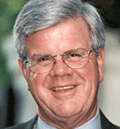
Public Service Commissioner Foster Campbell
Campbell, 69, from Elm Grove near Shreveport, has represented northwestern Louisiana on the Public Service Commission since 2003, a post he won after making three unsuccessful attempts to win a seat in the U.S. House. He also ran for governor in 2007, coming in fourth place in the primary.
The seat opened up after Republican U.S. Senator David Vitter decided not to seek re-election and run instead for governor, a race he lost to Democratic Governor John Bel Edwards. Given the Pelican State’s Republican tilt, Kennedy is considered the favorite in the race.
In addition to the Senate race, voters in the 3rd U.S. House District, which takes in southwestern Louisiana, and the 4th District, which takes in the northwest, will choose new congressmen.
In the 3rd District Republican Public Service Commissioner Scott Angelle from Breaux Bridge will face fellow Republican Clay Higgins, a former sheriff’s deputy from St. Landry Parish who became well known for tough-talking anti-crime videos that have gone viral on the Internet.
The seat opened when GOP U.S. Rep. Charles Boustany of Lafayette left to make an unsuccessful bid for the U.S. Senate seat, finishing third, just behind Campbell.
In the 4th District, Republican State Rep. Mike Johnson of Bossier Parish will face Democrat Marshall Jones, an attorney from Shreveport, in the runoff, which will be the last House pickup opportunity for Democrats.
The seat opened when U.S. Rep. John Fleming of Minden also decided to run for the Senate, where he finished fifth. Republicans have held this seat since 1988, making Johnson a prohibitive favorite.
Analysis: Election results show Democrats are still a long way from being competitive in the South
Clinton performed worse in the South than Barack Obama in 2012
♦By Rich Shumate, Chickenfriedpolitics.com editor
 (CFP) — Prior to the November 8 election, Democrats were publicly hopeful that they might finally be turning back Republican hegemony in the South, to the degree that pro-Hillary Clinton ads were running not only in the battleground states of Florida and North Carolina but also in reliably Republican Georgia and Texas.
Election results show that thinking was not just wishful, it was magical.
In fact, Clinton did comparatively worse in the South than Barack Obama did four years ago (which, oddly, seems to undercut the notion that the South’s resistance to Obama was based on his race.) A look at regional and state-by-state figures in the presidential race shows just how grim election night was for Southerners with a D attached to their name.
Donald Trump carried 53.3 percent of the vote and 13 out of 14 Southern states. That performance was not as good as Mitt Romney’s in 2012, when he came in with 54.4 percent (although Romney only carried 12 states.) However, the performance gap between Trump and Clinton was actually larger than the gap between Romney and Obama because Clinton’s underperformance was even worse.
She took just 42.5 percent of the Southern vote; Obama won 44.3 percent. Some of that was due to a larger third-party vote which, at 4.2 percent, was about 3 points more than it was in 2012. However, the gap between the Republican and Democratic share of the vote went up everywhere except Texas and Georgia and the lone Southern state Clinton carried, Virginia.
A look at raw vote totals shows the degree to which Clinton hemorrhaged Obama supporters.
In Mississippi, Clinton’s raw vote total was nearly 101,000 less than Obama’s in 2012, a huge shift in a state where less than 1.2 million votes were cast. Given that African-Americans play an outsized role in the state’s Democratic base, Clinton’s numbers are a clear sign that black voters did not turn out for her as they did for Obama.
But if Mississippi was bad for Clinton, Appalachia was even worse — down 51,000 votes in Kentucky, 92,000 in Tennessee, and 52,000 votes in West Virginia, where Trump’s percentage of the vote soared 15 points above Romney’s number. Those three states together have 270 counties; she carried exactly five.
In Arkansas, where Clinton was first lady and her husband governor for 10 years, she lost 16,000 votes and managed just 33.6 percent of the vote, 3.3 points lower than Obama’s vote in 2012. At the same time, Trump’s vote went up 34,000 over Romney’s, a net difference of nearly 50,000 votes.
Even in Virginia, which Clinton won, her vote total was 11,000 less than what Obama put up in 2016. She won because Virginia Trump’s vote total came in less than Romney’s by about 59,000 votes.
Meanwhile, as Clinton’s vote was fading, Trump’s was surging, beating 2012 GOP totals in every state except Virginia and Mississippi.
In Florida, where a growing Latino population was supposed to lead Clinton to victory, Trump added 442,000 votes to Romney’s tally, while Clinton added just 245,000 to Obama’s. In North Carolina, he added 69,000; she lost 16,000 in a battleground state she visited repeatedly.
In total across the South, Trump added more than 1 million votes to Romney’s haul; Clinton managed to add 448,000 by offsetting her losses in 11 states with gains in Texas, Florida and Georgia.
This led to some remarkable net vote changes between the two parties — 128,000 in Alabama, 166,000 in Kentucky, 150,000 in Tennessee and 118,000 in West Virginia.
The only glimmer of light at the end of this dark tunnel for Democrats was their improved performance in both Georgia and Texas.
In the presidential race, Democrats closed the gap with Republicans from 8 to 5 points in Georgia and 16 points to 9 points in Texas. Clinton also carried two big suburban counties in Atlanta, Cobb and Gwinnett, that had not gone Democratic in 40 years, along with Fort Bend County in suburban Houston, normally a no-man’s-land for a Democrat.
So perhaps Democratic wistfulness for those two states may not have been entirely misplaced, although that’s cold comfort when Trump carried Florida and North Carolina on his way to the White House.
And if the presidential results were grim, the U.S. Senate races were just as bad. Republicans went eight-for-eight, with a race in Louisiana heading for a December 10 runoff in which Republican State Treasurer John Kennedy is favored to keep the seat in GOP hands.
Democrats didn’t even bother contesting Alabama, Oklahoma or South Carolina; they did recruit credible candidates in the rest of the races, such as Conner Eldridge in Arkansas, Jim Barksdale in Georgia and Jim Gray in Kentucky. But all lost by double-digit margins.
The Democrats’ best shots to pick up GOP-held seats were thought to be in Florida, where U.S. Rep. Patrick Murphy was challenging Marco Rubio, and in North Carolina, where Deborah Ross was challenging Richard Burr. Murphy lost by 8 points; Ross, by 7. Both actually underperformed Clinton in their states.
The only good news for Democrats came in races for governor in West Virginia, where Jim Justice kept the office in Democratic hands, and in North Carolina, where Democratic Attorney General Roy Cooper appears to have ousted Republican Governor Pat McCrory, although that race may be headed for a recount.
Catch up on all the latest Southern election news at Chicken Fried Politics.com
News and reaction in races for president, U.S. Senate, U.S. House and governor
♦From Rich Shumate, Chickenfriedpolitics.com editor
Click here: chickenfriedpolitics.com


