
Latest Posts
Latest Coverage
-
Symbolic solution in search of an actual problem
Support of 9 Southern Republicans for Respect for Marriage Act shows why Supreme Court isn’t about to ban same-sex marriage ♦By Rich Shumate, ChickenFriedPolitics.com editor…
-

West Virginia stubborn, or playing hard to get
U.S. Senator Joe Manchin pisses off his party yet again … to what end? ♦By Rich Shumate, ChickenFriedPolitics.com editor Also in this report: Atlanta DA…
-

2 Mississippi Republican U.S. House members forced into runoffs after weak primary showings
Michael Guest narrowly trails challenger in 3rd District; Steven Palazzo clears just 32% in 4th District ♦By Rich Shumate, ChickenFriedPolitics.com editor JACKSON, Mississippi (CFP) –…
-

Mississippi Republican U.S. Rep. Steven Palazzo facing Tuesday primary fight amid ethics investigation
6 opponents hitting “No-Show Palazzo” over inattention to district, ethics problems ♦By Rich Shumate, ChickenFriedPolitics.com editor GULFPORT (CFP) — Mississippi U.S. Rep. Steven Palazzo —…
-

Primary Wrap: Kemp, Raffensperger survive Trump’s ire; Brooks makes Alabama U.S. Senate runoff
Texas Democratic U.S. Rep. Henry Cuellar survives challenge from the left; George P. Bush gets blown out by Attorney General Ken Paxton ♦By Rich Shumate,…
-

U.S. House’s last pro-life Democrat, Texas’s Henry Cuellar, fighting to keep seat in Tuesday primary runoff
Challenger Jessica Cisneros wanted House Democratic leaders to rescind Cuellar endorsement; they refused ♦By Rich Shumate, ChickenFriedPolitics.com editor LAREDO, Texas (CFP) — Amid the newly…
5 Southern senators, 79 U.S. House members support challenge to electoral vote count
Unsuccessful move to overturn Joe Biden’s win interrupted by mob insurrection at U.S. Capitol
♦By Rich Shumate, ChickenFriedPolitics.com editor
 WASHINGTON (CFP) — Despite an afternoon of violence that left four people dead and lawmakers running for cover, five Southern Republican U.S. senators and 79 of the region’s GOP U.S. House members persisted in supporting objections to President-elect Joe Biden’s Electoral College win that were overwhelmingly defeated once order was restored.
All of the Republican House members representing Alabama, Louisiana, Mississippi, Oklahoma, Tennessee and Virginia supported at least one of the objections to the counts of Biden’s win. By contrast, only a single member from both Kentucky and Arkansas voted yes.
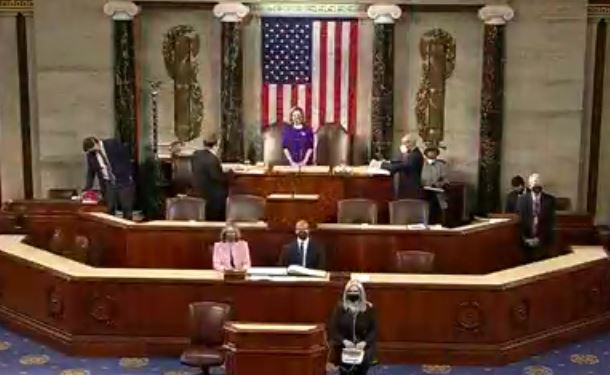
Joint sessions of Congress counts electoral vote (From C-SPAN)
Five Southern senators voted in favor of at least one of the objections filed to electoral vote results from Arizona and Pennsylvania, two swing states Biden flipped in November: Ted Cruz of Texas, John Kennedy of Louisiana, Cindy Hyde-Smith of Mississippi, Rick Scott of Florida and Tommy Tuberville of Alabama, who just took his seat on Sunday.
Cruz, the Senate sponsor of the Arizona challenge, voting in favor of objections to both states, along with Hyde-Smith and Tuberville. Kennedy only objected to Arizona, while Scott only objected to Pennsylvania.
The remaining 22 Southern Republican senators opposed both challenges, including Senate Majority Leader Mitch McConnell, who had warned earlier in the day that challenging the will of voters would plunge American democracy into a “death spiral,” and Lindsey Graham of South Carolina, one of President Donald Trump’s most fervent supporters, who told his fellow senators that “enough is enough.”
“When it’s over, it is over,” Graham said. “[Biden] won. He’s the legitimate president of the United States.”
Kelly Loeffler of Georgia, who had previously announced that she would support objections to the electoral vote, took the Senate floor to say that she changed her mind after Wednesday’s violent incursion into the Capitol. Her decision meant that a challenge to Georgia’s electoral votes failed for lack of a Senate sponsor.
Loeffler was defeated in Tuesday’s Senate runoff in Georgia, which means her votes on the Electoral College disputes could be among her last as a senator.
In the House, a majority of the Republican caucus voted to sustain the objections, including 79 out of 99 Southern members, a group that included the top-ranking Southerner, Minority Whip Steve Scalise of Louisiana.
However, among Kentucky’s five Republican members, only one, Hal Rogers, supported the objections. The rest of the delegation joined with McConnell and the Bluegrass State’s other senator, Rand Paul, in voting no: James Comer, Brett Guthrie, Thomas Massie and Andy Barr.
In the Arkansas delegation, only Rick Crawford supported the objections, which were opposed by both senators, Tom Cotton and John Boozman. French Smith, Bruce Westerman and Steve Womack all voted no.
Alone among their state Republican delegations in opposing the objections were Nancy Mace of South Carolina, who was elected in November to represent Charleston and the Low Country, and David McKinley of West Virginia.
Other Southern Republican House members who opposed the objections to Biden’s electoral vote count were Vern Buchanan and Michael Walz of Florida; Austin Scott and Drew Ferguson of Georgia; Patrick McHenry of NC; and Dan Crenshaw, Tony Gonzales, Michael McCaul, Chip Roy and Van Taylor of Texas.
Three members — Kay Granger and Kevin Brady of Texas and Maria Elvira Salazar of Florida — were in COVID-19 quarantine and did not vote.
Here is the list of Southern House members supporting the Electoral College objections, by state:
Alabama: Aderholt, Brooks, Carl, Moore, Palmer, Rogers
Arkansas: Crawford
Florida: Cammack, Diaz-Balart, Donalds, Dunn, Franklin, Gaetz, Giménez, Mast, Posey, Rutherford, Steube, Webster
Georgia: Allen, Carter, Clyde, Greene, Hice, Loudermilk
Louisiana: Higgins, Graves, Johnson, Scalise
Kentucky: Rogers
Mississippi: Guest, Kelly, Palazzo
North Carolina: Bishop, Budd, Cawthorn, Foxx, Hudson, Murphy, Rouzer
Oklahoma: Bice, Cole, Horn, Lucas, Mullin
South Carolina: Duncan, Norman, Rice, Timmons, Wilson
Tennessee: Burchett, DesJarlais, Fleischmann, Green, Harshbarger, Kustoff, Rose
Texas: Arrington, Babin, Burgess, Carter, Cloud, Fallon, Gohmert, Gooden, Jackson, Nehls, Pfluger, Sessions, Weber, Williams, Wright
Virginia: Cline, Good, Griffith, Wittmann
West Virginia: Miller, Mooney
Senate Majority Leader Mitch McConnell makes impassioned plea against Electoral College vote challenge
McConnell says overturning will of voters would put American democracy in a “death spiral”
♦By Rich Shumate, ChickenFriedPolitics.com
WASHINGTON (CFP) — Senate Majority Leader Mitch McConnell of Kentucky took to the Senate floor Wednesday to make a somber and impassioned plea against overturning President-elect Joe Biden’s Electoral College win, saying “nothing before us proves illegality anywhere near the massive scale” needed to overturn the election.
Video of McConnell’s speech at end of story
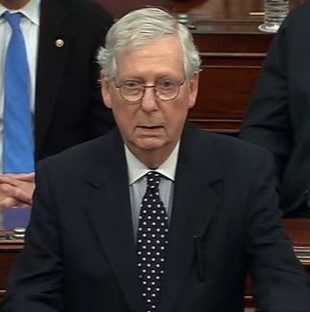
McConnell speaks against Electoral College challenge on Senate floor
“We cannot simply declare ourselves a national board of elections on steroids,” McConnell said. “If this election were overturned by mere allegations from the losing side, our democracy would enter a death spiral.”
“We’d never see the whole nation accept an election again. Every four years it would be a scramble for power at any cost.”
McConnell also decried the current level of contention in American politics, saying “we cannot keep drifting apart into two separate tribes with a separate set of facts and separate reality, with nothing in common except our hostility toward each other and distrust for the few national institutions that we all still share.”
McConnell’s remarks came less than an hour before the Senate had to be evacuated after pro-Trump protestors breached the Capitol.
In words that proved prescient, McConnell said, “I will not pretend such a vote will be a harmless protest gesture while relying on others to do the right thing.”
McConnell said he supported President Donald Trump’s right to use the legal system to challenge the election results, “but over and over, courts rejected these claims, including all-star judges whom the president himself has nominated.”
His remarks came on the day after Democrats appear to have won two U.S. Senate runoff races in Georgia, which will cost him his post as majority leader once both of those votes are confirmed.
McConnell, who was re-elected in November to a seventh term, called Wednesday’s vote “the most important vote I’ve ever cast” during his 36 years as a senator.
His remarks came during a debate triggered when Trump supporters in the House objected to certifying Arizona’s electoral votes and were joined by Texas Republican U.S. Senator Ted Cruz.
The session in both houses was suspended after protestors breached security and entered the U.S. Capitol building.
We tweet @ChkFriPolitics Join us!

The night the GOP’s lights went out in Georgia: Democrats gain Senate control
Democrats Raphael Warnock and Jon Ossoff defeat Republican U.S. Senators Kelly Loeffler and David Perdue
♦By Rich Shumate, ChickenFriedPolitics.com editor
 ATLANTA (CFP) — Democrats Raphael Warnock and Jon Ossoff won Georgia’s two hotly contested U.S. Senate runoffs Tuesday, handing Democrats control of the U.S. Senate and removing a significant impediment to President-elect Joe Biden’s legislative agenda.
In the last act of a long and contentious political season, Warnock — the senior pastor of Atlanta’s iconic Ebenezer Baptist Church who was making his political debut — defeated Republican U.S. Senator Kelly Loeffler, leading by about 564,000 votes, or margin of 50.3% to 49.3%.
Ossoff defeated U.S. Senator David Perdue by a smaller 25,000-vote margin, or 50.3% to 49.7%, a sweep of both races in a state that had not elected a Democrat to the Senate in 20 years.

Jon Ossoff and Raphael Warnock, D-Georgia
In a victory video posted on his campaign website, Warnock said “we were told that we couldn’t win this election, but tonight, we proved that with hope, hard work and the people by our side, anything is possible.”
“I am going to the Senate to work for all of the people of Georgia, no matter who you cast your vote for in this election.”
Warnock will make history as the first African American ever elected to the U.S. Senate from Georgia.
Loeffler, the multimillionaire Atlanta businesswoman appointed to the Senate last year by Republican Governor Brian Kemp, did not concede during brief remarks to her supporters, who gathered in person Tuesday night despite the COVID-19 pandemic: “We have a path to victory, and we’re staying on it.”
In a video post Wednesday morning, Ossoff, who narrowly lost a U.S. House race in 2017, thanked supporters and said he would focus on fighting the coronavirus pandemic once he gets to Washington.
“This campaign has been about health and jobs and justice for the people of this state,” said Ossoff, who, at 33, will become the youngest person to serve in the Senate in the last 40 years. “They will be my guiding principles as I serve this state in the U.S. Senate.”
Perdue’s campaign released a statement saying that “this exceptionally close election that will require time and transparency to be certain the results are fair and accurate.”
“We will mobilize every available resource and exhaust every legal recourse to ensure all legally cast ballots are counted,” the statement said. “We believe in the end, Senator Perdue will be victorious.”
However, Ossoff’s margin was more than twice as large as Biden’s win in November, which held up through two recounts.
Perdue, who was seeking a second term, had been in quarantine and off the campaign trail in the closing days of the race after a campaign staffer tested positive for COVID-19.
Tuesday’s results are yet another electoral rebuke to President Donald Trump, who lost Georgia in November and roiled the Senate runoffs with unsubstantiated claims of fraud and biting criticism of Kemp and Secretary of State Brad Raffensperger, who refused to validate Trump’s fraud allegations.
The Senate will be split 50-50 between Democrats and Republicans, with Vice President-elect Kamala Harris breaking the tie to give Democrats control.
Senate Majority Leader Mitch McConnell of Kentucky will lose his leadership perch, although he will remain as minority leader in a Senate divided 50-50.
With Senate control on the line, the four candidates and outside groups poured more than $882 million into the races — about $83 for every man, woman and child in the state.
The unprecedented spectacle of two Senate runoff elections on the same day in Georgia was the result of a Senate vacancy and an unusual feature of state law that requires candidates in general elections to secure an outright majority to win.
Loeffler was appointed to the Senate last year by Kemp to replace Johnny Isakson, who retired due to ill health. That triggered a special election to fill the two remaining years in Isakson’s turn, which featured an all-party contest in November in which the top two vote-getters — Warnock and Loeffler — won spots in a runoff.
Perdue defeated Ossoff in November’s vote but narrowly missed winning an outright majority, which Georgia law uniquely requires. So the two men faced each other again Tuesday.
With the Democratic victories in Georgia, the number of senators representing Southern states will rise from three to five, compared with 23 Republicans.
We tweet @ChkFriPolitics Join us!

Georgia runoffs will decide control of U.S. Senate Tuesday
President Donald Trump, President-elect Joe Biden both rally the Peach State faithful on campaign’s closing day
♦By Rich Shumate, ChickenFriedPolitics.com editor
ATLANTA (CFP) — With control of the U.S. Senate and the legislative prospects of the incoming Biden administration hanging in the balance, voters across Georgia will go to the polls Tuesday to decide two U.S. Senate runoffs, after both President Donald Trump and President-elect Joe Biden made last-minute appeals to supporters Monday.
Republican U.S. Senator David Perdue faces Democrat Jon Ossoff, a documentary filmmaker and former congressional aide. In the other race, Republican U.S. Senator Kelly Loeffler faces Democrat Raphael Warnock, senior pastor of Atlanta’s famed Ebenezer Baptist Church making his first bid for elected office.

From top left: Ossoff, Perdue, , Loeffler, Warnock
In-person polling runs from 7 a.m. to 7 p.m. ET Tuesday, although more than 3 million people have already cast their ballots through early and absentee voting.
If Ossoff and Warnock win, the Senate will be split 50-50 between Democrats and Republicans, with Vice President-elect Kamala Harris breaking the tie to give Democrats control.
If either Loeffler or Perdue win, Republicans will control the upper chamber, giving them a check against Biden’s legislative program and approval of his nominees.
With Senate control on the line, the four candidates and outside groups have poured more than $882 million into the races — about $83 for every man, woman and child in the state.
Biden emphasized the unusual impact that voters in a single state can have during an address to a rally Monday in Atlanta, where he told Peach State supporters that they “can chart the course not just for the next four years but for the next generation.”
“Georgia — the whole nation is looking to you,” Biden said. “The power is literally in your hands, unlike any time in my career.”
The president-elect spent most of his 16-minute speech touting Ossoff and Warnock, saying their election will help move coronavirus relief through Congress, “restoring hope and decency and honor for so many people who are struggling right now.”
He also had harsh words for what he termed the Trump’s administration’s “God-awful” rollout of COVID-19 vaccines, using the issue to take a swipe a Trump for his singular focus on election fraud claims since his loss in November.
“The president spends more time whining and complaining than doing something about the problem,” Biden said. “I don’t know why he still wants the job. He doesn’t want to do the work.”
Trump, in what was likely the last campaign rally of his presidency, spent much of his 80-minute speech in Dalton relitigating his November election loss and railing against what he termed a “rigged” process in Georgia, where he lost after the vote was recounted twice.
He also promised that he would produce new information that would change the election outcome and gave a lengthy recitation of fraud allegations that have been repeatedly rejected by elections officials in several states and in every court where lawsuits have been filed.
Trump also cast the consequences of Tuesday’s vote in Georgia in apocalyptic terms, casting Ossoff and Warnock as radical socialists who don’t reflect Georgia values.
“The stakes of this election should not be higher,” Trump said. “The radical Democrats are trying to capture Georgia’s Senate seats so they can wield unchecked, unrestrained absolute power over every aspect of your lives.”
Hanging over the last day of the campaign was a controversial phone call Trump made to Georgia’s Republican Secretary of State Brad Raffensperger, a recording of which was obtained by the news media on Saturday.
In it, the president asks the state’s top election official to “find” more than 11,000 votes to flip Georgia into his column; a local prosecutor in Atlanta says she is looking at possible criminal charges.
Neither Biden or Trump brought up the phone call in his speech, but Trump took a shot at both Raffensperger and Republican Governor Brian Kemp, who has also refused the president’s entreaties to overturn the Georgia election results.
“I’m going to be here in a year and a half, and I’m going to campaign against your crazy governor and secretary of state,” Trump said.
Also looming over Tuesday’s vote is an effort by Republicans in Congress to challenge Biden’s Electoral College win on Wednesday, turning what is normally a ceremonial event into a last-ditch effort to prevent Biden from winning the White House.
Hours before the Dalton rally with Trump, Loeffler finally announced the she would back the challenge, after refusing to take a position for several days. Perdue also said he backs the challenge, although, because his Senate term ended when the new Congress convened on Sunday, he will not vote on it.
Taking the stage next to Trump, Loeffler told the crowd that “this president fought for us. We’re going to fight for him.”
But during his speech in Atlanta, Biden hit both senators for taking a stand that he said was in defiance of the Constitution.
“You have two senators who think their loyalty is to Trump, not to Georgia,” Biden said. “You have two senators who think they’ve sworn an oath to Donald Trump, not to the United States Constitution.”
In his speech, Trump also alluded to the fact that Vice President Mike Pence will preside over the session Wednesday where the Electoral College votes will be counted.
“I hope Mike Pence comes through for us,” he said, then joked that “of course, if he doesn’t come through, I won’t like him as much.”
The unprecedented spectacle of two Senate runoff elections on the same day in Georgia is the result of a Senate vacancy and an unusual feature of state law that requires candidates in general elections to secure an outright majority to win.
Loeffler was appointed to the Senate last year by Kemp to replace Johnny Isakson, who retired due to ill health. That triggered a special election to fill the two remaining years in Isakson’s turn, which featured an all-party contest in November in which the top two vote-getters — Warnock and Loeffler — won spots in a runoff.
Perdue, running for a second term, defeated Ossoff in November’s vote but narrowly missed winning an outright majority, which Georgia law uniquely requires. So the two men are facing each other again Tuesday.
Perdue has been off the campaign trail in quarantine after a staffer tested positive for COVID-19 last week, and he did not appear with Trump at Monday’s night rally.
The four candidates in the race have, combined, raised more than $445 million, with outside groups adding at least another $437, according to figures from OpenSecrets.org.
We tweet @ChkFriPolitics! Join us

25 new Southern U.S. House members, 2 senators sworn in Sunday
Freshmen group includes youngest member in nearly 60 years, wave of Republican women
♦By Rich Shumate, ChickenFriedPolitics.com editor
WASHINGTON (CFP) — Members of the new 117th Congress will be sworn into office on Sunday, including 25 new Southern U.S. House members and two new Southern senators.
The Southern House freshmen include seven Republican women, part of a wave elected in November that more the doubled the number of GOP women in the chamber, and 25-year-old Madison Cawthorn of North Carolina, who is the youngest member of the House sworn in since 1965.
Also among the new Southern House members is former White House doctor Ronny Jackson, whom President Donald Trump tried unsuccessfully to elevate to Veterans Affairs secretary in 2018. He will represent now represent the Texas Panhandle.
Republican Stephanie Bice from Oklahoma City is making history as the first Iranian-American to serve in Congress. Her father emigrated from Iran in the 1970s.
Byron Donalds, the new member representing Southwest Florida, will be one of just two African American Republicans in the House and three in Congress overall.
Full list of new Southern House members at bottom of story
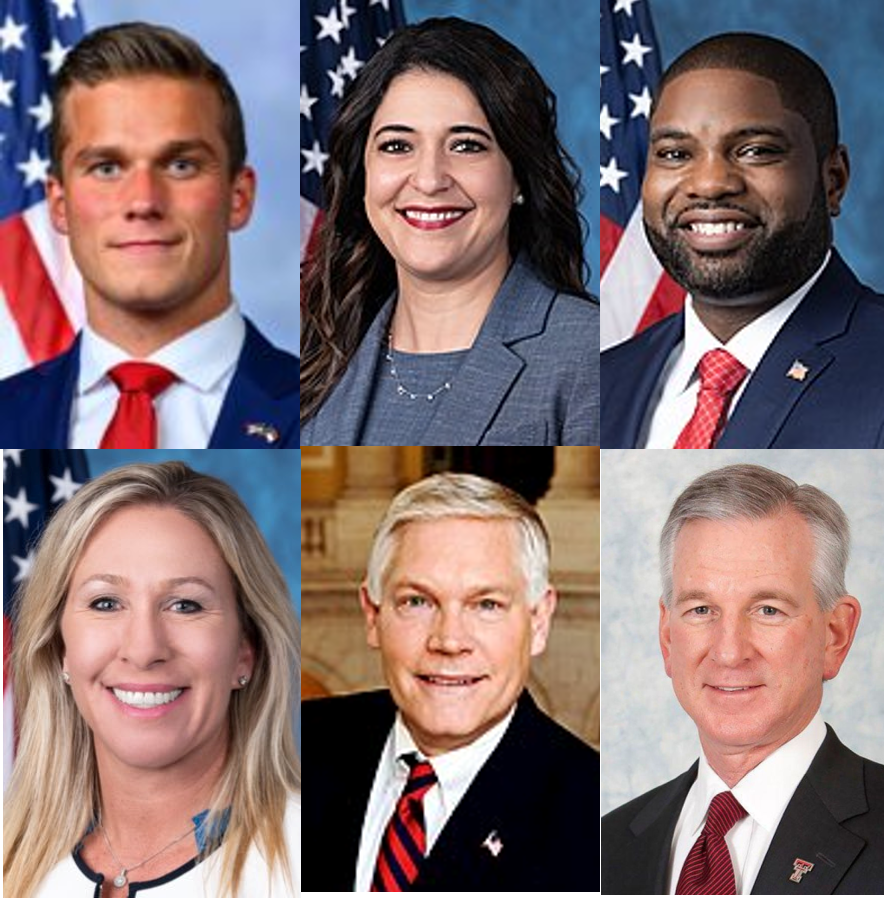
Clockwise from top left: Cawthorn, Bice, Donalds, Tuberville, Sessions, Greene
In the Senate, Tommy Tuberville, R-Alabama, and Bill Hagerty, R-Tennessee, will join a Southern contingent that now includes 25 Republicans and just three Democrats, after Tuberville defeated Doug Jones in November.
Lawmakers were sworn in during a rare Sunday session because the Constitution prescribes January 3 as the date for opening a new Congress.
Sunday’s House session is scheduled to include a moment of silence for Republican U.S. Rep.-elect Luke Letlow of Louisiana, who died from COVID-19 days before he was set to be sworn in.
While both the House and Senate were observing coronavirus precautions, including masks and social distancing, one new member from Georgia, Marjorie Taylor Greene, was spotted on the floor without a mask, prompting admonishment by House staff.
During orientation for new members, she had dismissed masks — which are required on the House floor — as “oppressive.”
Among the new members sworn in Sunday was one very familiar face — Republican Pete Sessions of Texas, who served 11 terms in the House before being defeated in 2018, then claiming a seat from a different district in November.
Sessions and Jackson are part of a group of seven new members from Texas, marking a turnover in nearly a fifth of the Lone Star State’s delegation amid a wave of retirements. All are Republicans.
Florida has five new members; Georgia, four; North Carolina, three; and Alabama, two. Oklahoma, South Carolina, Tennessee and Virginia each have one new member. Delegations from Arkansas, Kentucky, Mississippi and West Virginia were unchanged.
Eleven of the 25 new Southern members are women (seven Republicans and four Democrats), part of the largest group of women (121) ever sworn into a single Congress. The new Congress will also feature a record number of Republican women at 29, up from 13 in the last Congress.
The service of one Southern House member in the 117th Congress will be brief — Cedric Richmond, a New Orleans Democrat who will leave to become a senior aide to President-elect Joe Biden once he is sworn in on January 20.
Special elections will be held in Louisiana for Richmond and Letlow’s seats in March; neither are expected to change hands between parties.
The Constitution requires members of the House to be at least 25 years of age, a threshold Cawthorn met in August after winning the Republican primary in his Western North Carolina district. He will be the youngest House member since Jed Johnson Jr., a Democrat who represented Oklahoma for a single term between 1965 and 1967.
Sessions represented a Dallas-area seat during his first stint in the House, which he lost in 2018 to Collin Allred. Rather than try to reclaim it in 2020, he ran in a vacant seat in a district that includes Waco, where he grew up.
Of the 25 new Southern members, 21 were Republicans and just four were Democrats. Overall, Republicans hold 99 Southern seats and Democrats 52, with Letlow’s seat vacant.
Four Southern states — Arkansas, Oklahoma and West Virginia — have no Democrats in their House delegations, while five others — Alabama, Kentucky, Louisiana, Mississippi and South Carolina — have just one.
In only one Southern state do Democrats hold a majority of seats, Virginia, which is sending seven Democrats and only four Republicans to Washington.
Here is a list of new Southern House members, by state:
Alabama
Jerry Carl, R, 1st District (Mobile, South Alabama)
Barry Moore, R, 2nd District (Montgomery, southwest Alabama)
Florida
Kat Kammack, R, 3rd District (Gainesville, North-Central Florida)
Scott Franklin, R, 15 District (Lakeland, eastern Tampa suburbs)
Byron Donalds, R, 19th District (Fort Myers, Southwest Florida)
Carlos Giménez, R, 26th District (south Miami-Dade, Florida Keys)
Maria Elvira Salazar, R, 27th District (Miami-Dade)
Georgia
Nikema Williams, D, 5th District (Atlanta)
Carolyn Bourdeaux, D, 7th District (northeast Atlanta suburbs)
Andrew Clyde, R, 9th District (Gainesville, Northeast Georgia)
Marjorie Taylor Greene, R, 14th District (Rome, Northwest Georgia)
North Carolina
Deborah Ross, D, 2nd District (Raleigh)
Kathy Manning, D, 6th District (Greensboro)
Madison Cawthorn, R, 11th District (Western North Carolina)
Oklahoma
Stephanie Bice, R, 5th District (metro Oklahoma City)
South Carolina
Nancy Mace, R, 1st District (Charleston, Low Country)
Tennessee
Diana Harshbarger, R, 1st District (Tri-Cities, East Tennessee)
Texas
Pat Fallon, R, 4th District (Northeast Texas)
August Pfluger, R, 11th District (Midland, San Angelo, west-central Texas)
Ronny Jackson, R, 13th District (Amarillo, Wichita Falls, Panhandle)
Pete Sessions, R, 17th District (Waco, central-east Texas)
Troy Nehls, R, 22nd District (western Houston suburbs)
Tony Gonzales, R, 23rd District (West Texas)
Beth Van Duyne, R, 24th District (metro Dallas-Forth Worth)
Virginia
Bob Good, R, 5th District (Charlottesville, central Virginia)

 Chicken Fried Politics