
Latest Posts
Latest Coverage
-
Symbolic solution in search of an actual problem
Support of 9 Southern Republicans for Respect for Marriage Act shows why Supreme Court isn’t about to ban same-sex marriage ♦By Rich Shumate, ChickenFriedPolitics.com editor…
-

West Virginia stubborn, or playing hard to get
U.S. Senator Joe Manchin pisses off his party yet again … to what end? ♦By Rich Shumate, ChickenFriedPolitics.com editor Also in this report: Atlanta DA…
-

2 Mississippi Republican U.S. House members forced into runoffs after weak primary showings
Michael Guest narrowly trails challenger in 3rd District; Steven Palazzo clears just 32% in 4th District ♦By Rich Shumate, ChickenFriedPolitics.com editor JACKSON, Mississippi (CFP) –…
-

Mississippi Republican U.S. Rep. Steven Palazzo facing Tuesday primary fight amid ethics investigation
6 opponents hitting “No-Show Palazzo” over inattention to district, ethics problems ♦By Rich Shumate, ChickenFriedPolitics.com editor GULFPORT (CFP) — Mississippi U.S. Rep. Steven Palazzo —…
-

Primary Wrap: Kemp, Raffensperger survive Trump’s ire; Brooks makes Alabama U.S. Senate runoff
Texas Democratic U.S. Rep. Henry Cuellar survives challenge from the left; George P. Bush gets blown out by Attorney General Ken Paxton ♦By Rich Shumate,…
-

U.S. House’s last pro-life Democrat, Texas’s Henry Cuellar, fighting to keep seat in Tuesday primary runoff
Challenger Jessica Cisneros wanted House Democratic leaders to rescind Cuellar endorsement; they refused ♦By Rich Shumate, ChickenFriedPolitics.com editor LAREDO, Texas (CFP) — Amid the newly…

Outgoing GOP U.S. Rep. Mark Walker launches 2022 U.S. Senate run in North Carolina
Walker is first Republican candidate in race to replace retiring U.S. Senator Richard Burr
♦By Rich Shumate, ChickenFriedPolitics.com editor
 GREENSBORO, North Carolina (CFP) — With the dust still settling from November’s election, Republican U.S. Rep. Mark Walker has jumped into next campaign season by announcing he will run for North Carolina’s open U.S. Senate seat in 2022.
Walker opened his campaign December 1 with a video featuring endorsements from leaders around the state and Mike Huckabee, the former Arkansas governor and conservative talk show host. Walker said he was running “because serving others is my life, and I have the experience to fight and to win in Washington.”

U.S. Rep. Mark Walker, R-North Carolina
“Washington has lost its mind. Job killing regulations, the Green New Deal, defund the police, end our military — seriously?” Walker said. “I’m proud of my record taking on the radicals as well as the establishment.”
Watch video of Walker’s announcement below
Walker, 51, from Greesboro, was a Southern Baptist pastor before his election to Congress. He has represented the 6th U.S. House District since 2015 but did not seek re-election in November after a court-ordered redraw of the state’s congressional districts made his district more Democratic.
Earlier this year, he considered a primary challenge against U.S. Senator Thom Tillis but eventually decided against it. Tillis was re-elected in November.
The seat Walker is seeking will be open in 2022 because incumbent Republican U.S. Senator Richard Burr has announced his retirement.
Given the Tar Heel State’s partisan competitiveness, the race will likely be one of the most hotly contested and expensive battles of the 2022 cycle and a top Democratic target. However, a Democrat has not won a Senate election in North Carolina since 2008.
Among the names being mentioned as possible Republican candidates are Lara Trump, the president’s daughter-in-law, who grew up in North Carolina; Lieutenant Governor Dan Forest, who lost in November’s governor’s race; and former Governor Pat McCrory.
Among Democrats, Governor Roy Cooper will likely face pressure from Senate Democratic leaders to make a run but has not indicated he is considering it. Erika Smith, who ran unsuccessfully for the Democratic Senate nomination this year, is the party’s only announced candidate so far.
Watch video of Walker’s announcement
We tweet @ChkFriPolitics Join us!
2020 Overtime: Runoffs in 2 Georgia U.S. Senate races will decide party control
Democrats face uphill battle in flipping both Georgia seats in January 5 vote
♦By Rich Shumate, ChickenFriedPolitics.com editor
 ATLANTA (CFP) — Attention, Georgians: Prepare to have your Thanksgiving interrupted by politics. And your Christmas. And your New Year’s.
Runoffs will be held January 5 for both of the Peach State’s U.S. Senate seats, with party control of the Senate hanging in the balance, which will nationalize these contests and draw an avalanche of money and advertising.
If Democrats win both runoffs, the party will control the White House and both the U.S. House and Senate starting next January 20. If Republicans win just one, Senate Majority Leader Mitch McConnell will remain large and in charge — and standing in their way.
The stakes were summarized by one of the Republicans defending a Georgia seat, Kelly Loeffler, on Twitter after networks projected Joe Biden as the winner of the presidential contest: She said she and Republican seatmate David Perdue “are the last line of defense against the radical left.”

Jon Ossoff and David Perdue
Perdue defeated his Democratic challenger, Jon Ossoff, on election night, but fell just below the 50% threshold he needed to win the seat outright and avoid a runoff. (Georgia is the only state in the country that requires candidates to win a majority in a general election.)
In a special election to fill out the remainder of Republican Johnny Isakson’s term, Loeffler, who was appointed to the seat last year, faces Democrat Raphael Warnock, the senior pastor of Atlanta’s historic Ebenezer Baptist Church making his political debut.
The runoffs take on additional importance now that Democrat Kamala Harris has been elected as vice president. Currently, the Senate Republican caucus has 50 members, the Democratic caucus, 48. If Democrats win both Georgia seats, the balance in the chamber will stand at 50-50; Harris, in her role as president of the Senate, will give Democrats control.
However, Democrats will have an uphill battle in both runoff races.
Perdue came in nearly 93,000 votes ahead of Ossoff in the November 3 vote, which the Democrat will have to find a way to make up in what is likely to be a much smaller electorate in January.

Raphael Warnock and Kelly Loeffler
In the special election, which had 20 candidates running in the first round, Warnock held a 140,000-vote lead over Loeffler. However, the six Republican candidates in the race drew nearly 415,000 more votes combined than the eight Democrats.
Over the last 30 years, Republicans have won six of the seven statewide general election runoffs, including two in 2018. Democrats lost runoffs for U.S. Senate in 1992 and 2008, contests where their candidates had finished in first place in the first round.
Meeting with a group of supporters Friday, Ossoff expressed confidence he could turn the vote around.
“We have all the momentum. We have all the energy. We’re on the right side of history,” he said. “We’re just getting started.”
But Perdue’s campaign manager, Ben Fry, expressed similar confidence, saying “If overtime is required when all of the votes have been counted, we’re ready, and we will win.”
He also took a dig at Ossoff, who lost a runoff for a U.S. House seat in 2017, noting that “[t]here’s only one candidate in this race who has ever lost a runoff, and it isn’t David Perdue.”
Speaking to her supporters on election night, Loeffler made it clear that she will cast the election as a battle between “conservative values” and the “radical left.”
“In January, I have one of the most radical opponents on the Democrat ticket in the whole country,” she said.
But Warnock, like Ossoff, is touting himself as a sign that Georgia politics have changed, an argument that could take on new resonance if Biden secures the state’s 16 electoral votes after an impending recount.
“Something special and transformational is happening right here in Georgia,” he said. “The people — everyday people, ordinary people — are rising up, and they are demanding change.”
We tweet @ChkFriPolitics Join us!
Decision 2020: Georgia’s presidential contest heading to a recount
Joe Biden pulls slightly ahead of Donald Trump in Peach State
♦By Rich Shumate, ChickenFriedPolitics.com editor
 ATLANTA (CNN) — With unofficial results within 7,300 votes, Georgia election officials said Friday they will recount the ballots in the state’s presidential contest between President Donald Trump and Democrat Joe Biden.
“Interest in our election obviously goes far beyond Georgia’s borders,” said Republican Secretary of State Brad Raffensburger. “The final tally in Georgia at this point has huge implications for the entire country.”
Trump built a significant lead as results of in-person voting came in on election night. But as mail-in ballots were counted in Democratic counties in metro Atlanta, Biden closed the gap and then surpassed the president.
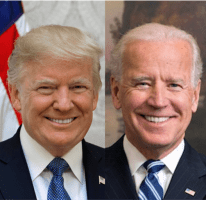
Trump, Biden neck-and-neck in Georgia results
Saturday, Biden’s lead stood at just 7,264 votes, out of nearly 5 million cast, a close enough margin to trigger an automatic recount.
If Biden prevails in the recount, he will be the first Democrat in 28 years to carry the Peach State and win its 16 electoral votes.
However, the result in Georgia will not affect the outcome of the presidential race, as Biden captured the White House when Pennsylvania was declared on Saturday.
While the Trump campaign has vowed to pursue legal challenges in other Democrat-controlled states that he appears to have lost, that could be more difficult in Georgia, where the governor and secretary of state are both Republicans. The state’s voting manager, Gabriel Sterling, said Friday that “we’re not seeing any widespread irregularities” in the vote count.
In addition to the presidential race, the late count of mail-in ballots also affected one of the two U.S. Senate races. Republican incumbent U.S. Senator David Perdue still leads over his Democratic rival, Jon Ossoff, but he has fallen below the majority he needs to win under state law.
That will set up a January 5 runoff between Perdue and Ossoff, which will take place at the same time as a special election runoff for the state’s other Senate seat between Democrat Ralphael Warnock and incumbent Republican U.S. Senator Kelly Loeffler.
If Biden wins the presidency and both Democrats win in Georgia, control of the Senate will shift from Republican to Democratic hands.
We tweet @ChkFriPolitics Join us!
Decision 2020: Democrats’ Lone Star hopes dashed as they come up bone dry in Texas
Dreams of turning Texas purple subsumed in a red wave in Tuesday’s vote
♦By Rich Shumate, ChickenFriedPolitics.com editor
 AUSTIN (CFP) — Heading into Tuesday’s election, Texas Democrats were hopeful that 2020 would finally be the year that the Lone Star State would turn purple.
They had targeted 10 U.S. House seats and had hopes of flipping a U.S. Senate seat and grabbing control of the state House — and perhaps even winning the state’s presidential electoral votes for the first time since 1976.
Exactly none of that happened.

U.S. Senator John Cornyn, R-Texas, re-elected
President Donald Trump carried Texas by 6 points; U.S. Senator John Cornyn won by 10 points over Democrat MJ Hegar; none of the targeted U.S. House incumbents lost; and the balance of power in the Texas House will be about where it was before the election began.
The only bright spot for Democrats was that they kept the two U.S. House seats they flipped in 2018, as Collin Allred won re-election in Dallas, and Lizzie Fletcher won in Houston.
Perhaps nothing symbolized Democrats’ night of woe as much as what happened in the 23rd U.S. House District, which stretches across a vast expanse of West Texas from San Antonio toward El Paso.
This district is always hard fought, changing hands four times in the last 20 years. Two years ago, Republican Will Hurd won it by a mere 926 votes over Democrat Gina Ortiz Jones.
After Hurd retired, Ortiz Jones ran again and was expected to pick up the seat. But she lost to Republican Tony Gonzales by 9,300 votes, a worse showing than two years ago.
Democrats had also expected to pick up the Dallas-area seat that had been held by Kenny Marchant, but former Irving Mayor Beth Van Duyne appears to have won a narrow victory over Democrat Candace Valenzuela, although the race has yet to be called.
Valenzuela had attracted national attention after winning the Democratic primary, picking up endorsements from Joe Biden, Barack Obama and Kamala Harris.
Republican House incumbents who survived included Mike McCaul in central Texas (+7), Van Taylor in the northern Dallas suburbs (+12), Chip Roy in the Austin suburbs (+7), Dan Crenshaw in Houston (+14), Ron Wright in suburban Dallas (+9), Roger Williams in metro Austin (+14) and John Carter in the northern Austin suburbs (+9).
Roy’s victory was particularly sweet for Republicans, as he defeated former Democratic State Senator Wendy Davis, who gained a national following in 2013 after filibustering to kill a bill restricting legal abortion, which she parlayed into an unsuccessful run for governor in 2014.
Davis moved from Fort Worth to Austin to run against Roy and raised nearly $9 million. But in the end, it was not enough to overcome Texas’s Republican tendencies.
Which was the story of the night for Texas Democrats.
We tweet @ChkFriPolitics Join us!
Decision 2020: Republicans’ red wall holds across the South
Though Joe Biden appears to have carried Georgia, Democrats failed to make gains in U.S. Senate, House
♦By Rich Shumate, ChickenFriedPolitics.com editor
 (CFP) — Republican political dominance across the South largely held up in Tuesday’s election, winning 12 states in the presidential race, most of the contested U.S. Senate contests, and taking down four U.S. House Democratic freshmen who had flipped seats in 2018.
However, Democratic presidential nominee Joe Biden holds a small lead in Georgia, pending a recount, and carried Virginia.
Republican incumbents appeared to have held on to Senate seats in Texas, Kentucky, and South Carolina and North Carolina, as well as flipping a seat in Alabama, where Democratic U.S. Senator Doug Jones lost to Republican Tommy Tuberville.
Two Senate seats in Georgia will be heading to January 5 runoffs. Republican incumbent David Perdue won a plurality against Democrat Jon Ossoff but not the majority he needed to avoid a runoff. In the other race, incumbent Republican Kelly Loeffler will face Democrat Raphael Warnock.
Among the GOP senators who will return are two who were prime targets for Democrats — Senate Majority Leader Mitch McConnell, who won a seventh term in Kentucky, and U.S. Senator Lindsey Graham, who won in South Carolina despite more than $100 million spent to defeat him by his Democratic opponent, Jaime Harrison.
McConnell defeated Democrat Amy McGrath by 20 points; Graham beat Harrison by 22.
Incumbents won both of the governor’s races in the South: Democrat Roy Cooper won in North Carolina and Republican Jim Justice won in West Virginia.
Republicans also retook several U.S. House seats that Democrats had won in 2018, ousting U.S. Reps. Debbie Mucarsel-Powell and Donna Shalala in Florida; Joe Cunningham in South Carolina; and Kendra Horn in Oklahoma.
Mucarsel-Powell and Shalala, whose districts are in based in metro Miami-Dade, were swept up in a Republican wave of Cuban-American voters, who were also key to Trump’s victory in the Sunshine State.
Republican Tony Gonzales also picked up an open GOP-held seat in West Texas, defeating Democrat Gina Ortiz Jones
The news was better in Georgia, where Democrat Lucy McBath kept her seat in the northwest Atlanta suburbs and and Democrat Carolyn Bourdeaux was leading in a Republican-held district in the northeast suburbs.
In the Hampton Roads area of Virginia, Democrat Elaine Luria also kept her seat, and Abigail Spanberger held a small lead in her district in the Richmond suburbs. Democrats also picked up two seats in North Carolina that had become more Democratic after a court-ordered redraw of the state’s map.
But Democrats came up bone dry in Texas, where they had targeted 10 seats and lost them all. They also failed to flip targeted seats in North Carolina, Florida and Arkansas.
Overall across the South, Democrats lost a net of two seats, which would put the balance of power at 103 Republicans and 48 Democrats.

 Chicken Fried Politics