
Latest Posts
Latest Coverage
-
Symbolic solution in search of an actual problem
Support of 9 Southern Republicans for Respect for Marriage Act shows why Supreme Court isn’t about to ban same-sex marriage ♦By Rich Shumate, ChickenFriedPolitics.com editor…
-

West Virginia stubborn, or playing hard to get
U.S. Senator Joe Manchin pisses off his party yet again … to what end? ♦By Rich Shumate, ChickenFriedPolitics.com editor Also in this report: Atlanta DA…
-

2 Mississippi Republican U.S. House members forced into runoffs after weak primary showings
Michael Guest narrowly trails challenger in 3rd District; Steven Palazzo clears just 32% in 4th District ♦By Rich Shumate, ChickenFriedPolitics.com editor JACKSON, Mississippi (CFP) –…
-

Mississippi Republican U.S. Rep. Steven Palazzo facing Tuesday primary fight amid ethics investigation
6 opponents hitting “No-Show Palazzo” over inattention to district, ethics problems ♦By Rich Shumate, ChickenFriedPolitics.com editor GULFPORT (CFP) — Mississippi U.S. Rep. Steven Palazzo —…
-

Primary Wrap: Kemp, Raffensperger survive Trump’s ire; Brooks makes Alabama U.S. Senate runoff
Texas Democratic U.S. Rep. Henry Cuellar survives challenge from the left; George P. Bush gets blown out by Attorney General Ken Paxton ♦By Rich Shumate,…
-

U.S. House’s last pro-life Democrat, Texas’s Henry Cuellar, fighting to keep seat in Tuesday primary runoff
Challenger Jessica Cisneros wanted House Democratic leaders to rescind Cuellar endorsement; they refused ♦By Rich Shumate, ChickenFriedPolitics.com editor LAREDO, Texas (CFP) — Amid the newly…

Insight: What do 2019’s election results in the South tell us about 2020?
Wins in Kentucky and Louisiana aren’t nirvana for Democrats, but they do show limits to GOP strategy of socialist pigeonholing
♦By Rich Shumate, ChickenFriedPolitics.com editor
 Now that the dust has cleared from elections in four Southern states earlier this month, what are the lessons, if any, for 2020 elections in which both the presidency and control of Congress will be on the line?
Some pundits in the chattering class and Democratic politicians have looked at victories by Democrats in governor’s races in deep red Kentucky and Louisiana and gleefully found evil portends for their GOP rivals next year.
That would be overreach.

Editor Rich Shumate
In Kentucky, Democrat Andy Beshear won because the Republican incumbent, Matt Bevin, was as popular as a skin rash after four years of gratuitous insults and irritation. In Louisiana, Democratic incumbent John Bel Edwards — that rarest of creatures, a pro-life Democrat — had strong job approval numbers and ran as far away as he could from the Elizabeth Warrens and Alexandria Ocasio-Cortezes in his party.
Trump couldn’t push Republicans over the finish line in either race, but Republicans carried all of the other statewide contests in both states and had a clean sweep in of state offices in Mississippi. So it would be a mistake to see these Democratic wins as a referendum on Trump, and Democrats shouldn’t find much solace in what was otherwise a rather dismal showing.
Still, the wins by Beshear and Edwards showed that the Republican strategy of calling Democrats socialists and ginning up the faithful with Trump rallies has its limits, even in states that the president carried by more than 20 points. In states with more even strength between the parties — Florida, Georgia, Texas, and North Carolina — that strategy could be even less effective next year, particularly at the presidential level and in U.S. Senate races in the latter three states.
What should be of more concern to Republicans is the fact that the Democratic vote in cities and suburban areas was unusually strong and decidedly Democratic in 2019, mirroring a trend seen in 2018 when Democrats took control of the U.S. House.
Beshear won in Kentucky by carrying Louisville and Lexington and their suburbs by a margin of 135,000 votes, swamping Republican margins in the rest of the state. In Louisiana, Edwards won by carrying Baton Rouge, Shreveport and New Orleans by almost 165,000 votes, including winning almost 90 percent of the vote in Orleans Parish and carrying suburban Jefferson Parish — home of House GOP Whip Steve Scalise — by 14 points.
The news for Republicans was even worse in Virginia, where Democrats took control of both houses of the legislature — in elections that used maps drawn by Republicans to protect Republicans — by gaining more ground in the suburbs around Washington, Richmond, and Norfolk. Among the casualties was the last Republican House member representing a district in the inner Washington suburbs, which 20 years ago was undisputed GOP territory.
In 2018, newfound Democratic strength in the suburbs allowed the party to take competitive U.S. House seats in Atlanta, Richmond, Miami, Dallas and Houston — and get surprise wins in Oklahoma City and Charleston. If that trend, also seen in 2019, continues into 2020, it could potentially put more seats into play in Little Rock, Tampa, Lexington, San Antonio and across North Carolina, where a court recently forced Republican legislators to redraw gerrymandered maps.
Over in the Senate, Republicans are defending two seats in Georgia and seats in Texas and North Carolina where Democrats now have a plausible path to victory, if they can push the urban/suburban vote past the pro-Trump margin in small towns and rural areas as they did in 2019. And the eyes of the nation will be on Kentucky, where Senate Majority Leader Mitch McConnell will be defending his seat in the wake of Beshear’s breakthrough.
McConnell’s job approval numbers are 13 points underwater in Kentucky, according to the latest Morning Consult survey, making him one of the nation’s least popular senators. However, McConnell has substantially more political acumen than Bevin and a much better political machine, and he could benefit if he faces a Democrat whom he can pigeonhole as a leftist.
McConnell’s campaign is already taking aim at his only announced Democratic rival, Amy McGrath, who raised $8.6 million in an unsuccessful congressional race in 2018 but started the campaign with an embarrassing flip-flop on whether she would have voted to confirm Brett Kavanaugh to the Supreme Court. (First she said yes, then she said no.)
Rocky Adkins, a folksy, pro-life state legislator from Eastern Kentucky who ran second to Beshear in this year’s gubernatorial primary, is also considering entering the race and could prove a much more slippery target for McConnell’s ad makers.
Democrats need a net gain of four seats to take control of the Senate; three seats will be enough if a Democrat also carries the White House. That task will be very uphill if they don’t make breakthroughs in the South.
In the presidential race, the question will be if any the Democrats in the 2020 field can survive in the South in a binary match-up against Trump and his faithful followers.
Virginia is probably a lock for the Democrats, and Florida and North Carolina are always in play. The wild cards will be Georgia and Texas, where the heavy urban-suburban Democratic vote seen in 2018 and 2019 could make things interesting if it materializes again in 2020. (Trump carried Georgia by just 5 points in 2016; the margin was 9 points in Texas.)
However, it should be noted that if either Beshear or Edwards were in the presidential race, they would be far and away the most conservative candidate in the Democratic field. So could a presidential candidate who is highly likely to be substantially to their left duplicate the success they had locally in 2019, particularly in states where the president remains more popular than he does nationally?
Mmmm … don’t bet the rent.
We tweet @ChkFriPolitics Join us!

Louisiana Democratic Governor John Bel Edwards defeats Republican Eddie Rispone
Edwards’s victory is a blow to Republicans and President Donald Trump after earlier GOP loss in Kentucky
♦By Rich Shumate, ChickenFriedPolitics.com editor
 NEW ORLEANS (CFP) — Louisiana Democratic Governor John Bel Edwards has narrowly won re-election to a second term, defeating Republican Baton Rouge businessman Eddie Rispone.
The win by Edwards in Saturday’s runoff gives Democrats victories in two out of three Southern governor’s races this year, despite fervent interventions in all three races by President Donald Trump in states he carried handily in 2016.
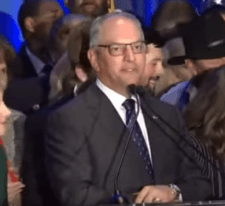
Governor John Bel Edwards speaks to supporters in New Orleans after winning second term (WWL-TV via YouTube)
Edwards took 51 percent of the vote in the runoff to 49 percent to Rispone, one of Louisiana’s wealthiest businessmen who was making his first bid for political office.
“How sweet it is,” Edwards said in his victory speech to supporters at a New Orleans hotel. “You didn’t just vote for me. You voted for four more years of putting Louisiana first.”
Edwards is the first Democrat to win a second term as Louisiana’s chief executive since Edwin Edwards (no relation) won re-election in 1975.
In the other statewide office on the ballot Saturday, Republican incumbent Secretary of State Kyle Ardoin easily defeated Democrat Gwen Collins-Greenup by a margin of 59 percent to 41 percent.
During the first round of voting in October, Edwards took 47 percent of the vote to 27 percent for Rispone, who had tried to close the gap by unifying the Republican vote, which he had split with the third place finisher, U.S. Rep. Ralph Abraham.
Trump — who carried Louisiana by 20 points in 2016 — visited the state three times during the campaign, most recently on Thursday night when he implored a rally in Bossier City that “you’ve gotta give me a big win” by electing Rispone.
Edwards responded to Trump’s involvement in the race with a classic Southern putdown in his victory speech.
“And as for the president — God bless his heart,” Edwards said. “If this campaign has taught us anything, it’s that the partisan forces in Washington, D.C. are not strong enough to break through the bonds that we share as Louisianans.”
Rispone led most of the night as the votes were counted, but Edwards caught and passed him as the vote came in from New Orleans, Baton Rouge, and Shreveport, where the governor rolled up large margins of victory — more than 90 percent in Orleans Parish.
Edwards, 53, is one of just three Democratic governors in the South, along with North Carolina’s Roy Cooper and Virginia’s Ralph Northam. But unlike Northam and Cooper, Edwards has positioned himself as a conservative Democrat who opposes legal abortion and gun control, both of which played well in Louisiana.
As a result, national Democrats, including the large crop of 2020 White House contenders, have conspicuously avoided campaigning on his behalf, although former President Barack Obama did make a robocall for the governor in the first round of the primary.
Louisiana’s governor’s race is the last contest on the 2019 election calendar and comes less than two weeks after Kentucky’s Republican governor, Matt Bevin, was defeated for re-election by Democratic Attorney General Andy Beshear, despite Trump campaigning on Bevin’s behalf.
Republicans had more success in Mississippi, where Republican Lieutenant Governor Tate Reeves won the governorship over Democratic Attorney General Jim Hood.
We tweet @ChkFriPolitics Join us!

Louisiana voters will decide governor’s race in Saturday runoff
Democratic Governor John Bel Edwards is facing Republican Eddie Rispone in quest for second term
♦By Rich Shumate, ChickenFriedPolitics.com
 BATON ROUGE (CFP) — Voters in Louisiana will decide who will hold the state’s governorship for the next four years in a Saturday runoff, with Democratic Governor John Bel Edwards trying to win re-election over Republican Baton Rouge businessman Eddie Rispone.
A win by Edwards in deep red Louisiana would give Democrats victories in two out of three Southern governor’s races this year, handing an embarrassing defeat to Republicans and President Donald Trump, who came to the Pelican State Thursday to campaign for Rispone for the third time.
“You’ve gotta give me a big win, please. OK?” Trump told a crowd in Bossier City, where he said Edwards “double-crossed you and you can never trust him. He will never vote for us.”

Democratic Governor John Bel Edwards will face Republican Eddie Rispone in Nov. 12 runoff
During the first round of voting in October, Edwards took 47 percent of the vote to 27 percent for Rispone. Since then, Rispone has been trying to close the gap by unifying the Republican vote, which he split with the third place finisher, U.S. Rep. Ralph Abraham.
Under Louisiana’s “jungle” primary system, candidates from all parties run together in the same contest, with the top two vote-getters advancing to the runoff if no one gets an outright majority.
Public polling in the governor’s race showed neither candidate with a statistically significant lead, pointing to a likely close result on Saturday.
One other statewide office will be on the ballot Saturday, the secretary of state’s race, where Republican incumbent Kyle Ardoin will face Democrat Gwen Collins-Greenup in a rematch of a 2018 special election won by Ardoin.
Edwards, 53, is one of just three Democratic governors in the South, along with North Carolina’s Roy Cooper and Virginia’s Ralph Northam. But unlike Northam and Cooper, Edwards has positioned himself as a conservative Democrat who opposes legal abortion and gun control, both of which have played well in Louisiana.
As a result, national Democrats, including the large crop of 2020 White House contenders, have conspicuously avoided campaigning on his behalf, although former President Barack Obama did make a robocall for the governor in the first round of the primary.
In 2015, Edwards claimed the governorship by defeating Republican U.S. Senator David Vitter, who was bogged down by personal scandals and the unpopularity of the outgoing GOP governor, Bobby Jindal.
Edwards signature achievements in office have been expanding Medicaid, over Republican objections, and dealing with a budget shortfall he inherited from Jindal.
However, the tax increases imposed to deal with the budget have become fodder for his Republican opponents, who say the new taxes have driven business out of the state.
Rispone, 70, owns an industrial contracting company that has made him one of Louisiana’s richest men. While he has long been a major GOP donor, this is his first race for political office, and he poured in more than $10 million of his own money to surge past Abraham into second place in the first round of voting.
Republicans have pulled out all the stops for Rispone in the runoff, with the Republican National Committee committing more than $2 million to the race. Trump, who carried Louisiana by 20 points in 2016, has visited three times, and Vice President Mike Pence has also campaigned on Rispone’s behalf.
Louisiana’s governor’s race is the last contest on the 2019 election calendar and comes less than two weeks after Kentucky’s Republican governor, Matt Bevin, was defeated for re-election by Democratic Attorney General Andy Beshear, despite Trump campaigning on Bevin’s behalf.
Republicans had more success in Mississippi, where Republican Lieutenant Governor Tate Reeves won the governorship over Democratic Attorney General Jim Hood.
We tweet @ChkFriPolitics Join us!

Kentucky Governor Matt Bevin concedes defeat after recanvass doesn’t change election results
Democrat Andy Beshear’s 5,200-vote lead stands up after review
♦By Rich Shumate, ChickenFriedPolitics.com editor
 FRANKFORT, Kentucky (CFP) — Republican Governor Matt Bevin has conceded defeat in the Kentucky governor’s race after a recanvass of the November 5 vote did not reverse Democratic Attorney General Andy Beshear’s 5,200-vote lead.
“We’re going to have a change in the governorship based on the vote of the people,” Bevin said at a November 14 news conference after the results of the recanvass came in. “I wish Attorney General Beshear well as he transitions to his next role in this state. It’s a big responsibility.”
He also said “every single facet of our administration that is desired is ready, willing and able … to help in this transition process.”

Governor Matt Bevin concedes defeat at news conference (From Louisville Courier-Journal via YouTube)
Bevin had refused to concede on election night, citing unspecified “irregularities” in the election. He asked for a recanvass, in which elections officials in the state’s 120 counties rechecked the accuracy of vote totals that had been reported.
The recanvass showed almost no change in the results in initially reported, which showed Beshear beating Bevin by 5,189 votes out of more than 1.4 million cast.
Ballots were not recounted; the state uses a system where paper ballots are marked and scanned by machines.
Watch Governor Matt Bevin’s concession at end of this story.
Beshear reacted to Bevin’s decision not to further contest the election on Twitter: “It’s official – thank you Kentucky. @GovMattBevin and his team have already begun a smooth transition. It’s time to get to work!”
Bevin’s concession culminates four tumultuous years in Frankfort that featured a bitter feud with public school teachers opposed to the governor’s attempts to fix holes in the state’s pension system. He also quarreled with fellow Republicans in the legislature and tossed his own lieutenant governor, Jenean Hampton, from his re-election ticket; members of his staff then tried to fire Hampton’s staff out from under her.
But Bevin’s most significant battle was against Beshear, who used the attorney generalship to haul the governor into court at least eight times, including a lawsuit that torpedoed a GOP-backed pension reform plan. The race between the two men became acrimonious, with Beshear accusing Bevin of being a bully and Bevin dismissing Beshear as a leftist ideologue.
Bevin wrapped himself in the mantle of President Donald Trump, who came to rally the Republican faithful in Lexington on the night before the election. But even Trump’s coattails — in a state he carried by 30 points in 2016 — couldn’t save a governor who topped the list of the nation’s most unpopular governors through much of his term.
Beshear, 41, who takes office December 10, will be following in the footsteps of his father, Steve Beshear, who served as governor from 2007 until 2015.
His lieutenant governor running mate, Jacqueline Coleman, an public school assistant principal and basketball coach, will take office at the same time. She has announced that she is expecting a child in February.
Beshear and Coleman will be the lone Democrats among statewide elected officials in Kentucky; Republicans swept the remaining five posts, including Attorney General-elect Daniel Cameron, a protegé and former aide to the state’s senior Republican, Senate Majority Leader Mitch McConnell, who will be the first Republican to hold that office in 71 years.
We tweet @ChkFriPolitics Join us!

Jeff Sessions wants his old job back as Alabama U.S. Senator
Sessions files to run in GOP primary to reclaim the seat he gave up to become Donald Trump’s attorney general
♦By Rich Shumate, ChickenFriedPolitics.com editor
 MONTGOMERY (CFP) — In 2017, Jeff Sessions gave up the U.S. Senate seat he had held for 20 years to become President Donald Trump’s first attorney general.
Now, after parting with the president on unhappy terms, Sessions wants that job back — but he’ll have to fight through Trump and a field of Alabama Republicans to get it.
Sessions, 72, who represented Alabama in the Senate from 1997 until 2017, announced November 7 that he will file the paperwork to run for his old seat, which is currently held by Democratic U.S. Senator Doug Jones.

Jeff Sessions announces Senate run on Fox News
“It’s not ‘my seat’ in the Senate, but I believe I have something to give,” Sessions said during an appearance on Tucker Carlson’s Fox News show where he announced his Senate run. “I have some convictions that I think need to be pushed.”
“We need to get some of the Republicans moving. They haven’t been pushing hard enough to advance the Trump agenda,” he said.
Sessions also released a campaign ad which made it clear that he will try to run for the Senate as a pro-Trump candidate, despite his rocky tenure and messy split from the administration.
Watch Jeff Session’s campaign ad at the end of this story.
“When I left President Trump’s Cabinet, did I write a tell-all book? No. Did I go on CNN and attack the president? Nope. Have I said a cross word about our president? Not one time,” Sessions said. “I’ll tell you why. First, that would be dishonorable. I was there to serve his agenda, not mine. Second, the president is doing a great job for America and Alabama, and he has my strong support.”
With Sessions in the race, the looming question is how loudly and often Trump might weigh in against a man he repeatedly dismissed as “weak” and disappointing before eventually firing him.
In the wake of Sessions’s interview with Carlson, Trump told reporters Friday that he has not decided whether to get involved in the race and that Sessions “said very nice things about me.” While not endorsing Sessions, he did not unload on him, either.
On Saturday, the president is visiting Tuscaloosa for the Alabama-LSU football game, putting the state’s Senate race top of mind, particularly for Sessions’s new primary rivals who may be vying for demonstrations of Trump’s favor.
Sessions’s last-minute decision to run — on the final day to file — shakes up a Republican primary race that had already attracted eight candidates, including U.S. Rep. Bradley Byrne from Mobile, former Auburn University football coach Tommy Tuberville, Secretary of State John Merrill, and Roy Moore, a former state Supreme Court justice who lost the seat to Jones in 2017 amid allegations of sexual conduct with underage girls.
Perhaps most affected is Byrne, who gave up his House seat to run for the Senate and could now end up out of office if he can’t beat Sessions, a proven vote-getter who has won five statewide races.
Byrne made it clear that Sessions’s fractured relationship with Trump will be part of the upcoming race.
“Alabama deserves a Senator who will stand with the President and won’t run away and hide from the fight,” Byrne said on Twitter.
Tuberville made the same point, calling Sessions “a career politician” who “failed the President at his point of greatest need.”
“[President] Trump said it best when he called Jeff Sessions ‘a disaster’ as AG and an ’embarrassment to [Alabama],” Tuberville said on Twitter.
Trump forced Sessions out as attorney general in 2018 after criticizing him for months for recusing himself from overseeing the investigation by special counsel Robert Mueller. The president called Sessions “weak” and said he regretted elevating him to the post.
Sessions’s candidacy did draw a quick endorsement from Alabama’s senior U.S. Senator, Republican Richard Shelby, who said Sessions would be “formidable candidate.”
“Jeff Sessions is a friend. I worked with him every day up here for 20 years,” Shelby said “He’s a man of integrity. Of course, he’ll have to run his own race, and that’s up to the people of Alabama.”
Sessions’s return is the latest twist in a topsy turvy political saga set off by his resignation to join Trump’s Cabinet.
Then-Governor Robert Bentley appointed Republican Luther Strange to the vacant seat. But when Bentley resigned amid a sex scandal, his successor, Governor Kay Ivey, ordered a special election to fill the vacancy, and Moore defeated Strange for the Republican nomination, despite Trump’s vocal support of Strange.
After Moore’s campaign imploded in scandal, Jones won a narrow victory, become the first Democrat to win a Senate race in the Yellowhammer State in 25 years.
Trump weighed in on the race twice, first to try to help Strange beat Moore and then to try to help Moore beat Jones, neither of which worked.
If Jones loses, the new senator would be the fourth person in four years to hold the seat, in a state that previously had not had a Senate vacancy in 20 years.
Jones is considered to be the most endangered 2020 Senate Democrat, running in a state Trump carried by 28 points, but is likely to benefit from turmoil in the Republican primary.
Watch Jeff Session’s new campaign ad:
We tweet @ChkFriPolitics Join us!

 Chicken Fried Politics