
Latest Posts
Latest Coverage
-
Symbolic solution in search of an actual problem
Support of 9 Southern Republicans for Respect for Marriage Act shows why Supreme Court isn’t about to ban same-sex marriage ♦By Rich Shumate, ChickenFriedPolitics.com editor…
-

West Virginia stubborn, or playing hard to get
U.S. Senator Joe Manchin pisses off his party yet again … to what end? ♦By Rich Shumate, ChickenFriedPolitics.com editor Also in this report: Atlanta DA…
-
2 Mississippi Republican U.S. House members forced into runoffs after weak primary showings
Michael Guest narrowly trails challenger in 3rd District; Steven Palazzo clears just 32% in 4th District ♦By Rich Shumate, ChickenFriedPolitics.com editor JACKSON, Mississippi (CFP) –…
-
Mississippi Republican U.S. Rep. Steven Palazzo facing Tuesday primary fight amid ethics investigation
6 opponents hitting “No-Show Palazzo” over inattention to district, ethics problems ♦By Rich Shumate, ChickenFriedPolitics.com editor GULFPORT (CFP) — Mississippi U.S. Rep. Steven Palazzo —…
-

Primary Wrap: Kemp, Raffensperger survive Trump’s ire; Brooks makes Alabama U.S. Senate runoff
Texas Democratic U.S. Rep. Henry Cuellar survives challenge from the left; George P. Bush gets blown out by Attorney General Ken Paxton ♦By Rich Shumate,…
-

U.S. House’s last pro-life Democrat, Texas’s Henry Cuellar, fighting to keep seat in Tuesday primary runoff
Challenger Jessica Cisneros wanted House Democratic leaders to rescind Cuellar endorsement; they refused ♦By Rich Shumate, ChickenFriedPolitics.com editor LAREDO, Texas (CFP) — Amid the newly…
Florida U.S. Rep. Matt Gaetz faces investigation over Michael Cohen tweet
House Ethics Committee will look at whether Gaetz’s February tweet about Cohen’s “girlfriends” was a threat
 WASHINGTON (CFP) — The House Ethics Committee will investigate whether U.S. Rep. Matt Gaetz of Florida violated ethics rules when he posted a tweet directed toward President Donald Trump’s former personal attorney, Michael Cohen, on the eve of his testimony to Congress.

U.S. Rep. Matt Gaetz, R-Florida
In the February 26 tweet, Gaetz asked, “Do your wife & father-in-law know about your girlfriends? Maybe tonight would be a good time for that chat. I wonder if she’ll remain faithful when you’re in prison. She’s about to learn a lot…”
An ethics subcommittee will investigate whether Gaetz “sought to threaten, intimidate, harass, or otherwise improperly influence” Cohen, according to a committee statement announcing the investigation.
The committee decided to proceed with an investigation after Gaetz, one of Trump’s most vocal supporters in Congress, refused a request from the committee to sit for an interview, according to the statement.
After a controversy arose over the tweet, Gaetz deleted it, apologized and denied that his intent was to threaten Cohen, who the next day regaled the House Oversight Committee with details of his years working at the president’s side.
Cohen is currently service a three-year federal prison sentence for tax and bank fraud and campaign finance violations.
Gaetz’s office did not immediately respond to the committee’s statement. But Politico quoted a text message from Gaetz: “If members of Congress want to spend their time psychoanalyzing my tweets, it’s certainly their prerogative. I won’t be joining them in the endeavor. Too busy.“
Gaetz has represented Florida’s 1st District, which covers the state’s western panhandle, since 2017.
The House members on the subcommittee that will handle the complaint against Gaetz includes Democrats Anthony Brown of Maryland and Raja Krishnamoorthi and Republicans Michael Guest of Mississippi and John Rose of Tennessee.
We tweet @ChkFriPolitics Join us!

10 takeaways from the second 2020 Democratic debate
Kamala Harris draws blood on Joe Biden on race issue; Sanders stands pat as grumpy socialist
♦By Rich Shumate, ChickenFriedPolitics.com
 MIAMI (CFP) — The second flight of 10 Democrats took the stage in Miami Thursday night for the second of two nights of debate among the more than two dozen candidates running for their party’s 2020 presidential nomination. Here’s a recap of some of the key takeaways from the proceedings:
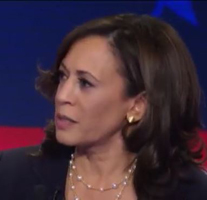
Kamala Harris challenges Joe Biden on race during Democratic debate (From MSNBC)
1. Race and Fireworks: The tussle of the night — and the clip every network will play for days — was between former Vice President Joe Biden and U.S. Senator Kamala Harris of California. It began when an emotional Harris took aim at Biden for his recent comments that he was able to work with segregationist senators in the past, which she called “hurtful.” “I will tell you on this subject, it cannot be an intellectual debate among Democrats,” she said, explaining how she benefited from school busing in the 1970s, which Biden opposed at the time. Biden, his anger rising, was having none of it: “I did not praise racists. This is not true,” he said, before launching into a somewhat disjointed defense of his record on civil rights, which ended awkwardly when he noted that his time was up. The former vice president seemed a bit rattled after the exchange, although he recovered his equilibrium later in the debate.
2. Bernie Being Bernie: The most consistent performer on the stage was U.S. Senator Bernie Sanders of Vermont, who, in his own indomitable style, stuck to his battle-tested positions on the need for a political revolution to take America back from the greedy, unscrupulous capitalist class. Asked how he, as a older white man, could represent the party’s diversity, he stuck to his economic line: “How come today the worker in the middle of our economy is making no more money than he or she was making 45 years ago … We need a party that is diverse, but we need a party that has guts.” Love him or hate him, this is one grumpy socialist who knows his own mind and never wavers — and does it all at the top of his lungs.
3. South Bend Shooting: Mayor Pete Buttegieg had to handle a hot potato question about a shooting of a black man by a white police officer in the city he leads, South Bend, Indiana. “It’s a mess, and we’re hurting … I have to face the fact that nothing I can say will bring (the victim) back,” he said. And while conceding that he has not been able as mayor to bring more diversity to the city’s mostly white police force, he also said that the investigation into the shooting needs to run its course — and ignored a shouted demand from U.S. Rep. Eric Swalwell of California that he fire the officer involved.
4. Generational Dust-Up: Swalwell got in a pointed dig at Biden by quoting a speech that the septuagenarian former vice president made calling for passing the torch to a new generation of leadership — 32 years ago, when Swalwell was 6. That set off a cacophony of cross-talk that only ended when Harris managed to get off the line of the night: “Hey guys, you know what, America does not want to witness a food fight. They want to know how we’re going to put food on the table.”
5. Private Insurance Fault Line: When asked by the moderator if they supported abolishing private health insurance as part of a Medicare-for-all plan, only two candidates — Sanders and Harris — raised their hands. Sanders offered a robust defense of the idea, saying that if other major countries such as Britain and Canada can operate a health care system for their citizens, the United States should be able to do the same. The biggest pushback on eliminating private insurance came from U.S. Senator Michael Bennet of Colorado, who noted that Canada has just a tenth of the population of the United States, and Biden, who touted his role in passing Obamacare and said he had no intention of scrapping it. Buttigieg proposed a mixture of public and private plans that he called “Medicare-for-all-who-want-it.”
6. At Back of the Pack: Unlike in the first debate, when former San Antonio Mayor Julián Castro had a breakout performance, none of the candidates lagging at the back of the pack turned in a performance that is likely to move the needle. Bennet did manage to grab a bit of air time; Swalwell tried to create moments on gun control and his calls for generational change; and U.S. Senator Kirsten Gillibrand of New York tried to do the same with her support for legal abortion. But neither they nor former Colorado Governor John Hickenlooper are likely to play much of a role in the post-debate conversation.
7. Stepping Up The Trump Attacks: The candidates in the second debate had clearly paid attention to pundits’ commentary after the first debate that President Donald Trump had not been sufficiently targeted. They stepped up the rhetoric against the president, particularly on his immigration policies. As Sanders put it, with his characteristic subtlety: “Trump is a phony. Trump is a pathological liar and a racist.”
8. Making News: Very little of what the candidates said during the debate was unexpected or made much news, with one exception — Gillibrand said that if elected, “my first act will be to engage Iran to stabilize the Middle East,” which would change 40 years of official hostility to the imams in Tehran.
9. Um, Why Were These People on the Stage? Democrats did nothing to burnish their reputation for seriousness by including new age guru Marianne Williamson and tech bro Andrew Yang as part of the debate, both of whom seemed hopelessly out of place and, frankly, in the way. It was perhaps not as silly as hosting Kim Kardashian, but it was close. Yang, to his credit, was mostly mute and later complained that his microphone had been turned off (if only); Williamson, alas, opted to interject herself with any number of peculiar observations, including that her first phone call as president would be to the president of New Zealand (which, by the way, doesn’t have a president) and that she was going to “harness love” to beat Trump. Good luck with that.
10. Winners and Losers: The winner of the night was clearly Harris, who managed to make herself look presidential and take a bite out of Biden. The biggest loser of the evening was Biden, who, as the front-runner, needed to stay above the fray, but, by letting Harris get under his skin, may have punctured his aura of invincibility. Sanders and Buttigieg did no harm to their prospects, but Gillibrand clearly suffered in comparison to Harris, the only other woman on the stage.
We tweet @ChkFriPolitics Join us!
10 takeaways from the first Democratic 2020 debate
Donald Trump draws surprisingly little fire; Texan Julián Castro has breakout performance
♦By Rich Shumate, ChickenFriedPolitics.com editor
 MIAMI (CFP) — The first 10 Democrats took the stage in Miami Wednesday night for the first of two nights of debate among the more than two dozen candidates running for their party’s 2020 presidential nomination. Here’s a recap of some of the key takeaways from the proceedings.
1. Life at the Top: U.S. Senator Elizabeth Warren of Massachusetts was the only one of the candidates in the top five in national polling to take the stage in the first debate, and she got pride of place to both open and close the proceedings. She made the most of her moments and avoided taking shots from the other candidates, although there was long stretches in the second half of two-hour debate where she faded out of the conversation. Her best moment came when she was asked if she had a plan as president to deal with Senate Majority Leader Mitch McConnell, and she responded, “I do” — then made a few fiery comments about energizing Democrats “to make this Congress reflect the will of the people.”

Former San Antonio Mayor Julián Castro has breakout performance at first Democratic debate (From MSNBC)
2. Breakout Performance: Among the candidates further back in the pack, the breakout performance of the night may have come from former San Antonio Mayor Julián Castro, one of two Southerns in the race, who got quite a bit of screen time and dominated the immigration portion of the debate, on a day when the crisis at the U.S.-Mexico border dominated the news cycle. As the only Latino in the 2020 race, Castro spoke with authority that other candidates were hard pressed to match.
3. Private Insurance Fault Line: When the candidates were asked if they supported creating a Medicare-for-all system that would abolish private insurance that employees receive from their employers, only two candidates — Warren and New York Mayor Bill DeBlasio — raised their hands, although both former U.S. Rep. Beto O’Rourke of Texas and U.S. Senator Cory Booker of New Jersey indicated they supported versions of Medicare-for-all that stopped short of ending private insurance. The greatest pushback on the idea came from former U.S. Rep. John Delaney of Maryland: “I think we should be the party that keeps what’s working and fixes what’s broken.”
4. Texas Immigration Tangle: Castro called for repeal of the section of federal law that makes it a crime to illegally cross the U.S. border, which he said had been used by the Trump administration to target migrants. Then he tried repeatedly to get O’Rourke and the other candidates on the stage to follow his lead — and interrupted O’Rourke as he tried to explain his immigration policy without taking a position on repeal, in what proved to be one of the few direct confrontations of the evening.
5. Personal Touch: In discussing issues brought up by the moderators, O’Rouke tried to set himself apart from his competitors by inserting personal stories of Americans whom he has met on the campaign trail and other anecdotes into his responses. This approach perhaps reached its nadir when he was asked if his Justice Department would pursue charges against President Donald Trump once he left office — and he launched into a non sequitur about a painting in the U.S. Capitol that shows George Washington resigning his commission as head of the army.
6. Biggest Threat? When candidates were asked who or what they thought presented the biggest threat to the United States, most said China or climate change. Only one — DeBlasio — said Russia “because they’re trying to undermine our democracy.” But Washington Governor Jay Inslee triggered a cascade of applause with his answer: “Donald Trump.”
7. A Different Kind of Democrat? Three of the candidates mired near the bottom in national polls tried to set themselves apart by portraying themselves as a different kind of Democrat. U.S. Rep. Tim Ryan of Ohio called for the party to pay more attention to blue collar voters in the Midwest, saying its center of gravity needed to shift away from coastal elites. Delaney issued a call for pragmatism, saying Democrats needed to adopt “real solutions, not impossible promises.” And U.S. Rep. Tulsi Gabbard of Hawaii, an Iraq War veteran and major in the Army National Guard, called for a complete U.S. pullout from Afghanistan, saying “we are no better off in Afghanistan today than we were when we began.”
8. Mayor Pushy: DeBlasio did his best to live up to the stereotype of New Yorkers as loud and obnoxious, frequently interrupting the proceedings and interjecting himself at high volume. He gave several lectures on how Democrats need to represent working people and invoked his biracial son to make a point about police reform. True, he got noticed among the flash mob on the stage, but probably not for the right reasons.
9. Where’s The Donald?: With the notable exception of Inslee’s line about Trump being the nation’s biggest existential threat, the Democrats spent surprisingly little time during the debate directly castigating the president — despite the fact that the 2020 election is shaping up as a referendum on the incumbent and the Democratic base sees the president in a slightly less favorable light than Satan.
10. Winners and Losers: Among the evening’s winners were Warren, who needed to get through the debate without stumbling and made a case that she can take on Trump, and Castro, who perhaps put himself back in the national conversation. The losers included DeBlasio, who came off as wild, goofy and unlikable, and O’Rourke, whose vague and often rambling responses couldn’t disguise the fact that he generally wasn’t answering the moderators’ questions. If his ardent supporters were looking for the debate to push him to the front ranks of the race, they’re probably going to be disappointed.
We tweet @ChkFriPolitics Join us!
Democrats’ 2020 White House roadshow descends on South Carolina
Nearly two dozen candidates for Democratic nomination speak at marathon session of state party
♦By Rich Shumate, ChickenFriedPolitics.com editor
 COLUMBIA, South Carolina (CFP) — The Democratic Party’s vast field of 2020 White House hopefuls turned up in South Carolina Saturday, jockeying for political position in the first-in-the-South primary state.
 Over the course of nearly nine hours, a parade of 23 candidates spoke to delegates at the South Carolina Democratic Party’s annual convention, as party leaders interspersed business with eight-minute pitches from contenders — major, minor and obscure.
“It is the price we pay for all of these people wanting to see you,” quipped Trav Robertson, the state party chair.
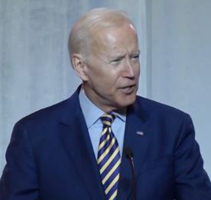
Former Vice President Joe Biden addresses South Carolina Democrats (From MSNBC)
During his speech, former Vice President Joe Biden — who held a 20-point lead over the rest of the field in the Palmetto State in a recent poll by Post and Courier newspaper — did not address his controversial remarks about being able to work with segregationist senators, which drew sharp criticism from his Democratic rivals.
He did, however, go directly after President Donald Trump, saying it was “imperative” to defeat him in 2020.
“You all know in your bones this election is more important than any other election you’ve been involved in,” Biden said. “Four more years of Donald Trump will permanently change the character of this country.”
In her remarks, U.S. Senator Elizabeth Warren of Massachusetts, who was in second place behind Biden in the Post and Courier poll, offered a litany of specific policy proposals, saying “people across this country understand its time for big structural change. The time for small ideas is over.”
The centerpiece of the program she outlined is a 2 percent increase on income tax for the wealthiest Americans to fund universal childcare and pre-K and tuition-free college tuition.
South Bend, Indiana Mayor Pete Buttigieg’s appearance in Columbia marked a return to the campaign trail after he returned home to deal with the fallout after a black man was shot by a police officer.
“We already know why such deep wounds are surfacing, why our whole community hurts,” Buttigieg said. “My community is full of people who believe in safety and justice. We will heal, and we will become stronger in the broken places.”
Buttigieg, who placed third behind Biden and Warren in the Post and Courier poll, said Democrats “need a new generation of leadership” to draw a contrast with Trump.
“We are not going to win by going on the president’s show,” he said. “Are you ready to stand with me and change the channel?”
The two Southerners in the Democratic field — former U.S. Rep. Beto O’Rourke of Texas and former San Antonio Mayor Julián Castro — were among the candidates who spoke Saturday.
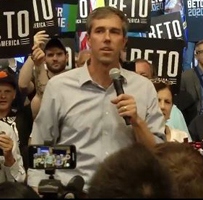
Beto O’Rourke goes down in the crowd to deliver remarks (From MSNBC)
O’Rourke, who eschewed the podium and gave his speech on the floor amid a scrum of delegates and photographers, offered blistering criticism of the Trump administration’s policy of separating migrant families at the U.S.-Mexico border.
“There are children sleeping on cold concrete floors with aluminum foil for blankets, in the worst, most inhumane conditions,” O’Rouke said. “That cannot be us. That cannot be America. But for as long as this man is in office, it will be.”
Castro made a call for police reform, rattling off a list of African Americans and Latinos who died at the hands of police.
“They deserve justice too,” said Castro, who said if he’s elected, “we won’t have any second-class citizens in the United States.”
In his remarks, U.S. Senator Bernie Sanders of Vermont pushed back on comments made earlier in the week at a gathering of party centrists that the self-described Democratic socialist presents “an existential threat” to the party.
“Why am I an existential threat? Maybe it’s because I will take on the insurance companies and the drug companies and pass a Medicare-for-all, single-payer program,” Sanders said. “Maybe it’s because we’re going to break up the major banks on Wall Street … Maybe it’s because we’re going to take on the fossil fuel industry.”
Sanders has been running second to Biden in most national polls, but he has been trying to regain his footing in South Carolina, where his support has dropped to just 9 percent in the latest Post and Courier poll, putting him in fourth place.
The day of speeches kicked off with U.S. Senator Kamala Harris of California, who criticized what she called Trump’s “rap sheet” in pushing tax cuts, tariffs and embracing “dictators” around the world.
“Let’s prosecute that case, and let’s not turn back the clock,” she said. “Let’s start the next chapter.”
The breakout performances of the day among the candidates at the back of the pack came from U.S. Senators Amy Klobuchar of Minnesota and Cory Booker of New Jersey.
Klobuchar highlighted her working class background and called for an “optimistic economic agenda” that works for all parts of the country.
“I don’t come from money. I have grit. And I got into politics for a reason,” Klobuchar said. “I know how to win.”
Booker said Democrats can’t be satisfied with just beating Trump but must embrace “bold dreams.”
“Beating Donald Trump gets us out of the valley, but it doesn’t get us to the mountaintop,” he said. “He wants to make this election about hate; we need to make this election about love. He wants to make this election about tearing people down; we need to make this election about building people up.”
South Carolina’s 2020 presidential primary, scheduled for Feb. 29, will be the fourth contest, after Iowa, New Hampshire and Nevada. It will be the first test of candidates’ appeal in the South and among African Americans, who make up a majority of Democratic voters in the state.
The Post and Courier’s latest poll found Biden was the choice of 37 percent of likely primary voters, bolstered by his strong support among black voters, among whom he tops 50 percent.
Warren was followed at 17 percent and Buttigieg at 11 percent. None of the other candidates were in double digits.
We tweet @ChkFriPolitics Join us!
GOP’s Alabama headache returns: Roy Moore running for U.S. Senate
Former chief justice ignores Donald Trump’s plea not to seek a rematch of 2017 loss
♦By Rich Shumate, ChickenFriedPolitics.com editor
 MONTGOMERY (CFP) — Former Alabama Chief Justice Roy Moore will try again in 2020 to get elected to the U.S. Senate, three years after his campaign for the same office imploded amid sexual misconduct allegations — and despite a Twitter plea from President Donald Trump to stay out of the race.
“Can I win? Yes, I can win. Not only can I, they know I can. That’s why there’s such opposition,” Moore said at his June 20 announcement, referring to Republican leaders who will now face the headache of dealing with Moore in the GOP primary as they try to reclaim the seat from Democratic U.S. Senator Doug Jones.

Roy Moore announces Senate run in Montgomery (WKRG via YouTube)
“Why does the mere mention of my name cause people just to get up in arms in Washington, D.C.?” Moore said. “Is it because I believe in God and marriage and in morality in our country, that I believe in the right of a baby in the womb to have a life? Are these things embarrassing to you?”
Moore’s candidacy is being opposed by the National Republican Senatorial Committee, the campaign arm of GOP senators, as well as Senate Majority Leader Mitch McConnell and Alabama’s Republican U.S. Senator, Richard Shelby.
But it is the opposition of Trump — hugely popular in the Yellowhammer State — that may be the most formidable Republican obstacle in Moore’s path.
In a May 29 tweet, as speculation swirled that Moore might run, Trump said, “If Alabama does not elect a Republican to the Senate in 2020, many of the incredible gains that we have made during my Presidency may be lost, including our Pro-Life victories. Roy Moore cannot win, and the consequences will be devastating.”
Asked about the president’s opposition during his campaign announcement, Moore reiterated his support for Trump’s agenda and said he believed the president was being pressured to come out against him.
“I think President Trump has every right to voice his opinion. I think he’s being pushed by the NRSC,” Moore said.
Moore, 72, once again denied allegations made by five women that he pursued them sexually when they were teenagers in the 1970s — allegations that proved devastating to his 2017 campaign against Jones.
“I’ve taken a lie-detector test. I’ve take a polygraph test. I’ve done everything I could do,” he said.
Moore also said Jones’s win in 2017 — the first by a Democrat in an Alabama Senate race in 25 years — was “fraudulent” because he was the victim of a “false flag operation using Russian tactics.”
In late 2018, several news organizations reported that a group financed by a Democratic operative used Twitter and Facebook to spread disinformation against Moore, who lost to Jones by just 1 percent of the vote.
Jones, who has said he was not aware of what the group was doing, repudiated what he termed “deceptive tactics” and called for a federal investigation.
In his 2020 announcement, Moore said he suspected “Republican collusion” in the Democratic disinformation campaign, although he didn’t offer specifics.
Moore will be running in the Republican primary against a field that already includes U.S. Rep. Bradley Byrne of Mobile, former Auburn University football coach Tommy Tuberville, Secretary of State John Merrill from Tuscaloosa, and State Rep. Arnold Mooney from suburban Birmingham.
The two top vote getters in the March 2020 primary will advance to a runoff.
The challenge for the NRSC and Senate Republican leaders will be finding a way to work against Moore while remaining neutral among the other candidates. In 2017, their open support of Luther Strange backfired when Moore turned his ties with the Washington establishment into a potent campaign issue.
Moore first gained national notoriety as a local judge in 1995 after battling the ACLU over his practice of opening court sessions with a prayer and hanging the Ten Commandments in his courtroom.
He parlayed that prominence into election as Alabama’s chief justice in 2000 but was forced out in 2003 after he had a display of the Ten Commandments installed in the rotunda of the state judicial building and then defied a federal judge’s order to remove it.
Moore was once again elected chief justice in 2012, but in 2016, he was suspended by a judicial disciplinary panel for the rest of his term for ethics violations after telling local officials that they didn’t have to comply with the U.S. Supreme Court decision legalizing same-sex marriage.
After losing an appeal of his suspension, Moore resigned from the Supreme Court to run for the Senate vacancy created when Jeff Sessions resigned to become Trump’s attorney general.
In 2017, Moore was able to use his base of support from his tenure as chief justice to get into the runoff, where he defeated Strange, who had been appointed to the seat temporarily by disgraced former Governor Robert Bentley.
Trump had backed Strange in the runoff but quickly got on board with Moore once he won. But after the sexual misconduct allegations surfaced, McConnell, Shelby and other Republican Senate leaders abandoned their wounded nominee, even announcing that they would expel him from the Senate if he won.
Jones, who now faces the formidable challenge of trying to hang on to his Senate seat in deep red Alabama, is considered to be the most vulnerable Democratic incumbent in the Senate in 2020.
Jones greeted Moore’s announcement with a tweet: “So it looks like my opponent will either be extremist Roy Moore or an extremist handpicked by Mitch McConnell to be part of his legislative graveyard team. Let’s get to work so we can get things done!”

 Chicken Fried Politics