
Latest Posts
Latest Coverage
-
Symbolic solution in search of an actual problem
Support of 9 Southern Republicans for Respect for Marriage Act shows why Supreme Court isn’t about to ban same-sex marriage ♦By Rich Shumate, ChickenFriedPolitics.com editor…
-

West Virginia stubborn, or playing hard to get
U.S. Senator Joe Manchin pisses off his party yet again … to what end? ♦By Rich Shumate, ChickenFriedPolitics.com editor Also in this report: Atlanta DA…
-

2 Mississippi Republican U.S. House members forced into runoffs after weak primary showings
Michael Guest narrowly trails challenger in 3rd District; Steven Palazzo clears just 32% in 4th District ♦By Rich Shumate, ChickenFriedPolitics.com editor JACKSON, Mississippi (CFP) –…
-

Mississippi Republican U.S. Rep. Steven Palazzo facing Tuesday primary fight amid ethics investigation
6 opponents hitting “No-Show Palazzo” over inattention to district, ethics problems ♦By Rich Shumate, ChickenFriedPolitics.com editor GULFPORT (CFP) — Mississippi U.S. Rep. Steven Palazzo —…
-

Primary Wrap: Kemp, Raffensperger survive Trump’s ire; Brooks makes Alabama U.S. Senate runoff
Texas Democratic U.S. Rep. Henry Cuellar survives challenge from the left; George P. Bush gets blown out by Attorney General Ken Paxton ♦By Rich Shumate,…
-

U.S. House’s last pro-life Democrat, Texas’s Henry Cuellar, fighting to keep seat in Tuesday primary runoff
Challenger Jessica Cisneros wanted House Democratic leaders to rescind Cuellar endorsement; they refused ♦By Rich Shumate, ChickenFriedPolitics.com editor LAREDO, Texas (CFP) — Amid the newly…
Republican field set for July runoff for vacant North Carolina 3rd District U.S. House seat
State Rep. Greg Murphy will face newcomer Joan Perry in runoff; winner faces Democrat Allen Thomas in September
♦By Rich Shumate, ChickenFriedPolitics.com
 GREENVILLE, North Carolina (CFP) — Two medical doctors will compete in a July 9 runoff for the Republican nomination for fill a U.S. House vacancy in Eastern North Carolina.
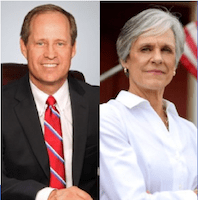
Greg Murphy and Joan Perry
State Rep. Greg Murphy from Greenville and Joan Perry, a pediatrician from Kinston and former member of the University of North Carolina System Board of Governors, took the top spots in the crowded April 23 primary for the 3rd District seat, which featured 17 Republican candidates.
The seat has been vacant since U.S. Rep. Walter Jones, who had held it for 24 years, died in February.
Murphy took 23 percent in the first round to 15 percent for Perry. Under state law, primary runoffs are held when no candidate gets 30 percent of the vote.
Among Democrats, former Greenville Mayor Allen Thomas won his party’s nomination outright in the first round, with 50 percent of the vote.
The winner of the Republican runoff will be prohibitive favorite in the 3rd District, which includes 17 mostly rural counties along the state’s Atlantic coast. President Donald Trump carried the district by 14 points in 2016.
In addition to the special election in the 3rd District, voters in the state’s 9th U.S. House District will also vote in a May 14 primary to fill a seat that has been vacant since the State Board of Elections ordered a redo of last November’s election amid allegations of absentee ballot fraud.
Ten Republicans are running that that primary. Democrat Dan McCready, who narrowly lost in the district in November, is the only Democrat on the ballot.
We tweet @ChkFriPolitics Join us!

Stacey Abrams won’t challenge U.S. Senator David Perdue in Georgia in 2020
Decision deprives Democrats of their top prospect to unseat Republican incumbent
♦By Rich Shumate, ChickenFriedPolitics.com editor
 ATLANTA (CFP) — Withstanding intense lobbying from Democratic leaders to run, Stacey Abrams has announced she will not challenge Georgia Republican U.S. Senator David Perdue in 2020, leaving Democrats without a top-tier candidate for a seat they hope to flip.
“I am so grateful for all the support and encouragement that I’ve received,” Abrams said in a video posted on Twitter. “However, the fights to be waged require a deep commitment to the job, and I do not see the U.S. Senate as the best role for me in this battle for our nation’s future.”

Stacey Abrams announces she won’t run for Senate in 2020 (From Twitter)
Addressing her political future, Abrams said, “I still don’t know exactly what’s next for me” — leaving open the possibility of seeking the Democratic presidential nomination in 2020, a idea she has discussed openly in recent months.
Abrams also took a parting shot at Perdue, saying she would work in 2020 to elect “a Georgian who cares more about protecting our farmers and our families than protecting the Trump administration.”
Abrams, 45, the former minority leader of the Georgia House, burst on to the national political stage in 2018 in the Georgia governor’s race, hoping to make history as the first African American woman ever elected governor of a U.S. state. Despite an avalanche of media attention, she lost to Republican Governor Brian Kemp by 55,000 votes.
Abrams, complaining that Kemp had mismanaged the election as secretary of state, refused to concede, although she eventually acknowledged him as the winner. She then founded a group called Fair Fight Action, which filed a federal lawsuit challenging Georgia’s election processes and demanding changes before the 2020 election.
Since her defeat, Abrams had been courted by Senate Minority Leader Chuck Schumer to run against Perdue, who is seeking his second term in 2020. She was selected to give the Democratic response to President Donald Trump’s State of the Union address in February.
Democrats haven’t won a Senate race in Georgia since 1996, but Abrams’s near victory over Kemp made her the party’s top prospect to take on Perdue. With Abrams out, that mantle falls, for the moment, on former Columbus Mayor Teresa Tomlinson.
Abrams’s decision was met with some glee at the National Republican Senatorial Committee, which fired off a statement from NRSC spokesman Jesse Hunt:
“Stacey Abrams handed Chuck Schumer his most embarrassing recruiting fail of the cycle, leaving Georgia Democrats stuck with an assortment of second-tier candidates,” Hunt said. “Her decision is the latest in a string of high-profile Democrats who have rejected Schumer’s pitch out of fear of facing formidable Republican Senators next fall.”
A spokesman for the Democratic Senatorial Campaign Committee, Stewart Boss, fired back: “Stacey and Georgia Democrats laid a strong foundation for 2020, and Senator Perdue will be held accountable for driving up health care costs, giving big corporations and millionaires like himself a tax break, and putting the president ahead of what’s right.”
Republicans currently hold a 53-47 majority in the Senate, which means Democrats will need to flip four seats in 2020 to take control, unless Trump loses, in which case they can control the Senate with a shift of three seats and the vice presidency.
Of the seats up next year, 21 are held by Republicans and just 13 by Democrats. However, most of those GOP seats are in states that tilt Republican; Democrats are hoping to add Georgia to a short list of GOP targets that includes seats in Colorado, Maine, Arizona and Iowa.
Democrats will also have to defend seats in heavily Republican Alabama and Michigan, which Trump carried in 2016.
A total of 13 Southern seats — 11 Republican and two Democratic — are up in 2020. Incumbents are expected to run for re-election for all of those seats except Tennessee, where Lamar Alexander is retiring.
Races in Texas, Tennessee, Alabama and North Carolina are likely to be competitive, while in Kentucky, Senate Majority Leader Mitch McConnell could face both primary and Democratic opposition.
We tweet @ChkFriPolitics Join us!
Democrat MJ Hegar enters race against Texas U.S. Senator John Cornyn
Hegar dismisses Cornyn as “that tall guy lurking behind Mitch McConnell”
♦By Rich Shumate, ChickenFriedPolitics.com editor
 AUSTIN (CFP) — MJ Hegar, a tattooed former Air Force fighter pilot who nearly pulled off an upset against a veteran Republican Texas U.S. House member in 2018, now has her sights on a bigger target — U.S. Senator John Cornyn.
Hegar launched her campaign to unseat Cornyn in 2020 with a video in which she rides a motorcycle and lampoons the former Senator majority whip for his close relationship with Senate Majority Leader Mitch McConnell.

MJ Hegar announces her U.S. Senate bid
“He’s that tall guy lurking behind Mitch McConnell in basically every single video,” Hegar said. “He calls himself Big John, but he shrinks out of the way while Mitch McConnell gets in the way of anything actually getting done in our government.”
Cornyn’s campaign fired back at Hegar, tweeting that she was Senate Minority Leader Chuck Schumer’s “hand-picked candidate.”
“If elected, she will end all of the progress Texas has made by eliminating private healthcare, raising taxes and supporting late-term abortion,” the campaign tweeted, posting a quiz for its followers to judge how liberal Hegar is.
In 2018, Hegar, a political newcomer from Round Rock, lost by just 3 points to seven-term Republican U.S. Rep. John Carter in the 31st District, based in Austin’s northern suburbs. Carter had carried the district by 22 points in 2016.
“I didn’t win that election, but we won something bigger,” Hegar said in her announcement video. “We helped change the status quo — new voices, new volunteers, new voters, standing up to demand better.”
WATCH: Hegar’s full announcement video
Hegar, 42, spent five years flying helicopters in the Air Force. While serving in Afghanistan in 2009, she was wounded when her helicopter was shot down by the Taliban, and she was awarded the Distinguished Flying Cross.
After Hegar could no longer fly because of her injuries, she was barred by military policy from serving in other combat roles. She was part of a group of women who sued to overturn the policy, which was repealed in 2013.
Hegar launched her 2018 campaign with a video entitled “Doors,” in which she displayed her tattoos, some of which cover her war injuries. The video went viral, helping her raise more than $5 million for her race against Carter, nearly tripling his fundraising take.
Other Democrats are expected to join the Texas Senate race against Cornyn, including U.S. Rep. Joaquin Castro from San Antonio.

U.S. Senator John Cornyn
Cornyn, 67, has represented Texas in the Senate since 2002 and served as the Senate majority whip, the chamber’s No. 2 position, from 2015 to 2019. He won his last re-election race in 2014 by 28 points.
While Cornyn had to face down a primary challenge in 2014, no Republicans have yet stepped forward to challenge him next year.
No Democrat has won a Senate race in Texas since 1988. However, after Beto O’Rourke nearly unseated U.S. Senator Ted Cruz in 2018, Democrats have made Cornyn one of their top targets for 2020.
O’Rourke decided to pursue the Democratic presidential nomination rather than taking on Cornyn.
We tweet @ChkFriPolitics Join us!
Southern Democrats who flipped seats in 2018 post strong fundraising numbers
South Carolina’s Joe Cunningham, Texas’s Colin Allred and Lizzie Fletcher lead pack in 2020 contributions
♦By Rich Shumate, ChickenFriedPolitics.com editor
 WASHINGTON (CFP) — The 10 Southern U.S. House Democrats who flipped Republican-held seats in 2018 all posted strong fundraising numbers for their re-election campaigns during the first quarter of 2019, as they try to build the war chests they will need to stave off GOP challengers next year.

U.S. Rep. Joe Cunningham, R-South Carolina
Leading the pack was Joe Cunningham, representing the Low Country of South Carolina, who raised $663,500 during the first three months of the year, according to campaign finance reports filed with the Federal Election Commission.
He raised more money than any other Southern House incumbent in either party, except for House Majority Whip Steve Scalise, a Republican from Louisiana, who raised $2.5 million.
Cunningham was followed by two Texans — Lizzie Pannill Fletcher in Houston, who raised $582,900, and Colin Allred in Dallas, who raised $530,400. In the Atlanta suburbs, Lucy McBath, who already has two Republicans actively campaigning against her for 2020, raised $482,000.
Among the three Democrats who won seats in Virginia in 2018, Jennifer Wexton, in the Washington D.C. suburbs, raised $424,200; Abigail Spanberger, in suburban Richmond, raised $415,300; and Elaine Luria, in Hampton Roads, took in $327,000.
In metro Miami, Debbie Mucarsel-Powell raised $457,000, while Donna Shalala took in just $269,370, the lowest fundraising total among the Southern House flippers.
Kendra Horn, who won a surprise victory last November in metro Oklahoma City, raised $377,600 during the quarter.
While all of these Democrats will have stout competition in 2020, no potential Republican challengers raised any significant money during the first quarter, except the two candidates running against McBath in Georgia. So as of now, all of these Democrats are out ahead financially of their challengers.
McBath raised more money than both of her Republican rivals combined. Karen Handel, who is gunning for a rematch with McBath after losing to her in 2018, raised $259,800, and State Senator Brandon Beach raised $123,800.
Historically, freshmen House members tend to be most vulnerable during their first re-election race, particularly in a wave year such as 2018, when large numbers of seats changed hands between parties.
Six of the 10 Southern Democrats who flipped seats won by 2 points or less in 2018, and, in 2020, President Donald Trump — who won or nearly won seven of these districts — will also be on the ballot.
Cunningham and Horn face perhaps the biggest hurdle. Both won their 2018 races by less than 2 points; Trump carried their districts by 13 points.
Trump won Spanberger’s district by 7 points in 2016, and she won it by 2 points in 2018. Trump narrowly won the districts represented by McBath and Luria; they each won by less than 2 points in 2018.
In Texas, Fletcher and Allred represent districts Trump narrowly lost, but their margins of victory in 2018 were slightly larger, 5 and 7 points respectively.
Wexton, Mucarsel-Powell, and Shalala would seem to have little to fear from a Trump effect in their districts, all of which Hillary Clinton carried handily. However, Mucarsel-Powell only won her 2018 race by 2 points, and her district, the 26th, has a history of swinging back and forth between the parties.
We tweet @ChkFriPolitics Join us!
Insight: Democrats display collective amnesia by blocking public testimony of Justin Fairfax’s accusers
Legislators need to hear Vanessa Tyson and Meredith Watson’s accusations against Virginia’s lieutenant governor
♦By Rich Shumate, ChickenFriedPolitics.com editor
 (CFP) — Collective amnesia is on display these days in Richmond, where Lieutenant Governor Justin Fairfax and Democrats in the House of Delegates are resisting calls to allow two women who have accused Fairfax of sexual assault to testify publicly.

ChickenFriedPolitics editor Rich Shumate
Why, it’s as if they don’t remember Brett Kavanaugh and Christine Blasey Ford. Even though that political drama played out a mere six months ago.
Instead of the public testimony by his accusers, Fairfax wants prosecutors in North Carolina and Boston — where the alleged assaults took place — to investigate cases that are 19 and 15 years old, respectively, knowing full well that said prosecutors have absolutely no incentive to get involved in cases that involve no one now living in their jurisdictions and are unlikely to lead to criminal prosecution.
Fairfax knows this because he used to be a prosecutor. He has also trotted out results of two polygraph tests that he passed as proof of vindication, conveniently ignoring the fact that there is a reason these tests aren’t allowed in court — because every scientific study that has looked at the technology has concluded it’s not reliable.
Virginia House Democrats are resisting public testimony because, in the words of Minority Leader Eileen Filler-Corn, the hearing proposed by Republicans would turn into “a politically motivated and unprecedented spectacle.”
Unprecedented? Really? Why, it’s as if they don’t remember Brett Kavanagh and Christine Blasey Ford.
Advocates in the #MeToo movement have also long asserted, with considerable justification, that victims of sexual assault should be believed because they have nothing to gain, and a lot to lose, from cooking up false claims against powerful men. And multiple claims increase credibility because they corroborate a pattern of behavior (just ask Al Franken and Roy Moore, neither of whom is a senator.)
In this case, Vanessa Tyson and Meredith Watson — who did not know each other and had never met before being swept up in this maelstrom — tell remarkably similar stories. How Fairfax disarmed them with friendliness, got them alone, and then pounced on them using physical force. How he may have targeted them because he knew both women had suffered sexual abuse in their pasts. How traumatized both women still are, more than 15 years later.
To dismiss their claims, you have to believe that these two women, one living in California and the other living in Maryland, both decided to make up similar allegations against the same man years later; in Watson’s case, you also have to believe that she told people Fairfax assaulted her back in 2000 (as she says she did) in anticipation, apparently, of the day she would spring her sinister trap and make him pay.
For what reason? To what end? Fairfax himself has not speculated on this. But surely he must have a theory. Why do Tyson and Watson feel such white hot hatred toward him that they would put themselves in jeopardy for revenge, years and years after their interactions with him?
One theory that has emerged with a vengeance on social media is that this is all an effort by Republicans to bring down a powerful black man rising through the political ranks. But these women are unlikely conspirators — Watson and Tyson are also black, and Tyson met Fairfax when both were working at the 2004 Democratic National Convention.
Perhaps the most pernicious bit of nonsense in all of this is the assertion being made, mostly on social media, that because Watson had accused another man of rape before accusing Fairfax, she is somehow less credible. So, rather than saying, “Oh my God, this poor woman has been raped twice,” we should say, “this b**** must be making this up”? Does that make any sense, particularly when Watson claims that Fairfax himself told her that he thought her previous rape would make her less likely to call police?
Or does it make more sense to conclude that Fairfax did what he’s accused of doing and is now paddling furiously to save what’s left of his political career?
In his recent news conference where he released the polygraph results, Fairfax said, “Let me begin by emphasizing how important it is to listen to women when they come forward withe allegations of sexual assault or harassment.” OK, if you truly believe that, then what possible reason can Democrats have for not letting Tyson and Watson testify publicly and letting the chips fall where they may? After all, Brett Kavanaugh sits on the Supreme Court today.
Letting Tyson and Watson and Fairfax all testify before legislators would, no doubt, create a media circus. But what is the alternative? Prosecutors in North Carolina and Boston probably won’t, and certainly shouldn’t, waste their time and taxpayers’ money investigating claims that aren’t likely to lead to a criminal prosecution. And this is no longer about whether Fairfax should go to jail — it’s about whether he’s fit to remain in high political office, a question that certainly falls under the purview of Virginia legislators.
The legal standard is guilt beyond a reasonable doubt. But the political standard is, do we believe these women? And if we do, what should happen to Justin Fairfax?
In the Kavanaugh case, Republicans did not let credible allegations keep him from a lifetime on the Supreme Court. But at least they allowed Ford to have her say and let the public judge her credibility. Do Watson and Tyson deserve any less?
Virginia House Republicans have been reluctant to proceed with hearings without Democratic participation, no doubt because doing so would be seen as nakedly partisan. But should Democratic recalcitrance trump the need to fully and publicly vet serious, credible allegations against the second most powerful man in state government?
And can anyone say, with a straight face, how much we need to listen to sexual assault victims while at the same time thwarting efforts to let them be heard?

 Chicken Fried Politics