
Latest Posts
Latest Coverage
-
Symbolic solution in search of an actual problem
Support of 9 Southern Republicans for Respect for Marriage Act shows why Supreme Court isn’t about to ban same-sex marriage ♦By Rich Shumate, ChickenFriedPolitics.com editor…
-

West Virginia stubborn, or playing hard to get
U.S. Senator Joe Manchin pisses off his party yet again … to what end? ♦By Rich Shumate, ChickenFriedPolitics.com editor Also in this report: Atlanta DA…
-

2 Mississippi Republican U.S. House members forced into runoffs after weak primary showings
Michael Guest narrowly trails challenger in 3rd District; Steven Palazzo clears just 32% in 4th District ♦By Rich Shumate, ChickenFriedPolitics.com editor JACKSON, Mississippi (CFP) –…
-
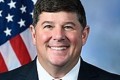
Mississippi Republican U.S. Rep. Steven Palazzo facing Tuesday primary fight amid ethics investigation
6 opponents hitting “No-Show Palazzo” over inattention to district, ethics problems ♦By Rich Shumate, ChickenFriedPolitics.com editor GULFPORT (CFP) — Mississippi U.S. Rep. Steven Palazzo —…
-

Primary Wrap: Kemp, Raffensperger survive Trump’s ire; Brooks makes Alabama U.S. Senate runoff
Texas Democratic U.S. Rep. Henry Cuellar survives challenge from the left; George P. Bush gets blown out by Attorney General Ken Paxton ♦By Rich Shumate,…
-

U.S. House’s last pro-life Democrat, Texas’s Henry Cuellar, fighting to keep seat in Tuesday primary runoff
Challenger Jessica Cisneros wanted House Democratic leaders to rescind Cuellar endorsement; they refused ♦By Rich Shumate, ChickenFriedPolitics.com editor LAREDO, Texas (CFP) — Amid the newly…
Alabama Governor Robert Bentley defiant as damning report on “Luv Guv” scandal is released
Report charges Bentley used law enforcement officers to hide evidence of affair, obstructed probe
♦By Rich Shumate, Chickenfriedpolitics.com editor
 MONTGOMERY (CFP) — Alabama Governor Robert Bentley is defiantly insisting he won’t resign, despite release of a politically damaging report detailing alleged efforts to cover up evidence of his relationship with a former female aide.
The report, prepared for the House Judiciary Committee, alleged that Bentley used law enforcement officers to retrieve audio of a salacious conversation with Rebekah Mason that had been recorded by his former wife, smeared the state official who disclosed their relationship and tried to obstruct the committee’s investigation into what has become known as the “Luv Guv” scandal.
He even tried to use law enforcement officers to break up with Mason on his behalf, according to the report.
Meanwhile, the legislature’s two top Republicans–House Speaker Mac McCutcheon, R-Monrovia, and Senate President Pro Tem Del Marsh, R-Anniston–are both calling on fellow Republican Bentley to step aside.
Resignation is “the only way to avoid taking our state on a long, painful and embarrassing journey whose ending is already likely known to us all,” McCutcheon said.
The Judiciary Committee had been scheduled to begin hearings on possible articles of impeachment against Bentley on April 10. However, Montgomery Circuit Court Judge Greg Griffin issued a temporary restraining order blocking the committee from beginning impeachment hearings until a hearing on May 15, just a week before the legislature is set to adjourn.
Bentley’s attorneys also tried unsuccessfully to block release of the Judiciary Committee report.

Alabama Governor Robert Bentley
As his lawyers fought in court, the governor took to the steps of the Capitol for an extraordinary six-minute appearance before reporters in which he denied doing anything illegal, asked the people of Alabama to pray for him and cast aspersions on the motives of his accusers.
“Those who are taking pleasure in humiliating and shaming me, shaming my family, shaming my friends–I don’t really understand why they want to do that. It may be out of vengeance, it may be out of anger, maybe out of personal political benefit. I don’t know,” he said.
“I actually forgive those who have hurt me, and I’m asking them to forgive me as well.”
He also insisted that the focus on the scandal was a distraction from his work on behalf of the people of Alabama.
“The people of this state have never asked to be told of, or shown, the intimate and embarrassing details of my personal life and my personal struggles,” he said. “Exposing embarrassing details of my past personal life … will not create one single job, will not pass one budget. It will not help one child get a good education, and it will not help any child get good health care.”
Addressing the people of Alabama, Bentley said “there’s no doubt that I have let you down. And all I ask is that you continue to pray for me, and I will continue to pray for you.”
He also said that “with the strength God gives me every day, and the blessed assurance I have in my salvation through Jesus Christ, I have worked hard to move beyond my past mistakes.”
In the midst of the scandal, the governor also said “I asked God to take these struggles and to help me carry these burdens. And I found freedom in that. And I completely gave Him all of me.”
The Judiciary Committee’s investigative report, prepared by outside counsel Jack Sharman, alleged that:
- Bentley used law enforcement officers to try to track down copies of an audio recording made in 2014 by his former wife, who caught him “speaking provocatively” to Mason, including trying to recover a copy from one of his sons. In that audio, which surfaced in March 2016, the septuagenarian governor can be heard expressing “love” to an unidentified party in a telephone conversation and talking about how much he enjoys touching her breasts. In 2015, Bentley and his wife of 50 years, Dianne, divorced.
- Bentley asked law enforcement officers to “end his relationship with Mason on his behalf.”
- Bentley smeared Spencer Collier, the former head of Alabama Law Enforcement Agency, with baseless accusations in order to discredit him. In March 2016, Bentley fired Collier for misusing state funds, citing findings of an internal report. But Collier was later cleared of any wrongdoing, and Sharman concluded that the report’s findings were disclosed to “further demonize” Collier, who knew about the governor’s relationship with Mason and publicly disclosed it shortly after he was fired.
- Bentley tried to impede Sharman’s investigation by refusing to cooperate and not complying fully with a subpoena for documents. Sharman said the committee “may consider the Governor’s non-cooperation as an independent ground for impeachment.”
- Mason “enjoyed a favored spot among (Bentley’s) staff, exercising extraordinary policy authority while receiving hundreds of thousands of dollars from Governor Bentley’s campaign account and from an apparently lawful but shadowy non-profit,” according to the report. The non-profit was the Alabama Council for Excellent Government, a 501(c)(4) group set up to support Bentley’s political agenda, which paid Mason’s salary while she worked on his staff.
- According to the report, the governor “made little effort” to hide his “inappropriate relationship” with Mason from his inner circle.
- The report also noted the Alabama Ethics Commission’s April 4 finding of probable cause that Bentley broke ethics and campaign finance laws by misusing state resources and using campaign funds to pay Mason’s legal fees. That finding has been referred to local prosecutors in Montgomery.
Bentley has denied having a sexual relationship with Mason, but he apologized to the people of Alabama for making “inappropriate” comments. Mason, who is married, also denied the affair but resigned from Bentley’s staff shortly after the allegations became public. Mason did not cooperate with Sharman’s investigation, according to his report.
In addition to possible impeachment proceedings and an investigation by the Ethics Commission, Bentley’s relationship with Mason is also being investigated by the state attorney general’s office and a federal grand jury. Collier is also suing him.
During her time in the governor’s office, Mason was, by Bentley’s own description, one of his top aides. Collier said Mason exhibited a svengali-like influence over Bentley that made her the “de facto governor.” He said he had received complaints about Mason from other law enforcement officials, as well as members of Bentley’s cabinet and members of his family.
If the Judiciary Committee approves articles of impeachment, the matter would go to the full House. If the House votes to impeach Bentley, he would be temporarily suspended from office pending trial in the Senate, and a conviction in the Senate would result in his removal from office. He would be succeeded by Lieutenant Governor Kay Ivey.
No Alabama governor has ever been impeached, although the state is no stranger to gubernatorial misdeeds.
In 1993 Republican Governor Guy Hunt resigned under pressure after he was convicted for looting his inaugural fund to pay personal expenses. Former Democratic Governor Don Siegelman also served five years in prison after being convicted of trading government favors for campaign contributions while he was governor.
Bentley, elected in 2010, is serving his second term. He is term-limited from seeking re-election in 2018.
Southern GOP, Democratic senators split on using “nuclear option” in Gorsuch fight
Senate eliminates filibusters of Supreme Court nominees in party-line vote
 WASHINGTON (CFP) — With the support of all 24 Southern Republicans, the U.S. Senate has changed its rules to eliminate filibusters for Supreme Court nominations, clearing the way for confirmation of Neil Gorsuch to a lifetime seat on the high court.
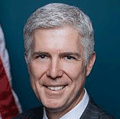
Supreme Court nominee Neil Gorsuch
After Democrats blocked Gorsuch’s nomination with a filibuster, the Republican majority used a parliamentary maneuver to change Senate rules, eliminating the need to reach 60 votes to overcome a filibuster.
That vote fell along party lines, with 52 Republicans in favor, 46 Democrats opposed and two independents who caucus with Democrats also voting against the move.
With the filibuster out of the way, Gorsuch was confirmed by a vote of 54 to 45, with just three Democrats supporting him, including Joe Manchin of West Virginia
Three of the four Southern Democratic senators — Bill Nelson of Florida and Mark Warner and Tim Kaine of Virginia — supported the filibuster and voted against confirming Gorsuch. While Manchin did not join the filibuster and voted for confirmation, he did not support the move by Republican leaders to eliminate filibusters for Supreme Court nominees.

U.S. Senator Joe Manchin of West Virginia
Manchin released a statement blistering both sides for “hypocrisy” and charging that the filibuster fight illustrates “precisely what is wrong with Washington.”
“Frustratingly, both parties have traded talking points: Republicans say it’s about obstructionism and Democrats say it’s a power grab. Their shifting positions and hypocrisy is the one thing that unites them,” he said.
Manchin also noted that in 2013, when Democrats used their majority to end filibusters for executive branch nominees, “every Republican Senator joined me in opposing the rules change then, but now, they stand united to do exactly what they opposed.”
Manchin is up for re-election in 2018 in a state President Donald Trump carried by a whopping 32 points. Warner and Kaine’s opposition to Trump’s first Supreme Court nominee presents less political risk in Virginia, the only Southern state Trump failed to carry last November.
Nelson, however, is also up for re-election in 2018 in a state Trump won and could be facing a formidable Republican foe in Florida Governor Rick Scott.
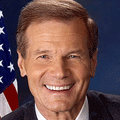
U.S. Senator Bill Nelson of Florida
In a statement announcing his decision to oppose Gorsuch, Nelson said he has “real concerns with (Gorsuch’s) thinking on protecting the right to vote and allowing unlimited money in political campaigns. In addition, the judge has consistently sided with corporations over employees.”
“I will vote no on the motion to invoke cloture (to end the filibuster) and, if that succeeds, I will vote no on his confirmation,” Nelson said.
The National Republican Senatorial Committee immediately released a statement noting that Nelson had opposed a previous Democratic filibuster of Supreme Court Justice Samuel Alito in 2006 and had previously voted to confirm Gorsuch to a seat on the Denver-based 10th U.S. Circuit Court of Appeals.
“Nelson proved to Floridians today that he no longer shares their values, and instead is more politically aligned with the liberal elite of Washington,” said Katie Martin, an NRSC spokeswoman. “Nelson has been in Washington too long and his move to ignore the will of voters in Florida will cost him his job in 2018.”

U.S. Senator Tim Kaine
Kaine, who is also up for re-election in 2018, is also being pounded by Republicans, particularly over a remark he made during the 2016 campaign saying he would support the “nuclear option” if Republicans filibustered any of Hillary Clinton’s Supreme Court nominees. At the time, Kaine was Clinton’s running mate.
In a lengthy statement explaining his support for the filibuster, Kaine noted that Republicans refused to consider President Obama’s selection of Merrick Garland for the Supreme Court vacancy created by the death of Justice Antonin Scalia in 2016, for which Gorsuch was nominated. He also said the filibuster, which Gorsuch would need 60 votes to overcome, ensures that high court nominees “receive significant bipartisan support.”
“That is especially important now given the many important issues pending before the court and the clear need to fill a position long held vacant through blatant partisan politics with someone who can bring independence and non-partisanship to the job,” Kaine said.
3 of 4 Southern Senate Democrats supporting Gorsuch filibuster
U.S. Senator Joe Manchin of West Virginia sole supporter of Trump Supreme Court nominee
WASHINGTON (CFP) — With the U.S. Senate headed for an epic showdown over a Democratic filibuster of President Trump’s first Supreme Court nominee, three of the four Democrats who represent Southern states in the Senate have lined up against Neil Gorsuch’s confirmation.
Supreme Court nominee Neil Gorsuch
Senators Bill Nelson of Florida and Mark Warner and Tim Kaine of Virginia have all announced they will support a Democratic filibuster designed to stop the Gorsuch nomination, which will likely prompt GOP leaders to end filibusters for Supreme Court nominees, a move that has come to be known as the “nuclear option.”
The lone supporter of Gorsuch left among Southern Democrats is Senator Joe Manchin of West Virginia. All 24 Southern Republicans in the Senate are expected to vote to end the filibuster and confirm Gorsuch.
Manchin — up for re-election in 2018 in a state Trump carried by a whopping 32 points — said in a statement that Gorsuch “has been consistently rated as a well-qualified jurist, the highest rating a jurist can receive, and I have found him to be an honest and thoughtful man.”
“I hold no illusions that I will agree with every decision Judge Gorsuch may issue in the future, but I have not found any reasons why this jurist should not be a Supreme Court Justice,” he said.
Warner and Kaine’s opposition to Trump’s nominee presents less political risk in Virginia, the only Southern state Trump failed to carry last November. Nelson, however, is up for re-election in 2018 in a state Trump won and could be facing a formidable Republican foe in Florida Governor Rick Scott.
U.S. Senator Bill Nelson of Florida
In a statement announcing his decision to oppose Gorsuch, Nelson said he has “real concerns with (Gorsuch’s) thinking on protecting the right to vote and allowing unlimited money in political campaigns. In addition, the judge has consistently sided with corporations over employees.”
“I will vote no on the motion to invoke cloture (to end the filibuster) and, if that succeeds, I will vote no on his confirmation,” Nelson said.
The National Republican Senatorial Committee immediately released a statement noting that Nelson had opposed a previous Democratic filibuster of Supreme Court Justice Samuel Alito in 2006 and had previously voted to confirm Gorsuch to a seat on the Denver-based 10th U.S. Circuit Court of Appeals.
“Nelson proved to Floridians today that he no longer shares their values, and instead is more politically aligned with the liberal elite of Washington,” said Katie Martin, an NRSC spokeswoman. “Nelson has been in Washington too long and his move to ignore the will of voters in Florida will cost him his job in 2018.”
U.S. Senator Tim Kaine
Kaine, who is also up for re-election in 2018, is also being pounded by Republicans, particularly over a remark he made during the 2016 campaign saying he would support the “nuclear option” if Republicans filibustered any of Hillary Clinton’s Supreme Court nominees. At the time, Kaine was Clinton’s running mate.
In a lengthy statement explaining his support for the filibuster, Kaine noted that Republicans refused to consider President Obama’s selection of Merrick Garland for the Supreme Court vacancy created by the death of Justice Antonin Scalia in 2016, for which Gorsuch has now been nominated. He also said the filibuster, which Gorsuch would need 60 votes to overcome, ensures that high court nominees “receive significant bipartisan support.”
“That is especially important now given the many important issues pending before the court and the clear need to fill a position long held vacant through blatant partisan politics with someone who can bring independence and non-partisanship to the job,” Kaine said.
If Republicans are unable to get 60 votes to end the filibuster against Garland, Republican leaders are expected to change Senate rules to end filibusters for Supreme Court nominees and allow them to be confirmed by a simple majority.
In 2013 when Democrats controlled the Senate, they invoked the so-called “nuclear option” to end filibusters for nominees for positions in the executive branch, after minority Republicans thwarted several of President Obama’s appointments.
U.S. Rep. Beto O’Rourke will take on Ted Cruz in Texas U.S. Senate race
Congressman from El Paso is first major Democrat to launch a bid to unseat Cruz
♦By Rich Shumate, Chickenfriedpolitics.com editor
 EL PASO (CFP) — Democratic U.S. Rep. Beto O’Rourke is giving up his safe House seat in order to make a long-shot bid to unseat Republican U.S. Senator Ted Cruz in 2018
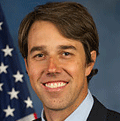
U.S. Rep. Beto O’Rourke, D-Texas
O’Rourke kicked off his campaign March 31 with a rally in his hometown of El Paso, which he represents in Congress, followed by a weekend of stops in major cities around the Lone Star State.
Without mentioning Cruz by name, O’Rourke accused him of putting political ambition above his job as a senator, saying that to meet the challenges of the future, Texans will need “a senator who’s working full time for Texas, a senator who’s not using this position of responsibility and power to serve his own interests, to run for president, to shut down the government.”

O’Rourke kicks off campaign in El Paso.
O’Rourke is also positioning himself as principled opponent to President Donald Trump, saying the new administration is “focused on the wrong things instead of the right things that (are) going to get us ahead,” such as a ban on refugees from Muslim counties, an immigration crackdown and construction of wall along the U.S.-Mexico border.
“We can decide that we’re going to take back this country, and we’re going to take back this state, and that we’re going to do that in 2018,” he said. “2018 starts right here, right now.”
O’Rourke, who had previously made a commitment to serve no more than four terms in the House, said that if elected, he would serve only two six-year terms in the Senate. He took a shot at the Washington political class, saying the American people need a Congress “that actually works, that’s not more preoccupied and focused on the re-election of its members than the business of this country.”
O’Rourke also gave part of his kickoff speech in Spanish, in which he is fluent. Texas has 4.8 million eligible Latino votes, making up about 28 percent of the states total eligible electorate, according to figures from the Pew Research Center.
O’Rourke, 44, was first elected to the House in 2012, representing the majority Latino 16th District, which takes in most of El Paso County and borders Mexico. He has strong political roots in El Paso, where his father, Pat, served as county judge.
Although the first name he uses, Beto, is a common Spanish nickname for his given name, Robert, O’Rourke is Irish, not Latino. He acquired the nickname in childhood.
O’Rourke will face an uphill battle against Cruz, given that no Democrat has won a statewide office in Texas since 1994 or a Senate race since 1988. His background and liberal policy positions may also prove to be a difficult sell.
O’Rourke played in a rock band in the early 1990s and was later arrested, but not convicted, on burglary and drunk driving charges. He is a supporter of LGBT rights and an opponent of what he calls the “failed war on drugs.” He supports comprehensive immigration reform and participated in a 2016 sit-in by House members in support of stronger restrictions on gun purchases.
O’Rourke may also have primary opposition from U.S. Rep. Joaquin Castro of San Antonio, who is also considering a run.
Cruz, who run unsuccessfully for the GOP presidential nomination in 2016, has so far not drawn any Republican primary opposition.
O’Rourke’s run will open up the 16th District seat in 2018. However, the seat in the strongly Democratic district is unlikely to change hands.
Former U.S. Rep. Steve Stockman blames “deep state” for his indictment on corruption charges
Former Texas congressman accused of diverting charitable donations for personal use
♦By Rich Shumate, Chickenfriedpolitics.com editor
HOUSTON (CFP) — Federal prosecutors are blaming former U.S. Rep. Steve Stockman and an aide for an ongoing scheme to bilk $1.25 million from charitable foundations and divert it for personal use. But Stockman, in the dock, is blaming the “deep state” for his legal woes.

Former U.S. Rep. Steve Stockman, R-Texas
Stockman, a Republican who served two stints in the House before losing a Senate primary in 2014, is facing charges of mail and wire fraud, money laundering, violating campaign finance laws, making false statements to the Federal Election Commission and filing a false tax return with the IRS. The indictment was unsealed March 28.
After his initial court appearance, Stockman proclaimed his innocence and said the “deep state” was trying to exact revenge for his longtime opposition to the IRS as a congressman, according to a report in the Houston Chronicle.
“This is part of a deep state that’s continuing to progress,” said Stockman, who was arrested at a Houston airport while trying to board a plane bound for the United Arab Emirates.
“Deep state” refers to a conspiracy theory that holds that unelected bureaucrats secretly run the U.S. government.
The indictment alleges that Stockman and an aide, Jason Posey, solicited donations from charitable foundations that they funneled to a web of non-profit groups they had set up, telling donors the funds would be used for “charitable and educational purposes.” Instead, the money was spent on personal expenses and to further Stockman’s political career, according to the indictment.
In all, $1.25 million in fraudulent donations were solicited between 2010 and 2014, according to the indictment.
Stockman, 60, was elected to Congress from a Houston-area district in 1994, on his third try. After two terms in the House, he left to make an unsuccessful bid for the Texas Railroad Commission in 1998.
He returned to Congress in 2013 but gave up his seat after a single term to make a primary run against Republican U.S. Senator John Cornyn.
In that campaign, Stockman tried to make the case that Cornyn, as a member of the Republican Senate leadership, had abandoned his conservative principles. But Cornyn crushed him by 40 points.
According to the indictment, some of the money diverted from the charitable groups was used to help Stockman’s Senate bid.


