
Latest Posts
Latest Coverage
-
Symbolic solution in search of an actual problem
Support of 9 Southern Republicans for Respect for Marriage Act shows why Supreme Court isn’t about to ban same-sex marriage ♦By Rich Shumate, ChickenFriedPolitics.com editor…
-

West Virginia stubborn, or playing hard to get
U.S. Senator Joe Manchin pisses off his party yet again … to what end? ♦By Rich Shumate, ChickenFriedPolitics.com editor Also in this report: Atlanta DA…
-
2 Mississippi Republican U.S. House members forced into runoffs after weak primary showings
Michael Guest narrowly trails challenger in 3rd District; Steven Palazzo clears just 32% in 4th District ♦By Rich Shumate, ChickenFriedPolitics.com editor JACKSON, Mississippi (CFP) –…
-
Mississippi Republican U.S. Rep. Steven Palazzo facing Tuesday primary fight amid ethics investigation
6 opponents hitting “No-Show Palazzo” over inattention to district, ethics problems ♦By Rich Shumate, ChickenFriedPolitics.com editor GULFPORT (CFP) — Mississippi U.S. Rep. Steven Palazzo —…
-

Primary Wrap: Kemp, Raffensperger survive Trump’s ire; Brooks makes Alabama U.S. Senate runoff
Texas Democratic U.S. Rep. Henry Cuellar survives challenge from the left; George P. Bush gets blown out by Attorney General Ken Paxton ♦By Rich Shumate,…
-
U.S. House’s last pro-life Democrat, Texas’s Henry Cuellar, fighting to keep seat in Tuesday primary runoff
Challenger Jessica Cisneros wanted House Democratic leaders to rescind Cuellar endorsement; they refused ♦By Rich Shumate, ChickenFriedPolitics.com editor LAREDO, Texas (CFP) — Amid the newly…
Former Georgia Governor Sonny Perdue picked as Trump’s agriculture chief
Perdue advised Trump on agricultural issues during presidential campaign
♦By Rich Shumate, Chickenfriedpolitics.com editor
 WASHINGTON (CFP) — Former Georgia Governor Sonny Perdue, a veterinarian by training who grew up on a family farm, has been nominated by President-elect Donald Trump to be the nation’s next agriculture secretary.
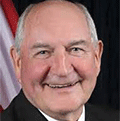
Former Georgia Governor Sonny Perdue
The selection of Perdue, announced a day before Trump’s inauguration on January 19, rounds out the new president’s cabinet.
“From growing up on a farm to being governor of a big agriculture state, (Perdue) has spent his whole life understanding and solving the challenges our farmers face,” Trump said in a statement announcing Perdue’s selection. “He is going to deliver big results for all Americans who earn their living off the land.”
In the same statement, Perdue said “making sure Americans who make their livelihood in the agriculture industry are thriving is near and dear to my heart.”
“I’m going to champion the concerns of American agriculture and work tirelessly to solve the issues facing our farm families in this new role,” he said.
If confirmed by the Senate, Purdue will oversee the sprawling U.S. Department of Agriculture, with more than 100,000 employees and a $140 billion budget. In addition to farm programs, the department also oversees food safety, national forests and the food stamp program that provides nutritional assistance to more than 40 million low-income Americans.
Perdue’s selection will present an unusual wrinkle in the Senate confirmation process, as one of the senators who will consider his nomination, U.S. Senator David Perdue, is Sonny Perdue’s first cousin.
Perdue, 70, served two terms as Georgia governor. His election in 2002 marked the first time a Republican had won the state’s chief executive post since Reconstruction, ending 130 years of Democratic dominance.
Perdue grew up on a farm in Houston County in central Georgia. During the presidential campaign, he had been a member of Trump’s agricultural advisory council.
13 Southern U.S. House Democrats bow out of Trump inaugural
All of the no-shows represent districts carried by Hillary Clinton
♦By Rich Shumate, Chickenfriedpolitics.com editor
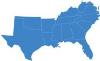 WASHINGTON (CFP) — Thirteen of the 40 Southern Democrats in the U.S. House have announced that they will not take part in the January 20 inauguration of Donald Trump.
Lawmakers from Florida, Georgia, Florida, Kentucky, Mississippi, North Carolina, Tennessee, Texas and Virginia are among the no-shows. All of the boycotting members represent urban or black-majority districts that were carried by Democrat Hillary Clinton.
Trump’s tweets castigating U.S. Rep. John Lewis, D-Georgia, for announcing an inauguration boycott seemed to particularly rankle some of the members opting not to attend; Trump’s reaction was called “repugnant,” “ignorant,” and “insensitive and foolish.”
“We are sending a message to Mr. Trump. Respect, like Pennsylvania Avenue, is a two-way street,” said U.S. Rep. Lloyd Doggett, D-Texas, who will be among the no-shows.
However, none of the three other Democrats in Lewis’s own Georgia delegation have joined the boycott. Also not joining so far is U.S. Rep. Debbie Wasserman Schultz, who, as head of the Democratic National Committee during the presidential campaign, had been a sharp Trump critic.
As for the contention by Trump supporters that the inauguration is a celebration not of him but of the peaceful transfer of power, U.S. Rep. Julian Castro, D-Texas, said, “Every American should respect the office of the presidency and the fact that Donald Trump will be the 45th President of the United States. But winning an election does not mean a man can show contempt for millions of Americans and then expect those very people to celebrate him.”
U.S. Rep. Gerry Connolly, D-Virginia, said Trump’s “behavior and harmful words during and after the campaign have left the country I love with open, bleeding wounds. Instead of binding those wounds, he has poured salt on them. Instead of unifying us, he has reveled in driving wedges between us.”
Trump won 108 of the 154 congressional districts across the South in the November election; none of them are represented by Democrats.
Lawmakers boycotting the inaugural are unlikely to pay a political price, as all but two of them represent districts that Clinton carried with at least 60 percent of the vote. However, U.S. Reps. Darren Soto, D-Florida, and John Yarmuth, D-Kentucky, come from districts where Clinton’s share was just 55 percent.
The list of boycotting Democrats includes:
Georgia
- John Lewis, D-Atlanta
Florida
- Alcee Hastings, D-Fort Lauderdale
- Darren Soto, D-Orlando
- Frederica Wilson, D-Miami-Dade
Kentucky
- John Yarmuth, D-Louisville
Mississippi
- Bennie Thompson, D-Jackson
North Carolina
- Alma Adams, D-Greensboro
- G.K. Butterfield, D-Wilson
Tennessee
- Steve Cohen, D-Memphis
Texas
- Lloyd Doggett, D-Austin
- Al Green, D-Houston
- Joaquin Castro, D-San Antonio
Virginia
- Gerry Connolly, D-Fairfax County
North Carolina Governor Roy Cooper enters office with call to end partisan friction
But new governor calls for repeal of law regulating transgendered bathroom use
♦By Rich Shumate, Chickenfriedpolitics.com editor
 RALEIGH (CFP) — In his inaugural address, incoming North Carolina Governor Roy Cooper issued a call to end the contentious politics that have bedeviled the start in recent years, but he also made it clear that he would push for repeal of a bill that limited use of public restroom facilities for transgendered people.
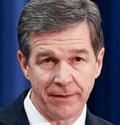
Attorney General Roy Cooper
“The people of this state are tired of yesterday’s politics. You expect and deserve public servants who reject cynicism, who don’t succumb to political paralysis, who negotiate differences in good faith,” Cooper said.
“I don’t think anyone believes that North Carolina families sit around the kitchen table every night thinking that their lives would change for the better if only the legislature would spend its time on the hot-button social issues of the day,” he said.
“People have bigger concerns, like why they haven’t gotten a raise in eight years or why the cost of health insurance is too much to bear or if they can afford to send their kids to college.”
Because of a snowstorm that paralyzed North Carolina, Cooper delivered his January 7 inaugural address on television, rather than to an outdoor crowd as initially planned.
Cooper, a Democrat, defeated incumbent Republican Governor Pat McCrory by just 10,277 votes out of nearly 4.8 million cast, which was the nation’s closest gubernatorial election this year and the only one that flipped from Republican to Democratic.
The most contentious issue in that election was House Bill 2 — passed by the GOP-controlled legislature and signed by McCrory — which required transgendered people to use bathrooms in public facilities consistent with their birth gender, rather than the gender with which they identify.
Cooper, who was attorney general at the time, opposed the measure and refused to defend it in court. In the wake of the bill’s passage, a number of major companies have dropped plans to move or expand in North Carolina, and the NBA, NCAA and ACC have all pulled sporting events out of the state.
After the election, the legislature met in special session to consider repealing the law, but Republican supporters of the law scuttled the effort. Cooper made in clear in his inaugural address that he would keep trying.
“This law has isolated and hurt a lot of people, damaged our state’s reputation and cost our economy hundreds of millions of dollars that could have paid our teachers and firefighters or built new highways,” he said.
“There are enough bipartisan votes in the legislature right now to fully repeal HB2 with no strings attached. This is not complicated. In fact, it’s very simple. Let them vote.”
Cooper will face a legislature dominated by Republicans. In the Senate, the GOP holds 35 seats to 15 for Democrats; in the House, Republicans have 74 seats and Democrats 46. Those margins are enough to override Cooper’s vetoes, which only requires a three-fifths majority in the Tar Heel State.
However, in late November, a federal judge struck down the state’s legislative districts on the grounds that they were improperly gerrymandered using racial considerations and ordered the legislature to draw new maps.
Unless the U.S. Supreme Court intervenes, new elections for the entire General Assembly will have to be held in 2017, which could allow Democrats to gain back some ground.
After the election, the legislature also passed measures to limit the number of political appointments Cooper can make and require that his cabinet picks to be approved by the legislature. Cooper has gone to court to challenge those new laws.
Cooper, 59, from Nash County in eastern North Carolina, served four terms as attorney general before seeking the governorship, the second longest tenure in that office in state history.
Electoral College: Despite protests, Southern electors stick with Trump
Trump carried 165 of the region’s 180 votes; two ‘faithless’ electors in Texas vote for Kasich, Ron Paul
♦By Rich Shumate, Chicken Fried Politics.com editor
(CFP) — Members of the Electoral College have met at 14 Southern statehouses and, as expected, gave the overwhelming majority of the region’s electoral votes to President-elect Donald Trump, ignoring calls by anti-Trump protestors to stop his elevation to the nation’s highest office.

Donald Trump
Trump carried 165 of the South’s 180 electoral votes in the December 19 vote. Hillary Clinton won the 13 electoral votes from Virginia, which was the only Southern state she carried.
The only place where Republican electors broke ranks was in Texas, where the defections of two Republican electors did not stop Trump from securing the 270 votes he needed to win the White House.
Chris Suprun, a Dallas paramedic who had previously announced he would not vote for Trump, cast his ballot for Ohio Governor John Kasich. Elector Bill Greene, who represented the 34th District, which takes in the Gulf Coast between Brownsville and Corpus Christi, voted for former Texas U.S. Rep. Ron Paul.
Afterward, Texas Governor Greg Abbott tweeted his support for a bill that would preclude so-called “faithless” electors by requiring them to vote for the candidate who carried the state on election day, in this case, Trump.
“This charade is over.,” Abbot said. “A bill is already filed to make these commitments binding. I look forward to signing it & ending this circus.
Twenty-nine states have laws binding electors to the popular vote winner in their states, including the Southern states of Oklahoma, Mississippi, Alabama, Florida, South Carolina, North Carolina and Virginia. Currently in Texas, state law doesn’t bind electors, although the Texas GOP required them to take an oath pledging to vote for the popular vote winner.
The Electoral College vote is usually a formality to which scant public attention is paid. However, Trump’s surprise win on November 8, coupled with his loss to Clinton by more than 2.8 million votes in the popular vote, galvanized anti-Trump protests at state capitols around the country.
Small groups of protestors gathered in Tallahassee, Atlanta, Nashville, Raleigh, Austin, Oklahoma City and Montgomery.
In Austin, shouts from protestors were audible inside the State House chamber where electors met, according to local media reports.
In Little Rock, anti-Trump activists took many of the seats in the old Supreme Court chamber in the State Capitol, where the vote took place. According to local media reports, one protestor was removed, although the electors also chatted amiably with the demonstrators before the vote took place.
South Carolina U.S. Rep. Mick Mulvaney named Trump’s budget chief
Mulvaney opposed Boehner, led the charge against 2013 bi-partisan budget deal
♦By Rich Shumate, Chicken Fried Politics.com editor
 WASHINGTON (CFP) — U.S. Rep. Mick Mulvaney of South Carolina, an ardent proponent of deep cuts in federal spending, is President-elect Donald Trump’s choice to lead the the Office of Management and Budget.

U.S. Rep. Mick Mulvaney, R-SC
Should Mulvaney be confirmed by the Senate, a special election will be triggered in the Palmetto State’s 5th District, which Mulvaney has represented since 2011. The district, which covers the north-central part of the state, is unlikely to change hands, as Mulvaney carried it by 20 points in the November election.
In a December 17 statement announcing his selection of Mulvaney, Trump called him “a very high-energy leader with deep convictions for how to responsibly manage our nation’s finances and save our country from drowning in red ink.”
“With Mick at the head of OMB, my administration is going to make smart choices about America’s budget, bring new accountability to our federal government, and renew the American taxpayer’s trust in how their money is spent,” Trump said.
In the same statement, Mulvaney said the new administration “will restore budgetary and fiscal sanity back in Washington after eight years of an out-of-control, tax-and-spend financial agenda.”
“Each day, families across our nation make disciplined choices about how to spend their hard earned money, and the federal government should exercise the same discretion that hardworking Americans do every day,” Mulvaney said.
Mulvaney, 49, from Lancaster, was elected to the House in the Tea Party wave of 2010, defeating former Democratic U.S. Rep. John Spratt, who had held the 5th District seat for 28 years.
Mulvaney is a member of the House Freedom Caucus, a group of conservative lawmakers who have often been at odds with their own GOP leadership. In 2013, he refused to support the re-election of John Boehner as House speaker, and later that year, he also opposed a bi-partisan budget deal hammered out by congressional leaders that was designed to prevent a government shutdown.
In 2015, Mulvaney endorsed one of Trump’s presidential rivals, U.S. Senator Rand Paul of Kentucky. But after Paul dropped out of the race, he switched his support to Trump.
Mulvaney is the second South Carolinian named to a major post in the incoming Trump administration. Governor Nikki Haley has been nominated to be the ambassador to the United Nations.


