
Latest Posts
Latest Coverage
-
Symbolic solution in search of an actual problem
Support of 9 Southern Republicans for Respect for Marriage Act shows why Supreme Court isn’t about to ban same-sex marriage ♦By Rich Shumate, ChickenFriedPolitics.com editor…
-

West Virginia stubborn, or playing hard to get
U.S. Senator Joe Manchin pisses off his party yet again … to what end? ♦By Rich Shumate, ChickenFriedPolitics.com editor Also in this report: Atlanta DA…
-

2 Mississippi Republican U.S. House members forced into runoffs after weak primary showings
Michael Guest narrowly trails challenger in 3rd District; Steven Palazzo clears just 32% in 4th District ♦By Rich Shumate, ChickenFriedPolitics.com editor JACKSON, Mississippi (CFP) –…
-

Mississippi Republican U.S. Rep. Steven Palazzo facing Tuesday primary fight amid ethics investigation
6 opponents hitting “No-Show Palazzo” over inattention to district, ethics problems ♦By Rich Shumate, ChickenFriedPolitics.com editor GULFPORT (CFP) — Mississippi U.S. Rep. Steven Palazzo —…
-

Primary Wrap: Kemp, Raffensperger survive Trump’s ire; Brooks makes Alabama U.S. Senate runoff
Texas Democratic U.S. Rep. Henry Cuellar survives challenge from the left; George P. Bush gets blown out by Attorney General Ken Paxton ♦By Rich Shumate,…
-

U.S. House’s last pro-life Democrat, Texas’s Henry Cuellar, fighting to keep seat in Tuesday primary runoff
Challenger Jessica Cisneros wanted House Democratic leaders to rescind Cuellar endorsement; they refused ♦By Rich Shumate, ChickenFriedPolitics.com editor LAREDO, Texas (CFP) — Amid the newly…
Former Texas Governor Rick Perry picked to head Energy Department
Perry will lead agency he pledged to abolish during his presidential campaigns
♦By Rich Shumate, Chicken Fried Politics.com editor
 WASHINGTON (CFP) — Former Texas Governor Rick Perry has been nominated to head the U.S. Department of Energy, despite his scathing criticism of President-elect Donald Trump when the two men battled for the Republican presidential nomination.

Former Texas Governor Rick Perry
Perry had also pledged to eliminate the department during his two presidential campaigns, most notably in his infamous “ooops” moment during a 2011 debate when he was unable to remember Energy as one of the three departments he had pledged to abolish.
In a December 14 statement announcing Perry’s nomination, Trump said that Perry “created a business climate that produced millions of new jobs and lower energy prices in his state, and he will bring that same approach to our entire country.”
“My administration is going to make sure we take advantage of our huge natural resource deposits to make America energy independent and create vast new wealth for our nation, and Rick Perry is going to do an amazing job as the leader of that process,” Trump said.
In the same statement, Perry said he was “deeply humbled” to be nominated for the energy post.
“As the former governor of the nation’s largest energy producing state, I know American energy is critical to our economy and our security,” he said. “I look forward to engaging in a conversation about the development, stewardship and regulation of our energy resources, safeguarding our nuclear arsenal, and promoting an American energy policy that creates jobs and puts America first.”
Perry, 66, served 14 years as governor of Texas from 2000 to 2014, the longest tenure of any governor in state history. But he was unable to parlay that experience into a successful run for the White House in either 2012 or 2016.
During his campaign against Trump for the 2016 nomination, Perry called him a “cancer on conservatism” and said his campaign would lead the GOP to “perdition.” But last May, as Trump was poised to capture the nomination, Perry endorsed him, and he later campaigned for Trump.
As energy secretary, Perry would oversee a vast bureaucracy that runs the nation’s nuclear programs, markets power from federal hydroelectric projects and regulates the nation’s electric grid and natural gas pipelines.
The agency also has a research arm that, among other things, has conducted studies regarding climate change. Perry has said he does not think the science used by proponents of climate change to make their case that human activity is warming the planet is “settled,” and he has rejected the idea that carbon dioxide — a naturally occurring compound fundamental to human life — should be considered a pollutant.
Perry is also a supporter of the Keystone XL pipeline, a project that proponents of climate change have been fighting. President Obama stopped the final phase of that project in 2015; Trump has vowed to reverse that decision and let construction proceed.
Kennedy wins Louisiana U.S. Senate seat; ‘Cajun John Wayne’ wins in House race
Republicans sweep the last three federal elections of the 2016 cycle
♦By Rich Shumate, Chicken Fried Politics.com editor
 BATON ROUGE (CFP) — The third time was the charm for State Treasurer John Kennedy, who has captured a U.S. Senate seat from Louisiana on his third attempt for the office.
Kennedy, a Republican, easily swept aside Democratic Public Service Commissioner Foster Campbell in the December 10 runoff, winning by a margin of 61 percent to 39 percent.
In the night’s only upset, voters in the 3rd U.S. House District went for a tough-talking former deputy sheriff, Clay Higgins,, who has been dubbed the “Cajun John Wayne” for anti-crime videos that have gone viral on the Internet. He beat Public Service Commissioner Scott Angelle, a veteran politician with a long pedigree.
The Senate race pitted two of the state’s best known and longest-serving politicians. Kennedy has been treasurer since 2000, while Campbell has served on the PSC since 2003.

State Treasurer John Kennedy
Kennedy, 64, from Madisonville, won on this third try for the Senate, having lost as a Democrat in 2004 and as a Republican in 2008 after switching parties in 2007.
Despite his long service in state office, Kennedy positioned himself as a political outsider ready to take on Washington.
“This campaign was about change versus status quo,” Kennedy said in his victory speech at a Baton Rouge hotel. “I believe that our future can be better than our present or our past, but not if we keep going in the direction that the Washington insiders have taken us for the past eight years.”
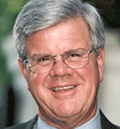
PSC Commissioner Foster Campbell
Campbell, 69, from Elm Grove, is also no stranger to losing campaigns, having lost three times for the U.S. House and once for governor. He faced an uphill battle in trying to win a Senate seat in a state that Donald Trump carried by nearly 20 points.
After Trump’s victory, donations to Campbell’s campaign poured in from around the country, pumping more than $2 million into his runoff effort. But in the end, it wasn’t enough.
“We worked as hard as possible. We left no stone unturned,” Campbell told supporters during a concession speech in downtown Baton Rouge. “We knew going in that this race was going to be tough.”
The Senate seat opened up after Republican U.S. Senator David Vitter decided to give it up to make an unsuccessful run for governor last year.
Kennedy’s win means Republicans will have 52 Senate seats, with 46 Democrats and two independents who caucus with the Democrats. Of the 28 Senate seats from the 14 Southern states, Republicans hold 24, with only four Democrats.
Runoffs were also held for two of Louisiana’s six U.S. House seats, which opened up when the incumbents made bids for the U.S. Senate. Republicans kept both seats.

U.S. Rep-elect Clay Higgins, R-La.
Celebrity trumped resume in the 3rd District, which takes in the Acadiana region of southwestern Louisiana.
Higgins, a former deputy sheriff in St. Landry Parish whose tough-talking Crime Stoppers videos became an Internet sensation, easily defeated Angelle, who has served for nearly 30 years in elected or appointed office, including a brief stint as lieutenant governor.
The margin was 56 percent to 44 percent. This was a Republican-versus-Republican runoff, as no Democrat survived the all-party jungle primary on November 8.
Bad blood left over from the 2015 governor’s race may have also played a role in Higgins’s victory. Angelle came in third in that race, behind Vitter and the eventual winner, Democrat John Bel Edwards, but refused to endorse Vitter in the runoff. That angered Republican leaders, some of whom worked on Higgins’s behalf.

U.S. Rep-elect Mike Johnson, R-La.
In the 4th District, which takes in the northwestern Louisiana, State Rep. Mike Johnson, from Bossier Parish defeated Democrat Marshall Jones, an attorney from Shreveport, by a margin of 65 percent to 35 percent.
With the victories by Angelle and Johnson, Republicans will maintain their 5-to-1 advantage in the state’s House delegation.
Across the South, Republicans hold 114 U.S. House seats to 40 for Democrats.
Oklahoma Attorney General Scott Pruitt picked as next EPA chief
Nomination of EPA critic to head agency is drawing fire from environmental groups
♦By Rich Shumate, Chicken Fried Politics.com editor
 WASHINGTON (CFP) — Oklahoma Attorney General Scott Pruitt, a vocal critic of the federal Environmental Protection Agency and a skeptic of climate change science, has been picked by President-elect Donald Trump to be the EPA’s next administrator.
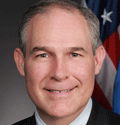
Oklahoma Attorney General Scott Pruitt
Pruitt’s nomination to the post was announced December 8 by Trump, who, like Pruitt, has been critical of EPA regulations on the energy industry designed to reduce carbon dioxide emissions.
“For too long, the Environmental Protection Agency has spent taxpayer dollars on an out-of-control anti-energy agenda that has destroyed millions of jobs, while also undermining our incredible farmers and many other businesses and industries at every turn,” Trump said in a statement announcing Pruitt’s selection.
“(Pruitt) will reverse this trend and restore the EPA’s essential mission of keeping our air and our water clean and safe.”
Pruitt, who has both sued and been publicly critical of the agency, said in his own statement that “the American people are tired of seeing billions of dollars drained from our economy due to unnecessary EPA regulations.”
“I intend to run this agency in a way that fosters both responsible protection of the environment and freedom for American businesses,” he said.
But Pruitt’s nomination has already run into fierce opposition from environmental groups.
Michael Brune, executive director of the Sierra Club, said in a statement that putting Pruitt in charge of the EPA “is like putting an arsonist in charge of fighting fires.”
Kassie Siegal, director of the Center for Biological Diversity’s Climate Law Institute, dismissed Pruitt as “a wholly owned subsidiary of the oil industry,” pointing to political contributions he has received from Oklahoma oil interests.
“Nominating him to lead the agency that protects our air, water and climate from pollution is like putting the Swamp Thing in charge of draining the swamp,” she said in a statement. “Any senator who doesn’t fight this nomination is handing corporate polluters a wrecking ball to destroy our future.”
Pruitt, 48, is in his second term as attorney general. His criticism of the EPA largely stems from the agency’s imposition of new restrictions on coal-fired power plants in order to curb carbon dioxide emissions, which proponents of climate change believe are harming the planet.
Pruitt, who has called the science behind the theory of climate change “unsettled,” sued the EPA after it rejected a plan put forward by the state to control power plant emissions in Oklahoma. He has also accused the EPA of overestimating the amount of air pollution caused by natural gas producers.
At a congressional hearing in 2015, Pruitt charged that the EPA was trying to force an “anti-fossil fuel agenda” on the states.
Trump, too, has been critical of the science behind climate change, once describing it as a hoax perpetuated by the Chinese. However, in an interview after he won the November 8 election, he partially walked back that statement, saying there might be a link between human activity and changes in global temperature.
Second Texas GOP elector bolts from Donald Trump
Elector Chris Suprun says Trump is not qualified to be president
♦By Rich Shumate, Chicken Fried Politics.com editor
DALLAS (CFP) — A Texas Republican presidential elector has announced he won’t vote for Donald Trump, making his case in a New York Times op-ed in which he argues the president-elect “shows daily he is not qualified for the office.”

Chris Suprin (Photo: Twitter)
“The election of the next president is not yet a done deal,” said Chris Suprun, a paramedic from Dallas. “Electors of conscience can still do the right thing for the good of the county. Presidential electors have the legal right and a constitutional duty to vote their conscience.”
Suprun said that while he has “poured countless hours into serving the party of Lincoln and electing its candidates,” Trump is an divisive demagogue who lacks foreign policy experience and has overseas business interests that would conflict with his role as president.
“I owe no debt to a party,” he said. “I owe a debt to my children to leave them a nation they can trust.”
Suprun did not say who would get his vote when Texas’s 38 electors meet to cast their ballots in Austin on December 19. However, he called on electors to “unify behind a Republican alternative, an honorable and qualified man or woman such as Gov. John Kasich of Ohio.”
Under Texas law, electors are not bound to vote for the candidate who carried the state in the November 8 election. However, the Texas Republican Party required all electors to take an oath pledging to vote for the winner.
Suprun was selected as the elector representing the 30th U.S. House District, a majority-minority area that includes much of the city of Dallas and southern Dallas County. While Trump carried the state, Hillary Clinton won Suprun’s district.
Suprun is the second Texas elector to refuse to vote for Trump, following Art Sisneros, who resigned as an elector rather than cast a ballot for the president-elect, which he said “would bring dishonor to God.
Sisneros will be replaced by the remaining electors when they meet on December 19.
Pat McCrory concedes to Roy Cooper in North Carolina governor’s race
Concession comes after vote recount in Durham County
♦By Rich Shumate, Chicken Fried Politics.com editor
 RALEIGH (CFP) — Nearly a month after election day, North Carolina’s hotly contested governor’s race has finally been settled and will flip into Democratic hands.
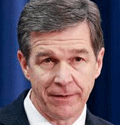
Attorney General Roy Cooper
Republican Governor Pat McCrory conceded the race to Democratic Attorney General Roy Cooper on December 5, after it became clear that an ongoing recount in Durham County would not overturn Cooper’s lead.
“Despite continued questions that should be answered regarding the voting process, I personally believe that the majority of our citizens have spoken,” McCrory said in a video posted on YouTube. “We now should do everything we can to support (Cooper).”
Cooper welcomed the concession in a Facebook post, bringing to an end a contentious race that became the most expensive governor’s race in state history.
“While this was a divisive election season, I know still that there is more that unites us than divides us,” Cooper said. “I’d like to thank all of the hardworking families in North Carolina, and I look forward to serving the greatest state in the country as your governor.”
Cooper’s lead over McCrory was 10,263 votes, out of more than 4.7 million votes cast, a difference of just .22 percent.
Cooper’s win is a rare moment of good news for Democrats in North Carolina, which went Republican in both the presidential and U.S. Senate races. The Cooper-McCrory contest was the only governor’s race in the country that shifted the office from Republican to Democrat.
Democrats will now hold four out 14 Southern governorships. The others are in Virginia, West Virginia and Louisiana. Republicans hold the remaining 10.
The contention over the results in Durham began on election night, when a batch of 90,000 votes came in all at once, propelling Cooper — who had trailed most of the night — into the lead statewide.
McCrory and his campaign found those results suspicious and demanded a recount. However, Durham election officials said the late reporting of results was caused by a technical problem that forced them to enter the results from voting machines by hand.
The Durham County elections board turned down McCrory’s request for a recount, but the State Board of Elections voted along party lines to order one.
In North Carolina, both state and county elections boards are appointed by the governor, and the governor’s party holds a majority.
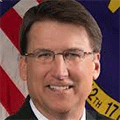
North Carolina Governor Pat McCrory
McCrory rode a GOP wave into office in 2012, but the Republican-controlled legislature’s passage of a controversial voter ID law and measures favored by religious conservatives made the governor a lightning rod.
The issue that dominated the race was McCrory’s decision to sign a law requiring transgendered students to use bathrooms that match their gender of birth, rather than their gender of identity, in public facilities.
McCrory continued to defend the law, even after a number of businesses scuttled expansion plans and the NCAA, NBA and ACC pulled events from the state.
Cooper not only opposed the measure, but he also refused to defend it in court when students and the federal government took legal action to overturn it.

 Chicken Fried Politics