
Home » Posts tagged 'Donald Trump' (Page 11)
Tag Archives: Donald Trump

Insight: How the coronavirus crisis has set off odd, angry crosscurrents across Southern politics
Budget woes, religious liberty, economic freedom crash against public health concerns
♦By Rich Shumate, ChickenFriedPolitics.com editor
 The collision between an untreatable and potentially deadly virus and a conservative Southern political culture that is both business-friendly and skeptical of government dicta has sent odd and even angry crosscurrents rippling across the region’s politics.
For example, in Mississippi, Governor Tate Reeves, who was slow to close down his state, had to backtrack on plans for a quick reopening when coronavirus cases rose, on the same day that legislators from both parties united to strip him of authority to spend a $1 billion pot of federal coronavirus money.
An angry Reeves accused them of “stealing.”

Editor Rich Shumate
In Nashville, Mayor John Cooper proposed a whopping 32 percent property tax increase to deal with a coronavirus-related shortfall in city revenue — and admitted that he agreed with critics who began howling about the possibility of sharply higher tax bills.
But, said Cooper, the city has no other choice.
In Kentucky, the new Republican attorney general, Daniel Cameron, joined a lawsuit seeking to invalidate a ban on interstate travel ordered by the new Democratic governor, Andy Beshear — which Beshear imposed because Tennessee’s Republican governor, Bill Lee, wasn’t imposing stay-at-home orders as strict as what Beshear issued in the Bluegrass State.
In Georgia, Governor Brian Kemp stubbornly stuck to plans to reopen his state, even though Peach State mayors and even President Donald Trump had urged him not to do so.
Coronavirus lockdowns have triggered angry protests across the South, and governors have struggled to stop pastors from holding church services — raising First Amendment arguments in the nation’s most religious section.
With a few exceptions, states in the South were among the last to close down due to the coronavirus, and they are now among the first to begin reopening, in spite of warnings from some public health officials that doing so might be dangerous.
The decisions being made by Southern governors certainly reflect the political split that coronavirus is increasingly causing nationwide, with conservatives willing to accept risk to revive the economy and liberals taking a more cautious (critics might say overcautious) approach that prioritizes public health over economic good.
Ten of the 14 Southern governors are Republicans, and the GOP controls both legislative chambers in every state except Virginia, fostering a political culture that tends to be friendly toward business interests and libertarian when it comes to questions of personal liberty.
But the push to reopen also reflects that fact that except for Louisiana, the coronavirus crisis has not been as extreme in the region as it has been in hot spots such as New York and New Jersey.
While Louisiana’s death rate per 100,000 people stands at 40, Georgia comes in at 11, and the rest of the Southern states are all less than 10 — statistics that bolster the arguments of unemployed people demanding an end to stay-at-home orders, although providing little comfort to people at higher risk for contracting COVID-19.
The push to reopen is also attractive to Southern leaders for another reason — the lockdown is blowing a hole in state and local budgets that will only get worse the longer it goes on, presenting an unpalatable choice between steep budget cuts or higher taxes.
State governments can’t deficit spend, and the income and sales tax revenues they rely on are falling sharply. The effect of the sales tax plunge will be particularly acute on three Southern states that don’t have an income tax to fall back on, Texas, Florida and Tennessee.
Florida — where Governor Ron DeSantis drew sharp criticism for being late to close — is also heavily reliant on taxes generated by tourism, which has been decimated by the crisis. Oil prices have also crashed, which affects Texas, Louisiana and Oklahoma, where lawmakers have been warned that they’ll need to deal with a $3 billion hit to the state’s budget.
Southern legislators have traditionally been reluctant to raise taxes, particularly income taxes in states that have them. But if they stick to that tradition, the cuts needed to balance budgets could be extreme — prompting outrage not only from those affected by the cuts, but also from those who believe the lockdowns were an unnecessary overreaction that caused more problems than they solved.
The strongest coronavirus crosscurrents have been seen in North Carolina and Kentucky, where Republicans control the legislature and Democratic governors were quicker to close and have been more reticent to reopen than their GOP counterparts.
In North Carolina, Roy Cooper faces the unenviable prospect of running for re-election in the middle of the pandemic against Republican Lieutenant Governor Dan Forest, who has been pushing the governor to move more quickly to reopen parts of the state less affected by the virus.
Anti-lockdown protests have also grown in size and anger in North Carolina, with much of the ire directed toward Cooper.
In Kentucky, Beshear’s moves to clamp down on church services have drawn criticism from U.S. senators Mitch McConnell and Rand Paul and other Republican leaders.
The GOP holds super-majorities in both houses of the legislature and could force Beshear to back down from his coronavirus restrictions, although — perhaps fortunately for the governor — legislators don’t have the power to call themselves back into session to undo his handiwork.
In the Southern state hit hardest by coronavirus, Louisiana, Democratic Governor John Bel Edwards’s imposition of a lockdown has encountered less resistance. But even there, some Republicans in the legislature are now plotting to use an obscure state law to force him to reopen the state.
The coronavirus crisis has focused attention, both nationally and regionally, on governors; however, governors in just two Southern states, North Carolina and West Virginia, have to face the voters this fall.
Of more consequence come November will be whether the Trump administration’s handling of the coronavirus crisis affects Republican candidates in races for federal offices, particularly the U.S. Senate, where 14 Southern seats are up.
That list includes both seats in Georgia, where Kemp has, for better or worse, forged his own path in dealing with the virus, and McConnell’s seat in Kentucky, where he’s already running ads touting his role in pushing coronavirus relief bills through Congress and his Democratic opponent, Amy McGrath, is deriding those bills as a sop to special interests.
Because no one knows how long the coronavirus crisis will last, or how things will turn out, its political consequences are as yet unknowable, particularly because we’ve never been through a crisis quite like this before.
Political stability and certainty, it seems, lie among coronavirus’s victims. The rest is unlikely to be peaceful.
We tweet @ChkFriPolitics Join us!
Kentucky U.S. Rep. Thomas Massie faces avalanche of criticism for forcing vote on coronavirus bill
Massie insists his stand was in defense of the Constitution, but Donald Trump suggests he be tossed from GOP
♦By Rich Shumate, ChickenFriedPolitics.com editor
 WASHINGTON (CFP) — U.S. Rep. Thomas Massie of Kentucky is defending his decision to force members of the House to return to Washington to vote on emergency coronavirus legislation against a torrent of criticism — including from President Donald Trump, who suggested Massie be drummed out of the Republican Party.
Massie objected to pushing through the $2 trillion measure with unanimous consent, which required House leaders to assemble a quorum of lawmakers who had to travel from their home districts back to the nation’s capital to vote on Friday.
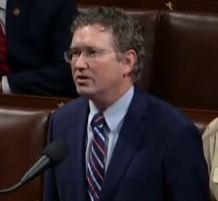
U.S. Rep. Thomas Massie, R-Kentucky, rises to object in the House (From C-SPAN via YouTube)
“I came here to make sure our republic doesn’t die by unanimous consent in an empty chamber,” Massie said on the House floor, drawing audible groans from his fellow lawmakers.
Earlier in the day, Massie defended his decision to try to delay the massive spending bill on Twitter, saying “I swore an oath to uphold the constitution, and I take that oath seriously.”
“The Constitution requires that a quorum of members be present to conduct business in the House,” he said. “Right now, millions of essential, working-class Americans are still required to go to work during this pandemic … Is it too much to ask that the House do its job, just like the Senate did?”
Massie’s stand derailed a plan by House leaders in both parties to push the bill through with unanimous consent, which would have allowed members to remain in their districts, where most of them had been during a scheduled recess.
However, while Massie blocked unanimous consent, he was unable to find enough support to force a roll call vote on the bill, which passed by a voice vote and was quickly signed into law by Trump.
Massie’s move triggered an eruption by Trump on Twitter, who dismissed the Kentuckian as a “third rate grandstander.”
“He just wants the publicity,” Trump said. “Workers & small businesses need money now in order to survive. Virus wasn’t their fault. It is ‘HELL’ dealing with the Dems, had to give up some stupid things in order to get the ‘big picture’ done. 90% GREAT! WIN BACK HOUSE, but throw Massie out of Republican Party!”
Trump also reacted to a tweet from former Secretary of State John Kerry after he said that Massie had “tested positive for being an asshole”: “Never knew John Kerry had such a good sense of humor! Very impressed!”
Trump’s reaction is welcome news for Todd McMurtry, a Covington attorney who is challenging Massie in the Republican primary in Kentucky’s 4th District — and would be the beneficiary if the president decides to move against Massie.
Massie had been sufficiently concerned about Trump’s potential support of McMurty that he aired an attack ad against him during Super Bowl weekend on TV in Palm Beach, Florida, where the president was staying.
The 4th District includes suburban Cincinnati and the Ohio River Valley between Louisville and Ashland.
Kentucky’s primary, originally scheduled for May, was moved to June 23 because of the coronavirus pandemic.
While Trump and Democrats were scorching in their criticism of Massie, two members of the conservative House Freedom Caucus came to his defense.
U.S. Rep. Chip Roy of Texas told Trump to “back off,” calling Massie “one of the most principled men in Congress.”
“He is defending the Constitution today by requiring a quorum. There’s nothing 3rd rate about that, @realDonaldTrump,” Roy said in a tweet.
In his own tweet, U.S. Rep Paul Gosar of Arizona called Massie “a good man and a solid conservative.”
“He believes in the Constitution strongly. We won’t always agree on strategy or policy. But he doesn’t warrant this dressing down,” Gosar said, adding “Thomas—Hang tough brother.”
Massie, 49, has served in Congress since 2012.
We tweet @ChkFriPolitics Join us!
Joe Biden sweeps to another victory in Florida Democratic presidential primary
Biden has now gone 10-for-10 in Southern primaries; Trump clinches GOP nomination
♦By Rich Shumate, ChickenFriedPolitics.com editor
 MIAMI (CFP) — Former Vice President Joe Biden easily vanquished his last major Democratic rival, U.S. Senator Bernie Sanders of Vermont, in Florida’s Democratic presidential primary Tuesday, in a race overshadowed by the coronavirus pandemic.
Biden took 62 percent of the vote, sweeping every one of the state’s 67 counties. Sanders took just 23 percent.
Meanwhile, President Donald Trump’s victory in the state’s Republican primary, against minor opposition, put him across the delegate threshold to clinch his party’s 2020 nomination. The president changed his residency to Florida earlier last year.
Florida election officials opted to proceed with Tuesday’s primary despite the national coronavirus shutdown. The run-up to election day was subdued, with neither Democratic candidate holding any rallies or campaign events. Trump has also called a halt to rallies with his supporters.

Biden speaks via video after Florida win
Biden’s win in Florida was wide and deep, taking his string of Southern victories to 10. His delegate margin over Sanders from the Sunshine State alone was more than 80 delegates.
The closest Sanders came to Biden was in Alachua County, home to the University of Florida. where Biden won by 11 points. But Sanders was pummeled in the heavily Democratic counties in South Florida, failing to clear 20 percent of the vote in either Broward or Palm Beach counties and getting just 22 percent in Miami-Dade.
Despite the concerns about coronavirus, the total turnout of Democratic voters was 1.7 million, about the same as it was in 2016, when Sanders took 33 percent of the vote in a race against Hillary Clinton. However, Florida makes extensive use of early voting that was less impacted by the pandemic.
Sanders, who was in Washington as the Senate considers emergency legislation to deal with the pandemic, did not make any public appearance after the vote.
With traditional election night celebrations canceled, Biden had to make do with a web video shot in his home in Wilmington, Delaware.
“We’ve moved closer to securing the Democratic Party’s nomination for president, and we’re doing it by building a broad coalition that we need to win in November,” Biden said.
As he did when he swept through the primaries a week ago, Biden also out an olive branch to Sanders and his supporters.
“Senator Sanders and I may disagree on tactics, but we share a common vision,” he said. “Our goal as a campaign, and my goal as a candidate for president, is to unify this party and then unify the nation.”
Four Southern states have yet to vote in the presidential race — Georgia, Louisiana, Kentucky, and West Virginia.
Georgia’s primary, scheduled from March 24, has been moved to May 19; Louisiana’s has been moved from April 4 to June 20; and Kentucky’s has been moved from May 19 to June 23. West Virginia’s primary is still scheduled for May 12.
We tweet @ChkFriPolitics Join us!

U.S. Senate nominations up for grabs Tuesday in 3 Southern states
Republicans will sort out the Senate race in Alabama, while Democrats tussle in Texas, North Carolina
 (CFP) — Alabama Republicans will decide Tuesday whether to reward or punish former Attorney General Jeff Sessions for his love-hate relationship with Donald Trump, while a gaggle of 12 Democrats jockey for the right to take on Texas Republican U.S. Senator John Cornyn in November.
Meanwhile, in North Carolina, the establishment pick for the Democratic nomination, Cal Cunningham, is trying to hold off two challengers, one of whom received unsolicited support from an unlikely source — a PAC affiliated with Senate Majority Leader Mitch McConnell.
Polls in Alabama and Texas are open from 7 a.m. to 7 p.m. local time; in North Carolina, the polls open at 6:30 a.m. and close at 6:30 p.m.
In Alabama, the Republican primary pits Sessions against U.S. Rep. Bradley Byrne, a Mobile Republican, and Tommy Tuberville, the former head football coach at Auburn University making his political debut. The winner will face Democratic U.S. Senator Doug Jones in November.
Sessions held the Senate seat for 20 years before giving it up in 2017 to become Trump’s attorney general, only to resign in late 2018 after his relationship with the president turned acrimonious in the wake of Sessions’s decision to recuse himself from the investigation into Russian meddling in the 2016 election.
Sessions parachuted into the Senate race last November, after Byrne and Tuberville had already been running for months. Since then, Sessions has gone out of his way to express fervent support for Trump, who carried Alabama by 28 points in 2016.
Trump has so far held his fire in the race, which polls show is likely headed to a runoff between Sessions and one of his two competitors on April 14.
Also in the race is Roy Moore, the former chief justice of the Alabama Supreme Court who lost to Jones in a special election in 2017 amid allegations of inappropriate sexual contact with underage girls, which he has denied. Polls show Moore lagging the rest of the field.
In Texas, the Democratic primary race in appears to be headed toward a runoff between MJ Hegar, who holds a strong lead the polls, and one of her 11 competitors.
Hegar, 43, a retired Air Force combat pilot, burst onto the political scene in 2018 when she nearly unseated Republican U.S. Rep. John Carter in his central Texas district. She entered the Senate race against Cornyn last April and raised nearly $4 million for the primary, which earned her an endorsement from the Senate Democrats’ campaign arm, the Democratic Senatorial Campaign Committee.
Battling for the second spot in the runoff are veteran State Senator Royce West from Dallas; Cristina Tzintzún Ramirez, a labor organizer from Austin who has garnered endorsements from a host of groups and figures on the left of the party, including New York U.S. Rep. Alexandria Ocasio Cortez; former U.S. Rep. Chris Bell from Houston; and Houston City Councilwoman Amanda Edwards.
If no candidate gets a majority, the top two competitors will face off in a May 26 primary.
In North Carolina, Cunningham, a Raleigh attorney and former state senator, is running against State Senator Erika Smith from Gaston and Mecklenberg County Commissioner Trevor Fuller.
A group called the Faith and Power PAC poured spent more than $2 million airing ads promoting Smith as the “progressive” in the race. Federal financial disclosure records show that the group was largely financed by the Senate Leadership Fund, a PAC closely aligned with McConnell that appeared to be trying to complicate Cunningham’s bid to unseat GOP U.S. Senator Thom Tillis.
Smith has denounced the ads, accusing Republicans of trying to meddle in the Democratic primary.
Under state law, Cunningham needs to win only 30 percent of the vote on Tuesday to avoid a runoff on May 12.
We tweet @ChkFriPolitics Join us!
Former Vice President Joe Biden makes comeback with blowout win in South Carolina
Biden revives his fortunes heading into Super Tuesday with nearly 30-point triumph in the Palmetto State
♦By Rich Shumate, ChickenFriedPolitics.com editor
COLUMBIA, South Carolina (CFP) — Former Vice President Joe Biden revived his flagging presidential campaign Saturday with a clear, convincing win in South Carolina’s first-in-the-South presidential primary, giving him crucial momentum heading into next week’s Super Tuesday contests.
Biden won 48 percent of the vote and carried all 46 counties, defeating Vermont U.S. Senator Bernie Sanders, who came in a distant second at 20 percent.
“Just days ago, the press and the pundits had declared this candidacy dead,” Biden told jubilant supporters in Columbia. “Now, thanks to you, the heart of the Democratic Party, we’ve just won, and we won big.”
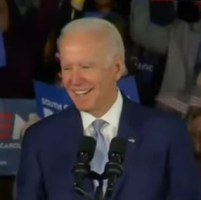
Joe Biden declares victory in South Carolina (From SkyNews via YouTube)
Biden used his victory speech to draw a contrast with Sanders, urging Democrats in the Super Tuesday states to “nominate someone who will build on Obamacare, not scrap it; take on the NRA and gun manufacturers, not protect them; [and] stand up to give the poor a fighting chance and have the middle class restored, not raise their taxes.”
The result in South Carolina was welcome news for Biden, who finished fourth in Iowa, fifth in New Hampshire, and a distant second to Sanders in Nevada. It also marked the first ever primary win for Biden in his third try for the White House.
The key to his win Saturday was a strong performance among African American voters, who made up 56 percent of the Palmetto State electorate. Exit polls showed that Biden took 60 percent of the black vote, running more than 40 points ahead of his nearest rival, Sanders.
Coming in third place in the statewide results was California billionaire Tom Steyer at 11 percent; followed by former South Bend, Indiana Mayor Pete Buttegieg, 8 percent; U.S. Senator Elizabeth Warren of Massachusetts, 7 percent; U.S. Senator Amy Klobuchar of Minnesota at 3 percent; and U.S. Rep. Tulsi Gabbard of Hawaii at 1 percent.
After the results came in, Steyer dropped out of the race.
Biden and Sanders were the only two candidates on the ballot Saturday who cleared the 15 percent threshold needed statewide and in congressional districts to claim delegates to this summer’s Democratic National Convention. Biden took 39 delegates, to 14 for Sanders.
However, former New York City Mayor Mike Bloomberg, who has spent nearly $500 million of his own fortune on his campaign, did not compete in South Carolina. He will make his debut in contests on Tuesday in 14 states, including seven in the South.
Only Democrats had a primary in South Carolina; Republicans canceled their primary in deference to President Donald Trump.
For Sanders, South Carolina marked his first defeat of the campaign, after tying for first in Iowa and winning outright in New Hampshire and Nevada. He also got a smaller percentage of the vote in than he did in 2016, when he won 26 percent in a two-way race against Hillary Clinton, and once again lost every county in the state.
Speaking to supporters in Virginia Beach, Sanders offered his congratulations to Biden before pivoting to make the case that he and not Biden offers the kind of revolutionary change that can lead to a Democratic victory in November.
“In order to defeat Trump, we are going to need the largest voter turnout in the history of this country,” Sanders said. “Old-fashioned politics — the same old, same old type of politics that doesn’t excite anybody, that doesn’t energize anybody — that is not going to be the campaign that beats Trump.”
Biden, Sanders and the rest of the field now turn their attention to Super Tuesday, with more than 1,300 delegates at stake nationwide, including 621 across the South.
The list of Southern states holding primaries Tuesday includes Virginia, North Carolina, Tennessee, Alabama, Texas, Oklahoma and Arkansas. Outside the region, primaries will be held in California, Colorado, Massachusetts, Minnesota, Maine, Utah and Vermont.
The state of the races in Alabama, Tennessee, Arkansas and Oklahoma is a big unknown, given a paucity of public polling in any of those states. The polling that has been done in Texas, North Carolina and Virginia shows Biden, Sanders and Bloomberg bunched at the top, with the other candidates trailing behind.
The question for Biden is whether his win in South Carolina will give him the momentum to push through in the Super Tuesday states, where he is being outspent by Bloomberg and will face Sanders’s formidable ground operation.
One of the biggest factors in who can carry these Southern states will be performance among African American voters, who make up a majority of the Democratic electorate in Alabama and more than a quarter in Arkansas, Tennessee, North Carolina and Virginia.
While Biden ran away with the black vote in South Carolina, he will face new competition Tuesday from Bloomberg, who has been organizing across the region and getting endorsements from African American elected officials.
 Chicken Fried Politics