
Home » Posts tagged 'Donald Trump' (Page 23)
Tag Archives: Donald Trump

Decision ’18: Democrat Bill Nelson concedes defeat in Florida U.S. Senate race
Republican Governor Rick Scott will move from Tallahassee to Washington after winning recount
♦By Rich Shumate, ChickenFriedPolitics.com
 TALLAHASSEE (CFP) — After protests, a flurry of lawsuits and two recounts, Democratic U.S. Senator Bill Nelson has conceded defeat to Republican Governor Rick Scott, possibly bringing the curtain down on a political career that spanned more than four decades and included a trip into space.
 Scott’s victory means there will be just four Democrats among the 28 senators representing Southern states, down one from the last Congress. And Florida will have two Republican senators for the first time since Reconstruction in 1875.
In a video released by his campaign, Nelson said that while he lost the Senate race, “I by no means feel defeated, and that’s because I’ve had the great privilege of serving the people of Florida and our country for most of my life.”
“It’s been a rewarding journey as well as a very humbling experience,” he said.
He also made a plea for more civility to combat “a gathering darkness” in American political life.
“We have to move beyond a politics that aims not just to defeat but to destroy, where truth is treated as disposable,” he said.
Scott, who has now won three consecutive statewide elections by thin margins, issued a statement thanking Nelson “for his years of public service.”
Nelson’s concession came after a machine recount of ballots in all 67 counties and a hand recount of ballots with under-votes or over-votes in the Senate race did not overturn Scott’s margin of victory.
Scott defeated Nelson by just 10,033 votes, out of nearly 8.2 million cast.
Scott had led on election night, but late reports of ballots from Democratic-leaning Broward and Palm Beach counties began narrowing the lead. Both Scott and President Donald Trump suggested that fraud was occurring in both counties, although evidence seemed to point to mismanagement rather than deliberate malfeasance.
In the following days, both campaigns went to court, and protests erupted outside elections offices in Broward — scenes reminiscent of the recount battle that erupted in the Sunshine State after the 2000 presidential election.
Nelson’s last hope was turning up uncounted ballots in Broward, where 25,000 fewer people voted in the Senate election than in the race for governor. But the hand recount confirmed that those ballots were indeed under-votes, which could have been caused by a flawed ballot design.
In Broward, the Senate race was listed at the bottom of a column underneath voting instructions, which could have resulted in some voters not seeing it.

Florida Governor Rick Scott
Scott, 65, went into politics after building a fortune in the health care industry. Financial disclosure reports put his net worth at around $250 million.
He won the governorship in 2010 with a margin of just 1.2 percent and won re-election in 2014 in an even closer race, 1 percent. His margin over Nelson in the Senate race was narrower still, 0.12 percent.
Scott’s win means Republicans will have at least 52 seats in the next Senate to 47 for Democrats, a net pickup of two seats. One seat remains to be decided in Mississippi, where Republicans are favored.
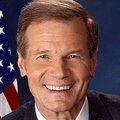
U.S. Senator Bill Nelson of Florida
Nelson, 76, won his first election, to the Florida House, in 1972. He served 12 years in the U.S. House and six years as Florida’s insurance commissioner before winning election to the Senate in 2000.
In 1986, while a sitting member of the House, Nelson went into space as a payload specialist on the space shuttle Columbia. His district included the Kennedy Space Center.
Just 10 days after his return, a different space shuttle, Challenger, exploded during launch, which ended NASA’s program of sending civilians into space.
With Nelson’s defeat, the only Democrats representing Southern states will be Mark Warner and Tim Kaine in Virginia, Joe Manchin in West Virginia, and Doug Jones in Alabama.
We tweet @ChkFriPolitics Join us!
Decision ’18: Florida governor’s race ends as Andrew Gillum reconcedes
Governor-elect Ron DeSantis will ascend to governorship after just four years in politics
♦By Rich Shumate, ChickenFriedPolitics.com editor
TALLAHASSEE (CFP) — The Florida governor’s race has come to an end with Democrat Andrew Gillum’s second concession to Republican Governor-elect Ron DeSantis.
Gillum — who had conceded on election night but took it back after late-reporting results showed the race tightening — took to Facebook Saturday to offer his congratulations to DeSantis and thank his supporters.
“More than 4 million of you decided that you wanted a different direction for the state of Florida,” he said. “We want you to know that we see you, we hear you, and that you voices will continue to power us.”
DeSantis responded to Gillum’s reconcession on Twitter: “This was a hard-fought campaign. Now it’s time to bring Florida together.”
After a statewide machine recount, Gillum still trailed DeSantis by 32,500 votes, which was more than the margin that would have triggered a hand recount of over-votes and under-votes that is underway in races for U.S. Senate and state agriculture commissioner.
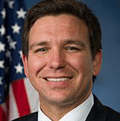
Florida Governor-elect Ron DeSantis
When DeSantis takes the governor’s chair in January, it will mark the latest step in his swift political rise, becoming the chief executive of the nation’s third-largest state at the age of 40, after just four years in politics.
DeSantis, who has degrees from Harvard and Yale, spent six years as an attorney in the U.S. Navy. In 2012, he was elected to a U.S. House seat representing part of metro Jacksonville.
In 2016, he entered the race for U.S. Senator Marco Rubio’s seat, which he had given up to run for president. But when Rubio reversed course after losing the Republican presidential nomination to President Donald Trump, DeSantis withdrew and ran for re-election to his House seat.
After Trump became president, DeSantis became one of his strongest defenders on television — a relationship that paid huge dividends when he decided to enter the governor’s race in January,
DeSantis was considered a long shot to defeat the establishment favorite, Agriculture Commissioner Adam Putnam. Then Trump tweeted an endorsement that catapulted DeSantis to a lead in the polls over Putnam that he never relinquished.
In the primary, the DeSantis campaign aired a TV ad in which he is seen reading Trump’s autobiography to his infant son and showing his daughter how to build a wall out of blocks, an echo of Trump’s call for a physical barrier along the U.S.-Mexico border.
Trump tweeted out congratulations after Gillum’s concession: “Against all odds, he fought & fought & fought, the result being a historic victory. He never gave up and never will. He will be a great Governor!’
However, Trump — who during the campaign had accused Gillum of being a “thief” — also tweeted out kind words about the Tallahassee mayor: “He will be a strong Democrat warrior long into the future – a force to reckon with!”
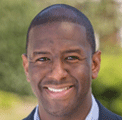
Tallahassee Mayor Andrew Gillum
Gillum, 39, became mayor of Tallahassee in 2014. Like DeSantis, he also won his party’s primary over the establishment favorite, former U.S. Rep. Gwen Graham, a victory which instantly made him a national political celebrity.
In his concession, Gillum indicated that he planned to remain in the political arena, although he gave no specifics. He will step down as mayor in January.
We tweet @ChkFriPolitics Join us!
Republican U.S. Rep. Karen Handel’s hard-won stay in Congress comes to a swift end
After winning her seat in 2017 in the most expensive U.S. House race in history, Georgia Republican concedes to political newcomer Lucy McBath
By Rich Shumate, ChickenFriedPolitics.com editor

 ROSWELL, Georgia (CFP) — In April 2017, veteran Georgia Republican politico Karen Handel, after twice losing races for statewide office, had arrived at the promised land, at end of a very long road.
She won a special election to fill Georgia’s 6th District U.S. House seat, narrowly defeating Democratic newcomer Jon Ossoff after $50 million was spent in a race fueled by Democratic anger over the election of Donald Trump.
Her future seemed assured in the 6th, anchored in Atlanta’s wealthy northern suburbs. The historically Republican seat had been previously held by former House Speaker Newt Gingrich and former U.S. Rep. Tom Price, who gave it up to serve in Trump’s cabinet. And when Ossoff decided not to challenge Handel again in the midterm election, her seat seemed secure and her political career restored.

Lucy McBath

Karen Handel
Until Tuesday’s midterm election, when Handel lost her seat to Democrat Lucy McBath, who didn’t have Handel’s political pedigree but did have a compelling personal story and an issue — gun control.
“After carefully reviewing all of the election results data, it is clear that I came up a bit short on Tuesday,” Handel said in a letter to Atlanta’s WSB-TV. “Congratulations to Representative-Elect Lucy McBath and send her only good thoughts and much prayer for the journey that lies ahead for her.”
The final result was close. Unofficial results showed McBath with a 2,900-vote lead, out of 316,000 votes cast. For Handel, it was déjà vu all over again — in 2010, she lost a Republican primary runoff for governor by 2,500 votes.
McBath, 58, a former flight attendant, had never held political office before. But she became a gun control activist after her 17-year-old son, Jordan Davis, was shot to death outside a convenience store in Jacksonville, Florida, by a man upset about loud hip-hop music played by Davis and three of his friends.
The shooter, Michael David Dunn, was convicted of first-degree murder in Jordan’s death and sentenced to life in prison.
After her son’s death, McBath became a national spokeswoman for Moms Demand Action for Gun Sense in America and was part of a group of mothers of slain African-American teens who appeared at the 2016 Democratic Convention. She decided to run for Congress after last February’s shooting at a high school in Parkland, Florida, in which 17 people died.
“Six years ago, I went from a Marietta mom to a mom on a mission,” McBath said in a statement declaring victory. “After my son was lost to gun violence, I stood up and started demanding more. After Parkland, I was compelled to enter this race for Congress — to provide leadership that would be about the business of putting lives over profit.”
McBath’s quest seemed implausible, running as she was against someone who had been county commission chair in the state’s largest country (Fulton) and secretary of state and came just a percentage point short in a race that would likely have made her governor. Gun control is also not an issue that generally helps Democrats, or anybody else, in Georgia.
Yet, McBath’s victory did not come completely out of left field. The district has become more diverse in recent years, with growing African-Amercian, Latino and Asian populations. Trump had only carried the 6th by 1.5 points in 2016, and Handel had to fight hard to win it in 2017. And toward the end of the campaign, McBath was winning the money chase, outraising Handel by a substantial margin.
Handel also wasn’t the only suburban Southern Republican who found tough sledding in the midterms. Incumbents lost in the Virginia suburbs of Washington, D.C., Richmond, Dallas, Houston and Miamia and even in Oklahoma City and Charleston, S.C..
But Handel’s loss, and a close call in the adjoining 7th District for Republican U.S. Rep. Rob Woodall, harbors a new reality for Georgia Republicans — in the age of Trump, suburbs are no longer safe GOP territory, even in the South.
The race for Georgia governor showed the ominous portents that may await. Democrat Stacey Abrams carried not only Fulton and DeKalb counties, both with large African-American populations, but also seven surrounding suburban counties, including the two biggest, Cobb and Gwinnett. Of the eight congressional districts that contain parts of metro Atlanta, four will now be held by Democrats, and a fifth was very nearly lost.
Republicans will, no doubt, come after McBath in 2020; the 6th is now truly a swing district. But she will have two years to build up her political profile, and she will be running for re-election in a presidential election year, which usually helps Democrats.
And Lucy McBath will always be the woman who won a race she wasn’t supposed to win, against a woman who wasn’t supposed to lose.
Election Preview: Four Southern U.S. Senate races are key in battle for control
Republicans are defending seats in Texas and Tennessee; Democrats in Florida and West Virginia
♦By Rich Shumate, ChickenFriedPolitics.com editor
(CFP) — With the balance of power in the U.S. Senate hanging in the balance, voters in four Southern states will decide hotly contested races in Tuesday’s midterm elections.
Republicans are defending seats in Texas and Tennessee that have turned out to be much more competitive than expected in two very Republican states. Meanwhile, Democratic incumbents are defending turf in Florida and West Virginia, states which President Donald Trump carried in 2016.
Another Senate seat is up in Virginia, where Democratic U.S. Senator Tim Kaine is favored to win re-election. Both seats are up this year in Mississippi, and Republican candidates are favored to hold both.
In Texas, Republican U.S. Senator Ted Cruz is seeking a second term against Democratic U.S. Rep. Beto O’Rourke, a race in which the challenger has sparked the imagination of Democratic activists around the country.
Cruz, who came in second to Trump in the 2016 Republican presidential nomination, was heavily favored for re-election at the beginning of 2018. But O’Rourke — trying to take advantage of a changing political electorate in fast-growing Texas, including more younger and Latino voters — has made the race competitive, even though Texas hasn’t elected a Democrat to the Senate in 30 years.
O’Rouke has raised more than $70 million for the race, the largest haul of any Senate candidate this cycle, according to Federal Election Commission records. Cruz has raised $40 million.
Despite Cruz’s often contentious relationship with Trump during the 2016 presidential primaries, which famously included Trump dubbing him “Lyin’ Ted,” the president has gone all out for Cruz in this race, even traveling to Houston for a campaign rally.
In Tennessee, Republican U.S. Rep. Marsha Blackburn is vying with former Democratic Governor Phil Bredesen for a seat which opened after the retirement of U.S. Senator Bob Corker, one of Trump’s strongest critics in Congress.
After first rebuffing calls for him to run after Corker announced he was leaving the Senate, Bredesen changed course last December and jumped into the race, giving Volunteer State Democrats a shot at capturing the seat behind the candidacy of a popular two-term moderate.
But Blackburn has fought back by trying to tie Bredesen to national Democratic leaders who are unpopular in Tennessee, in particular Hillary Clinton and Senate Minority Leader Chuck Schumer of New York.
Republicans currently have a slim one-vote majority in the Senate. However, because Democrats are defending more seats this cycle than Republicans, it is unlikely they can capture a Senate majority — and depose Kentucky’s Mitch McConnell as Senate majority leader — without winning in either Texas and Tennessee.
In Florida, Democratic U.S. Senator Bill Nelson is facing off against Republican Governor Rick Scott, who has served as the Sunshine State’s chief executive for the past eight years.
Nelson, who first arrived in Congress during the Carter administration, is a proven vote-getter seeking his fourth term. Scott’s two wins for governor were narrow, although his approval ratings have ticked up during the final year of his administration.
Florida is more evenly divided than either Texas or Tennessee, generally sending one senator from each party to Washington since the 1980s. Trump’s win in Florida in 2016 was by a single point, compared to a 9-point win in Texas and a 26-point win in Tennessee.
In West Virginia, Democratic U.S. Senator Joe Manchin was seen as particularly vulnerable given Trump’s 40-point win in the Mountaineer State. But Machin kept himself in contention by avoiding criticism of the president and supporting him on a number of high-profile issues, including both of Trump’s Supreme Court picks.
Manchin may have also benefited from the Republicans’ selection of a standard-bearer — State Attorney General Patrick Morrisey, who grew up in New Jersey, has only lived in West Virginia since 2006 and spent nearly a decade as a Washington lobbyist.
The folksy Manchin, a West Virginia native who served as governor before being elected to the Senate, has made much of that contrast. Morrisey has responded much the way Blackburn has in Tennessee — by trying to tie the incumbent to liberal establishment Democrats.
In Mississippi, both Senate seats are up this year due to the retirement of former U.S. Senator Thad Cochran. One race is a special election to fill the remainder of Cochran’s term; the other is for the seat occupied by Republican U.S. Senator Roger Wicker.
While Wicker is heavily favored over his Democratic challenger, State House Minority Leader David Baria, the special election features a three-way race in which candidates from all parties will compete and a runoff held between the top two vote-getters if no one captures a majority.
The special election is a three-way contest between Republican U.S. Senator Cindy Hyde-Smith, Cochran’s temporary replacement; Republican State Senator Chris McDaniel, who lost a bitter primary against Cochran in 2014; and Democrat Mike Espy, a former congressman who served as secretary of agriculture in the Clinton administration.
Depending on how evenly the Republican vote is divided, the top GOP candidate could face Espy in a November 27 runoff. But polls have showed Hyde-Smith with a wide lead over McDaniel, which could be enough for her to win the seat outright on Tuesday.
Although McDaniel was a vocal supporter of Trump in 2016, the president snubbed McDaniel and endorsed Hyde-Smith, who had been a Democrat until 2010. McDaniel has charged that Trump was “forced” into making the endorsement by Senate Republican leaders.
In Virginia, Kaine is facing Corey Stewart, chairman of the Prince William County Board of Supervisors, who served as Trump’s Virginia coordinator in 2016.
When he kicked off his campaign in July 2017, Stewart vowed to “run the most vicious, ruthless campaign” that he could against Kaine. However, public polling in the race has shown that strategy has failed to gain traction, and Kaine enjoys a wide lead.
See ChickenFriedPolitics.com’s latest ratings for hot U.S. Senate races
We tweet @ChkFriPolitics Join us!
Election Preview: Governor’s races could make history in Florida, Georgia
Democrats within shooting distance in Oklahoma, Tennessee; GOP incumbents heavily favored in Alabama, Arkansas, Texas and South Carolina
♦By Rich Shumate, ChickenFriedPolitics.com editor
(CFP) — Eight Southern governorships are on the ballot in Tuesday’s midterm elections, highlighted by close and contentious races in Florida and Georgia that have garnered national attention.

Abrams

Gillum
Democrats are hoping to make history: If Democrat Andrew Gillum wins in Florida, he will be the Sunshine State’s first African-American governor, while a victory by Democrat Stacey Abrams in Georgia would make her not only its first black governor but also the first woman to hold the post and the first black female governor in U.S. history.
However, in both states, Democratic nominees will have to overcome a long history of Republican control. The last time a Democrat won a governor’s race in Florida was 1994; in Georgia, 1998.

Kemp

DeSantis
In Florida, the Republican nominee is former U.S. Rep. Ron DeSantis, who has received considerable help in his quest for the governorship from President Donald Trump. The president stopped twice in Florida to campaign for DeSantis in the closing days of the campaign.
The Republican nominee in Georgia is Secretary of State Brian Kemp, who has also benefited from a Trump endorsement and a presidential visit on the Sunday before the vote.
Public polling has shown both races are within the statistical margin of error, which means neither race can be forecast with certainty heading into election day.
In 2016, Trump carried Florida by a single point and Georgia by 5 points. While Florida has long been a swing state, the result in Georgia was the smallest win by a Republican in the Peach State since 1996, giving Democrats hope that it might be in play in 2020.
A win by either Abrams or Gillum would be a boon to Democratic prospects in 2020. It will also give them a say in redrawing congressional districts after the 2020 census — a process that Republicans have totally controlled in both states for the past decade.
And if the race in Georgia is close, it might not be decided on election night. State law requires a candidate to win an outright majority to claim the governorship. With a Libertarian in the race, neither major-party candidate could reach that threshold, triggering a December 4 runoff between them.
The remaining six Southern governorships up this year — all held by Republicans — look to be more secure, though Democrats may have outside shots in Oklahoma and Tennessee.
 In the Sooner State, where Republican Governor Mary Fallin is term-limited, Republican businessman Kevin Stitt is facing former Democratic Attorney General Drew Edmondson, who comes to the race having served 16 years in statewide office.
Approval polling has pegged Fallin as America’s most unpopular governor, which has not helped Stitt’s cause. Oklahoma teachers also went on strike last year in a public display of protest that has reverberated through state politics.
Public polling has shown Stitt with a small lead near the edge of the margin of error. While Stitt is still regarded as the favorite, one prominent national prognosticator, The Cook Political Report, rates the race as a toss-up.
 In Tennessee, where voters are also filling an open seat for a term-limited incumbent, Governor Bill Haslam, Republican Bill Lee, a first-time candidate who worked in Haslam’s administration, is facing Democrat Karl Dean, the former mayor of Nashville.
Public polling has shown Lee above 50 percent and with a statistically significant lead over Dean.
Four other governor’s races on the midterm ballot — in Arkansas, Alabama, Texas and South Carolina — all feature Republican incumbents who are expected to easily win re-election:
- In Arkansas, Governor Asa Hutchinson is facing Jared Henderson, a non-profit executive and former NASA research scientist.
- In Alabama, Governor Kay Ivey is being challenged by Tuscaloosa Mayor Walt Maddox. Ivey became governor in 2017 after her predecessor, Robert Bentley, resigned after a sex scandal. Since then, Ivey ridden a wave of public approval for her handling of the aftermath.
- In Texas, Governor Greg Abbott is squaring off against former Dallas County Sheriff Lupe Valdez.
- In South Carolina, Governor Henry McMaster is running against Democratic State Rep. James Smith from Columbia. McMaster became governor in 2017 after Nikki Haley left office to become Trump’s U.N. ambassador.
Heading into Tuesday’s election, Republicans hold 11 of the 14 Southern governorships; Democrats are in charge in North Carolina, Louisiana and Virginia.
See ChickenFriedPolitics.com’s latest ratings for hot governor’s races.

