
Home » Posts tagged 'Donald Trump' (Page 33)
Tag Archives: Donald Trump

West Virginia Governor Jim Justice switches from Democrat to Republican
Governor makes dramatic announcement at Donald Trump rally
♦By Rich Shumate, ChickenFriedPolitics.com editor
 HUNTINGTON, West Virginia (CFP) — Just nine months after winning West Virginia’s top job as a Democrat, Governor Jim Justice has switched to the Republican Party, telling his voters that “I can’t help you anymore being a Democrat governor.”

Governor Jim Justice
Justice made his announcement in the most public way possible — at August 3 campaign-style Donald Trump rally in Huntington, with the president looking on. And the newly minted Republican, a longtime friend of Trump and his family, offered an unqualified endorsement of his new party’s standard-bearer.
“This man is a good man. He’s got a backbone,” Justice said. “He’s got real ideas. He cares about America. He cares about us in West Virginia.”
Trump carried West Virginia by 42 points in November, his biggest margin of victory in any state except Wyoming, at the same time Justice was keeping the statehouse in Charleston in Democratic hands.
However, Justice told the crowd in Huntington that the decision to bolt to the GOP also stemmed from a dispute he had with Democrats in the legislature after a tax plan he crafted with Republican help went down to defeat.
“At the altar, when we had it done, like or or not, but the Democrats walked away from me,” he said.
In response to Justice’s announcement, West Virginia Democratic chairwoman Belinda Biafore issued a statement accusing the governor of caring more about his own political future than the people of his state.
“During his campaign for governor, Jim Justice said he would never lie to the public; he said he would never be a politician, and he would definitely be a full-time governor. None of those promises were kept,” she said.
“Jim Justice took advantage of Democrats by taking our money and our votes. It’s a slap in the face to all of us who believed in what he was promising. I never thought I would see Jim Justice be anyone’s puppet. Shame on him.”
Republicans control both house of the West Virginia legislature, which means Justice will now be titular head of a party that has complete control of state government for the first time since at least 1931.
Justice, noting that his late parents were both “staunch Republicans,” said he imagined that his mother was in heaven “saying ‘Jimmy, it’s about damn time you came to your senses.”
He also took a shot at those focusing on the investigation into Russian meddling in the presidential election, which has been dominating the conversation in Washington.
“Haven’t we heard enough about the Russians?” Justice said, drawing thunderous applause from the pro-Trump crowd. “I mean, to our God in heaven above, think about it. The stock market’s at 22,000. And this country has hope. And we’re on our way.”
Like Trump, Justice, 66, was a billionaire businessman with no political experience before being elected, a fact the governor also noted while announcing his switch.
“This man and myself are not politicians. We ran to get something done,” he said. “We ran because we want nothing. We ran as our Founding Fathers did years and years ago, to serve.”
A sitting governor changing parties during his term in office is extraordinarily rare. The only recent precedent was former Florida Governor Charlie Crist, who switched from Republican to independent in 2010 during an unsuccessful run for U.S. Senator. Crist is now a Democratic member of the U.S. House.
Justice’s switch means that Democrats now hold just three of 14 Southern governorships, in North Carolina, Louisiana and Virginia. Nationwide, Republicans hold the governor’s office in 34 states, matching their all time high.
U.S. Rep. Diane Black will run for Tennessee governor in 2018
House Budget Committee chair is now the third woman vying for her state’s top job
♦By Rich Shumate, ChickenFriedPolitics.com editor
 NASHVILLE (CFP) — U.S. Rep. Diane Black will give up the chairmanship of the powerful House Budget Committee to make a run for Tennessee’s open governorship in 2018.

U.S. Rep. Diane Black, R-Tennessee
In an announcement video posted August 2, Black burnished her conservative bona fides as she prepares to battle two other Republican women also vying to be the first female governor in state history.
“In Tennessee, we’re conservative, and we do things the right way, no matter what Hollywood or Washington thinks about it,” Black said. “We believe in absolute truths — right is right, wrong is wrong, truth is truth, God is God, and a life is a life. And we don’t back down from any of it.”
And although, as a committee chairman, Black is part of the House GOP leadership team, she also touted her independence, insisting that “I wasn’t afraid to stand up to the weak-kneed people in my own party when I had to.”
“I believe in secure borders and tough choices in cutting spending and beating the liberals instead of caving in to them.”
Black, 66, who worked as a nurse before getting involved in politics, served in both houses of the Tennessee legislature before winning her seat in Congress, representing the Volunteer State’s 6th District. She became chair of the budget committee earlier this year when former chair Tom Price left to join President Trump’s Cabinet.
Her decision to run for governor opens up what is likely to be a lively Republican primary in the 6th District, which stretches from Nashville’s eastern suburbs across a swath of north-central Tennessee. The district is heavily Republican, making a Democratic pickup of the open seat unlikely.
The governorship is open in 2018 because incumbent Republican Governor Bill Haslam is term-limited.
For the last 220 years, every Tennessee governor has been a man. But Black is now the third prominent Republican woman in the governor’s race, joining State Senator Mae Beavers from Mt. Juliet, who has been in the Senate since 2002, and State House Speaker Beth Harwell from Nashville, who in 2011 became the first female House speaker in state history.
Two businessmen are also in the GOP race: Randy Boyd from Knoxville, who owns two minor league baseball teams and served as an adviser to Haslam, and Bill Lee, a Franklin rancher who owns a home services company.
On the Democratic race, former Nashville Mayor Karl Dean is running and may face State House Minority Leader Craig Fitzhugh of Ripley, who is considering a run.
While Tennessee has trended Republican in recent presidential elections and Republicans dominate the state’s congressional delegation, neither party has been able to win the governorship for more than two terms in a row since Democrats did so in 1966.
Republican Corey Stewart promises “vicious, ruthless” campaign to unseat U.S. Senator Tim Kaine
Stewart enters race just a month after losing race for governor
♦By Rich Shumate, ChickenFriedPolitics.com editor
 WOODBRIDGE, Virginia (CFP) — Just a month after narrowly losing a Republican primary for Virginia governor, Corey Stewart started a new race against U.S. Senator Tim Kaine with an unapologetic vow to “run the most vicious, ruthless campaign” he can to unseat the Democratic incumbent.

GOP Senate candidate Corey Stewart
“I’m going to go after him very, very hard,” said Stewart, who gained national prominence while serving as President Trump’s Virginia state chairman during the 2016 presidential campaign. “I think that Republicans have been playing by the Marquess of Queensberry rules for too long, and Democrats have been fighting a UFC fight.”
In his opening campaign salvo at his home in suburban Washington, D.C. on July 13, Stewart also made it clear that he would wrap himself in the Trump mantle in the Senate race, as he did in his unsuccessful race for governor.
“Tim Kaine is doing everything in his power to stop the president of the United States from making the economy great again, from bringing back jobs, from reforming health care and from making America great again,” he said, accusing Kaine of having a “blind hatred” for Trump that makes him “so focused on taking down the president of the United States that he is ignoring the true needs of Virginians and other Americans.”
However, Stewart didn’t stop with attacking Democrats. He began his announcement by saying how “disgusted” he had been by the 1989 inaugural address of President George H.W. Bush, a pillar of the GOP establishment.
“I was disgusted at the phrase kinder, gentler nation,” he said. “I knew right then that it was the end of the Reagan revolution.”
Stewart, 48, has been chairman of the Prince William County Board of Supervisors since 2006. He was Trump’s state chairman in Virginia until a month before the 2016 election, when he was sacked after organizing a protest outside of Republican National Committee headquarters demanding that the GOP hierarchy not abandon Trump in the wake of the release of an audiotape in which Trump made lewd sexual comments.
In the June 13 GOP gubernatorial primary, Stewart nearly defeated former RNC chairman Ed Gillespie, a one-time aide to President George W. Bush who had been seen as a presumptive favorite. Stewart said his surprisingly strong showing in that race, which he lost by only 4,500 votes, was part of the reason he decided to set his sights on unseating Kaine.
In the governor’s race, Stewart ran as an anti-establishment candidate and vowed to resist efforts to remove monuments honoring the Confederacy. He is not, however, a native Southerner, having been born in Minnesota.
Running as a Trump champion could be problematic in Virginia, which was the only Southern state Hillary Clinton carried in 2016.
Kaine — Clinton’s vice presidential running mate — also has a venerable political pedigree in the Old Dominion, having served as governor and lieutenant governor before being elected to the Senate in 2012. And no Republican has won a Senate race in the commonwealth since 2002.
Stewart’s vow of viciousness at the starting line drew a rebuke from Susan Swecker, chair of the Virginia Democratic Party, who called him “more extreme than Donald Trump.”
“Corey has completely ignored the needs of families in Prince William County to instead spend his time name calling, bashing immigrants and re-litigating the Civil War,” she said in a statement. “When he rarely turns his attention to the county he was elected to represent, he calls his colleagues ‘slimeballs’ and pushes an anti-immigrant, backwards agenda that has left working families behind.”
“The last thing Virginians need in the Senate is a rubber stamp for President Trump,” she said.
And before he gets to Kaine, Stewart will likely have to face down a primary challenge. Among the Republicans considering the race is Carly Fiorina, the former Hewlett-Packard executive who sought the Republican presidential nomination in 2016.
Fiorina ran for the U.S. Senate in California in 2010 but later relocated to Virginia, where she had lived earlier in her business career.
Analysis: South is the GOP’s ace in the hole in stopping Democratic takeover of U.S. House
Democrats will need to flip 11 Southern seats or make make up the difference elsewhere
♦By Rich Shumate, ChickenFriedPolitics.com editor
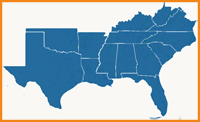 (CFP) — With President Trump’s approval ratings at historically low levels, Democrats have high hopes of taking back the U.S. House in 2018. But those hopes are tempered by a giant geographic obstacle standing in their way — namely, the South.
 To reclaim the House, Democrats need to flip 24 seats, shifting about 10 percent of the seats that Republicans now hold. And nearly half of the GOP caucus — 114 seats — is from the South, where Republican House members outnumber Democrats by 3-to-1.
So a 10 percent shift in the South would require winning 11 seats, in a region where Democrats won just two seats in 2016 (both in Florida and neither yet safe.) If Democrats fall short of that total, they will need to shift an even higher percentage of seats throughout the rest of the country — as much as 19 percent if they come up empty in the South.
And as Democrats plot and plan to add to their meager total of 40 Southern House seats, two recent special elections for open seats offer decidedly mixed omens on their chances for overturning the GOP’s hegemony.
In South Carolina’s 5th District, the swing away from Trump’s 2016 numbers in the special election was nearly 20 percent — not enough for Democrat Archie Parnell to win but a much bigger scare than Republicans had expected. Indeed, if that 20-point swing could be replicated across the South in 2018, 42 GOP-held seats could potentially be in play, more than Democrats would need to return Nancy Pelosi to the speaker’s chair.

Handel
But the results in the other race, in Georgia’s 6th District, pour substantial caution on such irrational exuberance. Republican Karen Handel kept the seat by running slightly ahead of Trump, in a race where Democrats spent a whopping $30 million and still came up short.
And this district in the northern Atlanta suburbs is exactly the kind of place where Democrats will need to compete to claw away at Republican dominance in the South next year — increasingly diverse, maturing suburbs whose upscale, educated voters, though conservative by inclination, are somewhat wary of Trump’s stewardship of the GOP brand.
If Democrats couldn’t win this race for an open seat in a low-turnout special election with a highly energized base and a president with historically low approval ratings, flipping these seats in 2018 will be a tall order indeed, particularly given Trump’s solid base of support in the South.
So where can Democrats start? Their first targets will be three majority Latino districts in metro Miami, all of which have large numbers of Cuban-American voters. Trump lost two of these districts and only narrowly won the third.
Veteran GOP U.S. Rep. Ileana Ros-Lehtinen is retiring, and Republicans will be hard pressed to keep her seat in a district Trump lost by 20 points. But in the other two districts, Democrats will have to unseat incumbents Carlos Curbelo, who has gone out of this way to distance himself from Trump, and Mario Diaz-Balart, who has been winning congressional elections with relative ease since 2002.
Democrats are also likely to target four other Southern districts where Hillary Clinton defeated Trump last year, which include three seats in Texas and one in Virginia. The GOP, however, has held three of these districts, in varying configurations, for decades.

Comstock
The Virginia seat, in the Washington D.C. suburbs, is held by Barbara Comstock, who first won it in 2014 and was narrowly re-elected in 2016. Even at this early date, she has already drawn six Democratic challengers in a district that, like the rest of Virginia, has become more hospitable to Democrats over the last decade.
In Texas, the climb for Democrats will be steeper. Clinton won the 32nd District in suburban Dallas, but that seat is held by Pete Sessions, a GOP titan who won by 52 points in 2016. She also won the 7th District in suburban Houston, where John Culberson ran well ahead of Trump to win by 12 points.
While Democrats appear eager to try to unseat both (Culberson already has seven challengers and Sessions nine), these districts have long Republican pedigrees reminiscent of Georgia’s 6th District, which was once represented by Newt Gingrich. Former President George H.W. Bush began his political career in the 7th District in 1967; former President George W. Bush’s Dallas home is in the 32nd.

Hurd
Democrats may have more luck in Texas’s 23rd District, which stretches from the suburbs of San Antonio across rural West Texas. This district is part of an ongoing legal fight over the state’s 2013 redistricting map, and a panel of federal judges is considering changes that could make it more difficult for Republican Will Hurd to hang on for a third term.
After those Clinton-won districts, the next set of seats Democrats might logically target are those where Trump’s winning margin was less than 10 points and where it would take less than a 10-point swing from the 2016 congressional results to put the seat in Democratic hands. But that list contains a scant eight seats — four in Texas, two in North Carolina and one each in Florida and Virginia. None of them are open at this point.
After that, the pickings get even slimmer — places like Arkansas’s 2nd District, where a Democrat can carry Little Rock only to get swamped by the Republican vote in the suburbs, and Florida’s 3rd District, where liberal-leaning Gainesville is subsumed in a sea of more traditional, conservative Southern voters. To be competitive in these districts, Democrats would have to commit to putting resources into races where chances of victory would appear, at the moment, to be rather remote.
So if Democrats can’t move the playing field into these second and third tiers, they have a reasonable shot at just seven Republican-held Southern seats, five of which have been in GOP hands for decades and all but one of which is likely to have an incumbent. And any anti-Trump tide that helps them in other parts of the country will likely not crest as high in the South.
With a lot of angry voters and a lot of luck, Democrats may indeed swing enough seats in 2018 to win control of the House. But as Republicans try to stop them, their ace in the hole is their dominance across the South, which should give them plenty of reason for confidence.
GOP keeps South Carolina U.S. House seat with vastly decreased margin
Republican Ralph Norman defeats Democrat Archie Parnell by just 3 points
♦By Rich Shumate, ChickenFriedPolitics.com editor
 COLUMBIA, South Carolina (CFP) — Republican Ralph Norman has won the special election for South Carolina’s 5th District U.S. House seat, but Democrat Archie Parnell managed to trim more than 17 points from the GOP’s 2016 margin despite getting little support from Democrats nationally.

U.S. Rep.-Elect Ralph Norman, R-South Carolina
With all of the precincts reporting in the June 20 vote, Norman, a former state representative, won 51.1 percent to 47.9 percent for Parnell, a former Goldman Sachs executive making his first run for political office.
That 3.2-point margin showed a marked deterioration in Republican support since the November election. President Trump won the district by 19 points in 2016, while Mick Mulvaney, who gave up the seat to become director of the Office of Management and Budget, won by nearly 21 points.
The 5th District takes in the north central part of the state, stretching along the I-77 corridor from the suburbs of Charlotte down to near Columbia.
Norman, 63, is a real estate developer from Rock Hill who served two stints in the state House, first from 2005 to 2007 and then from 2009 until he resigned to run for Mulvaney’s seat. He was favored to win after dispatching State Rep. Tommy Pope in May’s Republican primary runoff.

Archie Parnell, D-Congressional candidate
Parnell, 66, from Sumter, is a South Carolina native who is currently a senior adviser to Goldman Sachs after working there as a managing director for 20 years. He is also a former tax attorney for ExxonMobil and worked in Washington as senior counsel for a House committee from 1976 to 1980.
While Parnell’s long-shot campaign won enthusiasm from South Carolina Democrats, the national party and Democratic leaning outside groups largely avoided the 5th District race, concentrating their firepower instead on a House runoff in Georgia, held the same day, that was considered more winnable.
Parnell also had the endorsement of John Spratt, the Democrat who held the seat for 28 years before being ousted by Mulvaney in the Republican wave of 2010.
Norman’s win, along with a win by Republican Karen Handel in the Georgia 6th District runoff, means Republicans have successfully defended all four of the House seats that became vacant when their occupants were appointed to positions in the Trump administration. The other elections were in Kansas and Montana.

