
Home » Posts tagged 'Donald Trump' (Page 34)
Tag Archives: Donald Trump

Voters give verdict on expensive slugfest in Georgia’s 6th U.S. House District runoff
Democrat Jon Ossoff hoping to wrest away traditionally GOP seat in suburban Atlanta
♦By Rich Shumate, ChickenFriedPolitics.com editor
 ROSWELL, Georgia (CFP) — The most expensive U.S. House race in American history is drawing to a close, with Republican Karen Handel and Democrat Jon Ossoff making last-minute pitches in a special election runoff to fill Georgia’s vacant 6th District seat.
Polls in the June 20 runoff open at 7 a.m. and close at 7 p.m. EDT, with the results expected to draw outsized national attention.
A victory by Ossoff in a district the GOP has held for decades will be seen as a harbinger of potential doom for House Republicans in 2018. But a win by Handel would make Republicans three-for-three in winning House special elections this year, possibly tempering the speculation about how much President Trump’s historic unpopularity ratings are really eroding the party’s electoral health.
No matter the outcome, the competitiveness of the race wasn’t what Trump had in mind when he appointed Tom Price to head the U.S. Department of Health and Human Services, leaving an open seat that Republicans expected to defend easily.

Jon Ossoff, D, Georgia 6th District candidate
Fueled by liberal anger at Trump’s election, Ossoff — a 30-year-old filmmaker and former congressional aide seeking office for the first time — raised a staggering $23.6 million by the end of May, according to a report filed with the Federal Elections Commission. That figure doesn’t include any additional money raised during the first three weeks of June, as his runoff with Handel moved toward its climax.
Handel, a former Fulton County Commission chair and secretary of state, raised just $4.5 million by the end of May, although outside GOP-aligned groups have spent additional money on her behalf.
When all of the candidate and outside spending is tallied, the total is expected to approach $50 million, shattering all previous records for U.S. House races. To put that spending in perspective, a $50 million race would come to roughly $71 each for every man, woman and child in the district — and would be the equivalent of a $700 million statewide race in Georgia.
The 6th District arcs across Atlanta’s northern suburbs, taking in parts of Cobb, Fulton and DeKalb counties. Since its present configuration was drawn after the 1990 census, the seat has been held by Newt Gingrich, who went on to become speaker of the House; Johnny Isakson, who went on to the U.S. Senate; and Price, now in Trump’s Cabinet.
While Price won the district by 76,000 votes in November, Democrats smelled blood after Trump only managed to carry it by a scant 1.5 percent, on his way to becoming the first Republican to lose Cobb County since 1976. Trump also lost the March 2016 Republican primary in the district to U.S. Senator Marco Rubio of Florida.
Ossoff had initially begun his campaign with the slogan “Make Trump Furious.” But after coming in first in the April 19 primary, he eschewed nationalizing the campaign and sought to focus on district-specific issues.

Karen Handel, R. Georgia 6th District candidate
For Handel, 55, the second-place finish in the primary was a welcome political comeback after back-to-back losses to Governor Nathan Deal in a GOP runoff in 2010 and a Republican primary for the U.S. Senate in 2014. She served as secretary of state from 2007 to 2011 and as chair of the Fulton County Commission from 2003 to 2006.
Trump has not campaigned in person for Handel, although he did tape an anti-Ossoff robocall before the primary. But Vice President Mike Pence and Price both came down from Washington to make appearances on her behalf.
Primaries for Virginia governor echo 2016 presidential race
Establishment-versus-insurgent contests featured on both GOP and Democratic ballots
♦By Rich Shumate, ChickenFriedPolitics.com editor
 RICHMOND (CFP) — The calendar may read 2017, and the names on the ballot may not be the same, but voters in Virginia can be forgiven if the commonwealth’s primaries for governor seem vaguely reminiscent of last year’s presidential contest.
On the Republican side, a party stalwart and former aide in the George W. Bush White House is running against Donald Trump’s one-time Virginia campaign director. On the Democratic side, a Bernie Sanders-backed candidate is offering a stiff challenge to a veteran officeholder who was considered to be a shoo-in just six months ago.
As voters prepare to go to the polls June 13, polls show that many voters in both races are undecided, providing a level of uncertainty and suspense in the South’s only governor’s race this year.
Polls will be open from 6 a.m. to 7 p.m.
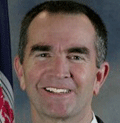
Lieutenant Governor Ralph Northam
On the Democratic side, Lieutenant Governor Ralph Northam appeared to be cruising to his party’s nomination unmolested until January, when former U.S. Rep. Tom Perriello jumped into the race and began casting himself as the anti-establishment alternative, in contrast to the well-connected Northam.
Northam has the backing of Democratic Governor Terry McAuliffe, who is barred by Virginia law from running for re-election, along with both of the commonwealth’s U.S. Senators, Mark Warner and Tim Kaine.

Former U.S. Rep. Tom Perriello, D-Virginia
Perriello has countered with endorsements from Sanders, U.S. Senator Elizabeth Warren of Massachusetts and a slew of former officials from Barack Obama’s administration, in which Perriello served. And while Obama has not offered an endorsement, Perriello has been reminding voters of his connection to the former president every chance he gets.
Polls have shown a close race, although the large numbers of undecided voters means there is no clear leader heading into election day.

Ed Gillespie
On the Republican side, Ed Gillespie, a former Republican National Committee chairman and Bush aide who ran a surprisingly strong race for U.S. Senate in 2014, has held a lead in the polls over his two challengers, Corey Stewart, chairman of the Prince William County Board of Supervisors, and State Senator Frank Wagner, from Virginia Beach, a former U.S. Navy officer who has served in the the state legislature for 25 years.
Because Virginia does not have primary runoffs, Gillespie only has to win a plurality to advance to the general election.

GOP candidate Corey Stewart
Stewart, who was once Trump’s Virginia state chairman, has wrapped himself in the Trump mantle, positioning himself as the man who can “take back Virginia from the establishment,” a not-so-veiled reference to Gillespie.
Stewart lost his job in the Trump campaign in October 2016 after organizing a protest outside of Republican National Committee headquarters demanding that the GOP hierarchy not abandon Trump in the wake of the release of an audiotape in which Trump made sexually suggestive comments. But he still continued to support Trump.
During the campaign, Stewart — an native of Minnesota — has also come out against efforts to remove Confederate monuments, which have sparked controversy in Charlottesville and other cities in the South.
The winners of both primaries will advance to the general election, which is one of only two governor’s races being held this year. The other is in New Jersey.
Once reliably Republican, Virginia is the only Southern state that Hillary Clinton carried in 2016, and it has now gone to the GOP in three successive elections.
Three of the commonwealth’s last four governors have been Democrats — Warner, Kaine and McAuliffe — and Virginia is among just three of 14 Southern states with a Democratic chief executive, the others being West Virginia and Louisiana.
South Carolina U.S. Rep. Trey Gowdy picked to head powerful oversight panel
Gowdy will head House Oversight and Government Reform Committee
♦By Rich Shumate, ChickenFriedPolitics.com editor
 WASHINGTON (CFP) — U.S. Rep. Trey Gowdy, who gained national prominence for his dogged investigation of the 2012 terrorist attack in Benghazi, Libya, has been selected to be the new chair of the House committee charged with investigating the executive branch.

U.S. Rep. Trey Gowdy, R-South Carolina
Gowdy was selected June 8 by the Republican Steering Committee to chair the Oversight and Government Reform Committee, replacing U.S. Rep. Jason Chaffetz of Utah, who is resigning from Congress.
“Oversight is constitutionally authorized and important to ensure branch integrity and equilibrium,” Gowdy said in a statement after his selection. “I look forward to working alongside the other committee members, as well as any member of Congress, as we discharge the jurisdiction assigned to us.”
Gowdy, 52, a former federal and state prosecutor in South Carolina, is in his fourth term representing the state’s 4th District, which includes the Greenville-Spartanburg metro area.
After four Americans died in a terrorist attack on a U.S. diplomatic compound in Benghazi in 2012, Gowdy was appointed by House GOP leaders to head a special committee to investigate the attack.
The primary target of that probe was Hillary Clinton, who was secretary of state at the time of the attack. Gowdy’s investigation eventually led to the disclosure that Clinton had used a private email server, which prompted an FBI investigation and dogged her throughout the 2016 presidential campaign.
After Donald Trump defeated Clinton, House Republicans shut down the Benghazi committee.
U.S. Rep. Mo Brooks jumps into Alabama’s U.S. Senate race
Four-term congressman says he offers “proven conservative leadership”
♦By Rich Shumate, ChickenFriedPolitics.com
 HUNSVILLE, Alabama (CFP) — Republican U.S. Rep. Mo Brooks has announced he will run in a special election to fill Alabama’s open U.S. Senate seat, adding a high-profile name to a crowded field trying to unseat the temporary incumbent, U.S. Senator Luther Strange.
 Announcing his candidacy in a series of events across the state on May 15, including in his hometown of Huntsville, Brooks touted himself as “the only candidate for the Senate who has a proven record of conservative leadership,” citing a list of accolades from business and conservative groups for his work in Washington.
“The solutions to America’s challenges are there. The roadblock to these solutions is all too often the U.S. Senate,” Brooks said. “We must elect senators with the understanding and backbone needed to face and defeat America’s challenges.”
Since 2011, Brooks, 63 has represented Alabama’s 5th District, which is anchored in Huntsville and takes in five counties in the northern part of the state along the Tennessee border.
During his announcement speech Brooks–who pointedly refused to endorse Donald Trump in last year’s presidential race–did not mention the president, a contrast with other candidates in the race who have embraced him.

U.S. Senator Luther Strange
Strange was appointed to the Senate seat in February by former Governor Robert Bentley after Jeff Sessions left to become U.S. attorney general. Although state law mandates that Senate vacancies be filled “forthwith,” Bentley delayed a special election until November 2018, giving Strange nearly two years of incumbency before he had to face voters.
But after a sex scandal forced Bentley from office, new Alabama Governor Kay Ivey reversed course and ordered a special election this year, which opened the floodgates for candidates eager to send Strange back home.
Brooks is the eighth Republican in the race, along with Roy Moore, the controversial favorite of the Christian right twice elected and twice ousted as Alabama’s chief justice; State Rep. Ed Henry, R-Hartselle, who launched the effort to impeach Bentley, and Randy Brinson, president of the Christian Coalition of Alabama.
Also expected to run is the top Republican in the Alabama Senate, Del Marsh from Anniston.
Two Democrats are also running, although any Democrat would be considered a longshot in a state where the party hasn’t won a Senate seat since 1992.
Party primaries are scheduled for August, with a runoff to follow if no candidate gets a majority. The general election is in December.
West Virginia U.S. Rep. Evan Jenkins will challenge Joe Manchin in U.S. Senate race
Jenkins hopes to parlay state’s increasing GOP tilt to unseat venerable Democratic incumbent
♦By Rich Shumate, Chickenfriedpolitics.com editor
 HUNTINGTON, West Virginia (CFP) — In 2014, GOP U.S. Rep. Evan Jenkins toppled a West Virginia political giant to get to Congress. In 2018, he’ll try to be a giant killer again.
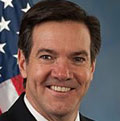
U.S. Rep. Evan Jenkins, R-West Virginia
Jenkins announced that he is giving up his House seat in an effort to defeat Democratic U.S. Senator Joe Manchin, in what is expected to become one of the South’s hottest Senate races.
In a campaign video released May 8, Jenkins went after Machin, accusing him of straying from the values he was elected to represent by supporting Hillary Clinton and Barack Obama.
“Joe changed when he got to Washington. West Virginia values? Not anymore,” Jenkins said. “Somewhere alone the way, Joe became one of them.”
Jenkins also tied himself firmly to Donald Trump, who won the Mountaineer State by a staggering 41 points in 2016, his second strongest showing in any state, behind only Wyoming.
“With Donald Trump in the White House, we’ve got a real chance to turn things around,” Jenkins said. “He needs our help, and I need your help … We can’t let liberal New York millionaires and D.C. lobbyists buy this race or the Senate.”
Jenkins, 56, was elected in 2014 to represent the 3rd District, which takes in the southern and western parts of the state. In that race, he unseated Nick Rahall, a Democrat who had been in Congress since 1977 and was, like Manchin, a political institution in West Virginia.
Jenkins had served 18 years in the state legislature as a Democrat before switching parties to run against Rahall.
West Virginia’s changing political climate has made Machin is a top Republican target in 2018. In 2014, the GOP captured all three U.S. House seats and a majority in the state legislature for the first time since 1931. In 2016, Shelley Moore Capito became the first Republican to win a U.S. Senate election since 1956.
Trump’s win was also the fifth in a row for Republican presidential candidate, in what had been considered a Democratic stronghold into the 1990s.

U.S. Senator Joe Manchin of West Virginia
However, Machin, 69, is a political institution in West Virginia, where he was first elected to political office in 1982 and was governor for six years before being elected to the Senate in 2010.
Manchin has styled himself as a political moderate, opposing legal abortion, supporting a balanced budget amendment and opposing efforts by the Obama administration to curtail use of coal, which is a mainstay of the West Virginia economy. He also broke ranks with other Democratic senators to support Trump’s Cabinet nominees and his selection of Neil Gorsuch for the U.S. Supreme Clourt.
One question mark in the race will be the issue of gun rights. Although Manchin has long received support from the National Rifle Association, he drew fire from some gun rights advocates after co-sponsoring legislation to strengthen background checks on firearms after the Sandy Hook school shooting in Newtown, Connecticut in 2012.
Jenkins took direct aim at Manchin on the gun issue in his opening campaign video, accusing the senator of violating a pledge he made in his first campaign to protect gun rights.
Jenkins’s decision to run against Manchin will open a House seat in West Virginia that could be a potential target for Democrats, although the GOP will be favored.
Jenkins may also have to survive a primary for the right to oppose Manchin, as state Attorney General Patrick Morrisey is thought to be eyeing the race.

