
Home » Posts tagged 'Julian Castro'
Tag Archives: Julian Castro

Julian Castro ends his run for Democratic presidential nomination
Former San Antonio mayor was the last Southerner left in the 2020 contest
♦By Rich Shumate, ChickenFriedPolitics.com
 SAN ANTONIO (CFP) — Julián Castro, the last Southerner and the only Latino in the 2020 presidential race, has ended his campaign for the White House.
“With only a month until the Iowa caucuses, and given the circumstances of this campaign season, I’ve determined that it simply isn’t our time,” Castro said in a video message to his supporters that he ended with the phrase “Ganaremos un día.” (One day, we’ll win.)

Julián Castro
Castro, who served as mayor of San Antonio and as housing secretary in the Clinton administration, also called for the Democratic Party to change its nominating process, which he said he believes disadvantages candidates of color.
In an appearance on MSNBC’s “Rachel Maddow Show,” Castro criticized starting the process in states such as Iowa and New Hampshire “that lack people of color ” and was also critical of the caucus process used in Iowa.
“If you didn’t know anything about the Iowa caucuses, and I told you, look, this is how we’re going to start this process — you can only vote on one day at 7 o’clock in the evening, there’s no early voting, there’s no secret ballot … people would think that Republicans designed the Iowa caucuses,” he said.
While Castro was polling poorly in Iowa and New Hampshire, he was also polling in low single digits nationally and in other early voting states such as Nevada and South Carolina that are more racially and ethnically diverse.
Castro was one of just three Southerners who entered the 2020 race. The other two — Democrat Beto O’Rourke from Texas and Republican Mark Sanford from South Carolina — had previously ended their campaigns.
We tweet @ChkFriPolitics.com Join us!
Beto O’Rourke ends quest for 2020 Democratic nomination
O’Rourke tells supporters in Iowa that “we do not have the means to pursue this campaign successfully”
♦By Rich Shumate, ChickenFriedPolitics.com editor
 DES MOINES, Iowa (CFP) — Seven months after beginning his quest for the presidency with high hopes and lavish media attention born of political star power, former Texas U.S. Rep. Beto O’Rourke has brought his campaign to an abrupt and quiet end.
O’Rourke’s exit from the race, amid anemic polling results and fundraising numbers, was made official November 1 in front of a crowd of supporters in Des Moines, Iowa, where he had been scheduled to speak at a Democratic event with the rest of the 2020 field.
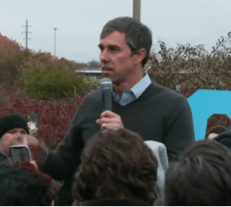
Beto O’Rourke withdraws from Democratic race in Iowa (NBC News via YouTube)
“This is a campaign that has prided itself on seeing things clearly and speaking honestly,” O’Rourke told a small crowd of subdued supporters. “We have clearly seen at this point that we do not have the means to pursue this campaign successfully and that my service will not be as a candidate, nor as the nominee of this party for president.”
An aide to O’Rourke later told reporters that he would not enter the U.S. Senate race in Texas, as some Democratic leaders have been urging him to do. The filing deadline in Texas is December 9.
Watch video of Beto O’Rourke’s speech leaving the 2020 race
O’Rourke’s short-lived campaign will perhaps be best remembered for a moment in a September debate where, in a call for mandatory buybacks of assault weapons, he said, “Hell, yes, we’re going to take your AR-15, your AK-47.”
While the audience cheered, even some of his fellow Democrats winced at a soundbite likely to be weaponized by Republicans — and which may have extinguished any hope of a statewide political future for O’Rourke in Texas.
But O’Rourke offered no apologies during his withdrawal speech, saluting his campaign for being “unafraid to confront the conventional wisdom of what it was possible to say in the public sphere.”
O’Rourke, 47 — whose given first name is Robert but who uses his childhood nickname, Beto, a Spanish diminutive — served three terms in Congress representing El Paso before deciding to challenge Republican U.S. Senator Ted Cruz in 2018.
Given little chance at the beginning, O’Rourke and his campaign fired the imagination of Democratic activists around the country, raising more than $80 million and coming within 3 points of ousting Cruz, the runner up to President Donald Trump in the 2016 GOP presidential contest.
O’Rourke hoped to ride that momentum to the Democratic nomination when he entered the race in late March. While his initial fundraising and polling numbers were strong amid an avalanche of media attention, both began to fade after uneven performances in early presidential debates.
O’Rourke pivoted to the gun control issue in August after a gunman killed 22 people at a Wal-Mart in his hometown of El Paso, but it did not resonate enough to propel him to the front of the Democratic pack.
O’Rourke was polling at 2 percent or less nationally and didn’t even register in one recent poll in Iowa, the first caucus state where he was drawing large crowds back in April.
His fundraising had also dried up, leaving his campaign with just $3.2 million at the end of September with early contests in Iowa and New Hampshire looming.
O’Rourke’s departure from the race leaves just one Southerner in the presidential race, former San Antonio Mayor Julián Castro.
We tweet @ChkFriPolitics Join us!

10 takeaways from the second 2020 Democratic debate
Kamala Harris draws blood on Joe Biden on race issue; Sanders stands pat as grumpy socialist
♦By Rich Shumate, ChickenFriedPolitics.com
 MIAMI (CFP) — The second flight of 10 Democrats took the stage in Miami Thursday night for the second of two nights of debate among the more than two dozen candidates running for their party’s 2020 presidential nomination. Here’s a recap of some of the key takeaways from the proceedings:
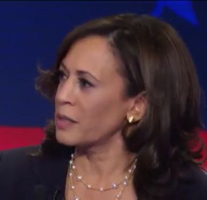
Kamala Harris challenges Joe Biden on race during Democratic debate (From MSNBC)
1. Race and Fireworks: The tussle of the night — and the clip every network will play for days — was between former Vice President Joe Biden and U.S. Senator Kamala Harris of California. It began when an emotional Harris took aim at Biden for his recent comments that he was able to work with segregationist senators in the past, which she called “hurtful.” “I will tell you on this subject, it cannot be an intellectual debate among Democrats,” she said, explaining how she benefited from school busing in the 1970s, which Biden opposed at the time. Biden, his anger rising, was having none of it: “I did not praise racists. This is not true,” he said, before launching into a somewhat disjointed defense of his record on civil rights, which ended awkwardly when he noted that his time was up. The former vice president seemed a bit rattled after the exchange, although he recovered his equilibrium later in the debate.
2. Bernie Being Bernie: The most consistent performer on the stage was U.S. Senator Bernie Sanders of Vermont, who, in his own indomitable style, stuck to his battle-tested positions on the need for a political revolution to take America back from the greedy, unscrupulous capitalist class. Asked how he, as a older white man, could represent the party’s diversity, he stuck to his economic line: “How come today the worker in the middle of our economy is making no more money than he or she was making 45 years ago … We need a party that is diverse, but we need a party that has guts.” Love him or hate him, this is one grumpy socialist who knows his own mind and never wavers — and does it all at the top of his lungs.
3. South Bend Shooting: Mayor Pete Buttegieg had to handle a hot potato question about a shooting of a black man by a white police officer in the city he leads, South Bend, Indiana. “It’s a mess, and we’re hurting … I have to face the fact that nothing I can say will bring (the victim) back,” he said. And while conceding that he has not been able as mayor to bring more diversity to the city’s mostly white police force, he also said that the investigation into the shooting needs to run its course — and ignored a shouted demand from U.S. Rep. Eric Swalwell of California that he fire the officer involved.
4. Generational Dust-Up: Swalwell got in a pointed dig at Biden by quoting a speech that the septuagenarian former vice president made calling for passing the torch to a new generation of leadership — 32 years ago, when Swalwell was 6. That set off a cacophony of cross-talk that only ended when Harris managed to get off the line of the night: “Hey guys, you know what, America does not want to witness a food fight. They want to know how we’re going to put food on the table.”
5. Private Insurance Fault Line: When asked by the moderator if they supported abolishing private health insurance as part of a Medicare-for-all plan, only two candidates — Sanders and Harris — raised their hands. Sanders offered a robust defense of the idea, saying that if other major countries such as Britain and Canada can operate a health care system for their citizens, the United States should be able to do the same. The biggest pushback on eliminating private insurance came from U.S. Senator Michael Bennet of Colorado, who noted that Canada has just a tenth of the population of the United States, and Biden, who touted his role in passing Obamacare and said he had no intention of scrapping it. Buttigieg proposed a mixture of public and private plans that he called “Medicare-for-all-who-want-it.”
6. At Back of the Pack: Unlike in the first debate, when former San Antonio Mayor Julián Castro had a breakout performance, none of the candidates lagging at the back of the pack turned in a performance that is likely to move the needle. Bennet did manage to grab a bit of air time; Swalwell tried to create moments on gun control and his calls for generational change; and U.S. Senator Kirsten Gillibrand of New York tried to do the same with her support for legal abortion. But neither they nor former Colorado Governor John Hickenlooper are likely to play much of a role in the post-debate conversation.
7. Stepping Up The Trump Attacks: The candidates in the second debate had clearly paid attention to pundits’ commentary after the first debate that President Donald Trump had not been sufficiently targeted. They stepped up the rhetoric against the president, particularly on his immigration policies. As Sanders put it, with his characteristic subtlety: “Trump is a phony. Trump is a pathological liar and a racist.”
8. Making News: Very little of what the candidates said during the debate was unexpected or made much news, with one exception — Gillibrand said that if elected, “my first act will be to engage Iran to stabilize the Middle East,” which would change 40 years of official hostility to the imams in Tehran.
9. Um, Why Were These People on the Stage? Democrats did nothing to burnish their reputation for seriousness by including new age guru Marianne Williamson and tech bro Andrew Yang as part of the debate, both of whom seemed hopelessly out of place and, frankly, in the way. It was perhaps not as silly as hosting Kim Kardashian, but it was close. Yang, to his credit, was mostly mute and later complained that his microphone had been turned off (if only); Williamson, alas, opted to interject herself with any number of peculiar observations, including that her first phone call as president would be to the president of New Zealand (which, by the way, doesn’t have a president) and that she was going to “harness love” to beat Trump. Good luck with that.
10. Winners and Losers: The winner of the night was clearly Harris, who managed to make herself look presidential and take a bite out of Biden. The biggest loser of the evening was Biden, who, as the front-runner, needed to stay above the fray, but, by letting Harris get under his skin, may have punctured his aura of invincibility. Sanders and Buttigieg did no harm to their prospects, but Gillibrand clearly suffered in comparison to Harris, the only other woman on the stage.
We tweet @ChkFriPolitics Join us!
10 takeaways from the first Democratic 2020 debate
Donald Trump draws surprisingly little fire; Texan Julián Castro has breakout performance
♦By Rich Shumate, ChickenFriedPolitics.com editor
 MIAMI (CFP) — The first 10 Democrats took the stage in Miami Wednesday night for the first of two nights of debate among the more than two dozen candidates running for their party’s 2020 presidential nomination. Here’s a recap of some of the key takeaways from the proceedings.
1. Life at the Top: U.S. Senator Elizabeth Warren of Massachusetts was the only one of the candidates in the top five in national polling to take the stage in the first debate, and she got pride of place to both open and close the proceedings. She made the most of her moments and avoided taking shots from the other candidates, although there was long stretches in the second half of two-hour debate where she faded out of the conversation. Her best moment came when she was asked if she had a plan as president to deal with Senate Majority Leader Mitch McConnell, and she responded, “I do” — then made a few fiery comments about energizing Democrats “to make this Congress reflect the will of the people.”
Former San Antonio Mayor Julián Castro has breakout performance at first Democratic debate (From MSNBC)
2. Breakout Performance: Among the candidates further back in the pack, the breakout performance of the night may have come from former San Antonio Mayor Julián Castro, one of two Southerns in the race, who got quite a bit of screen time and dominated the immigration portion of the debate, on a day when the crisis at the U.S.-Mexico border dominated the news cycle. As the only Latino in the 2020 race, Castro spoke with authority that other candidates were hard pressed to match.
3. Private Insurance Fault Line: When the candidates were asked if they supported creating a Medicare-for-all system that would abolish private insurance that employees receive from their employers, only two candidates — Warren and New York Mayor Bill DeBlasio — raised their hands, although both former U.S. Rep. Beto O’Rourke of Texas and U.S. Senator Cory Booker of New Jersey indicated they supported versions of Medicare-for-all that stopped short of ending private insurance. The greatest pushback on the idea came from former U.S. Rep. John Delaney of Maryland: “I think we should be the party that keeps what’s working and fixes what’s broken.”
4. Texas Immigration Tangle: Castro called for repeal of the section of federal law that makes it a crime to illegally cross the U.S. border, which he said had been used by the Trump administration to target migrants. Then he tried repeatedly to get O’Rourke and the other candidates on the stage to follow his lead — and interrupted O’Rourke as he tried to explain his immigration policy without taking a position on repeal, in what proved to be one of the few direct confrontations of the evening.
5. Personal Touch: In discussing issues brought up by the moderators, O’Rouke tried to set himself apart from his competitors by inserting personal stories of Americans whom he has met on the campaign trail and other anecdotes into his responses. This approach perhaps reached its nadir when he was asked if his Justice Department would pursue charges against President Donald Trump once he left office — and he launched into a non sequitur about a painting in the U.S. Capitol that shows George Washington resigning his commission as head of the army.
6. Biggest Threat? When candidates were asked who or what they thought presented the biggest threat to the United States, most said China or climate change. Only one — DeBlasio — said Russia “because they’re trying to undermine our democracy.” But Washington Governor Jay Inslee triggered a cascade of applause with his answer: “Donald Trump.”
7. A Different Kind of Democrat? Three of the candidates mired near the bottom in national polls tried to set themselves apart by portraying themselves as a different kind of Democrat. U.S. Rep. Tim Ryan of Ohio called for the party to pay more attention to blue collar voters in the Midwest, saying its center of gravity needed to shift away from coastal elites. Delaney issued a call for pragmatism, saying Democrats needed to adopt “real solutions, not impossible promises.” And U.S. Rep. Tulsi Gabbard of Hawaii, an Iraq War veteran and major in the Army National Guard, called for a complete U.S. pullout from Afghanistan, saying “we are no better off in Afghanistan today than we were when we began.”
8. Mayor Pushy: DeBlasio did his best to live up to the stereotype of New Yorkers as loud and obnoxious, frequently interrupting the proceedings and interjecting himself at high volume. He gave several lectures on how Democrats need to represent working people and invoked his biracial son to make a point about police reform. True, he got noticed among the flash mob on the stage, but probably not for the right reasons.
9. Where’s The Donald?: With the notable exception of Inslee’s line about Trump being the nation’s biggest existential threat, the Democrats spent surprisingly little time during the debate directly castigating the president — despite the fact that the 2020 election is shaping up as a referendum on the incumbent and the Democratic base sees the president in a slightly less favorable light than Satan.
10. Winners and Losers: Among the evening’s winners were Warren, who needed to get through the debate without stumbling and made a case that she can take on Trump, and Castro, who perhaps put himself back in the national conversation. The losers included DeBlasio, who came off as wild, goofy and unlikable, and O’Rourke, whose vague and often rambling responses couldn’t disguise the fact that he generally wasn’t answering the moderators’ questions. If his ardent supporters were looking for the debate to push him to the front ranks of the race, they’re probably going to be disappointed.
We tweet @ChkFriPolitics Join us!
Democrats’ 2020 White House roadshow descends on South Carolina
Nearly two dozen candidates for Democratic nomination speak at marathon session of state party
♦By Rich Shumate, ChickenFriedPolitics.com editor
 COLUMBIA, South Carolina (CFP) — The Democratic Party’s vast field of 2020 White House hopefuls turned up in South Carolina Saturday, jockeying for political position in the first-in-the-South primary state.
 Over the course of nearly nine hours, a parade of 23 candidates spoke to delegates at the South Carolina Democratic Party’s annual convention, as party leaders interspersed business with eight-minute pitches from contenders — major, minor and obscure.
“It is the price we pay for all of these people wanting to see you,” quipped Trav Robertson, the state party chair.

Former Vice President Joe Biden addresses South Carolina Democrats (From MSNBC)
During his speech, former Vice President Joe Biden — who held a 20-point lead over the rest of the field in the Palmetto State in a recent poll by Post and Courier newspaper — did not address his controversial remarks about being able to work with segregationist senators, which drew sharp criticism from his Democratic rivals.
He did, however, go directly after President Donald Trump, saying it was “imperative” to defeat him in 2020.
“You all know in your bones this election is more important than any other election you’ve been involved in,” Biden said. “Four more years of Donald Trump will permanently change the character of this country.”
In her remarks, U.S. Senator Elizabeth Warren of Massachusetts, who was in second place behind Biden in the Post and Courier poll, offered a litany of specific policy proposals, saying “people across this country understand its time for big structural change. The time for small ideas is over.”
The centerpiece of the program she outlined is a 2 percent increase on income tax for the wealthiest Americans to fund universal childcare and pre-K and tuition-free college tuition.
South Bend, Indiana Mayor Pete Buttigieg’s appearance in Columbia marked a return to the campaign trail after he returned home to deal with the fallout after a black man was shot by a police officer.
“We already know why such deep wounds are surfacing, why our whole community hurts,” Buttigieg said. “My community is full of people who believe in safety and justice. We will heal, and we will become stronger in the broken places.”
Buttigieg, who placed third behind Biden and Warren in the Post and Courier poll, said Democrats “need a new generation of leadership” to draw a contrast with Trump.
“We are not going to win by going on the president’s show,” he said. “Are you ready to stand with me and change the channel?”
The two Southerners in the Democratic field — former U.S. Rep. Beto O’Rourke of Texas and former San Antonio Mayor Julián Castro — were among the candidates who spoke Saturday.
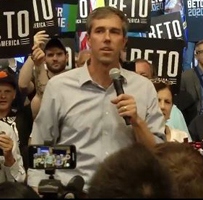
Beto O’Rourke goes down in the crowd to deliver remarks (From MSNBC)
O’Rourke, who eschewed the podium and gave his speech on the floor amid a scrum of delegates and photographers, offered blistering criticism of the Trump administration’s policy of separating migrant families at the U.S.-Mexico border.
“There are children sleeping on cold concrete floors with aluminum foil for blankets, in the worst, most inhumane conditions,” O’Rouke said. “That cannot be us. That cannot be America. But for as long as this man is in office, it will be.”
Castro made a call for police reform, rattling off a list of African Americans and Latinos who died at the hands of police.
“They deserve justice too,” said Castro, who said if he’s elected, “we won’t have any second-class citizens in the United States.”
In his remarks, U.S. Senator Bernie Sanders of Vermont pushed back on comments made earlier in the week at a gathering of party centrists that the self-described Democratic socialist presents “an existential threat” to the party.
“Why am I an existential threat? Maybe it’s because I will take on the insurance companies and the drug companies and pass a Medicare-for-all, single-payer program,” Sanders said. “Maybe it’s because we’re going to break up the major banks on Wall Street … Maybe it’s because we’re going to take on the fossil fuel industry.”
Sanders has been running second to Biden in most national polls, but he has been trying to regain his footing in South Carolina, where his support has dropped to just 9 percent in the latest Post and Courier poll, putting him in fourth place.
The day of speeches kicked off with U.S. Senator Kamala Harris of California, who criticized what she called Trump’s “rap sheet” in pushing tax cuts, tariffs and embracing “dictators” around the world.
“Let’s prosecute that case, and let’s not turn back the clock,” she said. “Let’s start the next chapter.”
The breakout performances of the day among the candidates at the back of the pack came from U.S. Senators Amy Klobuchar of Minnesota and Cory Booker of New Jersey.
Klobuchar highlighted her working class background and called for an “optimistic economic agenda” that works for all parts of the country.
“I don’t come from money. I have grit. And I got into politics for a reason,” Klobuchar said. “I know how to win.”
Booker said Democrats can’t be satisfied with just beating Trump but must embrace “bold dreams.”
“Beating Donald Trump gets us out of the valley, but it doesn’t get us to the mountaintop,” he said. “He wants to make this election about hate; we need to make this election about love. He wants to make this election about tearing people down; we need to make this election about building people up.”
South Carolina’s 2020 presidential primary, scheduled for Feb. 29, will be the fourth contest, after Iowa, New Hampshire and Nevada. It will be the first test of candidates’ appeal in the South and among African Americans, who make up a majority of Democratic voters in the state.
The Post and Courier’s latest poll found Biden was the choice of 37 percent of likely primary voters, bolstered by his strong support among black voters, among whom he tops 50 percent.
Warren was followed at 17 percent and Buttigieg at 11 percent. None of the other candidates were in double digits.
 Chicken Fried Politics