
Home » Posts tagged 'Stacey Abrams' (Page 3)
Tag Archives: Stacey Abrams

Decision ’18: Democrats fail to make major breakthrough in the South
Republicans sweep U.S. Senate and governor’s races; Democrats make a net gain of at least 9 seats in the U.S. House
♦By Rich Shumate, ChickenFriedPolitics.com
 (CFP) — The big, blue wave that Democrats hoped would carry them to a breakthrough in the South crashed into the Republican’s big, red wall in Tuesday’s midterm elections.
Republicans won the high-profile governor’s race in Florida and held a lead in Georgia, easily defended U.S. Senate seats in Texas and Tennessee and appear to have ousted Democratic U.S. Senator Bill Nelson in Florida.

Joe Manchin
The lone bright spot for Democrats in statewide races was in West Virginia, where U.S. Senator Joe Manchin held his seat.
Democrats did flip at least nine Republican-held U.S. House seats, ousting three incumbents in Virginia and winning a seat in South Carolina and another in Oklahoma that they had not won in more than 40 years. Three seats are still too close to call, with Republicans leading in two of them.
However, Republicans carried two-thirds of the 30 seats that Democrats had targeted across the region, including seven seats in Florida and Kentucky’s 6th District, where Democrat Amy McGrath failed to oust U.S. Rep. Andy Barr despite spending $7.8 million dollars.

Brian Kemp

Ron DeSantis
Republicans won all nine of the governor’s races in the South, including Florida, where Republican former U.S. Rep. Ron DeSantis defeated Tallahassee Mayor Andrew Gillum, and Georgia, where Republican Secretary of State Brian Kemp was leading former State Rep. Stacey Abrams by 60,000 votes with some mail-in ballots left to be counted.
Abrams has refused to concede.
“Votes remain to be counted. Voices waiting to be heard,” she told supporters early Wednesday morning. “We are going to make sure that every vote is counted because in a civilized nation, the machinery of democracy should work everywhere for everyone.”
Gillum and Abrams were hoping to become the first African-American governor in their respective states and end 20-year droughts in the governor’s office.
In addition to victories in Florida and Georgia, Republican governors were re-elected in Texas, Arkansas, Alabama and South Carolina, and GOP candidates kept open seats in Tennessee and Oklahoma.
Of the seven U.S. Southern Senate races, Republicans won four and the Democrats two, with one race in Mississippi heading to a November runoff, which amounts to a net gain of one seat for the GOP.

Beto O’Rourke

Ted Cruz
The most high-profile race was in Texas, where Democratic U.S. Senator Beto O’Rourke ran a spirited race to try to oust Republican U.S. Senator Ted Cruz. But in the end, Cruz won 51 percent of the vote to 48 percent for O’Rourke.
In Florida, Republican Governor Rick Scott defeated Nelson, who was trying for his fourth term. Scott’s win means that Florida will have two Republican senators for the first time in 100 years.
Republicans also defended a seat in Mississippi, where U.S. Senator Roger Wicker won easily, and in Tennessee, where Republican U.S. Rep. Marsha Blackburn defeated Democratic former Governor Phil Bredesen by an surprisingly large 55 percent to 44 percent margin.
In Virginia, Democratic U.S. Senator Tim Kaine won 57 percent to 41 percent for Republican Corey Stewart.
In a special election in Mississippi to fill the vacancy created by the resignation of former U.S. Senator Thad Cochran, Republican Cindy Hyde-Smith, Cochran’s temporary replacement in the Senate, advanced to a November 27 runoff against Democrat Mike Espy, a former congressman who served as agriculture secretary in the Clinton administration.
Hyde-Smith and Smith both came in at 41 percent,short of the majority they needed to avoid a runoff. Republican State Senator Chris McDaniel came in third at 17 percent.
In the U.S. House races, the most high-profile casualty was 11-term Republican U.S. Rep. Pete Sessions, who lost his Dallas-area House seat to Colin Allred, an attorney and former NFL player.

Comstock

Brat
Other Republican U.S. House losers were Dave Brat in the suburbs of Richmond; John Culberson in Houston; Barbara Comstock in the Virginia suburbs of Washington, D.C.; Carols Curbelo in Miami; and Scott Taylor, in the Hampton Roads area of southeastern Virginia.
In Miami, Democrat Donna Shalala, who served as health secretary in Bill Clinton’s administration, won an open seat that had been held for 30 years by retiring U.S. Rep. Ileana Ros-Lehtinen.
Two of the night’s biggest surprises came in Oklahoma City, where Republican Steve Russell was defeated by Democratic newcomer Kendra Horn, and in the Low Country of South Carolina, Democrat Joe Cunningham held a slender lead over Republican State Rep. Katie Arrington, who had ousted the incumbent, U.S. Rep. Mark Sanford, in the Republican primary.

Arrington

Cunningham
Republican incumbent Rob Woodall led by 4,000 votes in the Atlanta suburbs, and in the Charlotte area, Republican Mark Harris held a small lead over Democrat Dan McCready.
The news was not as good for Karen Handel in suburban Atlanta, who trailed her Democratic challenger, Lucy McBath, by 2,100 votes after all of the precincts had reported.
Handel won that seat just last year in a special election that became the most expensive House race in U.S. history, in which more than $50 million was spent.
We tweet @ChkFriPolitics Join us!
Election Preview: Governor’s races could make history in Florida, Georgia
Democrats within shooting distance in Oklahoma, Tennessee; GOP incumbents heavily favored in Alabama, Arkansas, Texas and South Carolina
♦By Rich Shumate, ChickenFriedPolitics.com editor
(CFP) — Eight Southern governorships are on the ballot in Tuesday’s midterm elections, highlighted by close and contentious races in Florida and Georgia that have garnered national attention.

Abrams

Gillum
Democrats are hoping to make history: If Democrat Andrew Gillum wins in Florida, he will be the Sunshine State’s first African-American governor, while a victory by Democrat Stacey Abrams in Georgia would make her not only its first black governor but also the first woman to hold the post and the first black female governor in U.S. history.
However, in both states, Democratic nominees will have to overcome a long history of Republican control. The last time a Democrat won a governor’s race in Florida was 1994; in Georgia, 1998.

Kemp

DeSantis
In Florida, the Republican nominee is former U.S. Rep. Ron DeSantis, who has received considerable help in his quest for the governorship from President Donald Trump. The president stopped twice in Florida to campaign for DeSantis in the closing days of the campaign.
The Republican nominee in Georgia is Secretary of State Brian Kemp, who has also benefited from a Trump endorsement and a presidential visit on the Sunday before the vote.
Public polling has shown both races are within the statistical margin of error, which means neither race can be forecast with certainty heading into election day.
In 2016, Trump carried Florida by a single point and Georgia by 5 points. While Florida has long been a swing state, the result in Georgia was the smallest win by a Republican in the Peach State since 1996, giving Democrats hope that it might be in play in 2020.
A win by either Abrams or Gillum would be a boon to Democratic prospects in 2020. It will also give them a say in redrawing congressional districts after the 2020 census — a process that Republicans have totally controlled in both states for the past decade.
And if the race in Georgia is close, it might not be decided on election night. State law requires a candidate to win an outright majority to claim the governorship. With a Libertarian in the race, neither major-party candidate could reach that threshold, triggering a December 4 runoff between them.
The remaining six Southern governorships up this year — all held by Republicans — look to be more secure, though Democrats may have outside shots in Oklahoma and Tennessee.
 In the Sooner State, where Republican Governor Mary Fallin is term-limited, Republican businessman Kevin Stitt is facing former Democratic Attorney General Drew Edmondson, who comes to the race having served 16 years in statewide office.
Approval polling has pegged Fallin as America’s most unpopular governor, which has not helped Stitt’s cause. Oklahoma teachers also went on strike last year in a public display of protest that has reverberated through state politics.
Public polling has shown Stitt with a small lead near the edge of the margin of error. While Stitt is still regarded as the favorite, one prominent national prognosticator, The Cook Political Report, rates the race as a toss-up.
 In Tennessee, where voters are also filling an open seat for a term-limited incumbent, Governor Bill Haslam, Republican Bill Lee, a first-time candidate who worked in Haslam’s administration, is facing Democrat Karl Dean, the former mayor of Nashville.
Public polling has shown Lee above 50 percent and with a statistically significant lead over Dean.
Four other governor’s races on the midterm ballot — in Arkansas, Alabama, Texas and South Carolina — all feature Republican incumbents who are expected to easily win re-election:
- In Arkansas, Governor Asa Hutchinson is facing Jared Henderson, a non-profit executive and former NASA research scientist.
- In Alabama, Governor Kay Ivey is being challenged by Tuscaloosa Mayor Walt Maddox. Ivey became governor in 2017 after her predecessor, Robert Bentley, resigned after a sex scandal. Since then, Ivey ridden a wave of public approval for her handling of the aftermath.
- In Texas, Governor Greg Abbott is squaring off against former Dallas County Sheriff Lupe Valdez.
- In South Carolina, Governor Henry McMaster is running against Democratic State Rep. James Smith from Columbia. McMaster became governor in 2017 after Nikki Haley left office to become Trump’s U.N. ambassador.
Heading into Tuesday’s election, Republicans hold 11 of the 14 Southern governorships; Democrats are in charge in North Carolina, Louisiana and Virginia.
See ChickenFriedPolitics.com’s latest ratings for hot governor’s races.
We tweet @ChkFriPolitics Join us!
Georgia governor’s debate: Candidates clash over allegations of voter suppression
Kemp insists he is “absolutely not” trying to keep down the minority vote; Abrams says voters are “scared”
♦By Rich Shumate, ChickenFriedPolitics.com editor
 ATLANTA (CFP) — The charge that Georgia’s Republican Secretary of State Brian Kemp has been deliberately disenfranchising minority voters to gain an edge for his campaign for governor took center stage at a debate where he faced off with his Democratic challenger, Stacey Abrams.
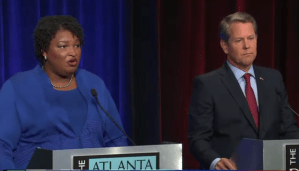
Abrams and Kemp square off in first debate (Courtesy GPB)
In their first face-to-face encounter, aired October 23 by Georgia Public Broadcasting, Kemp insisted that he has “absolutely not” been targeting voters based on race, a charge made by Abrams and other voting rights advocates amid news reports that more than 50,000 voter registrations are being held in Kemp’s office because of paperwork errors.
But Abrams said Kemp’s office, by systematically removing voters from the registration rolls and holding up new registrations, has created a climate of fear for potential voters.
“They’ve been purged, they’ve been suppressed, they’ve been scared,” she said. “Voting suppression is not only about blocking the vote. It’s about creating an atmosphere of fear, making people worry that their votes won’t count.
Kemp insisted that all of the voters with registrations pending will still be allowed to vote and called allegations of voter suppression “a distraction to take away from Ms. Abrams’s extreme agenda.”
He also charged that Abrams has been encouraging illegal immigrants to come out and vote for her, an allegation she denied.
“I only believe that those who have a legal eligibility to vote should cast a ballot,” she said.
Kemp, who oversees elections as secretary of state, also said that he would not recuse himself if the governor’s race ends in a recount because recounts are primarily the responsibility of county officials, not his office.
“I took an oath of office to serve as secretary of state, and that’s exactly what I’m going to continue to do,” he said
While the candidates had expected disagreements on immigration and expanding Medicare, the debate, sponsored by the Atlanta Press Club, began with a question about an incident from Abrams’s past that rocketed through cyberspace on the day for the debate – her participation in a 1992 protest where the Georgia state flag, which then featured the Confederate battle ensign, was set on fire.
“Twenty-six years ago, as a college freshman, I along with many other Georgians, including the governor of Georgia, were deeply disturbed by the racial divisiveness that was embedded in the state flag with that Confederate symbol,” she said.
“I took an action of peaceful protest. I said that that was wrong, and 10 years later, my opponent, Brian Kemp actually voted to remove that symbol (as a state senator).”
Although the flag burning issue has been gathering widespread attention, neither Kemp nor Libertarian nominee, Ted Metz, brought it up again during the rest of the debate. The Confederate emblem was removed from the state flag in 2001.
In her campaign, Abrams has been calling for expanding Medicaid under Obamacare, an idea that has been blocked by Republicans in the Georgia Legislature. In the debate, she touted Medicaid expansion as a way to spur economic development in rural areas.
“Rural Georgia has been losing hospitals at an alarming rate, and because of that loss we have companies leaving, we have people without access to health care, we’re not doing the kind of economic development work we can do,” she said, adding that expanding Medicaid would bring $3 billion in federal money to the state and create 56,000 jobs.
But Kemp, who opposes Medicaid expansion, said that “expanding a broken government program is no answer to solving the problem.”
He also pointed to a book Abrams wrote in which she called for a single-payer government health plan financed by tax increases and cuts in Medicaid and Medicare, an idea he called “radical.”
“Abrams’s plan will make your current insurance plan illegal. It will not allow you to choose your doctor, and she’s going to raise your taxes to pay for it,” he said. “And if you’re on Medicaid or Medicare, this should scare you to death.”
Kemp also criticized Abrams for wanting to extend the state’s HOPE scholarship program for high school students to Georgia graduates who were brought into the country illegally as children, commonly known as Dreamers. He said he also opposes allowing them to attend state colleges.
“I’ve been running my whole campaign on putting Georgians first. I think we need to continue to do that,” he said. “I think we need to continue to fight for our own people, our own state.”
But Abrams said, “I stand by believing that every Georgian who graduates from our high schools should be allowed to attend our colleges, and if they’re eligible, receive the HOPE scholarship.”
Abrams, 44, is an Atlanta attorney and former Democratic minority leader in the Georgia House of Representatives. Kemp is a former state senator from Athens who has served two terms as secretary of state.
They are scheduled to meet for a second and final debate on November 4, the Sunday before the November 6 election.
With polls showing a close race and Metz on the ballot, the governor’s race in the Peach State could be headed to a runoff.
Georgia is the only state that requires a general election winner to capture a majority of the vote. If neither Abrams or Kemp win a majority, a runoff between them will be held December 4.
In the last open race for governor, in 2010, the Libertarian nominee got 4 percent of the vote
General election runoffs, while rare, have proven to have unpredictable results. In 1992, Republican Paul Coverdell ousted Democratic U.S. Senator Wyche Fowler in a runoff, even though Fowler had come out slightly ahead in the initial vote.
We tweet @ChkFriPolitics Join us!
Secretary of State Brian Kemp gets landslide win in GOP runoff for Georgia governor, will now face Stacey Abrams
Democrats pick nominees for two targeted GOP-held seats in Atlanta suburbs
♦By Rich Shumate, ChickenFriedPolitics.com editor

 ATLANTA (CFP) — With the backing of both President Donald Trump and Vice President Mike Pence, Secretary of State Brian Kemp has won the Republican nomination for Georgia governor, winning a runoff by nearly 40 points after a stunning collapse by Lieutenant Governor Casey Cagle.
Kemp’s win sets up one of the nation’s marquee governor’s races this fall against Democrat Stacey Abrams, the first African American woman ever nominated for governor by a major political party in a U.S. state, who won her nomination in May without a runoff.
Georgia Democrats have also settled on nominees for two Republican-held U.S. House seats in metro Atlanta being targeted this fall, picking Lucy McBath in the 6th District and Carolyn Bourdeaux in the 7th District.
McBath will now face U.S. Rep. Karen Handel, while Bourdeaux will take on U.S. Rep. Rob Woodall.
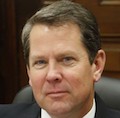
Secretary of State Brian Kemp
In the GOP governor’s race, Kemp took 69 percent of the vote in the July 24 runoff to 31 percent for Cagle, who had finished 13 points ahead of Kemp in the first round of voting in May but saw his support collapse in the final weeks of the race.
“We have earned a clear and convincing victory,” Kemp told supporters at a election night rally in Athens. “We had the momentum in this race, and those endorsements by the president and vice president — they poured gasoline on the fire.”
Although both men had vied for the Trump vote, the president endorsed Kemp a week before the runoff, and Pence traveled to Georgia to campaign with him. Cagle, serving his third term as lieutenant governor, was endorsed by incumbent Republican Governor Nathan Deal, who is term limited.
During the campaign, Kemp drew criticism for a humorous ad in which he points a shotgun at a young man who wants to date one of his daughters and gets him to acknowledge “a healthy appreciation for the Second Amendment, sir.” Kemp was unapologetic, saying in a statement that “liberal media and radical, left-wing activists — who have probably never even held a firearm — are freaking out and creating fake controversy.”
The National Rifle Association had earlier endorsed Cagle after the lieutenant governor proposed stripping a lucrative tax exemption from Atlanta-based Delta Airlines to retaliate against the company for ending a discount program for NRA members in the wake of the massacre of high school students in Parkland, Florida.
The turning point in the race may have been release of secretly recorded audio in June in which Cagle admitted that he had supported “bad public policy” in the legislature to undercut one of his primary rivals and complained that the Republican primary had devolved into a contest of “who had the biggest gun, who had the biggest truck and who could be the craziest.”
In a concession speech to supporters in Atlanta, Cagle promised his “full, undivided support” for Kemp in the general election.
“It didn’t turn out the way we wanted it, but at the end of the day, I can promise you my life is so rich,” he said.
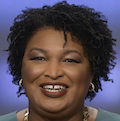
Democratic nominee Stacey Abrams
Democrats, who have not won a governor’s race in Georgia since 1998, are hoping to turn those fortunes around with Abrams, 44, a Yale-educated Atlanta lawyer who served six years as minority leader of the Georgia House.
During the Democratic primary, Abrams had argued that the way to reclaim the governor’s mansion was to energize and expand the electorate, rather than trying to appeal to Republican-leaning voters by offering more moderate stands. That strategy will be put to the test against Kemp, 54, a conservative businessman from Athens who has been secretary of state since 2011.
Kemp went after Abrams in his victory speech, calling her an “out-of-touch radical liberal who cares more for her billionaire backers than for you all.”
“This election is going to be for the soul of our state,” Kemp said. “It is going to be about our values, and it is going to be literally a fight for the future of the great state of Georgia.”
While Republicans have dominated Georgia politics for nearly two decades, demographic changes — particularly an influx of new minority voters — have begun to shift the political calculus. In 2004, George W. Bush carried Georgia by 16 points; Trump only won by 5 points in 2016, and he lost two large suburban Atlanta counties — Cobb and Gwinnett — that had not gone Democratic in a generation.
Both of the U.S. House races where Democrats may have a shot this fall are anchored in those same suburbs. In the 6th District, which takes in Cobb, North Fulton and North DeKalb counties, Trump won by just 1.5 points; in the 7th District, which includes Gwinnett and Forsyth counties, he won by just 6 points.

Lucy McBath

Karen Handel
Handel won the 6th District seat in a special election in 2017 that became nationalized amid rising resistance to Trump. More than $50 million was spent on that race, making it the most expensive House election in history.
The Democrat who Handel defeated in that race, Jon Ossoff, decided against a rematch, leaving her to face McBath, a retired flight attendant and gun control activist from Cobb County, who took 54 percent in the runoff to defeat Kevin Abel, a Sandy Springs businessman, who took 46 percent.
McBath’s son, Jordan Davis, was shot and killed in 2012 by a man at a gas station in Jacksonville, Florida, over a dispute over loud hip-hop music. His case became part of the nationwide campaign against deadly violence aimed at young African-American men. The shooter, Michael David Dunn, was later convicted of first-degree murder and sentenced to life without parole.

Rob Woodall

Carolyn Bourdeaux
In the 7th District, Woodall will face Bourdeaux, from Suwanee, a professor at Georgia State University and former budget analyst for the Georgia Senate. In the runoff, she took 52 percent of the vote to defeat Duluth businessman David Kim with 48 percent.
In the runoff, Republicans also settled on their nominees for the posts of lieutenant governor and secretary of state given up by Cagle and Kemp.
In the lieutenant governor’s race, former State Rep. Geoff Duncan from Cumming, a former professional baseball player, edged out State Senator David Shafer from Duluth. However, the two candidates were separated by less than 1,700 votes, which could trigger a runoff.
Duncan will now face the Democratic nominee, Kennesaw businesswoman Sarah Riggs Amico.
In the secretary of state’s race, State Rep. Brad Raffensperger from Johns Creek defeated Alpharetta Mayor David Belle Isle. He will now face former U.S. Rep. John Barrow from Athens, who was the last white Democrat left in Georgia’s congressional delegation until he was defeated in 2014.
State Primary Wrap: Stacey Abrams roars to Democratic governor’s nomination in Georgia; GOP faces runoff
Final fields for governor’s races also set in Arkansas and Texas; incumbent survives in Arkansas Supreme Court contest
♦By Rich Shumate, ChickenFriedPolitics.com editor
 ATLANTA (CFP) — Democrat Stacey Abrams has made history in Georgia’s Democratic primary for governor, crushing her opponent to become the first African American woman ever nominated for governor by a major political party in a U.S. state.
Georgia Republicans are headed to a runoff between Lieutenant Governor Casey Cagle and Secretary of State Brian Kemp, after neither won a majority in the May 22 primary.
Meanwhile, in Arkansas, Republican Governor Asa Hutchinson was nominated for a second term and will be heavily favored over the Democratic winner, political newcomer Jared Henderson. And Texas Democrats picked former Dallas County Sheriff Lupe Valdez to face incumbent Republican Governor Greg Abbott in November, making her the first Latina and first openly lesbian candidate to be nominated by a major party for Texas governor.
Georgia Democratic governor nominee Stacey Abrams
In Georgia, Abrams, the former minority leader of the Georgia House whose candidacy has drawn national attention, took 76 percent of the vote to 24 percent for former State Rep. Stacey Evans, winning all but six of the state’s 159 counties.
Speaking to jubilant supporters in Atlanta, Abrams vowed to create a “coalition that reaches across backgrounds, sharing our constant belief in our capacity to win.”
“We have to reach out to those who do not believe their voices matter, who’ve been disappointed again and again by promises made and never kept,” she said. “In the Book of Esther, there is a verse that reminds us that we were born for such a time as this.”
After seeing their party lose four governor’s elections in a row, Democrats who voted in the primary clearly bought into Abrams’s argument that the way to reclaim the governor’s mansion was to expand the electorate, rather than Evans’s argument that Democrats needed a nominee who could appeal to Republican-leaning voters by offering more moderate stands.
But while Abrams did win more votes in the primary than any candidate on either side of the ballot, overall, 54,000 more voters picked up Republican ballots, in a state that has no party registration.
Brian Kemp

Casey Cagle
In the Republican primary, Cagle, serving his third term as lieutenant governor, took 39 percent of the vote to 26 percent for Kemp, who has been secretary of state since 2011. Cagle beat Kemp in the large suburban Atlanta counties, where the bulk of Georgia Republicans live, and in all of the smaller cities except Athens, which Kemp once represented in the Georgia Senate.
However, Georgia has a long history of the second-place finisher in a primary coming from behind to win a runoff, most notably in 2010, when current Governor Nathan Deal defeated Karen Handel, who returned to political office last year by winning a seat in Congress.
The runoff in Georgia in July 24.
In another Georgia race of interest, former Democratic U.S. Rep. John Barrow, who lost his seat in 2014, won his party’s nomination for secretary of state without a runoff. Republicans will have a runoff between former Alpharetta Mayor David Belle Isle and State Rep. Brad Raffensperger of Johns Creek.
 In Arkansas, Hutchinson took 70 percent to 30 percent for Jan Morgan, a gun rights activist and television pundit who ran at the governor from the right, beating him in five rural counties. In November, he will face Henderson, a former NASA scientist who runs a Little Rock non-profit that advocates on education issues.
The most contentious battle in the Natural State was a non-partisan contest for a seat on the Arkansas Supreme Court, where incumbent Justice Courtney Hudson Goodson advanced to a runoff against David Sterling, who was appointed by Hutchinson as chief counsel for the Arkansas Department of Human Services. Goodson took 37 percent of the vote; Sterling, 34 percent.
A week before the election, Goodson filed a defamation lawsuit against the Judicial Crisis Network, a Washington-based conservative legal group, over ads it was running against her on Arkansas TV stations which alleged she accepted gifts for donors and sought a pay raise.
She also asked judges in three jurisdictions to enjoin stations from airing the ads, triggering protests from media organizations, although some of them voluntarily agreed to stop running the ads. JCN also spent more than $500,000 in 2016 to defeat Goodson in a race for chief justice.
Although the JCN’s ads targeted Sterling’s opponents, he has insisted that he has no connection to the group.
Goodson and Sterling will now face each other on the November general election ballot.
 In Texas, in the Democratic race for governor, Valdez defeated Andrew White, a Houston businessman and the son of former Governor Mark White, by a margin of 53 percent to 47 percent. Abbott won the Republican nomination outright in the March primary.
Valdez, 70, was elected to four terms as sheriff of Dallas County, the state’s second largest with 2.5 million people. She resigned in 2017 when she launched her campaign for governor.
Valdez starts the race as a decided underdog against Abbott, who has raised more than $43 million for the campaign. Texas has not elected a Democratic governor since 1988.
 Chicken Fried Politics