
Home » 2018 (Page 15)
Yearly Archives: 2018

Election Preview: Four Southern U.S. Senate races are key in battle for control
Republicans are defending seats in Texas and Tennessee; Democrats in Florida and West Virginia
♦By Rich Shumate, ChickenFriedPolitics.com editor
 (CFP) — With the balance of power in the U.S. Senate hanging in the balance, voters in four Southern states will decide hotly contested races in Tuesday’s midterm elections.
Republicans are defending seats in Texas and Tennessee that have turned out to be much more competitive than expected in two very Republican states. Meanwhile, Democratic incumbents are defending turf in Florida and West Virginia, states which President Donald Trump carried in 2016.
Another Senate seat is up in Virginia, where Democratic U.S. Senator Tim Kaine is favored to win re-election. Both seats are up this year in Mississippi, and Republican candidates are favored to hold both.
In Texas, Republican U.S. Senator Ted Cruz is seeking a second term against Democratic U.S. Rep. Beto O’Rourke, a race in which the challenger has sparked the imagination of Democratic activists around the country.
Cruz, who came in second to Trump in the 2016 Republican presidential nomination, was heavily favored for re-election at the beginning of 2018. But O’Rourke — trying to take advantage of a changing political electorate in fast-growing Texas, including more younger and Latino voters — has made the race competitive, even though Texas hasn’t elected a Democrat to the Senate in 30 years.
O’Rouke has raised more than $70 million for the race, the largest haul of any Senate candidate this cycle, according to Federal Election Commission records. Cruz has raised $40 million.
Despite Cruz’s often contentious relationship with Trump during the 2016 presidential primaries, which famously included Trump dubbing him “Lyin’ Ted,” the president has gone all out for Cruz in this race, even traveling to Houston for a campaign rally.
In Tennessee, Republican U.S. Rep. Marsha Blackburn is vying with former Democratic Governor Phil Bredesen for a seat which opened after the retirement of U.S. Senator Bob Corker, one of Trump’s strongest critics in Congress.
After first rebuffing calls for him to run after Corker announced he was leaving the Senate, Bredesen changed course last December and jumped into the race, giving Volunteer State Democrats a shot at capturing the seat behind the candidacy of a popular two-term moderate.
But Blackburn has fought back by trying to tie Bredesen to national Democratic leaders who are unpopular in Tennessee, in particular Hillary Clinton and Senate Minority Leader Chuck Schumer of New York.
Republicans currently have a slim one-vote majority in the Senate. However, because Democrats are defending more seats this cycle than Republicans, it is unlikely they can capture a Senate majority — and depose Kentucky’s Mitch McConnell as Senate majority leader — without winning in either Texas and Tennessee.
In Florida, Democratic U.S. Senator Bill Nelson is facing off against Republican Governor Rick Scott, who has served as the Sunshine State’s chief executive for the past eight years.
Nelson, who first arrived in Congress during the Carter administration, is a proven vote-getter seeking his fourth term. Scott’s two wins for governor were narrow, although his approval ratings have ticked up during the final year of his administration.
Florida is more evenly divided than either Texas or Tennessee, generally sending one senator from each party to Washington since the 1980s. Trump’s win in Florida in 2016 was by a single point, compared to a 9-point win in Texas and a 26-point win in Tennessee.
In West Virginia, Democratic U.S. Senator Joe Manchin was seen as particularly vulnerable given Trump’s 40-point win in the Mountaineer State. But Machin kept himself in contention by avoiding criticism of the president and supporting him on a number of high-profile issues, including both of Trump’s Supreme Court picks.
Manchin may have also benefited from the Republicans’ selection of a standard-bearer — State Attorney General Patrick Morrisey, who grew up in New Jersey, has only lived in West Virginia since 2006 and spent nearly a decade as a Washington lobbyist.
The folksy Manchin, a West Virginia native who served as governor before being elected to the Senate, has made much of that contrast. Morrisey has responded much the way Blackburn has in Tennessee — by trying to tie the incumbent to liberal establishment Democrats.
In Mississippi, both Senate seats are up this year due to the retirement of former U.S. Senator Thad Cochran. One race is a special election to fill the remainder of Cochran’s term; the other is for the seat occupied by Republican U.S. Senator Roger Wicker.
While Wicker is heavily favored over his Democratic challenger, State House Minority Leader David Baria, the special election features a three-way race in which candidates from all parties will compete and a runoff held between the top two vote-getters if no one captures a majority.
The special election is a three-way contest between Republican U.S. Senator Cindy Hyde-Smith, Cochran’s temporary replacement; Republican State Senator Chris McDaniel, who lost a bitter primary against Cochran in 2014; and Democrat Mike Espy, a former congressman who served as secretary of agriculture in the Clinton administration.
Depending on how evenly the Republican vote is divided, the top GOP candidate could face Espy in a November 27 runoff. But polls have showed Hyde-Smith with a wide lead over McDaniel, which could be enough for her to win the seat outright on Tuesday.
Although McDaniel was a vocal supporter of Trump in 2016, the president snubbed McDaniel and endorsed Hyde-Smith, who had been a Democrat until 2010. McDaniel has charged that Trump was “forced” into making the endorsement by Senate Republican leaders.
In Virginia, Kaine is facing Corey Stewart, chairman of the Prince William County Board of Supervisors, who served as Trump’s Virginia coordinator in 2016.
When he kicked off his campaign in July 2017, Stewart vowed to “run the most vicious, ruthless campaign” that he could against Kaine. However, public polling in the race has shown that strategy has failed to gain traction, and Kaine enjoys a wide lead.
See ChickenFriedPolitics.com’s latest ratings for hot U.S. Senate races
We tweet @ChkFriPolitics Join us!
Election Preview: Governor’s races could make history in Florida, Georgia
Democrats within shooting distance in Oklahoma, Tennessee; GOP incumbents heavily favored in Alabama, Arkansas, Texas and South Carolina
♦By Rich Shumate, ChickenFriedPolitics.com editor
(CFP) — Eight Southern governorships are on the ballot in Tuesday’s midterm elections, highlighted by close and contentious races in Florida and Georgia that have garnered national attention.

Abrams

Gillum
Democrats are hoping to make history: If Democrat Andrew Gillum wins in Florida, he will be the Sunshine State’s first African-American governor, while a victory by Democrat Stacey Abrams in Georgia would make her not only its first black governor but also the first woman to hold the post and the first black female governor in U.S. history.
However, in both states, Democratic nominees will have to overcome a long history of Republican control. The last time a Democrat won a governor’s race in Florida was 1994; in Georgia, 1998.

Kemp

DeSantis
In Florida, the Republican nominee is former U.S. Rep. Ron DeSantis, who has received considerable help in his quest for the governorship from President Donald Trump. The president stopped twice in Florida to campaign for DeSantis in the closing days of the campaign.
The Republican nominee in Georgia is Secretary of State Brian Kemp, who has also benefited from a Trump endorsement and a presidential visit on the Sunday before the vote.
Public polling has shown both races are within the statistical margin of error, which means neither race can be forecast with certainty heading into election day.
In 2016, Trump carried Florida by a single point and Georgia by 5 points. While Florida has long been a swing state, the result in Georgia was the smallest win by a Republican in the Peach State since 1996, giving Democrats hope that it might be in play in 2020.
A win by either Abrams or Gillum would be a boon to Democratic prospects in 2020. It will also give them a say in redrawing congressional districts after the 2020 census — a process that Republicans have totally controlled in both states for the past decade.
And if the race in Georgia is close, it might not be decided on election night. State law requires a candidate to win an outright majority to claim the governorship. With a Libertarian in the race, neither major-party candidate could reach that threshold, triggering a December 4 runoff between them.
The remaining six Southern governorships up this year — all held by Republicans — look to be more secure, though Democrats may have outside shots in Oklahoma and Tennessee.
 In the Sooner State, where Republican Governor Mary Fallin is term-limited, Republican businessman Kevin Stitt is facing former Democratic Attorney General Drew Edmondson, who comes to the race having served 16 years in statewide office.
Approval polling has pegged Fallin as America’s most unpopular governor, which has not helped Stitt’s cause. Oklahoma teachers also went on strike last year in a public display of protest that has reverberated through state politics.
Public polling has shown Stitt with a small lead near the edge of the margin of error. While Stitt is still regarded as the favorite, one prominent national prognosticator, The Cook Political Report, rates the race as a toss-up.
 In Tennessee, where voters are also filling an open seat for a term-limited incumbent, Governor Bill Haslam, Republican Bill Lee, a first-time candidate who worked in Haslam’s administration, is facing Democrat Karl Dean, the former mayor of Nashville.
Public polling has shown Lee above 50 percent and with a statistically significant lead over Dean.
Four other governor’s races on the midterm ballot — in Arkansas, Alabama, Texas and South Carolina — all feature Republican incumbents who are expected to easily win re-election:
- In Arkansas, Governor Asa Hutchinson is facing Jared Henderson, a non-profit executive and former NASA research scientist.
- In Alabama, Governor Kay Ivey is being challenged by Tuscaloosa Mayor Walt Maddox. Ivey became governor in 2017 after her predecessor, Robert Bentley, resigned after a sex scandal. Since then, Ivey ridden a wave of public approval for her handling of the aftermath.
- In Texas, Governor Greg Abbott is squaring off against former Dallas County Sheriff Lupe Valdez.
- In South Carolina, Governor Henry McMaster is running against Democratic State Rep. James Smith from Columbia. McMaster became governor in 2017 after Nikki Haley left office to become Trump’s U.N. ambassador.
Heading into Tuesday’s election, Republicans hold 11 of the 14 Southern governorships; Democrats are in charge in North Carolina, Louisiana and Virginia.
See ChickenFriedPolitics.com’s latest ratings for hot governor’s races.
We tweet @ChkFriPolitics Join us!
Election Preview: GOP’s Southern U.S. House wall faces Democratic challenge in suburbs
Democrats have put 31 Republican-held seats in play across the South
♦By Rich Shumate, ChickenFriedPolitics.com editor
(CFP) — Will the Republican’s big, blue Southern wall that has been the linchpin of their U.S. House majority hold, or will Democrats reverse a decade of disappointment and eat away at GOP dominance in the South?
That question will be answered in Tuesday’s midterm elections, in which voters will decide all 152 House seats in 14 Southern states.
Heading into the vote, Republicans hold a 112-to-40 advantage across the region. But at least 31 GOP-held seats are on the Democrats’ radar for possible takeaways in 2018, which could portend the biggest comeback for the party in Congress since 1994, when scores of traditionally Democratic seats in the South melted away, seemingly for good.
By contrast, none of the 40 Democrat-held seats in the region are expected to flip.
The possible Republican-to-Democrat flips are concentrated in four states — Florida, with nine; Texas, with eight; and Virginia and North Carolina, with four each.
But Democrats have also targeted Republican seats in West Virginia, Arkansas and Oklahoma, where they were shut out in 2016, and South Carolina, where they won but a single seat.
Many of the most competitive races are in suburban areas around major cities that have traditionally been solidly Republican, including districts in and around Dallas, Houston, Austin, Atlanta, Tampa, Miami, Richmond, Raleigh, Charlotte, Little Rock, Oklahoma City and Washington, D.C.
The elephant in the room in all of these races has been President Donald Trump, with Democrats trying to make inroads in normally Republican districts where Trump underperformed in 2016, as he was overperforming in rural areas on his way to capturing the White House.
This election might also portend the revival of what has in recent years become something of a endangered species in Congress — the white Southern Democrat.
Currently, just 13 white Democrats who are not Latino or Asian hold Southern House seats. But of the 31 competitive seats this year, 22 feature a white Democrat trying to oust a Republican.
 Among the Southern races drawing the most national attention are in Kentucky’s 6th District, where Democratic newcomer Amy McGrath, a former Marine fighter pilot, raised more than $7.8 million in a bid to unseat Republican U.S. Rep. Andy Barr — a race which drew a visit from Trump on Barr’s behalf.
Kentucky has the nation’s earliest poll closing, at 6 p.m. in the part of the state located in Eastern time zone. So the McGrath-Barr race should provide an early indication of how the national results may develop.
 Another possible bellweather race: West Virginia’s 3rd District, where Democratic State Senator Richard Ojeda is battling Republican State Rep. Carol Miller for an open seat in a district that Trump carried by a whopping 49 points in 2016.
Polls close in the Mountaineer State at 7:30 p.m. ET; an Ojeda win or a close vote could be a harbinger of a difficult night for the GOP.
In Texas, Republican U.S. Rep. Pete Sessions is in the fight of his political life in suburban Dallas, where he faces Colin Allred, a lawyer and former NFL linebacker who worked in the Obama administration.
Sessions, first elected in 1996, is the chairman of the House Rules Committee and was one of the architects of the Republican wave in 2010, which swept the party back into control of Congress.
While he won re-election with 71 percent of the vote in 2016, Hillary Clinton was narrowly carrying his district, which made him a top Democratic target in2018.
Another Texas Republican whose race is a toss-up is U.S. Rep. John Culberson, whose metro Houston district was also carried by Clinton in 2016. He faces Lizzie Pannill Fletcher, a Democratic attorney.
Culberson’s district has been in Republican hands since former President George H.B. Bush won it in 1966.

Barbara Comstock
The most endangered Southern Republican is U.S. Rep. Barbara Comstock, who represents a district in Virginia suburbs of Washington, D.C. Polls have shown her trailing Democratic State Senator Jennifer Wexton in a district where Clinton scored a 10-point win.
In Florida, Democrat Donna Shalala, President Bill Clinton’s former health secretary and former president of the University of Miami, is trying to win an open Republican-held seat in a district Clinton won by 20 points. But she has run into a stiff challenge from Republican Maria Elvira Salazar, a popular journalist on Spanish-language TV.

Karen Handel
Meanwhile, in suburban Atlanta, Republican U.S. Rep. Karen Handel — who won her seat in a sensational 2017 special election in which $50 million was spent — is in a tight race with Democrat Lucy McBath, a gun control advocate whose son died in a racially charged shooting.
In Virginia, U.S. Rep. Dave Brat, the giant-killer who ousted former House Majority Leader Eric Cantor in a 2014 primary, is being challenged by Abigail Spanberger, a former CIA operative.
In North Carolina, three Republican incumbents find themselves in competitive races — George Holding, Richard Hudson and Ted Budd — and the GOP is trying to keep control of an open seat in metro Charlotte.
The news is better in Alabama, Mississippi, Louisiana and Tennessee, where Republican incumbents are all expected to survive without any trouble.
See ChickenFriedPolitics.com’s latest ratings for hot U.S. House races.
We tweet @ChkFriPolitics. Join us!
Florida governor’s debate: Gillum, DeSantis get personal in verbal slugfest
Democrat Gillum offers a new explanation for”Hamilton” tickets provided by undercover FBI agent
♦By Rich Shumate, ChickenFriedPolitics.com editor
 DAVIE, Florida (CFP) – On a day when bombs arrived at the doors of political leaders across America, the two candidates vying to be Florida’s next governor made little effort to cool the political temperature, engaging in a personal, verbal slugfest that included allegations of lying, corruption and was capped off by the spelling out of a racial slur on statewide television.
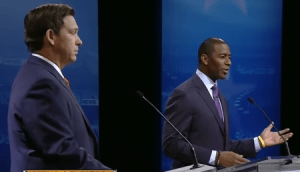
DeSantis, Gillum meet for second debate (Courtesy WPBF)
In their second and final debate at Broward College, Democrat Andrew Gillum was forced to explain how he wound up accepting a pricey Broadway ticket from an undercover FBI agent investigating corruption in a community redevelopment agency in Tallahassee, where he is the mayor.
Republican Ron DeSantis later got into an argument with the debate’s moderator when he tried to ask a question about appearances DeSantis made before a conservative group whose members have expressed anti-Muslim and racist views.
“How the hell am I supposed to know every single statement somebody makes?” DeSantis snapped, drawing boos from the crowd. “I am not going to bow down to the altar of political correctness. I’m not going to let the media smear me like they like to do with so many other people.”
At that, Gillum pounced.
“(DeSantis) has spoken at racist conferences. He has accepted a contribution and would not return it from someone who referred to the former president of the United States as a Muslim n-i-g-g-e-r,” Gillum said. “Now I’m not calling Mr. DeSantis a racist. I’m simply saying the racists believe he’s a racist.”
DeSantis responded in kind: “I’m not going to sit here and take this nonsense from a guy like Andrew Gillum, who always plays the victim … who’s aligning himself with groups who attack our men and women in law enforcement, attack our military.”
During a previous debate on Sunday, Gillum refused to answer DeSantis’s repeated questions about who paid for his ticket to the hit musical “Hamilton.”
He attended the play in New York in 2016 while traveling with an undercover FBI agent posing as a developer as part of an investigation into alleged kickbacks at Tallahassee’s community redevelopment agency.
Before the second debate, emails released as part of an ethics probe showed that Gillum had been told that the tickets had been arranged by the FBI agent – a revelation which DeSantis said showed that Gillum had lied during the first debate.
“He wouldn’t accept responsibility from getting a $1,000 ticket from an FBI agent at the last debate. We now know that he lied about that,” DeSantis said. “At some point, you’ve got to demonstrate leadership and accept responsibility for what you’ve done.”
While Gillum’s campaign had previously said that he thought his brother had paid for their tickets, he told the debate audience that he was aware that the agent and a lobbyist friend who was also on the trip had arranged for the tickets.
However, he said his brother repaid the men who arranged the “Hamilton” tickets with tickets to an upcoming Jay-Z/Beyoncé concert.
“I understood that to have solved whatever the issue was with regard to the expenses associated with it,” Gillum said. “I take responsibility for not having asked more questions.”
After insisting that he is not under FBI investigation, Gillum sought to downplay the “Hamilton” issue by saying it was a distraction from the real issues in the campaign.
“In the state of Florida, we got a lot of issues. In fact, we have 99 issues, and ‘Hamilton’ ain’t one of them,” he said.
DeSantis was also asked by the moderator, Todd McDermott of WPBF-TV in West Palm Beach, about how he could maintain that Gillum was unfit to be governor due to the FBI investigation in Tallahassee while remaining a strong supporter of President Donald Trump, who is the subject of investigations with the FBI, special counsel Robert Mueller and Congress.
DeSantis did not answer the question, choosing instead to defend his role in efforts by House Republicans to investigate FBI agents for alleged improprieties in the Russia probe.
As he did in the first debate, DeSantis continued to hammer Gillum on immigration, saying that his unwillingness to cooperate with Immigration and Customs Enforcement if he is elected governor would put Floridians at risk to indulge his “hate” of Trump.
“Say you’re convicted of child molestation. You’re here illegally. You’ve served your sentence, state prison. Are you going to hand them over to ICE or not?” he said. “He will not commit to doing that. That means that child molester convicted gets released back on the streets after serving the sentence. And guess what? That child molester will re-offend, and someone’s son or daughter in Florida will end up paying the price.”
At that point, the audience booed, and Gillum replied, “Shame on you.”
At another point in the debate, after DeSantis criticized Gillum for not doing more to bring down Tallahassee’s murder rate, Gillum retorted, “I would suggest the congressmen might want to reconsider whether he wants to be governor. The governor’s mansion is in Tallahassee. I’d hate for you to be hurt.”
The debate in Davie is the last scheduled face-to-face meeting for the candidates before the November 6 vote.
DeSantis, 40, served six years in the U.S. House representing a Jacksonville-area district. Gillum, 39, has been mayor of Tallahassee since 2014.
Recent public polling has put the race within the margin of error, which means neither man has a statistically significant lead. However, the most recent poll has shown some movement toward Gillum in the race.
Democrats have not won a governor’s race in Florida since 1994.
 Chicken Fried Politics