

North Carolina U.S. Senator Richard Burr steps down from chairmanship after FBI searches phone
Burr is under investigation for stock trades made before markets tanked due to coronavirus crisis
♦By Rich Shumate, ChickenFriedPolitics.com editor
 WASHINGTON (CFP) — The political and legal jeopardy facing U.S. Senator Richard Burr intensified Thursday, after the FBI executed a search warrant for his phone as part of an investigation into stock sales he made before the coronavirus crisis caused a market plunge.
Just hours after the Los Angeles Times broke the news about the search warrant, the North Carolina Republican temporarily stepped aside as chair of the Senate Intelligence Committee.
Senate Majority Leader Mitch McConnell, R-Kentucky, said Burr would relinquish the chairmanship “during the pendency of the investigation.”
“We agreed that this decision would be in the best interests of the committee,” McConnell said in a statement.

U.S. Senator Richard Burr, R-North Carolina
In brief remarks to a reporter Thursday, Burr, who has previously denied any wrongdoing in the stock sales, said he had been cooperating with the investigation, which he said should be allowed “to play out.”
Burr said he decided to step down from his chairmanship because the investigation “is a distraction to the hard work of the committee, and the members and I think that the security of the country is too important to have a distraction.”
Burr had been cruising toward retirement in his last term in the Senate as head of one of its most important committees before he was hit by blowback from stock sales he made in February, which are now being investigated by both the Justice Department and the Securities and Exchange Commission.
At issue is whether Burr used inside information he obtained as a senator to make the stock sales, which would violate federal law.
An FBI search warrant would have required a finding by a federal judge of probable cause that a crime had been committed and approval at the highest levels of the Justice Department, an indication of the seriousness of Burr’s potential legal jeopardy.
An analysis of financial disclosure reports by the Center for Responsive Politics, a non-partisan research group, showed that on February 13, Burr sold 33 stocks worth between $628,000 and $1.7 million dollars, including stocks in hotel companies hard hit by the coronavirus. The stock market began to plunge about a week later.
Senators only have to report financial transactions within ranges on disclosure reports, so the exact amount of Burr’s stock sales is unknown.
Prior to his stock sales, Burr, as the intelligence committee chair, was receiving daily briefings from Trump administration officials about coronavirus.
ProPublica subsequently reported that Burr’s brother-in-law, Gerald Fauth, sold stock on the same day.
Members of Congress are permitted to own and trade stocks. However, trades have to be disclosed, and it is illegal for them to buy and sell stock based on insider information that isn’t available to the general public, under a law passed in 2012 that Burr voted against.
Burr has said his stock trades were based solely on publicly available information.
In addition to the stock sales themselves, Burr’s public comments during the early days of the coronavirus crisis have contributed to the firestorm he now faces.
On February 7, Burr co-wrote an opinion article for Fox News in which he said that the United States “is better prepared than ever before to face emerging public health threats, like the coronavirus” and said public health officials were moving “swiftly and decisively” to deal with the threat.
But a week later, he began selling stock, and on February 27, he told a private meeting of North Carolina business leaders that coronavirus “is much more aggressive in its transmission than anything that we have seen in recent history,” according to audio of the speech obtained by National Public Radio.
Burr also likened coronavirus to the 1918 Spanish flu pandemic that is believed to have killed at least 17 million people worldwide, NPR reported.
Burr, 64, was first elected in 2004. He has announced he won’t seek re-election to a fourth term in 2022.
It will be up to McConnell to pick a new chair for the intelligence panel Among the names being considered is Florida U.S. Senator Marco Rubio.
Speaking to reporters Thursday, Rubio indicated he would be wiling to serve but downplayed the impact of the change, saying “whoever gets it is going to be a backup quarterback coming into the game for a few plays while the guy goes through a concussion protocol.”
Several other senators have had their stock trades come under scrutiny amid the coronavirus market plunge, including Kelley Loeffler of Georgia and Dianne Feinstein of California.
A spokesperson for Loeffler said Thursday that she has not been served with a search warrant.
We tweet @ChkFriPolitics Join us!
Jeff Sessions’s plea to Alabama: I really, really love Donald Trump. Really.
Sessions pens open letter touting his pro-Trump bona fides as he battles for his political life in GOP U.S. Senate primary runoff
♦By Rich Shumate, ChickenFriedPolitics.com editor
MONTGOMERY (CFP) — Facing political headwinds blowing from President Donald Trump’s Twitter feed, U.S. Senate candidate Jeff Sessions has taken the extraordinary step of sending open letter to his fellow Alabamians in which he expresses undying fealty to the man who has repeatedly, publicly belittled him.

Former Attorney General Jeff Sessions
“I have remained faithful to the President and his agenda. I have always stood up for him, and I never backed down, not even for one moment. My convictions are immovable, built on rock, not sand,” Sessions said in the letter released May 12.
“I believe President Trump is a great President who is steadily making progress for America, despite relentless opposition. My support for his agenda is not about me, or even about him. It’s about doing the right thing for the country I so love.”
Insisting that there is no daylight between him and Trump, Sessions said “the people of Alabama do not have to choose between voting for the President and voting for me, they can do both.”
Read full text of Session’s open letter.
However, Sessions also defended the decision he made that has drawn Trump’s unending ire — recusing himself as U.S. attorney general from the investigation into allegations of Russian interference in the 2016 presidential election after his own meeting with Russia’s ambassador in Washington became public.
“I did what the law required me to do,” Sessions said. “I was a central figure in the campaign and was also a subject of and witness in the investigation and could obviously not legally be involved in investigating myself.”
“If I had ignored and broken the law, the Democrats would have used that to severely damage the President.”
But as he tries to reclaim the goodwill of Trump’s most fervent partisans, Sessions also dismissed the investigation as “a disruptive and prolonged fiasco for America and especially for President Trump, and a massive waste of money chasing the deep state myth of Russian collusion.”
He also said that from the beginning of the administration, he had urged Trump to fire the man who launched the Russia investigation, former FBI Director James Comey.
“I concluded that Comey was driven by ego, lacked self-discipline, and lacked the judgement necessary to lead an agency as critical as the FBI,” he said.
Sessions’s letter is the latest chapter in his quest to regain the Senate seat he gave up in 2017 to become attorney general — a seat he had held for 20 years and likely could have kept for life had he not agreed to join the Trump administration.
Trump was publicly critical of Sessions during his time attorney general and has continued to needle him since firing Sessions in 2018, including in an interview just days before Session’s open letter in which he said Sessions had “begged” to be attorney general and was “a very average guy” and a “total disaster.”
The president has endorsed Session’s opponent in the July 14 GOP primary runoff, former Auburn football coach Tommy Tuberville — an endorsement that has left Sessions fighting for his political life in a state where the president remains popular.
In his letter, Sessions noted that in 2016, he the first member of Congress to endorse Trump, at a time when “many thought I was nuts to do so.”
“I helped Trump win and traveled the country with him, embedded in his campaign. I am one of the architects of his agenda, and I was pushing his agenda even before he ran for office,” he said.
Sessions also noted that after Trump fired him, “I did not say a cross word about him, as I thought that would be dishonorable.”
He also said that while Alabamians “enthusiastically” support Trump, “we also make our own decisions on who to send to the U.S. Senate.”
“Alabamians have long resisted pressure from people in Washington telling them how to vote,” Sessions said.
We tweet @ChkFriPolitics Join us!
Insight: How the coronavirus crisis has set off odd, angry crosscurrents across Southern politics
Budget woes, religious liberty, economic freedom crash against public health concerns
♦By Rich Shumate, ChickenFriedPolitics.com editor
 The collision between an untreatable and potentially deadly virus and a conservative Southern political culture that is both business-friendly and skeptical of government dicta has sent odd and even angry crosscurrents rippling across the region’s politics.
For example, in Mississippi, Governor Tate Reeves, who was slow to close down his state, had to backtrack on plans for a quick reopening when coronavirus cases rose, on the same day that legislators from both parties united to strip him of authority to spend a $1 billion pot of federal coronavirus money.
An angry Reeves accused them of “stealing.”

Editor Rich Shumate
In Nashville, Mayor John Cooper proposed a whopping 32 percent property tax increase to deal with a coronavirus-related shortfall in city revenue — and admitted that he agreed with critics who began howling about the possibility of sharply higher tax bills.
But, said Cooper, the city has no other choice.
In Kentucky, the new Republican attorney general, Daniel Cameron, joined a lawsuit seeking to invalidate a ban on interstate travel ordered by the new Democratic governor, Andy Beshear — which Beshear imposed because Tennessee’s Republican governor, Bill Lee, wasn’t imposing stay-at-home orders as strict as what Beshear issued in the Bluegrass State.
In Georgia, Governor Brian Kemp stubbornly stuck to plans to reopen his state, even though Peach State mayors and even President Donald Trump had urged him not to do so.
Coronavirus lockdowns have triggered angry protests across the South, and governors have struggled to stop pastors from holding church services — raising First Amendment arguments in the nation’s most religious section.
With a few exceptions, states in the South were among the last to close down due to the coronavirus, and they are now among the first to begin reopening, in spite of warnings from some public health officials that doing so might be dangerous.
The decisions being made by Southern governors certainly reflect the political split that coronavirus is increasingly causing nationwide, with conservatives willing to accept risk to revive the economy and liberals taking a more cautious (critics might say overcautious) approach that prioritizes public health over economic good.
Ten of the 14 Southern governors are Republicans, and the GOP controls both legislative chambers in every state except Virginia, fostering a political culture that tends to be friendly toward business interests and libertarian when it comes to questions of personal liberty.
But the push to reopen also reflects that fact that except for Louisiana, the coronavirus crisis has not been as extreme in the region as it has been in hot spots such as New York and New Jersey.
While Louisiana’s death rate per 100,000 people stands at 40, Georgia comes in at 11, and the rest of the Southern states are all less than 10 — statistics that bolster the arguments of unemployed people demanding an end to stay-at-home orders, although providing little comfort to people at higher risk for contracting COVID-19.
The push to reopen is also attractive to Southern leaders for another reason — the lockdown is blowing a hole in state and local budgets that will only get worse the longer it goes on, presenting an unpalatable choice between steep budget cuts or higher taxes.
State governments can’t deficit spend, and the income and sales tax revenues they rely on are falling sharply. The effect of the sales tax plunge will be particularly acute on three Southern states that don’t have an income tax to fall back on, Texas, Florida and Tennessee.
Florida — where Governor Ron DeSantis drew sharp criticism for being late to close — is also heavily reliant on taxes generated by tourism, which has been decimated by the crisis. Oil prices have also crashed, which affects Texas, Louisiana and Oklahoma, where lawmakers have been warned that they’ll need to deal with a $3 billion hit to the state’s budget.
Southern legislators have traditionally been reluctant to raise taxes, particularly income taxes in states that have them. But if they stick to that tradition, the cuts needed to balance budgets could be extreme — prompting outrage not only from those affected by the cuts, but also from those who believe the lockdowns were an unnecessary overreaction that caused more problems than they solved.
The strongest coronavirus crosscurrents have been seen in North Carolina and Kentucky, where Republicans control the legislature and Democratic governors were quicker to close and have been more reticent to reopen than their GOP counterparts.
In North Carolina, Roy Cooper faces the unenviable prospect of running for re-election in the middle of the pandemic against Republican Lieutenant Governor Dan Forest, who has been pushing the governor to move more quickly to reopen parts of the state less affected by the virus.
Anti-lockdown protests have also grown in size and anger in North Carolina, with much of the ire directed toward Cooper.
In Kentucky, Beshear’s moves to clamp down on church services have drawn criticism from U.S. senators Mitch McConnell and Rand Paul and other Republican leaders.
The GOP holds super-majorities in both houses of the legislature and could force Beshear to back down from his coronavirus restrictions, although — perhaps fortunately for the governor — legislators don’t have the power to call themselves back into session to undo his handiwork.
In the Southern state hit hardest by coronavirus, Louisiana, Democratic Governor John Bel Edwards’s imposition of a lockdown has encountered less resistance. But even there, some Republicans in the legislature are now plotting to use an obscure state law to force him to reopen the state.
The coronavirus crisis has focused attention, both nationally and regionally, on governors; however, governors in just two Southern states, North Carolina and West Virginia, have to face the voters this fall.
Of more consequence come November will be whether the Trump administration’s handling of the coronavirus crisis affects Republican candidates in races for federal offices, particularly the U.S. Senate, where 14 Southern seats are up.
That list includes both seats in Georgia, where Kemp has, for better or worse, forged his own path in dealing with the virus, and McConnell’s seat in Kentucky, where he’s already running ads touting his role in pushing coronavirus relief bills through Congress and his Democratic opponent, Amy McGrath, is deriding those bills as a sop to special interests.
Because no one knows how long the coronavirus crisis will last, or how things will turn out, its political consequences are as yet unknowable, particularly because we’ve never been through a crisis quite like this before.
Political stability and certainty, it seems, lie among coronavirus’s victims. The rest is unlikely to be peaceful.
We tweet @ChkFriPolitics Join us!
Kentucky U.S. Rep. Thomas Massie faces avalanche of criticism for forcing vote on coronavirus bill
Massie insists his stand was in defense of the Constitution, but Donald Trump suggests he be tossed from GOP
♦By Rich Shumate, ChickenFriedPolitics.com editor
 WASHINGTON (CFP) — U.S. Rep. Thomas Massie of Kentucky is defending his decision to force members of the House to return to Washington to vote on emergency coronavirus legislation against a torrent of criticism — including from President Donald Trump, who suggested Massie be drummed out of the Republican Party.
Massie objected to pushing through the $2 trillion measure with unanimous consent, which required House leaders to assemble a quorum of lawmakers who had to travel from their home districts back to the nation’s capital to vote on Friday.
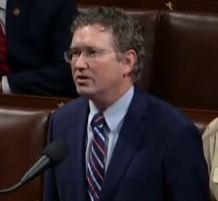
U.S. Rep. Thomas Massie, R-Kentucky, rises to object in the House (From C-SPAN via YouTube)
“I came here to make sure our republic doesn’t die by unanimous consent in an empty chamber,” Massie said on the House floor, drawing audible groans from his fellow lawmakers.
Earlier in the day, Massie defended his decision to try to delay the massive spending bill on Twitter, saying “I swore an oath to uphold the constitution, and I take that oath seriously.”
“The Constitution requires that a quorum of members be present to conduct business in the House,” he said. “Right now, millions of essential, working-class Americans are still required to go to work during this pandemic … Is it too much to ask that the House do its job, just like the Senate did?”
Massie’s stand derailed a plan by House leaders in both parties to push the bill through with unanimous consent, which would have allowed members to remain in their districts, where most of them had been during a scheduled recess.
However, while Massie blocked unanimous consent, he was unable to find enough support to force a roll call vote on the bill, which passed by a voice vote and was quickly signed into law by Trump.
Massie’s move triggered an eruption by Trump on Twitter, who dismissed the Kentuckian as a “third rate grandstander.”
“He just wants the publicity,” Trump said. “Workers & small businesses need money now in order to survive. Virus wasn’t their fault. It is ‘HELL’ dealing with the Dems, had to give up some stupid things in order to get the ‘big picture’ done. 90% GREAT! WIN BACK HOUSE, but throw Massie out of Republican Party!”
Trump also reacted to a tweet from former Secretary of State John Kerry after he said that Massie had “tested positive for being an asshole”: “Never knew John Kerry had such a good sense of humor! Very impressed!”
Trump’s reaction is welcome news for Todd McMurtry, a Covington attorney who is challenging Massie in the Republican primary in Kentucky’s 4th District — and would be the beneficiary if the president decides to move against Massie.
Massie had been sufficiently concerned about Trump’s potential support of McMurty that he aired an attack ad against him during Super Bowl weekend on TV in Palm Beach, Florida, where the president was staying.
The 4th District includes suburban Cincinnati and the Ohio River Valley between Louisville and Ashland.
Kentucky’s primary, originally scheduled for May, was moved to June 23 because of the coronavirus pandemic.
While Trump and Democrats were scorching in their criticism of Massie, two members of the conservative House Freedom Caucus came to his defense.
U.S. Rep. Chip Roy of Texas told Trump to “back off,” calling Massie “one of the most principled men in Congress.”
“He is defending the Constitution today by requiring a quorum. There’s nothing 3rd rate about that, @realDonaldTrump,” Roy said in a tweet.
In his own tweet, U.S. Rep Paul Gosar of Arizona called Massie “a good man and a solid conservative.”
“He believes in the Constitution strongly. We won’t always agree on strategy or policy. But he doesn’t warrant this dressing down,” Gosar said, adding “Thomas—Hang tough brother.”
Massie, 49, has served in Congress since 2012.
We tweet @ChkFriPolitics Join us!
U.S. Senator Rand Paul pushes back against criticism for not entering self-quarantine while awaiting coronavirus results
Kentucky Republican was reportedly using Senate gym just hours before positive test result
♦By Rich Shumate, ChickenFriedPolitics.com
WASHINGTON (CFP) — U.S. Senator Rand Paul of Kentucky is pushing back against criticism that he may have put others in the Senate in danger by continuing with his work as a senator for nearly a week while awaiting the results of a coronavirus test that came back positive.
Paul was reportedly seen working out in a Senate gym on Sunday morning, just hours before he learned he had tested positive for the virus and went into self-quarantine.

U.S. Senator Rand Paul, R-Kentucky
In a statement issued Monday, Paul acknowledged he took the coronavirus test on March 16 and did not self-quarantine while waiting for the results, which came back on March 22.
However, Paul said he had no reason to believe that he had been exposed to coronavirus prior to the positive result and had only been tested as a precaution because of a lung injury he suffered during an attack by a neighbor in 2017.
“For those who want to criticize me for lack of quarantine, realize that if the rules on testing had been followed to a tee, I would never have been tested and would still be walking around the halls of the Capitol,” Paul said. “The current guidelines would not have called for me to get tested nor quarantined. It was my extra precaution, out of concern for my damaged lung, that led me to get tested.”
Paul also said that while he did attend a March 7 museum fundraiser in Louisville that was also attended by two people who later tested positive for coronavirus, he did not have contact with either of them, and his decision to get tested was unrelated to his attendance at the benefit.
“The event was a large affair of hundreds of people spread throughout the museum,” he said. “I was not considered to be at risk since I never interacted with the two individuals even from a distance and was not recommended for testing by health officials.”
Paul said he was “at a higher risk for serious complications” because he had part of his lung removed after he developed complications from rib fractures he suffered when he was attacked by a neighbor, Rene Boucher, outside of his Bowling Green home in 2017.
In his statement, Paul also renewed his call for more immediate, widespread testing of people who do not yet show any symptoms of coronavirus.
“The broader the testing and the less finger-pointing we have, the better,” he said.
Paul’s positive test prompted two fellow senators who had contact with him — Mitt Romney and Mike Lee, both of Utah — to enter self-quarantine, which means five Republican senators are now out of action as Congress grapples with emergency coronavirus legislation.
In his statement, Paul did not confirm or deny reports that he swam and worked out in the Senate gym on Sunday before the results of his coronavirus test came back.
Politico reported that one of Paul’s colleagues, Jerry Moran of Kansas, told colleagues a Republican lunch on Sunday that he had seen Paul using the facilities. That report led another senator, Kyrsten Sinema of Arizona, to blast Paul’s behavior as “absolutely irresponsible.”
“You cannot be near other people while waiting for coronavirus test results,” she said in a tweet. “It endangers others & likely increases the spread of the virus.”
Paul’s office responded by noting that he had left the Senate “immediately” after the diagnosis and entered self-quarantine.
Paul’s actions with regard to coronavirus are also being scrutinized because of his background — he is a graduate of the Duke University School of Medicine who worked for 20 years as an ophthalmologist before being elected to the Senate.
In an interview on MSNBC Monday, Ezekiel Emanuel, former chief of bioethics at the National Institutes of Health and health policy adviser in the Obama administration, accused Paul of a “lack of leadership” for not going into self-quarantine until his test results came back.
“Multiple times Rand Paul has sort of violated his basic oath of being a physician, that he should model good, healthy behaviors,” Emanuel said.
In addition to Paul, Romney and Lee, two other Republican senators — Rick Scott of Florida and Cory Gardner of Colorado — are in self-quarantine after coming into contact with people who tested positive for the virus.
That leaves just 48 GOP members in the upper chamber who are able to vote on coronavirus legislation because Senate rules require senators to be present in person in order to vote.
Paul was among just eight senators who voted against an emergency coronavirus funding bill that passed March 18 and the only senator who opposed an earlier coronavirus funding measure that passed on March 5.
In a letter to his constituents sent over the weekend, Paul vowed to continue to oppose “more spending, more debt, and more mandates on the American people.”
 Chicken Fried Politics