

Former Vice President Joe Biden makes comeback with blowout win in South Carolina
Biden revives his fortunes heading into Super Tuesday with nearly 30-point triumph in the Palmetto State
♦By Rich Shumate, ChickenFriedPolitics.com editor
 COLUMBIA, South Carolina (CFP) — Former Vice President Joe Biden revived his flagging presidential campaign Saturday with a clear, convincing win in South Carolina’s first-in-the-South presidential primary, giving him crucial momentum heading into next week’s Super Tuesday contests.
Biden won 48 percent of the vote and carried all 46 counties, defeating Vermont U.S. Senator Bernie Sanders, who came in a distant second at 20 percent.
“Just days ago, the press and the pundits had declared this candidacy dead,” Biden told jubilant supporters in Columbia. “Now, thanks to you, the heart of the Democratic Party, we’ve just won, and we won big.”
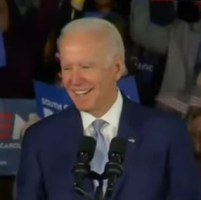
Joe Biden declares victory in South Carolina (From SkyNews via YouTube)
Biden used his victory speech to draw a contrast with Sanders, urging Democrats in the Super Tuesday states to “nominate someone who will build on Obamacare, not scrap it; take on the NRA and gun manufacturers, not protect them; [and] stand up to give the poor a fighting chance and have the middle class restored, not raise their taxes.”
The result in South Carolina was welcome news for Biden, who finished fourth in Iowa, fifth in New Hampshire, and a distant second to Sanders in Nevada. It also marked the first ever primary win for Biden in his third try for the White House.
The key to his win Saturday was a strong performance among African American voters, who made up 56 percent of the Palmetto State electorate. Exit polls showed that Biden took 60 percent of the black vote, running more than 40 points ahead of his nearest rival, Sanders.
Coming in third place in the statewide results was California billionaire Tom Steyer at 11 percent; followed by former South Bend, Indiana Mayor Pete Buttegieg, 8 percent; U.S. Senator Elizabeth Warren of Massachusetts, 7 percent; U.S. Senator Amy Klobuchar of Minnesota at 3 percent; and U.S. Rep. Tulsi Gabbard of Hawaii at 1 percent.
After the results came in, Steyer dropped out of the race.
Biden and Sanders were the only two candidates on the ballot Saturday who cleared the 15 percent threshold needed statewide and in congressional districts to claim delegates to this summer’s Democratic National Convention. Biden took 39 delegates, to 14 for Sanders.
However, former New York City Mayor Mike Bloomberg, who has spent nearly $500 million of his own fortune on his campaign, did not compete in South Carolina. He will make his debut in contests on Tuesday in 14 states, including seven in the South.
Only Democrats had a primary in South Carolina; Republicans canceled their primary in deference to President Donald Trump.
For Sanders, South Carolina marked his first defeat of the campaign, after tying for first in Iowa and winning outright in New Hampshire and Nevada. He also got a smaller percentage of the vote in than he did in 2016, when he won 26 percent in a two-way race against Hillary Clinton, and once again lost every county in the state.
Speaking to supporters in Virginia Beach, Sanders offered his congratulations to Biden before pivoting to make the case that he and not Biden offers the kind of revolutionary change that can lead to a Democratic victory in November.
“In order to defeat Trump, we are going to need the largest voter turnout in the history of this country,” Sanders said. “Old-fashioned politics — the same old, same old type of politics that doesn’t excite anybody, that doesn’t energize anybody — that is not going to be the campaign that beats Trump.”
Biden, Sanders and the rest of the field now turn their attention to Super Tuesday, with more than 1,300 delegates at stake nationwide, including 621 across the South.
The list of Southern states holding primaries Tuesday includes Virginia, North Carolina, Tennessee, Alabama, Texas, Oklahoma and Arkansas. Outside the region, primaries will be held in California, Colorado, Massachusetts, Minnesota, Maine, Utah and Vermont.
The state of the races in Alabama, Tennessee, Arkansas and Oklahoma is a big unknown, given a paucity of public polling in any of those states. The polling that has been done in Texas, North Carolina and Virginia shows Biden, Sanders and Bloomberg bunched at the top, with the other candidates trailing behind.
The question for Biden is whether his win in South Carolina will give him the momentum to push through in the Super Tuesday states, where he is being outspent by Bloomberg and will face Sanders’s formidable ground operation.
One of the biggest factors in who can carry these Southern states will be performance among African American voters, who make up a majority of the Democratic electorate in Alabama and more than a quarter in Arkansas, Tennessee, North Carolina and Virginia.
While Biden ran away with the black vote in South Carolina, he will face new competition Tuesday from Bloomberg, who has been organizing across the region and getting endorsements from African American elected officials.
We tweet @ChkFriPolitics Join us!
South Carolina Democrats deciding first-in-the-South presidential primary
Joe Biden faces crucial test against Bernie Sanders in the Palmetto State
♦By Rich Shumate, ChickenFriedPolitics.com editor
 CHARLESTON (CFP) — Democrats are going to the polls across South Carolina Saturday to pick their favorite for the party’s presidential nomination, which former Vice President Joe Biden hoping to revive his flagging fortunes heading into Super Tuesday and Vermont U.S. Senator Bernie Sanders hoping to add to his list of victories.
Not on the ballot in Saturday’s first-in-the-South primary is former New York City Mayor Mike Bloomberg, who has spent nearly $500 million of his own fortune on his campaign and will make his debut in contests on Tuesday in 14 states, including seven in the South.
Polls in the Palmetto State close at 7 p.m. ET. Only Democrats are voting; South Carolina Republicans opted to cancel their primary in support of President Donald Trump.
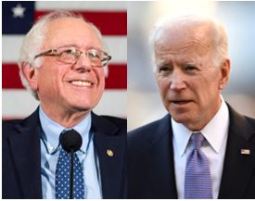
Sanders and Biden compete in South Carolina
After finishing fourth in Iowa and New Hampshire and a distant second to Sanders in Iowa, Biden’s campaign hopes his strong support among African American voters — who will make up about 60 percent of the electorate in South Carolina — will propel him to his first victory of the presidential race.
Four years ago, Sanders was crushed nearly 3-to-1 in South Carolina by Hillary Clinton, who carried all 46 counties. But this time around, his chances will be helped by a more fractured field and a strong statewide organization built since his defeat last time around.
Most public polling in the last week of the race showed no statistically significant difference between Biden and Sanders, although some polls showed the former vice president had built a lead.
Five other candidates are on the ballot Saturday: California businessman Tom Steyer, former South Bend, Indiana Mayor Pete Buttegieg, U.S. Senators Elizabeth Warren of Massachusetts and Amy Klobuchar of Minnesota, and U.S. Rep. Tulsi Gabbard of Hawaii.
Polls show Steyer, who wasn’t a factor in the first three contests, in third place behind Biden and Sanders in South Carolina, with the rest of the candidates trailing.
A pot of 54 delegates are at stake Saturday, 12 allocated proportionally based on the statewide results and 35 allocated proportionally based on the results in the state’s seven congressional districts. However, only candidates who win at least 15 percent of the vote statewide or in a congressional district qualify for any delegates.
Pre-election polling indicates that Biden and Sanders could end up splitting all 54 delegates between them, although that will depend on district-level results, where public polling has not been done.
After Saturday, the presidential race in the South turns to seven Super Tuesday states where delegates will be selected — Virginia, North Carolina, Tennessee, Alabama, Arkansas, Texas and Oklahoma.
We tweet @ChkFriPolitics Join us!

March Madness: Presidential primary season turns South with a vengeance
10 Southern states hold primaries during March, with nearly 1,000 Democratic delegates at stake
♦By Rich Shumate, ChickenFriedPolitics.com editor
 The 2020 presidential primary calendar finally turns to the South on the last day of February, when South Carolina Democrats cast their ballots in their state’s first-in-the-South primary.
Then, buckle up. The political version of March Madness is about to take off.
During March, 10 Southern states will hold Democratic presidential primaries, with 981 delegates at stake — nearly 25 percent of the total pledged delegates who will officially pick the party’s presidential nominee in Milwaukee in July.
Louisiana, which votes in April, and West Virginia and Kentucky, which vote in May, are the only three Southern states who won’t pick delegates in March.
On March 3, seven Southern states — Arkansas, Alabama, Oklahoma, Tennessee, Virginia, Texas and North Carolina — will vote, with 621 Democratic delegates on the line, including 228 alone in the Lone Star State. Florida, with 219 delegates, goes two weeks later, and Georgia, with 105, goes the week after that.
In most of these states, the amount of public polling on the Democratic race has been sparse to non-existent. That, combined with the fluidity of the race after Iowa and New Hampshire, means all of the Southern races are shrouded in uncertainty.
So the presidential race takes on a twang, here are some things to watch for:
If Biden Bites the Dust: The former vice president’s campaign will be on life support, or worse, if he loses in South Carolina, which will particularly shake up the landscape in the South because of his heretofore solid support among African American voters.
Black voters make up a majority of the Democratic electorate in South Carolina, Georgia, Alabama, Mississippi and Louisiana; they are a smaller but still powerful group everywhere else. If Biden exits after South Carolina, his African American supporters will be looking for a new home, opening up an avenue for someone to come in and hoover up a crop of Southern delegates. Or, the black vote could fracture between multiple candidates, adding even more uncertainty to the overall race.
Bloomberg’s Debut: The March 3 Super Tuesday primaries (seven in the South and seven in other parts of the country) will be the first test for former New York City Mayor Michael Bloomberg, who has been building staff and airing ads across the region while his competitors dallied and debated in the early states. If he can tap into Biden’s African American support, Bloomberg could become an unstoppable force; his performance across the South will tell us whether that’s probable or even possible.
Bernie, Bless His Heart: Four years ago, Hillary Clinton plum wore out Bernie Sanders all across the South. The only states he carried were West Virginia and Oklahoma (and how on earth did a self-described socialist win Oklahoma?), a haul that gave her an insurmountable delegate lead. Against a much more fractured field, Sanders is likely to improve on that dismal performance, but if Bloomberg or one of the other candidates puts together a coalition that sweeps the South, it could be deja vu all over again for Bernie and his ‘bros.
Wave the Rainbow Shirt: Pete Buttigieg is the first openly gay man to make a serious run for the presidential nomination in either political party. How will this play in the evangelical South? Or among culturally conservative African American voters? Polling to date has shed little light on this; the results in March might, although there are a myriad of reasons Buttigieg might falter in the South that have nothing to do with his sexual identity, particularly his sparse political resume.
Danged Yankees: The 2020 Democratic race features one current (Bloomberg) and one former (Sanders) New Yorker, along with candidates from Boston, Delaware, Minnesota, and Indiana. Indeed, for the first time since the modern primary process took root in the 1950s, a competitive Democratic primary race is taking off with nary a Southerner among the major players (if one remembers that for all her New York bona fides, Hillary Clinton was once first lady of Arkansas.) So to the degree that any regional political affinity remains, it won’t be in play in 2020, although Elizabeth Warren does try to remind folks at every opportunity that she grew up in Oklahoma. (As if that compensates for moving to Boston and becoming a Red Sox fan.)
Expanding The Map: If one considers that the primary — perhaps only — purpose of a presidential primary process is to pick a candidate who can win in November, the outcomes of Democratic primary season would seem a poor barometer to predict what might happen in the general election. After all, no matter how well a Democrat does in Arkansas or Alabama or Mississippi in March, she or he is not going to carry these states in November, unless something goes catastrophically wrong on the Republican side.
However, Florida and North Carolina will be hotly contested in the general election, and Democrats have hopes of flipping Texas and Georgia. So time, energy and money (think Bloomberg) expended in those states in the primary seasons could pay dividends down the line. (It’s worth noting that after Barack Obama organized in Virginia and Indiana to compete against Hillary Clinton during the 2008 primaries, he flipped both of those states in November.)
What About Trump? The GOP is holding primaries at the same time as Democrats in all of the Southern states except for South Carolina and Virginia, where they have been cancelled in deference to President Donald Trump. Trump, of course, has no serious opposition, but his campaign has embarked on a strategy of trying to drive up his vote totals in uncontested primaries as a sign of strength. So don’t be surprised if you see Trump parachuting into the South during March to rally his faithful — and, as a delightful bonus, to irritate the Democrats.
We tweet @ChkFriPolitics Join us!
Two Southern Democratic senators representing Trump states vote to convict president
Doug Jones of Alabama and Joe Manchin of West Virginia likely to face blowback back home for supporting Trump’s removal
♦By Rich Shumate, ChickenFriedPolitics.com editor
 WASHINGTON (CFP) — Two Southern Democrats in the U.S. Senate who represent states President Donald Trump carried in 2016 — Doug Jones of Alabama and Joe Manchin of West Virginia — voted to find Trump guilty on two articles of impeachment, a decision that will subject them to significant blowback in their home states.
The other two Southern Democrats in the Senate — Tim Kaine and Mark Warner of Virginia — also voted to convict Trump, while all 24 Republicans representing Southern states voted no. Both impeachment articles failed to get the two-thirds majority necessary to remove the president from office.
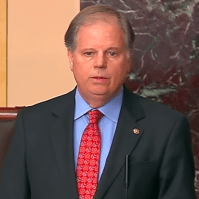
Jones announces decision on Senate floor (From PBS via YouTube)
Jones — considered to be the most vulnerable Democrat running for re-election in 2020, in a state Trump carried by 28 points — said he concluded that “the evidence clearly proves that the president used the weight of his office … to coerce a foreign government to interfere in our election for his personal political benefit.”
“I fear that moral courage, country before party, is a rare commodity these days. We can write about it and talk about it in speeches and in the media, but it is harder to put into action when political careers may be on the line,” Jones said in a floor speech announcing his vote. “I did not run for the Senate hoping to take part in the impeachment trial of a duly elected president. But I cannot and will not shrink from my duty to defend the Constitution and to do impartial justice.”
Watch full video of Jones’s floor speech at end of story
Manchin didn’t disclose his decision in the impeachment trial until moments before the Senate began voting, with each senator standing and pronouncing Trump either “guilty” or “not guilty.”
“Voting whether or not to remove a sitting President has been a truly difficult decision, and after listening to the arguments presented by both sides, I have reached my conclusion reluctantly,” Manchin said in a statement released on Twitter. “I have always wanted this President, and every President to succeed, but I deeply love our country and must do what I think is best for the nation.”
Trump carried West Virginia by 41 points in 2016. However, unlike Jones, Manchin isn’t up for re-election again until 2024, which means he’s unlikely to face any immediate political consequences from his decision.
In the days before the final vote, Manchin had floated the idea of a Senate censure of Trump, which would have condemned his conduct without acquitting him on the impeachment charges. But the idea failed to gain traction among senators in either party.
Both Jones and Manchin also criticized the refusal by Senate Republicans to agree to introduce additional witnesses and documents into the trial, which Jones said “would have provided valuable context, corroboration or contradiction to what we have heard.”
The first article of impeachment, which accused Trump of abuse of power, failed to get the necessary two-thirds majority to remove Trump from office, with 48 senators voting guilty and 52 not guilty. The second article, accusing Trump of obstruction of Congress, failed on a 47-to-53 vote.
Mitt Romney of Utah was the only Republican to vote for conviction on the first article, joined by all 47 Democrats. The vote on the second article fell along party lines.
In 2017, Jones, a former federal prosecutor, won a special election to become the first Democrat to represent the Yellowhammer State in the Senate in 27 years. With the November election looming, he had been under considerable pressure to vote to acquit Trump, with Republicans organizing demonstrations outside of his Alabama offices.
Terry Lathan, chair of the Alabama GOP, said the senator’s decision showed that he “continues to take his marching orders from Chuck Schumer and his liberal California campaign donors.”
“Senator Jones once again is demonstrating his contempt for the majority of Alabamians who are opposed to impeachment,” Lathan said in a statement. “The voters of Alabama will keenly remember this day on November 3rd and replace Senator Jones with someone who will truly represent Alabama’s values.”
One of Jones’s GOP opponents, Bradley Byrne, called his vote the “final straw.”
“I’ve never been so fired up to take back this seat & send Trump a conservative fighter,” Bryne said on Twitter.
Another Republican competitor, Jeff Sessions, in an interview with Breitbart News, said Jones “clearly revealed himself to be a part of the Schumer team, the liberal team, that would create a majority in the Senate, that would make every committee chairman a Democrat—some of them radical Democrats—and all of which is contrary to the values of Alabama.”
Sessions held the Senate seat now held by Jones for 20 years before resigning in 2017 to become Trump’s attorney general. He is now trying to make a comeback by wrapping himself in the Trump mantle, despite a frequently frosty relationship with the president that led to his ouster from the Justice Department in 2018.
We tweet @ChkFriPolitics Join us!
Ebenezer Baptist pastor Raphael Warnock enters Georgia U.S. Senate special election
Warnock gets an early boost from Stacey Abrams, who narrowly lost a governor’s race in 2018
♦By Rich Shumate, ChickenFriedPolitics.com
 ATLANTA — Atlanta pastor Ralphael Warnock, who holds the historic pulpit where both Martin Luther King Jr. and his father preached, has entered the special election race for a U.S. Senate seat held by Republican Kelly Loeffler, giving Democrats a high-profile candidate for a seat they have high hopes of flipping.
“I’ve committed my whole life to service and helping people realize their highest potential,” he said in a video announcing his campaign. “I’ve always thought that my impact doesn’t stop at the church door — that’s actually where it starts.”

U.S. Senate candidate Raphael Warnock, D-Georgia
Warnock’s campaign launch came with a full-throated endorsement from Stacey Abrams, who energized Democrats nationally in a unsuccessful race for governor in 2018.
“Wherever there is need, Reverend Warnock can be found on the front lines,” Abrams said in a letter sent to her supporters. “And that’s where we need him at this moment. On the front lines of the battle for the soul of America.”
Since 2005, Warnock has been senior pastor at Atlanta’s historic Ebenezer Baptist Church, from which King helped lead the civil rights movement in the 1950s and 1960s. The Senate race is his first run for political office.
Loeffler was appointed to the Senate seat in December by Governor Brian Kemp to replace Republican Johnny Isakson, who retired due to ill health. Georgia voters will decide in November who fills the remaining two years of Isakson’s term; candidates from all parties will run in a special election, with the top two voter-getters facing each other in a runoff if no one gets a majority.
Warnock’s entry into the race further complicates Loeffler’s effort to hold the seat. She is already facing an intra-party challenge from U.S. Rep. Doug Colllins, who was passed over by Kemp when he filled the Senate vacancy.
Four other candidates will be competing with Warnock for Democratic votes: Matt Lieberman, a businessman from Cobb County and son of former Connecticut U.S. Senator Joe Lieberman; Ed Tarver, a former state senator and federal prosecutor from Augusta; Richard Winfield, a philosophy professor at the University of Georgia; and Tamara Johnson-Shealey, a nail salon owner and law student from DeKalb County.
The next wrinkle in the Senate race may take place in the Georgia legislature, where Collins supporters — with the backing of Democrats — are trying to push through a change in state law to hold party primaries instead of an all-parties special election, setting up a one-on-one match-up between Collins and Loeffler in a Republican-only electorate.
The change would also ensure that a Democrat would get a clean shot at either Loeffler or Collins, rather than battling them both.
Kemp has threatened to veto the bill. However, House Democrats have indicated they may support the change, which could create a veto-proof majority with just 45 out of the 104 Republicans in the House.
Georgia’s other Senate seat, held by Republican David Perdue, is also up in 2020. And while Georgians haven’t elected a Democrat to the Senate since 2000, the two Georgia seats could be key to Democrat’s hopes of overturning the GOP’s three-seat majority.
We tweet @ChkFriPolitics Join us!
 Chicken Fried Politics