
Latest Posts
Latest Coverage
-
Symbolic solution in search of an actual problem
Support of 9 Southern Republicans for Respect for Marriage Act shows why Supreme Court isn’t about to ban same-sex marriage ♦By Rich Shumate, ChickenFriedPolitics.com editor…
-

West Virginia stubborn, or playing hard to get
U.S. Senator Joe Manchin pisses off his party yet again … to what end? ♦By Rich Shumate, ChickenFriedPolitics.com editor Also in this report: Atlanta DA…
-

2 Mississippi Republican U.S. House members forced into runoffs after weak primary showings
Michael Guest narrowly trails challenger in 3rd District; Steven Palazzo clears just 32% in 4th District ♦By Rich Shumate, ChickenFriedPolitics.com editor JACKSON, Mississippi (CFP) –…
-

Mississippi Republican U.S. Rep. Steven Palazzo facing Tuesday primary fight amid ethics investigation
6 opponents hitting “No-Show Palazzo” over inattention to district, ethics problems ♦By Rich Shumate, ChickenFriedPolitics.com editor GULFPORT (CFP) — Mississippi U.S. Rep. Steven Palazzo —…
-

Primary Wrap: Kemp, Raffensperger survive Trump’s ire; Brooks makes Alabama U.S. Senate runoff
Texas Democratic U.S. Rep. Henry Cuellar survives challenge from the left; George P. Bush gets blown out by Attorney General Ken Paxton ♦By Rich Shumate,…
-

U.S. House’s last pro-life Democrat, Texas’s Henry Cuellar, fighting to keep seat in Tuesday primary runoff
Challenger Jessica Cisneros wanted House Democratic leaders to rescind Cuellar endorsement; they refused ♦By Rich Shumate, ChickenFriedPolitics.com editor LAREDO, Texas (CFP) — Amid the newly…
Democrat Jon Ossoff jumps into Georgia U.S. Senate race against David Perdue
Ossoff became a national political sensation in unsuccessful 2017 U.S. House race
♦By Rich Shumate, ChickenFriedPolitics.com
 ATLANTA (CFP) — Democrat Jon Ossoff, who raised and spent more than $30 million in an unsuccessful congressional bid in the wake of President Donald Trump’s 2016 election, will return to the political stage to challenge Republican U.S. Senator David Perdue in 2020.
Ossoff announced his run with a video on Twitter and local and national video appearances in which he cast himself as someone who will take on a “crisis of political corruption” in Washington.

Jon Ossoff on MSNBC
“[Perdue] is a guy who has not once in five years come down from his private island to hold a single public town hall,” Ossoff said in an interview on MSNBC. “He is a caricature of Washington corruption.”
Among the “corruption” Ossoff cited was the influence of money on politics, concentration of wealth and the refusal of Congress to pass gun control measures opposed by the National Rifle Association.
“We need now to mount an all-out attack on political corruption in America, or I’m not sure our democracy will survive, ” he said.
Ossoff’s decision gives Democrats a high-profile challenger with proven fundraising chops to run against Perdue as they try to overturn the GOP’s three-seat majority in the Senate.
He also got a quick endorsement from Georgia Democratic icon U.S. Rep. John Lewis, who in a statement said Ossoff’s 2017 campaign “sparked a flame that is burning brighter than ever, in Georgia and across the country.”
However, the National Republican Senatorial Committee quickly dismissed Ossoff as a “unaccomplished, far-left candidate” who “will stand in sharp contrast to David Perdue’s positive record of delivering results for all of Georgia.”
Ossoff, 32, is a former congressional aide and documentary filmmaker. In 2017, shortly after Trump’s election, he ran for the 6th District U.S. House seat in Atlanta’s northwestern suburbs, which turned into a high-octane relitigation of the presidential vote.
Although the 6th was long considered a safe Republican seat, Ossoff channeled national Democratic anger over 2016 into a fundraising behemoth, eventually raising and spending nearly $32 million to make the race competitive.
In the end, he lost by 3 points to Republican Karen Handel; however, Democrat Lucy McBath — running with the political infrastructure built by Ossoff’s campaign — defeated Handel in 2018.
With the retirement of U.S. Senator Johnny Isakson at the end of this year, both of Georgia’s U.S. Senate seats will be on the ballot in 2020.
Ossoff decided to pursue the Democratic nomination to oppose Perdue rather than running in an open contest for Isakson’s seat against candidates from both parties, likely including Isakson’s yet-to-be-announced temporary Republican replacement, who will be appointed by Governor Brian Kemp.
By choosing to run for Perdue’s seat, Ossoff will have to win a primary in which three other Democrats are already running. However, going after Isakson’s seat would have required him to defend it again in 2022 if he won it in 2020.
The last Democrat to win a Senate race in Georgia was the late Zell Miller in 2000.
Other Democrats in the race against Perdue include Sarah Riggs Amico, the party’s unsuccessful candidate for lieutenant governor in 2018; Clarkston Mayor Ted Terry and former Columbus Mayor Teresa Tomlinson.
We tweet @ChkFriPolitics Join us!

Voters decide Tuesday who fills disputed North Carolina 9th District U.S. House seat
Donald Trump heading to Tar Heel state to rally Republicans ahead of vote
♦By Rich Shumate, ChickenFriedPolitics.com editor
 CHARLOTTE (CFP) — Voters in two North Carolina congressional districts will go to the polls Tuesday to fill vacant seats, with Democrats hoping to make a breakthrough by flipping the 9th District into their column.
In a sign of the national implications of the vote, President Donald Trump is heading to Fayetteville Monday to campaign for Republican State Senator Dan Bishop, who is in a tight race with Democrat Dan McCready in the 9th District.

Dan McCready and Dan Bishop
A McCready win would flip a House seat to the Democrats and add to the majority they won in 2018. The seat has been vacant for nine months after a narrow GOP win last November was overturned amid allegations of absentee ballot fraud.
In the 3rd District, Republican State Rep. Greg Murphy is heavily favored to win over Democrat Allen Thomas, the former mayor of Greenville. The seat became vacant when longtime incumbent GOP U.S. Rep. Walter Jones died in February.
The 9th District stretches from the suburbs of Charlotte east toward Fayetteville. The 3rd District takes in the counties along the state’s Atlantic coast.
Polls point to a close race between McCready, a political newcomer who came close to winning in last November’s disputed election, and Bishop, a veteran state lawmaker whom Republican picked to replace their previous tarnished nominee.
In November, McCready fell 900 votes short in a race against Republican Mark Harris. But the State Board of Elections ordered a rerun of the election after allegations of absentee ballot fraud were raised against a contractor working for Harris.
The contractor is now facing criminal charges; Harris dropped out of the race, clearing the way for Republicans to pick Bishop in an effort to keep the seat.
Bishop, 55, is a social conservative who has served in both houses of the legislature. He is best known as one of the authors of North Carolina’s “bathroom bill,” a law passed in 2016 which required transgendered people to use the restroom assigned to their birth gender in public facilities. After a public outcry and organized boycotts of the state, the law was repealed in 2017.
McCready, 36, is a Marine Corps veteran and solar energy entrepreneur making his first bid for political office.
Trump won the district by 12 points in 2015, but the district swung toward the Democrats in 2018, part of a similar shift seen in suburban areas across the South.
While that shift allowed Democrats to make breakthroughs in Atlanta, Dallas, Houston, Richmond, Charleston and Oklahoma City, they came up short in all four targeted House races in North Carolina. Winning Tuesday would be a bit of redemption.
Republicans currently hold a 8-to-3 advantage in the state’s congressional delegation, with two seats vacant.
We tweet @ChkFriPolitics Join us!

Former South Carolina Governor Mark Sanford will challenge Donald Trump for GOP nomination
Sanford says Trump has strayed from Republican orthodoxy and damaged political institutions
♦By Rich Shumate, ChickenFriedPolitics.com editor
Note: Video of Sanford’s announcement is at end of post.
 WASHINGTON (CFP) — Former South Carolina governor and congressman Mark Sanford has announced he will challenge President Donald Trump for the 2020 Republican presidential nomination, faulting the president for straying from GOP orthodoxy on spending and trade and damaging the nation’s political culture.
“I think we need to have a conversation on what it means to be a Republican. I think that as a Republican Party, we have lost our way,” Sanford said on Fox News Sunday, where he announced his challenge on September 8. “Americans deserve and need a choice.”
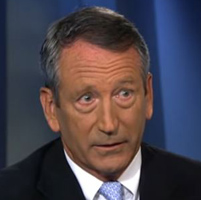
Sanford announces on Fox News Sunday
Despite his long pedigree in politics, which includes two terms as governor and 12 years in the U.S. House, Sanford faces the steepest of uphill climbs in trying to unseat Trump, whose approval ratings among Republicans top 80 percent.
The Republican National Committee has shut down the possibility of primary debates, and state parties have begun scrapping primary contests against Trump — including Sanford’s home state of South Carolina.
The president, who announced his 2020 re-election bid shortly after his inauguration in 2017, has already raised $125 million for the coming campaign.
Asked about the long odds he faces, Sanford noted that Trump was also considered a long shot when he ran in 2016 and insisted rank-and-file Republicans are more interested in a primary contest than their party leaders.
“This is the beginning of a long walk, but it begins with that first step,” he said.
Sanford said he would emphasize the ballooning level of spending and debt on Trump’s watch and the president’s tariffs policy, both of which he said are a departure from conventional Republican positions of spending restraint and free trade.
He said his campaign would also provide the opportunity to discuss “the degree to which institutions and political culture are being damaged by this president.”
“Those institutions and that political culture is really the glue that holds together our balance of power,” Sanford said.
He also took a slap at Trump’s use of his favorite medium of communication, Twitter.
“At the end of the day, a tweet is interesting, maybe newsworthy, but it’s not leadership,” he said. “And we’re not going to solve some of the profound problems that we have as Americans by tweet.”
After winning his second term as the Palmetto State’s governor in 2006, Sanford was being mentioned as a possible presidential candidate for 2012 — until he disappeared after telling his staff that he was off hiking the Appalachian Trail, when he was actually in Argentina canoodling with his mistress.
Ignoring calls to resign, Sanford completed his term in 2011. Two years later, he came back from the political graveyard by reclaiming his Low Country House seat in a special election.
After Trump was elected, Sanford became one of the few Republicans in the House willing to criticize him publicly. The president got his revenge by endorsing Sanford’s opponent on the day of the 2018 primary election — and taking great public glee when Sanford lost. (Democrat Joe Cunningham won the seat in November.)
Sanford told Fox News that his run against Trump is not personal but based on principle, noting that he voted with the president 90 percent of the time. But he said Trump’s active opposition to his re-election “is indicative of the way he makes too many things personal.”
“The world of Trump is personal loyalty,” he said.
In addition to Sanford, former Massachusetts Governor Bill Weld and former U.S. Rep. Joe Walsh from Illinois are running against Trump. Weld comes from the GOP’s moderate wing; Walsh, like Sanford, is a conservative.
In addition to South Carolina, Republicans in Nevada and Kansas have also canceled their 2020 primary contests.
Video of Sanford’s announcement
We tweet @ChkFriPolitics Join us!
U.S. Senator Joe Manchin won’t try to reclaim job as West Virginia governor
Decision removes a significant obstacle to Republican Governor Jim Justice’s path to re-election
♦By Rich Shumate, ChickenFriedPolitics.com
 CHARLESTON, West Virginia (CFP) — After toying for months with the idea of leaving the U.S. Senate for another shot at West Virginia’s governorship, Democrat Joe Manchin has announced he will not run against Republican Governor Jim Justice in 2020.
The decision deprives Democrats of the most formidable candidate they had to defeat Justice, who bolted to the GOP shortly after winning election as a Democrat in 2016.
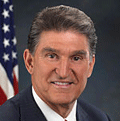
U.S. Senator Joe Manchin
In a September 3 statement announcing his decision, Manchin called the governorship, which he held from 2005 to 2010, “the best job I ever had.” But he said he decided he “couldn’t focus just on which job I enjoyed the most, but on where I could be the most effective.”
“I believe my role as U.S. Senator allows me to position our state for success for the rest of this century,” he said.
Manchin also went out of his way to mention President Donald Trump, an popular figure in the Mountaineer State who campaigned against his re-election in 2018 and will likely pull out all of the tops for Justice next year.
“As I have done since coming to Washington, I will work with the President to accomplish what best serves our state and our country, and I will speak truth to power when I don’t agree with the path the President has chosen to take,” he said. “That is what West Virginians elected me to do.”
Manchin’s decision came just days after the West Virginia Metro News published a poll showing him with a 10-point lead over Justice in a hypothetical match-up.
The senator has won two statewide contests for governor and three for Senate, surviving in 2018 despite Trump’s vocal support for his Republican opponent, in a state the president carried by 40 points in 2016.
With Manchin out, Democrats in West Virginia have a thin bench of possibilities to take on Justice.
Manchin is the only Democrat holding federal office, Republicans control both houses of the legislature, and the only Democrat holding statewide office is State Treasurer John Perdue, who is running for re-election to his seventh term.
While Manchin’s decision not to run clears a major hurdle for Justice, the governor is facing at least two Republican primary challengers. Pro- and anti-Justice factions have been battling for control of the state party, and the governor’s business dealings have also come under scrutiny, including questions about conflicts of interest and delinquent taxes.
Justice, 68, a billionarie who had never held elected office before winning the governorship, is thought to be the state’s wealthiest individual, with interests in coal mining and agribusiness. He also owns the famed Greenbrier resort in White Sulphur Springs.
In 2015, he switched his party registration from Republican to Democrat to run for governor. Less than seven months after being elected, he announced he was switching parties during a rally with Trump.
The White House has signaled the president’s support for Justice, sending two key aides to West Virginia to advise his campaign.
We tweet @ChkFriPolitics Join us!
Georgia Republican U.S. Senator Johnny Isakson will resign at the end of the year
Decision means both of the Peach State’s Senate seats will be up in 2020
♦By Rich Shumate, ChickenFriedPolitics.com editor
WASHINGTON (CFP) — Two days after undergoing surgery to remove a tumor from his kidney, Republican U.S. Senator Johnny Isakson of Georgia has announced he will resign at the end of the year because due to poor health.
The decision means that both of the Peach State’s Senate seats will be open in 2020, giving Republicans another seat to defend in as they try to maintain their three-seat majority in Congress’s upper chamber.
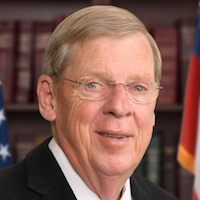
U.S. Senator Johnny Isakson
Isakson, who has been battling Parkinson’s disease, underwent surgery on August 26 for removal of a renal carcinoma. In a statement announcing his resignation, he said, “I am leaving a job I love because my health challenges are taking their toll on me, my family and my staff.”
“With the mounting health challenges I am facing, I have concluded that I will not be able to do the job over the long term in the manner the citizens of Georgia deserve,” he said. “It goes against every fiber of my being to leave in the middle of my Senate term, but I know it’s the right thing to do on behalf of my state.”
Republican Governor Brian Kemp will appoint a replacement for Isakson to serve until a special election is held in November 2020 to fill the two years remaining on his Senate term.
The seat of the state’s other Republican senator, David Perdue, is also up for election in 2020, putting both seats on the ballot.
However, under state law, there will be no party primaries for Isakson’s seat. Candidates from all parties will run in the same race, with the top two finishers meeting in a runoff if no one gets a majority.
That last time that happened in Georgia, in 2017 in the 6th U.S. House district, it triggered a contentious nationalized race between Republican Karen Handel and Democrat Jon Ossoff during which the candidates blew through $50 million. Handel won that race, although she lost the seat to Democrat Lucy McBath in 2018.
One possible Democratic contender for Isakson’s seat, Stacey Abrams, the party’s unsuccessful candidate against Kemp in 2018, quickly announced that she would not be a candidate. She had earlier passed on challenging Perdue.
Isakson, 74, was first elected to the Senate in 2004 after losing campaigns for governor in 1990 and Senate in 1996. He was re-elected easily in 2010 and 2016, becoming the first Republican in state history to win three Senate elections.
His decision to retire brings to a close a storied career in Georgia GOP politics, dating back to the early 1970s when he was among a small number of Republicans serving in the Democrat-dominated legislature, representing suburban Cobb County near Atlanta.
In 1990, Isakson gave up his legislative seat to run for governor against conservative Democrat Zell Miller, falling short but coming closer than any Republican had in decades — a portent of the rising fortunes for a GOP that now dominates state politics.
In 1999, Isakson was elected to the U.S. House to succeed former Speaker Newt Gingrich and went to the Senate five years later when Miller retired.
In 2013, Isakson was diagnosed with Parkinson’s disease but sought re-election in 2016 as he battled the illness. However, this summer he was seriously injured in a fall at his Washington home. After returning to Georgia for the congressional recess, he underwent surgery to remove what his office described as “a 2-centimeter renal cell carcinoma” from his kidney.

 Chicken Fried Politics