
Latest Posts
Latest Coverage
-
Symbolic solution in search of an actual problem
Support of 9 Southern Republicans for Respect for Marriage Act shows why Supreme Court isn’t about to ban same-sex marriage ♦By Rich Shumate, ChickenFriedPolitics.com editor…
-

West Virginia stubborn, or playing hard to get
U.S. Senator Joe Manchin pisses off his party yet again … to what end? ♦By Rich Shumate, ChickenFriedPolitics.com editor Also in this report: Atlanta DA…
-
2 Mississippi Republican U.S. House members forced into runoffs after weak primary showings
Michael Guest narrowly trails challenger in 3rd District; Steven Palazzo clears just 32% in 4th District ♦By Rich Shumate, ChickenFriedPolitics.com editor JACKSON, Mississippi (CFP) –…
-
Mississippi Republican U.S. Rep. Steven Palazzo facing Tuesday primary fight amid ethics investigation
6 opponents hitting “No-Show Palazzo” over inattention to district, ethics problems ♦By Rich Shumate, ChickenFriedPolitics.com editor GULFPORT (CFP) — Mississippi U.S. Rep. Steven Palazzo —…
-

Primary Wrap: Kemp, Raffensperger survive Trump’s ire; Brooks makes Alabama U.S. Senate runoff
Texas Democratic U.S. Rep. Henry Cuellar survives challenge from the left; George P. Bush gets blown out by Attorney General Ken Paxton ♦By Rich Shumate,…
-

U.S. House’s last pro-life Democrat, Texas’s Henry Cuellar, fighting to keep seat in Tuesday primary runoff
Challenger Jessica Cisneros wanted House Democratic leaders to rescind Cuellar endorsement; they refused ♦By Rich Shumate, ChickenFriedPolitics.com editor LAREDO, Texas (CFP) — Amid the newly…
Donald Trump kicks off 2020 re-election with mass rally in Orlando
Trump touts economic growth, hits Democrats for socialism, calls Russia investigation “great illegal witch hunt”
♦By Rich Shumate, ChickenFriedPolitics.com editor
 ORLANDO (CFP) — To shouts of “Four More Years” and “Build The Wall” from an exuberant capacity crowd, President Donald Trump formally kicked off his 2020 re-election campaign Tuesday night with a stem-winding speech in the key swing state of Florida.
“We did it once, and we’re going to do it again,” Trump told the crowd at the Amway Center in Orlando, many of whom had waited hours in the summer sun and braved thunderstorms for the chance to get inside. “And this time, we’re going to finish the job.”
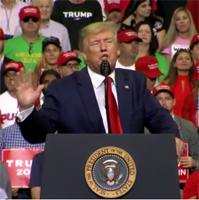
President Donald Trump addresses his campaign kickoff rally in Orlando on June 18 (YouTube)
“I have news for Democrats who want to take us back to the bitter failure and betrayals of the past. We are not going back.”
The president also unveiled the new tagline for his 2020 campaign: “Keep America Great,” building on 2016’s theme of “Make America Great Again.”
During his hour-long speech, Trump touted the nation’s robust economy, lower unemployment, tax cuts and appointment of conservative judges as evidence of his administration’s accomplishments.
But he also spent the first part of his speech relitigating the Russia investigation, which he called a “great illegal witch hunt” designed to overturn the results of 2016 election.
“No president should ever have to go through this again. It’s so bad for our country,” he said. “No collusion, no obstruction. And they spent $40 million on this witch hunt.”
The president largely avoided mentioning his potential 2020 Democratic opponents by name in his speech, except for a single reference each to “Sleepy Joe” Biden and “Crazy Bernie” Sanders.
However, in a likely preview of next year”s campaign, he offered biting criticism of the Democratic Party, which he said had embraced socialism and was “more radical, more dangerous and more unhinged than at any point in the history of our country.”
“America will never be a socialist country. Ever,” he said. “Republicans don’t believe in socialism. We believe in freedom, and so do you.”
Trump also blamed Democrats for what he termed “illegal mass migration” and accused them of “moral cowardice” for being unwilling to fix an immigration system that he branded as a “disgrace.”
The president also leaned in on his hard-line trade policy that has drawn criticism even from some Republican members of Congress, insisting tariffs have revived the American steel industry and let China know that “the days of stealing American jobs … are over.”
Fans of the president began lining up outside the Amway Center, which seats 20,000 people, some 40 hours before the speech began.
Trump told the crowd that 120,000 people had requested tickets for the rally, which marked an unusually early campaign kickoff for an incumbent president.
The president carried Florida in 2016 on his way to winning the Electoral College, and the Sunshine State will again be a state he’ll need to secure a second term.
Orlando sits in the I-4 corridor, a swath of Central Florida that often plays decisive roles in statewide elections.
We tweet @ChkFriPolitics Join us!
Insight: Are the politics of Obamacare changing in the South?
Cracks are starting to show in the wall of Southern opposition to Medicaid expansion
♦By Rich Shumate, ChickenFriedPolitics.com editor
 After Obamacare made its way through Congress in 2009, triggering the Tea Party rebellion, Republican-controlled Southern statehouses became a redoubt of opposition to what critics saw as meddlesome socialist overreach.

ChickenFriedPolitics editor Rich Shumate
When, three years later, the U.S. Supreme Court ruled that the Obama administration couldn’t force states to enact a key Obamacare provision — expanding Medicaid to cover more low-income residents — most Southern states took advantage of the decision and didn’t.
Today, nine of the 14 states that haven’t expanded Medicaid are in the South, leaving more than 2.3 million low-income Southerners who would qualify for Medicaid without health care coverage, according to researchers at the Kaiser Family Foundation.
But there are some signs that the blanket opposition to expanding Medicaid in the South may be retreating, albeit slightly and slowly.
Louisiana and Virginia expanded Medicaid after electing Democratic governors in 2017. In Arkansas and Kentucky, where expansion passed under Democratic governors, it has endured despite their replacement by more skeptical Republicans.
In Florida and Oklahoma, petition drives are underway to put expansion on the ballot in 2020, doing an end-run around recalcitrant GOP leaders. And in Mississippi, a Democrat is trying to use expansion as a wedge issue to end a 16-year Republican lock on the governor’s office.
In states with expanded Medicaid, low-income people making up to 138 percent of the federal poverty level — about $17,000 for an individual — can get coverage. In states without expansion, the income limit for a family of three is just under $9,000; single people are excluded entirely.
Most of the singles and families who are not eligible for traditional Medicaid don’t make enough money to get the tax credits they need to buy insurance on the Obamacare insurance exchanges. According to estimates from Kaiser, 92 percent of all Americans who fall into this coverage gap live in Southern states that haven’t expanded Medicaid, including nearly 800,000 people in Texas, 450,000 in Florida, 275,000 in Georgia, and 225,000 in North Carolina.
The federal government pays 90 percent of the cost of Medicaid expansion; states must pick up the rest. Republican leaders who oppose the idea have balked at making a financial commitment to such an open-ended entitlement, which Congress could change at any time.
But that argument didn’t hold in Virginia after Democrats campaigning on expansion nearly took control of the legislature in 2017. When expansion came up for a vote, 18 House Republicans who survived that blue wave joined Democrats to pass it.
Louisiana Governor John Bel Edwards, who issued an executive order on his first day in office to expand Medicaid, is now running for re-election touting that decision; voters will give their verdict in October.
In Mississippi, Attorney General Jim Hood is also making expanded Medicaid the centerpiece of his gubernatorial campaign this year, arguing that his state, with the nation’s highest poverty rate, is cutting off its nose to spite its face by refusing to extend coverage to people who would benefit from it.
In Arkansas and Kentucky, where Democratic governors managed to push through expansion in 2014, the Republicans who replaced them have left the programs essentially intact, although they have fiddled at the edges by imposing premiums and work requirements on recipients. (Federal judges have blocked those changes.)
Die-hard Obamacare opponents have not been able to scuttle the program in either state — even in Arkansas, where the program has to be reauthorized annually by a three-fourths majority in both houses of the legislature.
In Florida and Oklahoma, supporters of expansion — including groups representing doctors, nurses and hospitals — are trying to put constitutional amendments expanding Medicaid coverage on the ballot in 2020.
Those ballot measures will be a key test of whether the public mood is more sympathetic to the idea of expansion than are the states’ conservative leaders, who have argued that the program is unaffordable and discourages people from seeking employment to secure health care.
However, the strategy of pursuing ballot initiatives is of limited use in the South because among states that haven’t expanded Medicaid, only Florida, Oklahoma and Mississippi allow the public to put measures on the ballot via petition. Texas, Georgia, Alabama, Tennessee, North Carolina, and South Carolina do not.
In Florida, the ballot measure will also need to get approval from 60 percent of the voters to pass.
The question to be answered this year and next is whether the fiscal and philosophical arguments against expansion will hold against the argument that low-income Southerners — rural and urban, black and white — deserve health care coverage and will benefit from it, in spite of its association with Obamacare.
We tweet @ChkFriPolitics Join us!
Southern House Democrats in targeted seats vote to turn up pressure on Trump
House Judiciary Committee can now sue to force compliance with requests for documents, testimony
♦By Rich Shumate, ChickenFriedPolitics.com editor
 WASHINGTON (CFP) — In the first major test of how Southern Democrats in vulnerable seats will navigate through ongoing House investigations of President Donald Trump, all of them stuck to the party line in supporting new powers that could escalate those inquiries.
By a vote of 229-191 on June 11, the House authorized the Judiciary Committee to go into federal court and demand that the Justice Department comply with requests for documents and witness testimony.
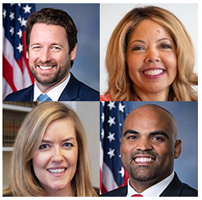
From top left clockwise: Cunningham, McBath, Allred, Weston
All 10 Southern House Democrats who flipped seats in 2018 and are at the top of the GOP hit list in 2020 agreed to give the committee the power to sue to force compliance, although none of them yet support moving toward impeaching the president.
That list includes Reps. Joe Cunningham of South Carolina; Lucy McBath of Georgia; Kendra Horn of Oklahoma; Elaine Luria, Jennifer Wexton and Abigail Spanberger of Virginia; Colin Allred and Lizzie Fletcher of Texas; and Debbie Mucarsel-Powell and Donna Shalala of Florida.
Not a single Southern Republican supported the resolution, including 11 GOP members who are on the Democrats’ target list for 2020.
The resolution is aimed squarely at Attorney General William Barr, who has refused to comply with some document requests, and former White House counsel Don McGahn, who has refused to testify at a committee hearing under instructions fro the White House.
The resolution ratchets up the pressure on the Trump administration, as an increasing number of House Democrats are calling for an impeachment inquiry.
While none of the Southern Democrats in competitive seats have so far come out in favor of an impeachment inquiry, 14 members in safe seats have done so.
That list includes Steve Cohen of Tennessee; Val Demings of Florida; Veronica Escobar, Sheila Jackson Lee, Joaquin Castro, Lloyd Doggett, Al Green, and Filemon Vela of Texas; Cedric Richmond of Louisiana; Alma Adams and G.K. Butterfield of North Carolina; Don Beyer of Virginia; Bennie Thompson of Mississippi; and John Yarmuth of Kentucky.
We tweet @ChkFriPolitics Join us!

Poll showing Biden with a lead over Trump in Texas is not what it seems
Media reports of Quinnipiac poll overstate possibility that Trump is in trouble in the Lone Star State
♦By Rich Shumate, ChickenFriedPolitics.com editor
 AUSTIN (CFP) — Media organizations have been trumpeting results of a new poll that purports to show President Donald Trump trailing former Vice President Joe Biden in Texas — a somewhat shocking result, given that a Democrat hasn’t carried the Lone Star State since 1976 and hasn’t been close since 1996.
But a closer look at the numbers of the Quinnipiac Poll show that, from a purely statistical perspective, those reports may be misleading.
The poll, released June 5, found Biden leading Trump by a margin of 48-44 percent among registered voters in Texas, with a margin of error of plus or minus 3.4 percent.
What that margin of error means is that Biden’s actual support among registered voters in Texas could be as high as 51.4 percent or as low as 44.6 percent; Trump’s actual support could be as high as 47.4 percent or as low as 40.6 percent.
Because those two intervals overlap, it is statistically possible that Trump is actually ahead, as the high end of his support is above the low end of Biden’s support. So although it is probable that Biden has a lead, because the range of his support is higher, the poll does not absolutely establish a lead for Biden.
In order to establish with statistical certainty that Biden is leading Trump, his lead would need to be at least 6.8 percent, or double the margin of error.
The poll’s results for hypothetical match-ups of Trump with other Democratic 2020 contenders are even more muddled because neither candidate has a lead larger than the margin of error, which means that no one can even be said to even probably be ahead.
The poll results do, however, indicate that at this early stage of the race, the battle for Texas is closer that what might be expected and Biden appears to be performing more strongly against Trump than other 2020 competitors, including two Texans, former U.S. Rep. Beto O’Rourke and former San Antonio Mayor Julián Castro.
In 2016, Trump carried Texas by more than 800,000 votes, a margin of 9 points.
The Quinnipiac poll did turn up one result well beyond the margin of error — 60 percent of Texas don’t want to see Trump impeached, while only 34 percent do.
We tweet @ChkFriPolitics Join us!
Virginia Governor Ralph Northam calls special session in response to gun violence
Northam needs GOP support to pass gun control measures in the wake of Virginia Beach mass murder
By Rich Shumate, ChickenFriedPolitics.com editor
 RICHMOND (CFP) — Just four days after a mass shooting in Virginia Beach left 12 people dead, Democratic Governor Ralph Northam has launched a renewed push for gun control.
But he needs Republican support to get anything through the legislature — and GOP leaders are giving a frosty reception to a sure-to-be contentious initiative from the commonwealth’s politically wounded chief executive.
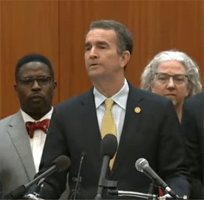
Northam calls for special session on gun control (From CBSN via YouTube)
Saying “no one should go to work, to school or to church wondering if they will come home,” Northam announced at a June 4 news conference that he will call state lawmakers in a special session to consider gun control measures, including universal background checks and limits on ammunition magazines.
“We must do more than give our thoughts and prayers. We must give Virginians the action they deserve,” Northam said. “I will be asking for votes and laws, not thoughts and prayers.”
However, Republicans control both houses of the legislature, and GOP leaders quickly pushed back.
House Speaker Kirk Cox called the special session “hasty and suspect when considered against the backdrop of the last few months” — a not-so-subtle reference to Northam’s ongoing political troubles since a photo surfaced in January of a man in blackface on his medical school yearbook page.
Northam has since resisted calls for him to resign, including from a number of fellow Democrats.
The Republican Party of Virginia denounced Northam’s “gun-grab session” as “craven” and accused him in a statement of trying to “take advantage of this tragedy to try and boost his own disgraced image.”
Cox also noted that while the governor can summon lawmakers into special session, “he cannot specify what the General Assembly chooses to consider or how we do our work.”
“We intend to use that time to take productive steps to address gun violence by holding criminals accountable with tougher sentences — including mandatory minimums,” he said in a statement.
Northam has previously vetoed bills establishing mandatory minimum sentences for criminal offenders, which he says disproportionately affect people of color.
Republicans hold a 51-49 majority in the House of Delegates and a 21-19 majority in the Senate, which means Northam’s gun control proposals would need at least two Republican votes in each chamber to pass.
The governor said he would propose bans on magazines holding more than 10 rounds of ammunition, bump stocks and silencers; universal background checks; new “extreme risk” protective orders to keep guns out of the hands of people who might be violent; and a limit on purchases of handguns to no more than one a month.
Those proposals failed to pass in the last regular session of the legislature, but Northam said he would try to pass them again because “it is wrong, it is outrageous, it is unforgivable to turn our municipal centers, our schools, our churches and synagogues and mosques into battlefields.”
However, the National Rifle Association noted in a statement that “none of the governor’s gun control proposals would have prevented the horrible tragedy at Virginia Beach.”
According to police, the shooter who killed 12 people in a Virginia Beach municipal building had legally purchased his weapons and had no criminal convictions or mental health issues that would have resulted in a protective order.
He did, however, use a silencer, which may have contributed to the death toll by delaying the law enforcement response to the sound of gunfire.
The murders in Virginia Beach marked the second time the commonwealth has been rocked by mass violence.
In 2007, a mentally ill Virginia Tech student killed 32 people in two campus buildings, in what remains the deadliest school shooting in U.S. history.

 Chicken Fried Politics